


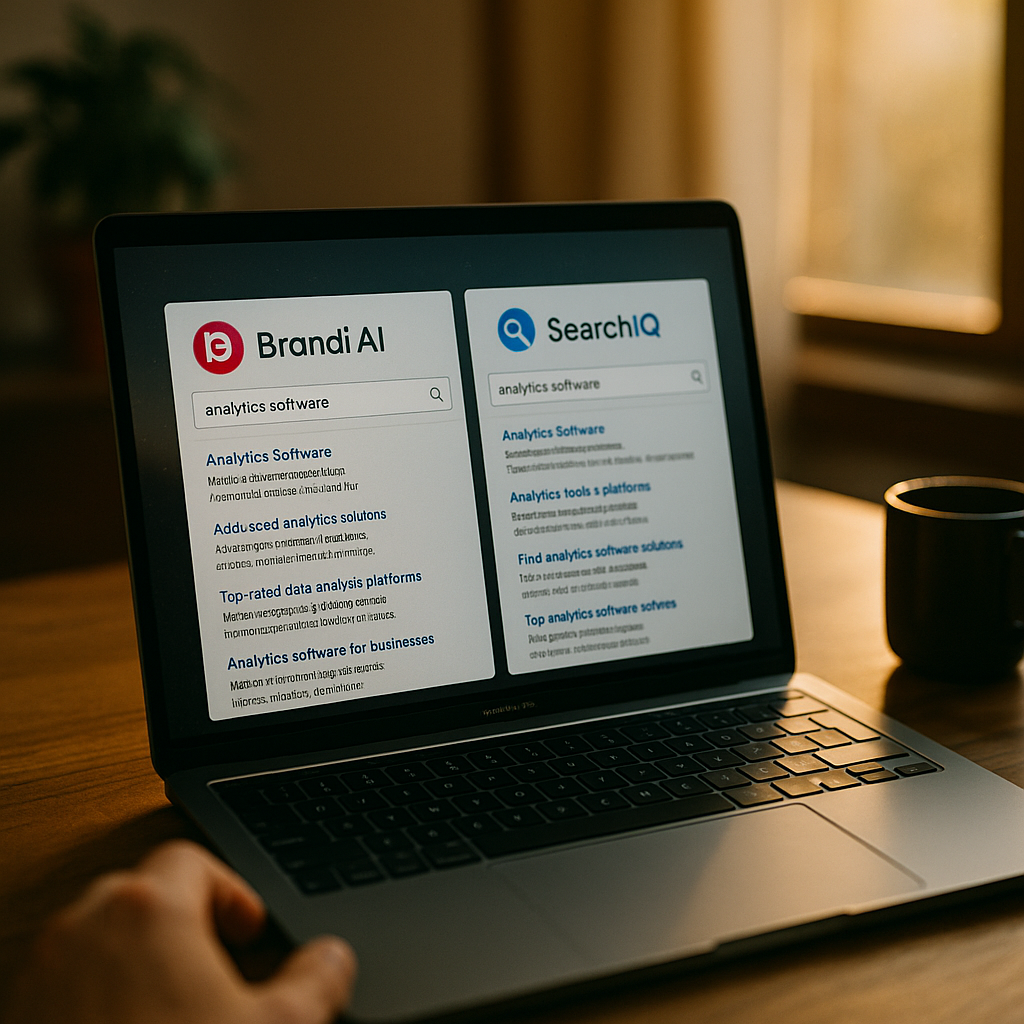
Nearly 60% of B2B buyers now start research with an AI chat interface instead of a search bar, according to eMarketer data on shifting discovery behavior. If your brand isn’t showing up in those AI-generated answers, you’re invisible to a growing share of your funnel. That’s the pressure driving mid-market marketers toward tools like Brandi AI and SearchIQ. Both promise enterprise-grade AI search visibility. Only one fits most mid-market budgets without painful trade-offs.
This comparison breaks down features, pricing structures, and the operational realities of running either platform inside a lean marketing team. No vendor fluff, just what you need to make the call.
Why AI Search Visibility Became a Board-Level Metric
Generative engine optimization, or GEO, stopped being a niche experiment somewhere in the last eighteen months. Marketing leaders now report to CMOs and CFOs about “share of AI answer” the way they once reported organic rankings. The stakes are different, though. There’s no Search Console equivalent for ChatGPT, Perplexity, or Gemini. You’re flying partially blind, which is exactly why visibility platforms like Brandi AI and SearchIQ exist.
Both tools track how often, and how favorably, your brand appears in AI-generated responses across major LLM platforms. Both claim to help you close the gap between traditional SEO performance and this new discovery layer. But “tracking AI mentions” is a broad category, and the two platforms approach it from fairly different philosophies.
The real cost of ignoring AI search visibility isn’t a ranking drop, it’s a citation gap that compounds silently until a competitor owns the narrative in every AI answer about your category.
Brandi AI: Built for Brand Narrative Control
Brandi AI positions itself less as a rank tracker and more as a brand perception monitor for the LLM era. Its core strength is sentiment and narrative analysis: not just “did we get mentioned,” but “how were we described, and against whom.”
Key features that stand out:
- Sentiment scoring per citation, flagging whether an AI response frames your brand positively, neutrally, or with competitive disadvantage.
- Competitor share-of-voice dashboards that map how often rivals appear alongside you in the same prompts.
- Prompt clustering, which groups thousands of query variations into themes so marketing teams aren’t drowning in raw prompt logs.
- Content gap recommendations tied to specific citation losses, suggesting what content assets might close the gap.
Where Brandi AI shines is qualitative depth. If your leadership team cares about brand safety and narrative accuracy as much as raw visibility counts, this is a meaningful differentiator. It’s the kind of tool that pairs well with a GEO vendor audit process, similar to what we outlined in our guide to verifying GEO vendor citation claims, since Brandi AI’s own citation methodology is transparent enough to stress-test.
Pricing for Brandi AI runs on a tiered model, with mid-market plans typically landing in the $1,200–$2,800 per month range depending on prompt volume and brand tracking limits. Enterprise tiers scale up from there, often requiring custom quotes once you exceed a few hundred tracked prompts monthly.
Where Brandi AI Falls Short
It’s not a full-stack platform. Brandi AI doesn’t do much on the technical SEO side, and its integrations with existing martech (think CDPs or attribution tools) are thinner than competitors. If your team wants AI visibility data flowing directly into a broader analytics pipeline, you’ll need middleware or manual exports. That’s a real operational cost worth factoring into total ownership, not just the sticker price.
SearchIQ: Volume, Automation, and Technical Depth
SearchIQ takes the opposite approach. It’s built for scale and automation first, narrative nuance second. Think of it as the enterprise SEO suite mentality applied to AI search, comprehensive coverage across more LLM platforms, deeper API access, and heavier automation for reporting.
Notable capabilities:
- Broader model coverage, including regional and vertical LLMs beyond the usual ChatGPT/Gemini/Perplexity trio.
- API-first architecture that plugs into existing BI dashboards, making it easier to blend AI visibility metrics with traditional SEO and paid media data.
- Automated alerting when citation share drops below a set threshold, useful for teams managing dozens of product lines or regional brands.
- Bulk prompt testing at a scale Brandi AI doesn’t match, useful for enterprises tracking thousands of long-tail queries.
SearchIQ’s pricing structure is more granular and, frankly, more confusing at first glance. Base mid-market plans start around $1,800 per month, but the API access tier and expanded model coverage push many real-world mid-market accounts closer to $3,500–$4,500 monthly once you add the modules most teams actually need. That’s a meaningful gap over Brandi AI’s comparable tier, and it’s the kind of pricing sprawl we’ve flagged before in our review of Semrush’s GEO toolkit budget impact.
Is that extra spend justified? It depends entirely on whether your team will actually use the API integrations. If you’ve already invested in a data warehouse or a unified marketing dashboard, SearchIQ’s architecture pays for itself in saved manual reporting hours. If you’re a five-person marketing team without dedicated data engineering support, you’re paying for infrastructure you won’t touch.
Feature-by-Feature: Where the Real Differences Live
Strip away the marketing copy and three differences matter most for mid-market buyers.
1. Reporting philosophy. Brandi AI builds reports for marketing and comms stakeholders, clean visuals, sentiment framing, executive-ready summaries. SearchIQ builds for analysts, exposing raw data through APIs and expecting you to build your own visualization layer, or at least customize the defaults heavily.
2. Model coverage vs. narrative depth. SearchIQ tracks more models. Brandi AI analyzes each mention more thoroughly. Neither is objectively better, it’s a question of whether breadth or depth matters more to your use case. A retail brand chasing every regional LLM might need SearchIQ’s coverage. A B2B brand obsessed with how AI describes its category positioning probably gets more value from Brandi AI’s sentiment layer.
3. Integration friction. This is where a lot of buyers get burned. Teams evaluating either tool should run the same interoperability checks we recommend before signing any martech contract, a lesson that applies just as much to AI agent interoperability audits as it does to visibility platforms. Ask both vendors for a sandbox environment before committing. If they hesitate, that’s a signal.
Feature checklists rarely predict satisfaction six months in. Integration friction and reporting fit determine whether a tool gets used daily or quietly abandoned by quarter three.
Pricing, Contracts, and the Fine Print
Both vendors default to annual contracts for their best pricing, month-to-month options exist but carry a 15-20% premium in both cases. Neither publishes full enterprise pricing publicly, which is standard for this category but still worth pushing back on during negotiation. Ask for pilot pricing, a 60-90 day trial at reduced rates tied to specific KPIs like citation share improvement or sentiment score movement.
Watch for these contract details specifically:
- Prompt volume caps, and what overage charges look like once you exceed them.
- Whether historical data is exportable if you cancel (Brandi AI retains it for 90 days post-cancellation; SearchIQ’s policy varies by tier).
- Model coverage guarantees, since LLM providers update frequently and vendors don’t always add new models immediately.
- Whether sentiment/citation methodology is documented enough for your legal or compliance team to sign off on, particularly relevant if your industry faces scrutiny from bodies like the FTC around AI-driven marketing claims.
If you’re weighing Brandi AI against other budget-conscious visibility tools, it’s also worth reviewing how it stacks up against Peec AI in a direct budget comparison, since pricing pressure in this category is intensifying fast as more vendors enter the space.
Which One Should Mid-Market Brands Actually Choose?
There’s no universal winner here, and any article claiming otherwise is selling something. But a few patterns hold up across the accounts we’ve reviewed.
Choose Brandi AI if your marketing team is small, your primary concern is brand narrative accuracy, and you need executive-ready reporting without building a custom dashboard. It’s the lower-friction, lower-cost entry point for most mid-market teams testing AI visibility monitoring for the first time.
Choose SearchIQ if you already have data infrastructure, need coverage across niche or regional LLMs, and your team includes someone who can own API integration. The higher price tag buys genuine technical depth, but only if someone’s actually using it.
One more consideration: neither tool operates in a vacuum. AI visibility data means more when it’s triangulated against actual conversion and attribution data, similar to the multi-touch modeling approach discussed in triangulating ROI with AI-powered MMM and MTA. A high citation score means little if it’s not moving pipeline.
The Bottom Line
Run a 60-day pilot with whichever tool matches your current infrastructure, not the one with the flashiest demo. Track citation share and sentiment weekly, tie it to at least one downstream metric like branded search volume or demo requests, and revisit the decision at renewal with real data instead of vendor promises.
Frequently Asked Questions
What is the main difference between Brandi AI and SearchIQ?
Brandi AI focuses on brand sentiment and narrative analysis within AI-generated answers, with executive-friendly reporting. SearchIQ prioritizes broader LLM coverage, API access, and automation, making it better suited to teams with existing data infrastructure.
How much does enterprise AI search visibility software typically cost for mid-market brands?
Mid-market plans generally range from $1,200 to $4,500 per month depending on prompt volume, model coverage, and whether API access is included. Enterprise-scale tracking often requires custom quotes.
Do these tools track all major AI platforms like ChatGPT and Gemini?
Most visibility platforms, including Brandi AI and SearchIQ, cover the major consumer LLMs like ChatGPT, Gemini, and Perplexity. SearchIQ generally extends coverage further into regional and vertical-specific models.
Is AI search visibility monitoring worth it for smaller marketing teams?
Yes, if your buyers are researching in AI chat interfaces, which is increasingly common in B2B categories. The key is choosing a tool that matches your team’s capacity to act on the data, not just collect it.
Can AI visibility data be integrated with existing marketing dashboards?
It depends on the vendor. SearchIQ’s API-first design makes integration easier for teams with data engineering support. Brandi AI offers more limited integrations and works best as a standalone reporting tool.
How do I evaluate a vendor’s citation rate claims before signing a contract?
Request a sandbox trial, ask for documented methodology, and cross-check a sample of claimed citations manually. This due diligence process is critical since citation tracking methods vary significantly between vendors.
FAQs
What is the main difference between Brandi AI and SearchIQ?
Brandi AI focuses on brand sentiment and narrative analysis within AI-generated answers, with executive-friendly reporting. SearchIQ prioritizes broader LLM coverage, API access, and automation, making it better suited to teams with existing data infrastructure.
How much does enterprise AI search visibility software typically cost for mid-market brands?
Mid-market plans generally range from $1,200 to $4,500 per month depending on prompt volume, model coverage, and whether API access is included. Enterprise-scale tracking often requires custom quotes.
Do these tools track all major AI platforms like ChatGPT and Gemini?
Most visibility platforms, including Brandi AI and SearchIQ, cover the major consumer LLMs like ChatGPT, Gemini, and Perplexity. SearchIQ generally extends coverage further into regional and vertical-specific models.
Is AI search visibility monitoring worth it for smaller marketing teams?
Yes, if your buyers are researching in AI chat interfaces, which is increasingly common in B2B categories. The key is choosing a tool that matches your team’s capacity to act on the data, not just collect it.
Can AI visibility data be integrated with existing marketing dashboards?
It depends on the vendor. SearchIQ’s API-first design makes integration easier for teams with data engineering support. Brandi AI offers more limited integrations and works best as a standalone reporting tool.
How do I evaluate a vendor’s citation rate claims before signing a contract?
Request a sandbox trial, ask for documented methodology, and cross-check a sample of claimed citations manually. This due diligence process is critical since citation tracking methods vary significantly between vendors.
Top Influencer Marketing Agencies
The leading agencies shaping influencer marketing in 2026
Agencies ranked by campaign performance, client diversity, platform expertise, proven ROI, industry recognition, and client satisfaction. Assessed through verified case studies, reviews, and industry consultations.
Moburst

-
2

The Shelf
Boutique Beauty & Lifestyle Influencer AgencyA data-driven boutique agency specializing exclusively in beauty, wellness, and lifestyle influencer campaigns on Instagram and TikTok. Best for brands already focused on the beauty/personal care space that need curated, aesthetic-driven content.Clients: Pepsi, The Honest Company, Hims, Elf Cosmetics, Pure LeafVisit The Shelf → -
3

Audiencly
Niche Gaming & Esports Influencer AgencyA specialized agency focused exclusively on gaming and esports creators on YouTube, Twitch, and TikTok. Ideal if your campaign is 100% gaming-focused — from game launches to hardware and esports events.Clients: Epic Games, NordVPN, Ubisoft, Wargaming, Tencent GamesVisit Audiencly → -
4

Viral Nation
Global Influencer Marketing & Talent AgencyA dual talent management and marketing agency with proprietary brand safety tools and a global creator network spanning nano-influencers to celebrities across all major platforms.Clients: Meta, Activision Blizzard, Energizer, Aston Martin, WalmartVisit Viral Nation → -
5

The Influencer Marketing Factory
TikTok, Instagram & YouTube CampaignsA full-service agency with strong TikTok expertise, offering end-to-end campaign management from influencer discovery through performance reporting with a focus on platform-native content.Clients: Google, Snapchat, Universal Music, Bumble, YelpVisit TIMF → -
6

NeoReach
Enterprise Analytics & Influencer CampaignsAn enterprise-focused agency combining managed campaigns with a powerful self-service data platform for influencer search, audience analytics, and attribution modeling.Clients: Amazon, Airbnb, Netflix, Honda, The New York TimesVisit NeoReach → -
7

Ubiquitous
Creator-First Marketing PlatformA tech-driven platform combining self-service tools with managed campaign options, emphasizing speed and scalability for brands managing multiple influencer relationships.Clients: Lyft, Disney, Target, American Eagle, NetflixVisit Ubiquitous → -
8

Obviously
Scalable Enterprise Influencer CampaignsA tech-enabled agency built for high-volume campaigns, coordinating hundreds of creators simultaneously with end-to-end logistics, content rights management, and product seeding.Clients: Google, Ulta Beauty, Converse, AmazonVisit Obviously →