


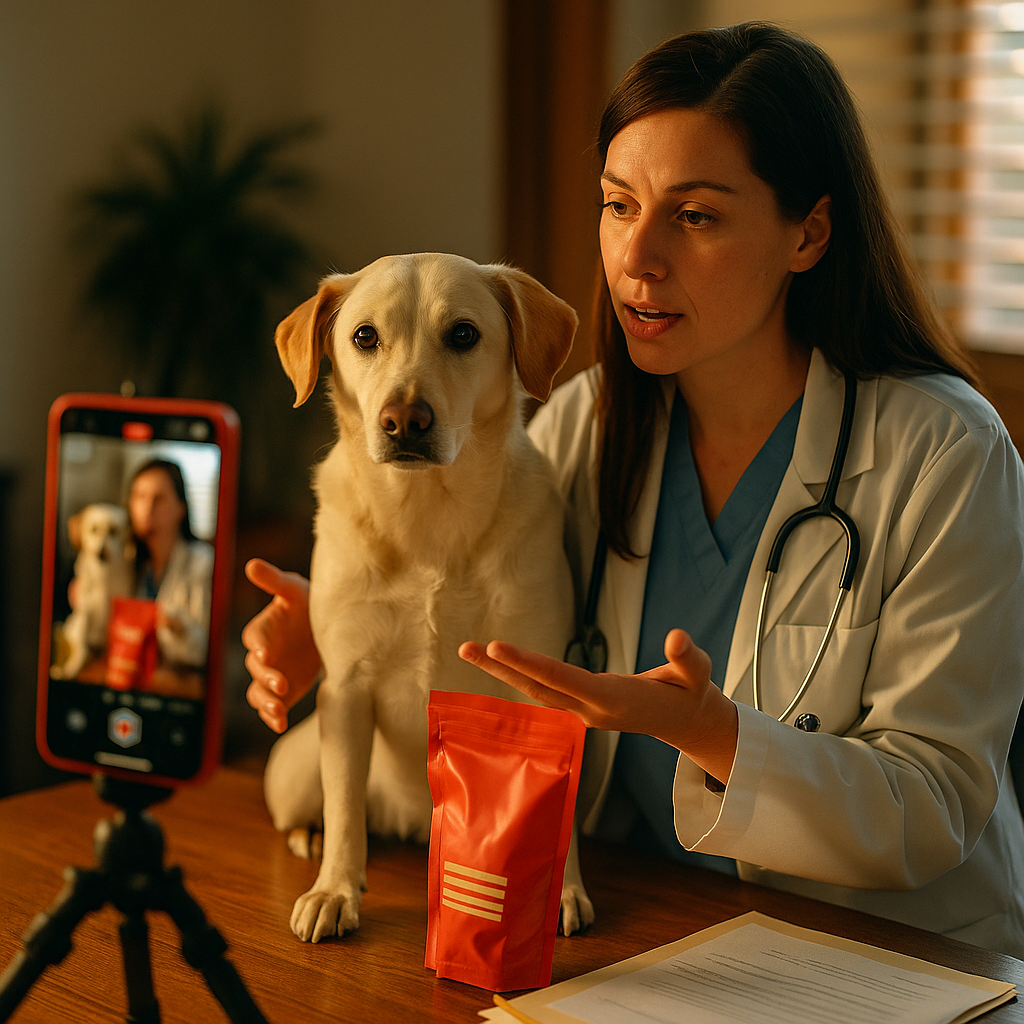
Seventy-one percent of pet owners say they’d switch brands over a single health claim they couldn’t verify. That’s the trap most pet food marketers walk into — and it’s exactly why Ollie’s Pet Food nano-creator strategy is worth studying. Instead of chasing celebrity veterinarians or making bold label claims, Ollie built credibility through dozens of small, credentialed creators who let their expertise speak for itself.
The result: a fresh-food brand operating in one of the most legally sensitive categories in consumer goods, growing subscriber trust without a single FTC health-claim inquiry.
Why Pet Food Is a Legal Minefield for Influencer Marketing
Pet food sits at an uncomfortable intersection. It’s regulated like an ingestible product but marketed like a lifestyle brand. The FDA oversees labeling and ingredient claims. The FTC oversees advertising, including anything an influencer says on camera. Say “clinically proven to reduce joint inflammation” without substantiation, and you’ve got two agencies with reason to call.
Most brands respond by either avoiding health claims entirely (boring, low-converting content) or leaning on vague wellness language that regulators increasingly scrutinize anyway. Ollie found a third path: let licensed veterinary professionals make measured, personal observations rather than brand-scripted claims.
A credentialed creator saying “I’ve seen improved coat condition in my own patients” carries different legal weight than a brand claiming “clinically proven to improve coat health” — the former is professional opinion, the latter is an unsubstantiated claim.
That distinction isn’t just semantic. It’s the entire architecture of Ollie’s compliance strategy.
The Nano-Creator Bet: Small Audiences, Big Credibility
Ollie didn’t sign a celebrity vet with 2 million followers. Instead, the brand built a roster of roughly 40 nano-creators — veterinarians, vet techs, and credentialed animal nutritionists with follower counts between 3,000 and 25,000. Small audiences, sure. But every single one carried a license number, a clinic affiliation, or a certification that could be independently verified.
This mirrors a pattern seen across other trust-sensitive categories. Poppi’s nano-creator rebuild after litigation showed that smaller, more credible voices often outperform reach when trust is the product being sold. Ollie applied the same logic before a crisis forced its hand, not after.
Why nano over macro? Three operational reasons stack up:
- Verification is feasible. You can check a vet tech’s license across 40 people. Try that across 400 macro-influencers claiming pet expertise.
- Engagement rates run higher. Nano-creators in pet niches routinely post engagement rates above 5%, compared to sub-2% for many pet influencer accounts with six-figure followings, according to data cited by Sprout Social.
- Cost per credentialed voice is dramatically lower. Ollie reportedly paid nano-creators in the low hundreds to low thousands per campaign, versus five- or six-figure vet-influencer partnerships that larger competitors have pursued.
How the Credential Vetting Process Actually Works
This is the part most brands skip, and it’s the part that actually protects you. Ollie’s team, working with an influencer marketing platform plus in-house legal review, built a three-step credential check before any creator entered rotation:
- License verification. State veterinary board lookups confirm active licensure. No license, no partnership — regardless of follower count or content quality.
- Content history audit. Past posts get reviewed for prior health claims that might contradict FDA/FTC guidance. A creator who’s previously said a supplement “cures” anything is a red flag, even if licensed.
- Legal briefing, not script. Creators receive guidelines on what constitutes a claim versus an observation. They’re not handed talking points. They’re handed guardrails.
That third step matters most. Scripted health claims from a paid partner are exactly what the FTC’s endorsement guidelines scrutinize most closely, especially when the brand controls the language. Ollie’s legal team deliberately kept creator language unscripted and personal, shifting liability exposure and, frankly, making the content feel more authentic in the process.
This isn’t unlike the compliance-first approach detailed in Chubbies’ FTC-compliant drop strategy, where structural guardrails did more work than any single disclaimer.
What the Content Actually Looks Like
Forget polished studio shoots. Ollie’s top-performing nano-creator content looks almost boringly authentic: a vet tech in scrubs explaining why she switched her own dog to fresh food, filmed in a break room. A veterinarian walking through a case file (with owner permission, details altered) describing dietary changes she recommended.
None of it says “Ollie cures anything.” It says “here’s what I noticed, here’s what I know professionally, here’s what I chose for my own pet.” That framing — personal choice backed by credentials, not brand-issued claims — is the entire trick.
Disclosure stayed simple: #OlliePartner or #ad, visible and unambiguous, consistent with FTC disclosure guidance. No buried hashtags, no “sp” abbreviations hidden in caption walls. Ollie’s legal team treated disclosure clarity as non-negotiable, not a suggestion.
The Numbers: Trust Metrics Over Vanity Metrics
Ollie doesn’t publicize granular financials (it’s a private company), but reported program indicators tell a clear story:
- Nano-vet content drove noticeably higher save and share rates than brand-produced video, a pattern consistent with what eMarketer has documented broadly across trust-category advertising.
- Customer surveys cited by the brand’s marketing team showed vet-credentialed content as the top-ranked trust driver among new subscribers, ahead of price and packaging.
- Zero FTC inquiries or complaints tied to the nano-creator program since its expansion, a claim that matters more in a regulated category than almost any engagement stat.
That last point is the real headline. Plenty of pet brands can show engagement charts. Few can show a multi-year influencer program with zero regulatory friction in a category where the FDA and FTC both have teeth.
What Other Regulated Categories Can Steal From This Playbook
Pet food isn’t unique here. Supplements, functional beverages, skincare with active ingredients, even fintech — any category where a health, financial, or safety claim could trigger regulatory review can borrow Ollie’s structure:
- Recruit credentialed micro-voices, not mega-reach. A licensed professional with 8,000 followers is a lower-risk, higher-trust asset than a lifestyle influencer with 800,000.
- Separate “observation” from “claim” in every creative brief. Train legal and marketing to speak the same language on this distinction, because a mislabeled brief is where most compliance breaches originate.
- Build a verification pipeline, not a one-time check. Licenses lapse. Creators change jobs. Quarterly re-verification isn’t paranoid, it’s basic hygiene.
- Let disclosure be loud, not buried. Ambiguous disclosure is a bigger regulatory risk than most brands assume.
This approach echoes broader industry movement toward AI-assisted and process-driven vetting. Programs like the one detailed in a supplement brand’s AI vetting overhaul show that credential and compliance checks don’t have to be manual bottlenecks. They can be built into discovery tools directly, cutting both risk and cost simultaneously.
Compare this, too, with the creator vetting failures documented in Sephora’s tween beauty backlash. The lesson runs in the opposite direction from Ollie’s: skip verification, and reputational damage follows fast, especially with a young or vulnerable audience segment (in Sephora’s case) or a regulator-watched category (in pet food’s case).
Where This Could Still Go Wrong
No program is risk-proof, and Ollie’s isn’t either. A few exposure points worth flagging for anyone replicating this model:
First, “unscripted” doesn’t mean unmonitored. Brands still need content review before publish, not just guidelines beforehand. Second, credential verification needs an expiration date and a refresh cycle — a vet tech’s license status today doesn’t guarantee status in eighteen months. Third, personal testimonial content (“I chose this for my own pet”) can drift into implied efficacy claims if a creator gets too specific about outcomes. That drift is subtle and easy to miss without ongoing legal spot-checks.
Brands running influencer programs in regulated verticals should treat compliance review as a recurring line item, not a one-time legal sign-off. Budget for it the way you’d budget for content production.
Next Steps for Brands in Regulated Categories
If you’re marketing anything ingestible, injectable, or health-adjacent, the Ollie model offers a template worth adapting rather than copying wholesale: recruit for credentials first, script for authenticity second, and build verification into your operating cadence, not just your onboarding. Start with a pilot of five to ten credentialed nano-creators, run one full compliance cycle, and measure trust lift before scaling spend.
FAQs
What makes a nano-creator “vet-credentialed”?
It means the creator holds a verifiable professional license or certification — such as a state veterinary license, veterinary technician certification, or accredited animal nutrition credential — that can be independently confirmed through a licensing board or certifying body before any paid partnership begins.
How does using credentialed creators reduce FTC health-claim risk?
When a licensed professional shares a personal or professional observation rather than a brand-scripted claim, it shifts the content from an unsubstantiated marketing claim toward protected professional opinion. Combined with clear disclosure and no brand-dictated language, this structure lowers exposure under FTC endorsement guidelines, though it doesn’t eliminate the need for legal review.
Why did Ollie choose nano-creators over celebrity veterinarians?
Nano-creators are cheaper to vet, cheaper to pay, and typically deliver higher engagement rates within niche pet-health communities. They’re also easier to verify individually, since checking licensure across 40 small-audience creators is far more feasible than vetting hundreds of larger accounts.
Can this strategy work outside the pet food category?
Yes. Any regulated category — supplements, skincare with active ingredients, fintech, functional beverages — can apply the same framework: recruit credentialed micro-voices, separate observation from claim in briefs, verify credentials on a recurring basis, and keep disclosure unambiguous.
What’s the biggest compliance mistake brands make with influencer health content?
Scripting language for creators. When a brand writes or heavily edits a claim and a paid creator repeats it verbatim, the brand assumes greater liability than if the creator shares an authentic, credential-backed personal observation.
FAQs
What makes a nano-creator “vet-credentialed”?
It means the creator holds a verifiable professional license or certification — such as a state veterinary license, veterinary technician certification, or accredited animal nutrition credential — that can be independently confirmed through a licensing board or certifying body before any paid partnership begins.
How does using credentialed creators reduce FTC health-claim risk?
When a licensed professional shares a personal or professional observation rather than a brand-scripted claim, it shifts the content from an unsubstantiated marketing claim toward protected professional opinion. Combined with clear disclosure and no brand-dictated language, this structure lowers exposure under FTC endorsement guidelines, though it doesn’t eliminate the need for legal review.
Why did Ollie choose nano-creators over celebrity veterinarians?
Nano-creators are cheaper to vet, cheaper to pay, and typically deliver higher engagement rates within niche pet-health communities. They’re also easier to verify individually, since checking licensure across 40 small-audience creators is far more feasible than vetting hundreds of larger accounts.
Can this strategy work outside the pet food category?
Yes. Any regulated category — supplements, skincare with active ingredients, fintech, functional beverages — can apply the same framework: recruit credentialed micro-voices, separate observation from claim in briefs, verify credentials on a recurring basis, and keep disclosure unambiguous.
What’s the biggest compliance mistake brands make with influencer health content?
Scripting language for creators. When a brand writes or heavily edits a claim and a paid creator repeats it verbatim, the brand assumes greater liability than if the creator shares an authentic, credential-backed personal observation.
Top Influencer Marketing Agencies
The leading agencies shaping influencer marketing in 2026
Agencies ranked by campaign performance, client diversity, platform expertise, proven ROI, industry recognition, and client satisfaction. Assessed through verified case studies, reviews, and industry consultations.
Moburst

-
2

The Shelf
Boutique Beauty & Lifestyle Influencer AgencyA data-driven boutique agency specializing exclusively in beauty, wellness, and lifestyle influencer campaigns on Instagram and TikTok. Best for brands already focused on the beauty/personal care space that need curated, aesthetic-driven content.Clients: Pepsi, The Honest Company, Hims, Elf Cosmetics, Pure LeafVisit The Shelf → -
3

Audiencly
Niche Gaming & Esports Influencer AgencyA specialized agency focused exclusively on gaming and esports creators on YouTube, Twitch, and TikTok. Ideal if your campaign is 100% gaming-focused — from game launches to hardware and esports events.Clients: Epic Games, NordVPN, Ubisoft, Wargaming, Tencent GamesVisit Audiencly → -
4

Viral Nation
Global Influencer Marketing & Talent AgencyA dual talent management and marketing agency with proprietary brand safety tools and a global creator network spanning nano-influencers to celebrities across all major platforms.Clients: Meta, Activision Blizzard, Energizer, Aston Martin, WalmartVisit Viral Nation → -
5

The Influencer Marketing Factory
TikTok, Instagram & YouTube CampaignsA full-service agency with strong TikTok expertise, offering end-to-end campaign management from influencer discovery through performance reporting with a focus on platform-native content.Clients: Google, Snapchat, Universal Music, Bumble, YelpVisit TIMF → -
6

NeoReach
Enterprise Analytics & Influencer CampaignsAn enterprise-focused agency combining managed campaigns with a powerful self-service data platform for influencer search, audience analytics, and attribution modeling.Clients: Amazon, Airbnb, Netflix, Honda, The New York TimesVisit NeoReach → -
7

Ubiquitous
Creator-First Marketing PlatformA tech-driven platform combining self-service tools with managed campaign options, emphasizing speed and scalability for brands managing multiple influencer relationships.Clients: Lyft, Disney, Target, American Eagle, NetflixVisit Ubiquitous → -
8

Obviously
Scalable Enterprise Influencer CampaignsA tech-enabled agency built for high-volume campaigns, coordinating hundreds of creators simultaneously with end-to-end logistics, content rights management, and product seeding.Clients: Google, Ulta Beauty, Converse, AmazonVisit Obviously →