


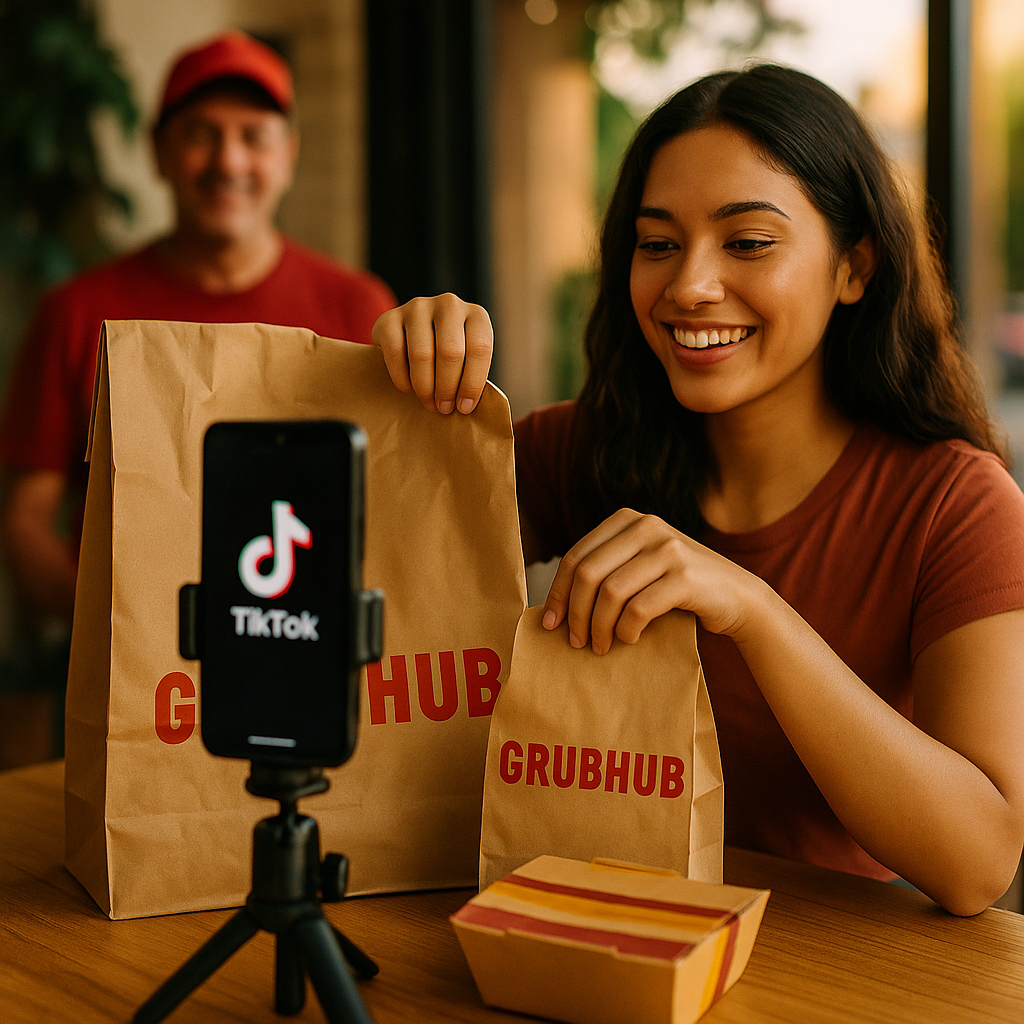
One food delivery app just proved that a $50 creator can outperform a $50,000 celebrity post. Grubhub’s micro-creator food review push on TikTok drove a measurable spike in app downloads without a single A-list endorsement. For brands still writing seven-figure checks to celebrity talent, this Grubhub case study on TikTok food reviews is a wake-up call.
Why Grubhub Walked Away From Celebrity Spend
Grubhub has run celebrity campaigns before. Big names, big production budgets, big awareness lifts that didn’t always translate into app installs. Awareness is not the same as conversion, and Grubhub’s growth team knew it. Delivery apps live and die on one metric that matters more than any other: does the download turn into a repeat order?
Celebrity content is built for reach. It’s rarely built for trust at the point of decision — the moment someone is scrolling, hungry, and deciding which app to open. That’s a very different job than a 30-second Super Bowl spot. So Grubhub shifted budget toward creators whose entire value proposition is believability: micro-creators with 10,000 to 100,000 followers, posting food reviews that look like something your coworker filmed on lunch break.
Grubhub’s pivot wasn’t about saving money — it was about buying trust at a lower cost per believable impression than celebrity talent could ever deliver.
The Mechanics: What the Campaign Actually Looked Like
The structure was simple, almost boringly so. Grubhub identified regional and niche food creators — the kind who review $8 tacos or rank late-night wing spots — and gave them a small stipend plus a promo code tied to the app. No scripts. No brand-safe corporate voiceover. Just creators doing what they already do, with Grubhub folded into the narrative.
- Creator receives a modest flat fee (reportedly in the low hundreds, not thousands, per post) plus performance bonuses tied to code redemption
- Content follows the creator’s existing format: unboxing, taste test, “rating local spots” series
- Grubhub app is shown mid-video, ordering demonstrated in real time, promo code flashed on-screen and pinned in caption
- Videos posted natively, no paid boost in the first 48 hours to preserve organic signal
- Performance tracked via unique promo codes and app attribution links, not vanity metrics like views
That last point matters more than it sounds. Grubhub wasn’t optimizing for views. It was optimizing for a specific, trackable action: someone downloading the app and completing a first order. Every creator got a unique code, which meant the marketing team could see exactly which videos, which creators, and which cities were converting — not just guess based on comment sentiment.
Why Micro-Creators Beat Celebrities on This Specific Job
Food is a trust category. People don’t want to be sold to about what they eat; they want a recommendation from someone who seems like them. A celebrity eating a burger on camera reads as an ad. A micro-creator eating the same burger, filmed in their car, reads as a recommendation. That distinction is the entire campaign.
There’s also a reach-versus-relevance tradeoff that a lot of brand teams get wrong. Celebrity content maximizes reach per dollar but minimizes relevance per viewer. Micro-creator content flips that ratio. Fewer eyeballs per post, but a far higher percentage of those eyeballs are the exact person deciding what to order for dinner tonight, in that exact city, on that exact app.
This isn’t a new insight for the category. HelloFresh’s dual-strategy model made a similar bet by pairing big awareness campaigns with a long tail of affiliate creators, and food delivery brands are now following the same logic. Grubhub simply went further, cutting celebrity spend almost entirely rather than running both in parallel.
The Numbers Behind the Shift
Influencer marketing benchmarks back up the strategic logic here. According to eMarketer, nano and micro-creators consistently post higher engagement rates than mega-influencers and celebrities, often by a factor of two to three times on platforms like TikTok. Higher engagement doesn’t automatically mean higher conversion, but for a category like food delivery — where the purchase decision happens in minutes, not weeks — engagement is a reasonable proxy for attention at the right moment.
Cost efficiency is the other half of the equation. A single celebrity partnership can run into the mid-six-figures for a campaign package. That same budget, redirected to micro-creators at a few hundred dollars per post, buys dozens — sometimes hundreds — of individual pieces of content, each targeting a different city, cuisine niche, or audience segment. Grubhub’s team reportedly worked with creator volume in the low hundreds across multiple markets, a scale that would be financially impossible with celebrity-tier talent.
Diversifying spend across hundreds of micro-creators doesn’t just cut cost per post — it multiplies the number of local, contextually relevant moments a brand can show up in.
Platforms have caught up to this model too. TikTok’s ad platform makes it straightforward to boost organic creator content once it’s proven itself, which lets brands like Grubhub double down on winning videos after the fact rather than betting the budget upfront on unproven celebrity content.
What Made the Content Actually Convert
Volume alone doesn’t drive downloads. The content had specific characteristics that separated it from typical branded influencer posts.
It showed the app, not just the food. A huge share of food content on TikTok never mentions how the food was obtained. Grubhub’s creator briefs required a visible moment of opening the app, searching, and ordering — the exact friction point brands need to normalize.
It leaned into hyperlocal specificity. “This spot in Austin” beats “delicious food” every time. Local creators reviewing local restaurants gave viewers a reason to act immediately, not just admire the food aesthetically.
It used believable imperfection. Shaky camera work, real reactions, the occasional bad bite — this is the opposite of polished celebrity production, and that’s precisely why audiences trusted it. Research from HubSpot has repeatedly shown that authenticity ranks among the top factors consumers cite when deciding whether to trust influencer content, often above production quality or follower count.
This mirrors what’s worked for other brands leaning on demo-style content over polish. Ridge Wallet’s TikTok demo strategy built a nine-figure brand on the same principle: show the product working, skip the discount, let the demonstration do the selling.
Compliance Wasn’t an Afterthought
Any campaign running hundreds of creators simultaneously carries FTC exposure if disclosure isn’t baked into the workflow. Grubhub required #ad or #GrubhubPartner tags on every sponsored post, a non-negotiable line item in every creator agreement. This matters because the FTC’s endorsement guidelines apply regardless of creator size or payment amount — a $200 stipend triggers the same disclosure obligation as a $200,000 celebrity deal.
Brands scaling nano and micro-creator programs have learned this lesson the hard way in other categories. Ollie’s vet-credentialed nano-creator approach and Chubbies’ FTC-compliant creator drops both show that disclosure discipline scales fine when it’s built into the contract template from day one, not retrofitted after a legal review flags a problem.
Grubhub’s approach also avoided a pitfall that’s tripped up beauty and wellness brands: inadequate vetting at scale. The Sephora tween beauty backlash is a cautionary example of what happens when creator vetting doesn’t keep pace with campaign volume. Grubhub kept its creator pool tightly filtered by engagement authenticity and audience geography, not just follower count.
What This Means for Brands Weighing Celebrity vs. Micro-Creator Spend
The Grubhub model won’t fit every category. A luxury brand launching a new fragrance might legitimately need the reach and prestige signal a celebrity provides. But for any app-download or transactional goal — food delivery, fintech, subscription services — the calculus tilts hard toward micro-creators.
Three questions should guide the decision for any brand team evaluating this shift:
- Is the goal awareness or action? Celebrities build awareness. Micro-creators drive action. Know which one you’re actually buying.
- Can you track attribution at the creator level? Grubhub’s unique promo codes made ROI measurable. Without that infrastructure, you’re flying blind regardless of creator tier.
- Do you have the operational capacity to manage volume? Running one celebrity deal is easy. Running 200 micro-creator relationships requires contract templates, disclosure workflows, and a vetting process that doesn’t buckle under scale.
Brands in adjacent categories are already validating this playbook. Chewy’s nano-creator subscription engine and Chagee’s livestream and nano-creator category build both point to the same conclusion: scale beats star power when the goal is a measurable transaction, not a headline.
The Takeaway
Grubhub’s campaign didn’t just save money — it proved that trust, not fame, is the real currency behind app downloads. Any brand chasing a transactional goal should audit its celebrity spend against a simple test: could 100 micro-creators, tracked properly, do this job cheaper and more believably? For Grubhub, the answer was yes.
FAQs
How much did Grubhub spend on micro-creators compared to a typical celebrity deal?
Grubhub reportedly paid creators in the low hundreds of dollars per post plus performance bonuses, a fraction of the mid-six-figure packages typical of celebrity endorsement deals. The total campaign budget across hundreds of creators still came in well below a single major celebrity contract.
What size creators did Grubhub work with in this campaign?
The campaign focused on micro-creators with roughly 10,000 to 100,000 followers, chosen for engagement authenticity and local audience relevance rather than raw follower count.
How did Grubhub track app downloads back to individual creators?
Each creator received a unique promo code and attribution link, allowing Grubhub’s team to measure app downloads and first orders back to specific videos, creators, and markets rather than relying on view counts or engagement estimates.
Is this micro-creator model applicable outside food delivery?
Yes. Any brand with a transactional, trackable goal — app downloads, subscriptions, first purchases — can apply the same framework: unique codes, hyperlocal or niche-relevant creators, and disclosure built into every contract from the start.
What FTC disclosure requirements applied to Grubhub’s creators?
Every sponsored post required clear disclosure, such as #ad or a partnership tag, regardless of how small the creator’s payment was. The FTC’s endorsement guidelines apply equally to nano-creators and celebrities.
Top Influencer Marketing Agencies
The leading agencies shaping influencer marketing in 2026
Agencies ranked by campaign performance, client diversity, platform expertise, proven ROI, industry recognition, and client satisfaction. Assessed through verified case studies, reviews, and industry consultations.
Moburst

-
2

The Shelf
Boutique Beauty & Lifestyle Influencer AgencyA data-driven boutique agency specializing exclusively in beauty, wellness, and lifestyle influencer campaigns on Instagram and TikTok. Best for brands already focused on the beauty/personal care space that need curated, aesthetic-driven content.Clients: Pepsi, The Honest Company, Hims, Elf Cosmetics, Pure LeafVisit The Shelf → -
3

Audiencly
Niche Gaming & Esports Influencer AgencyA specialized agency focused exclusively on gaming and esports creators on YouTube, Twitch, and TikTok. Ideal if your campaign is 100% gaming-focused — from game launches to hardware and esports events.Clients: Epic Games, NordVPN, Ubisoft, Wargaming, Tencent GamesVisit Audiencly → -
4

Viral Nation
Global Influencer Marketing & Talent AgencyA dual talent management and marketing agency with proprietary brand safety tools and a global creator network spanning nano-influencers to celebrities across all major platforms.Clients: Meta, Activision Blizzard, Energizer, Aston Martin, WalmartVisit Viral Nation → -
5

The Influencer Marketing Factory
TikTok, Instagram & YouTube CampaignsA full-service agency with strong TikTok expertise, offering end-to-end campaign management from influencer discovery through performance reporting with a focus on platform-native content.Clients: Google, Snapchat, Universal Music, Bumble, YelpVisit TIMF → -
6

NeoReach
Enterprise Analytics & Influencer CampaignsAn enterprise-focused agency combining managed campaigns with a powerful self-service data platform for influencer search, audience analytics, and attribution modeling.Clients: Amazon, Airbnb, Netflix, Honda, The New York TimesVisit NeoReach → -
7

Ubiquitous
Creator-First Marketing PlatformA tech-driven platform combining self-service tools with managed campaign options, emphasizing speed and scalability for brands managing multiple influencer relationships.Clients: Lyft, Disney, Target, American Eagle, NetflixVisit Ubiquitous → -
8

Obviously
Scalable Enterprise Influencer CampaignsA tech-enabled agency built for high-volume campaigns, coordinating hundreds of creators simultaneously with end-to-end logistics, content rights management, and product seeding.Clients: Google, Ulta Beauty, Converse, AmazonVisit Obviously →