


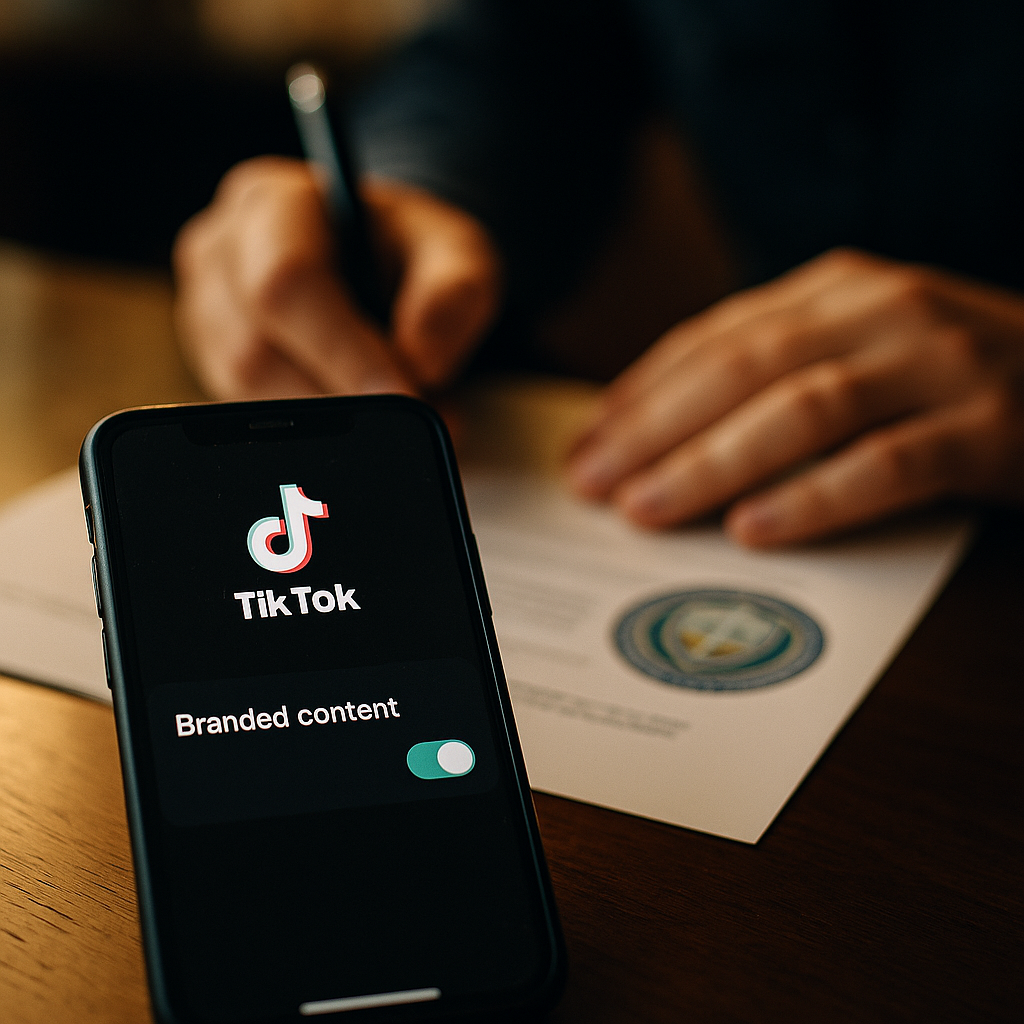
Roughly 78% of TikTok Shop campaigns Influencers Time reviewed this year used the platform’s branded-content toggle as the sole disclosure mechanism. Zero also included the words “ad” or “sponsored” in the caption. If your compliance strategy stops at flipping that switch, you don’t have a disclosure program — you have a false sense of security.
The TikTok branded-content toggle myth persists because it’s convenient. One tap, and legal feels satisfied. But the FTC doesn’t recognize platform labels as a substitute for its own disclosure standard, and that gap is where brands are getting burned.
What the Toggle Actually Does (And Doesn’t Do)
TikTok’s branded-content toggle exists to serve TikTok, not the Federal Trade Commission. When a creator flips it on, the platform appends a small “Paid partnership” tag to the video and, critically, unlocks the ability for brands to boost that content through Spark Ads. It’s a monetization and ad-transparency feature built into the platform’s own terms of service.
That’s it. That’s the whole job.
The FTC’s disclosure requirements under the FTC’s Endorsement Guides ask a different question entirely: would a reasonable consumer, scrolling at normal speed with sound off, understand that this content is a paid promotion? A platform-generated tag sitting in small gray text below the username doesn’t automatically clear that bar. Placement, size, contrast, and language all matter to the FTC in ways they simply don’t to TikTok’s toggle.
Platform labels are designed to satisfy platform rules. FTC disclosure exists to protect consumers from being misled — and it doesn’t defer to any single platform’s UI decisions.
Why “Paid Partnership” Isn’t Automatically Sufficient
Here’s the part that trips up even experienced brand teams: the FTC has never approved “Paid partnership” as a blanket-compliant phrase. It’s never blessed any platform’s native label as legally sufficient on its own. The Commission’s guidance consistently points back to clarity and conspicuousness — disclosures need to be hard to miss, not just technically present.
Consider the mechanics. TikTok’s tag appears in small type, often overlapped by other UI elements, and disappears from view within a couple of seconds on many devices. If a viewer has to pause, squint, or already know where to look, that’s a disclosure problem. The FTC has said plainly that disclosures buried in bios, hashtag strings, or “more” buttons don’t count. A toggle-generated tag sitting in a visually similar position raises the exact same conspicuousness concerns.
Then there’s language ambiguity. “Paid partnership” tells a viewer money changed hands somewhere, but it doesn’t say who paid whom or clarify the nature of the relationship in plain terms. Compare that to “#ad” or “Sponsored by [Brand]” — language the FTC has repeatedly cited as clear examples of adequate disclosure. Toggle labels are ambiguous by design; they’re built to be minimally intrusive to the viewing experience, which is precisely the opposite of what regulators want.
A Quick Reality Check on Enforcement
The FTC’s recent enforcement actions and warning letters keep hammering the same point: labels alone don’t cut it if they’re not clear and prominent within the actual content, not just in metadata. Brands that treat the toggle as their entire compliance layer are betting on an agency reading the platform’s UX as legally definitive. That’s a bet regulators haven’t validated once.
Livestream shopping makes this worse. TikTok Shop’s countdown timers and rapid-fire selling formats leave almost no room for a viewer to notice a small paid-partnership tag before moving to checkout. We covered this collision in detail in our piece on livestream disclosure rules clashing with countdown timers — and the underlying issue is the same one driving the toggle myth: platform tools built for speed and monetization aren’t built for regulatory clarity.
The Real Cost of Relying on One Signal
Why does this matter operationally, beyond the legal theory? Because brands are the ones holding liability, not creators, and not TikTok.
The FTC has been explicit that both advertisers and endorsers can be held responsible for inadequate disclosure. If a creator relies solely on the toggle and skips a verbal or on-screen “ad” callout, the brand that briefed them, approved the content, or ran it through Spark Ads shares exposure. Agencies aren’t shielded either — if you managed the campaign, you’re a name on the same enforcement letter.
There’s also a reputational dimension marketing leaders underweight. Consumer trust research from firms like eMarketer has repeatedly shown that audiences penalize brands they perceive as hiding sponsorships, regardless of whether a technical disclosure existed somewhere on screen. A toggle that satisfies TikTok’s terms but leaves viewers feeling misled doesn’t just create legal risk. It erodes the exact trust influencer marketing is supposed to build.
A disclosure that only lawyers and platform auditors can find isn’t a disclosure. It’s a paperwork exercise that happens to look like compliance.
This is also where line-by-line script control creates its own liability layer. Brands that dictate exact wording to creators — without independently verifying the disclosure is clear and unmissed — open themselves up to the arguments we detailed in FTC liability risks of line-by-line UGC script approval. Controlling the message means owning the disclosure outcome, toggle or not.
Building a Disclosure Stack That Actually Holds Up
So what does adequate disclosure look like in practice, layered on top of (not instead of) the platform toggle?
- Verbal disclosure in video: A spoken “this is a paid ad for [Brand]” in the first few seconds, especially for livestream and Shop content where viewers are moving fast.
- On-screen text disclosure: Burned-in captions reading “Ad” or “Sponsored,” placed where they can’t be cropped or scrolled past, not tucked into a corner.
- Caption-level disclosure: “#ad” or “#sponsored” placed at the start of the caption, not buried after fifteen unrelated hashtags.
- Platform toggle: Still worth using — it’s required by TikTok’s own commerce terms and helps with Spark Ads eligibility — but treated as a floor, not a ceiling.
Redundancy is the point. If one disclosure layer gets cropped, muted, or skipped, another one catches the viewer. That’s the standard the FTC actually applies: multiple reasonable chances for a consumer to understand they’re looking at an ad.
None of this works without contract language that makes disclosure non-negotiable and auditable. Brands should be requiring documented proof — screenshots, video timestamps, caption text — as a deliverable before payment, not trusting a creator’s word that “the toggle’s on.” Our compliance audit framework for UGC sponsorship lays out how to build that verification step into standard campaign workflows without slowing down launch timelines.
Cross-Border Complicates the Toggle Myth Further
If your campaigns run outside the U.S., the toggle myth gets more dangerous, not less. The UK’s ICO and the ASA apply their own conspicuousness standards, and the EU’s DSA layers on additional platform-accountability obligations. A single platform label almost never satisfies three regulatory regimes at once, because none of them were designed with each other in mind.
We mapped the overlaps and gaps in our cross-border disclosure matrix for FTC, ASA, and DSA rules — worth bookmarking if you’re running any multi-market TikTok Shop program. The short version: build for the strictest applicable standard, then layer platform tools on top, not the reverse.
What About AI-Generated or AI-Assisted Content?
Add AI-scripted UGC into the mix and the toggle problem compounds again. If a creator’s script was AI-generated or AI-assisted and the brand approved it without documenting the disclosure language explicitly, you’re stacking two unresolved compliance questions on top of each other. Our coverage of AI creator scripts needing an FTC-proof documentation trail is directly relevant here — the paper trail matters as much as the on-screen label.
Practical Next Step
Audit your last ten TikTok campaigns this week. If the branded-content toggle is the only disclosure signal present, you have a gap, not a compliance program — fix it before your next FTC-scrutinized quarter, not after a warning letter forces the issue.
FAQs
Does TikTok’s branded-content toggle satisfy FTC disclosure rules on its own?
No. The toggle meets TikTok’s platform requirements and enables features like Spark Ads, but the FTC evaluates disclosures based on clarity, placement, and whether a reasonable consumer would notice and understand them — standards the toggle alone doesn’t guarantee.
Who is liable if a TikTok ad’s disclosure is inadequate?
Both the brand and the creator can face FTC scrutiny. Advertisers who brief, approve, or amplify content are treated as responsible parties alongside the endorser, regardless of who technically posted it.
What disclosure language does the FTC consider clear?
Straightforward terms like “Ad,” “Sponsored,” or “Paid partnership with [Brand]” placed prominently, ideally reinforced both verbally and visually, rather than buried in hashtags or bios.
Should brands still use the TikTok branded-content toggle?
Yes. It’s required under TikTok’s commerce terms and unlocks paid amplification options. It should be one layer in a disclosure stack, not the entire strategy.
How does this issue change for TikTok Shop livestreams?
Livestream formats move fast and often use countdown timers, making a small platform tag even easier to miss. Verbal disclosure at the start of the stream becomes essential, not optional.
Top Influencer Marketing Agencies
The leading agencies shaping influencer marketing in 2026
Agencies ranked by campaign performance, client diversity, platform expertise, proven ROI, industry recognition, and client satisfaction. Assessed through verified case studies, reviews, and industry consultations.
Moburst

-
2

The Shelf
Boutique Beauty & Lifestyle Influencer AgencyA data-driven boutique agency specializing exclusively in beauty, wellness, and lifestyle influencer campaigns on Instagram and TikTok. Best for brands already focused on the beauty/personal care space that need curated, aesthetic-driven content.Clients: Pepsi, The Honest Company, Hims, Elf Cosmetics, Pure LeafVisit The Shelf → -
3

Audiencly
Niche Gaming & Esports Influencer AgencyA specialized agency focused exclusively on gaming and esports creators on YouTube, Twitch, and TikTok. Ideal if your campaign is 100% gaming-focused — from game launches to hardware and esports events.Clients: Epic Games, NordVPN, Ubisoft, Wargaming, Tencent GamesVisit Audiencly → -
4

Viral Nation
Global Influencer Marketing & Talent AgencyA dual talent management and marketing agency with proprietary brand safety tools and a global creator network spanning nano-influencers to celebrities across all major platforms.Clients: Meta, Activision Blizzard, Energizer, Aston Martin, WalmartVisit Viral Nation → -
5

The Influencer Marketing Factory
TikTok, Instagram & YouTube CampaignsA full-service agency with strong TikTok expertise, offering end-to-end campaign management from influencer discovery through performance reporting with a focus on platform-native content.Clients: Google, Snapchat, Universal Music, Bumble, YelpVisit TIMF → -
6

NeoReach
Enterprise Analytics & Influencer CampaignsAn enterprise-focused agency combining managed campaigns with a powerful self-service data platform for influencer search, audience analytics, and attribution modeling.Clients: Amazon, Airbnb, Netflix, Honda, The New York TimesVisit NeoReach → -
7

Ubiquitous
Creator-First Marketing PlatformA tech-driven platform combining self-service tools with managed campaign options, emphasizing speed and scalability for brands managing multiple influencer relationships.Clients: Lyft, Disney, Target, American Eagle, NetflixVisit Ubiquitous → -
8

Obviously
Scalable Enterprise Influencer CampaignsA tech-enabled agency built for high-volume campaigns, coordinating hundreds of creators simultaneously with end-to-end logistics, content rights management, and product seeding.Clients: Google, Ulta Beauty, Converse, AmazonVisit Obviously →