


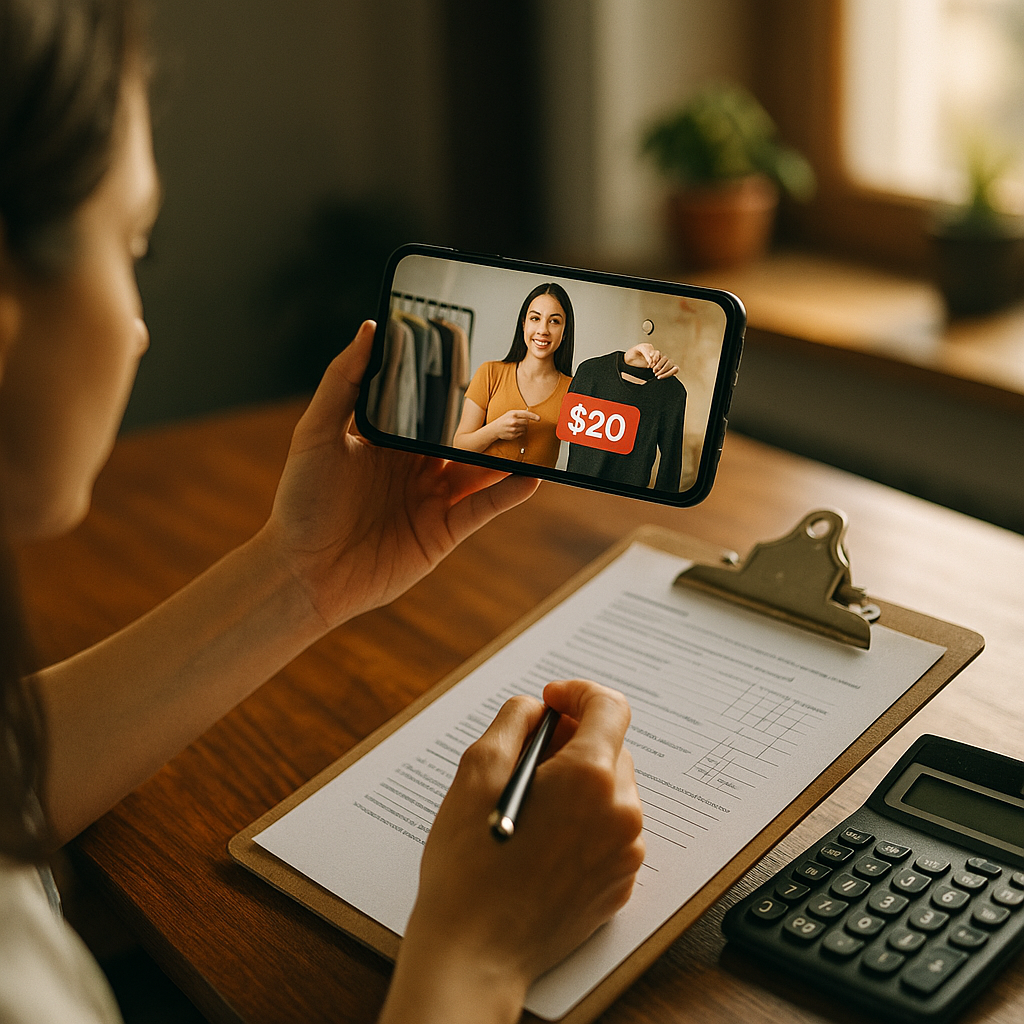
A “limited-time price drop” that isn’t actually limited is a false claim — and the FTC has said so repeatedly. Livestream shopping scripts are churned out fast, often by hosts riffing off bullet points, and almost none of them get the same scrutiny as a paid search ad. Yet the FTC’s substantiation standard applies exactly the same way to a host shouting “lowest price of the year” as it does to a banner ad. If you’re running livestream shopping and haven’t audited your scripts against that standard, you’re carrying more legal exposure than your finance team probably realizes.
This isn’t a theoretical risk. Livestream commerce in the US is projected to top $68 billion by the end of the decade, according to eMarketer estimates, and every dollar of that growth comes with claims made in real time, unscripted, and often unreviewed. Let’s break down how brands should actually audit these scripts before they go live — and what “substantiation” really requires when the format is fast, improvisational, and running on a countdown clock.
What the FTC Actually Requires for Price Claims
The FTC’s substantiation doctrine is old — it predates influencer marketing entirely — but it hasn’t softened. Any objective claim about price, savings, or value needs a “reasonable basis” before it’s made, not after. That means if a host says “this is 40% off,” someone on your team needs to be able to prove the regular price, the sale price, and the duration of that discount with real records, not vibes.
The tricky part with livestream shopping is that claims aren’t scripted line-by-line the way a TV spot is. Hosts riff. They compare prices to competitors. They say things like “cheapest it’s ever been” without checking pricing history. Each of those is a substantiation claim, and each one needs backup documentation that exists before the stream airs, not scrambled together after a complaint lands.
If your legal team can’t produce pricing documentation within an hour of a claim being made, you don’t have substantiation — you have a hope that nobody asks.
The FTC’s guidance on deceptive pricing claims — including former Guides on retail price comparisons — treats “was/now” pricing and percentage-off claims as inherently risky unless the “was” price reflects a real, recent selling price. Brands running livestream shopping on TikTok Shop, Amazon Live, or Whatnot need to treat every price mention as a claim requiring a paper trail, whether it’s scripted or ad-libbed.
Why Livestream Scripts Are a Different Animal Than Static Ads
Static ads get legal review. Livestream scripts often don’t — or they get a cursory glance at the outline while the actual delivery is left to the host’s discretion. That gap is where the risk lives.
Consider the countdown timer problem, which Influencers Time has covered extensively: platforms like TikTok Shop use urgency mechanics — countdown clocks, “X sold in the last hour” tickers — that hosts reference verbally during a stream. If the countdown resets after it hits zero, or the “sale” price is actually the everyday price, that’s a substantiation failure baked into the platform mechanics, not just the script. We’ve detailed how this collides with disclosure rules in our piece on FTC livestream disclosure rules and the parallel risk in countdown timer disclosure requirements.
Add the improvisational layer — hosts fielding live comments, comparing prices to competitors in real time, throwing out exaggerated superlatives to keep energy up — and you’ve got a compliance surface area that’s fundamentally different from a 30-second pre-approved commercial.
Building the Audit: What to Actually Check
An audit isn’t a one-time legal sign-off. It’s a repeatable process that should run before every livestream event, especially recurring ones. Here’s what belongs in it.
- Price history documentation. For every “was” price referenced, pull at least 30-90 days of actual selling price history (state rules vary, but longer is safer). If the item hasn’t been sold at the “regular” price recently, the comparison claim is unsupportable.
- Discount math verification. Someone needs to independently recalculate every percentage-off claim in the script against the actual current listed price. Scripts drift. A “30% off” line written two weeks before the stream can be wrong by air time if pricing changed.
- Superlative claims flagged for evidence. “Lowest price ever,” “best deal of the year,” “cheaper than Amazon” — these all require supporting data. If you can’t produce it, cut the line.
- Inventory and scarcity claims. “Only 12 left” needs to reflect actual inventory, not a marketing device. The FTC has pursued cases over fabricated scarcity messaging before, and livestream tickers make this an easy target.
- Host improvisation guardrails. Give hosts a “claims bank” — pre-approved ways to talk about price and value — and a clear list of phrases that are banned outright, regardless of context.
- Real-time moderation protocol. Someone should be monitoring the live feed with authority to interject or cut the stream if a host makes an unsupportable claim on the fly.
This is the same discipline we’ve argued for in creator-led UGC generally — see our breakdown of line-by-line UGC script approval risk, which explores the tension between over-controlling scripts (which can create employment/agency liability) and under-controlling them (which creates substantiation gaps). Livestream shopping needs a middle path: documented claims banks, not word-for-word scripts read verbatim.
The Documentation Trail Regulators Actually Want to See
Substantiation isn’t just about having the right number somewhere in a spreadsheet. Regulators and plaintiffs’ attorneys want a contemporaneous record — proof that the basis for the claim existed at the time it was made, not reconstructed after the fact.
Build a claims log for every livestream event. For each price or discount claim scripted or pre-approved, log: the source data, the date it was pulled, who approved it, and the exact language used. Tie this to your existing FTC compliance paper trail processes — the same infrastructure we recommend in our piece on building a compliance paper trail applies directly here, just applied to pricing claims instead of testimonials.
Retention matters too. State AGs have been active on deceptive pricing — our coverage of state AG crackdowns on countdown timers shows enforcement isn’t limited to federal action. Keep claims logs for at least the statute of limitations period in your most litigious operating states, generally two to four years depending on jurisdiction.
A claims log that exists only in someone’s memory or a deleted Slack thread is not a defense. It’s a liability waiting for a subpoena.
Who Owns This Inside the Organization?
Livestream shopping tends to fall between departments — commerce, social, brand, and legal all touch it, and none fully own compliance. That ambiguity is exactly how substantiation gaps happen.
The fix is assigning a single accountable owner for claims review, typically someone in legal or compliance, who signs off on the claims bank before every stream and has veto power over specific lines. This person doesn’t need to write the script. They need authority to strike unsupported claims and the standing to shut down a stream mid-broadcast if a host goes rogue.
If you’re working with creators rather than in-house hosts, this needs to be a contract term, not a verbal expectation. Review your creator agreements for script control language — our audit framework on creator contract audits for script control risk is a good starting template for building this into renewal cycles. Vendor and agency relationships running your livestream programs should carry the same clause requiring pre-stream claims review and real-time moderation access.
Platform-Specific Wrinkles Worth Knowing
Not all livestream shopping environments carry the same risk profile.
TikTok Shop’s branded content toggle is frequently mistaken for a compliance solution — it isn’t. As we covered in why the branded content toggle isn’t FTC compliance, the toggle addresses material connection disclosure, not price substantiation. You need both, and they’re separate workstreams.
Amazon Live and Whatnot both have their own seller policies layered on top of FTC requirements, and Amazon in particular has pulled listings over pricing violations independent of any FTC action — a business risk on top of the legal one. Check current seller guidelines directly through platform support resources or the relevant marketplace’s seller center before assuming your FTC compliance covers platform ToS as well; they frequently don’t overlap perfectly.
For brands running livestreams across UK or EU storefronts simultaneously, add the ASA and DSA layer — pricing disclosure standards differ meaningfully by jurisdiction, and our cross-border disclosure matrix maps out where FTC, ASA, and DSA rules diverge on exactly this kind of claim.
A Realistic Cadence for Ongoing Audits
One-time script review isn’t enough given how fast pricing and inventory change. Build the audit into your operating cadence:
- Pre-stream: claims bank review and sign-off, 24-48 hours before air.
- Live: real-time moderation with stop authority.
- Post-stream: archive the recording, claims log, and pricing data together as a single compliance record.
- Quarterly: sample past streams against current FTC guidance and any new state AG activity to catch drift.
This mirrors the audit rigor already common in adjacent risk areas — see how we recommend structuring quarterly vendor audits for attribution data. Pricing substantiation deserves the same discipline, run by the same muscle.
Livestream shopping isn’t going away, and neither is regulatory attention on it. Build the claims bank, assign an owner, log the evidence before you air — not after someone files a complaint with the FTC.
Frequently Asked Questions
What counts as a “price claim” in a livestream shopping context?
Any statement comparing current price to a past price, a competitor’s price, or implying scarcity or exclusivity tied to price — including verbal ad-libs by hosts, not just scripted lines or on-screen graphics.
Do FTC substantiation rules apply to unscripted host comments during a livestream?
Yes. The FTC doesn’t distinguish between scripted and improvised claims. If a host says it on air and it’s an objective claim about price or savings, it needs a reasonable basis that existed before the statement was made.
How long should brands keep documentation supporting price claims?
At minimum, retain claims logs and supporting pricing data for the length of the statute of limitations in your most litigious operating states, generally two to four years, though longer retention reduces risk further.
Does TikTok Shop’s branded content disclosure toggle satisfy FTC pricing substantiation requirements?
No. The toggle addresses material connection disclosure between creators and brands. Price and discount substantiation is a separate legal requirement and needs its own documented review process.
Who should be responsible for auditing livestream shopping scripts?
A designated compliance or legal owner should review and approve the claims bank before every stream, with contractual authority over creators and agencies to enforce claim limits and halt broadcasts if needed.
Frequently Asked Questions
Top Influencer Marketing Agencies
The leading agencies shaping influencer marketing in 2026
Agencies ranked by campaign performance, client diversity, platform expertise, proven ROI, industry recognition, and client satisfaction. Assessed through verified case studies, reviews, and industry consultations.
Moburst

-
2

The Shelf
Boutique Beauty & Lifestyle Influencer AgencyA data-driven boutique agency specializing exclusively in beauty, wellness, and lifestyle influencer campaigns on Instagram and TikTok. Best for brands already focused on the beauty/personal care space that need curated, aesthetic-driven content.Clients: Pepsi, The Honest Company, Hims, Elf Cosmetics, Pure LeafVisit The Shelf → -
3

Audiencly
Niche Gaming & Esports Influencer AgencyA specialized agency focused exclusively on gaming and esports creators on YouTube, Twitch, and TikTok. Ideal if your campaign is 100% gaming-focused — from game launches to hardware and esports events.Clients: Epic Games, NordVPN, Ubisoft, Wargaming, Tencent GamesVisit Audiencly → -
4

Viral Nation
Global Influencer Marketing & Talent AgencyA dual talent management and marketing agency with proprietary brand safety tools and a global creator network spanning nano-influencers to celebrities across all major platforms.Clients: Meta, Activision Blizzard, Energizer, Aston Martin, WalmartVisit Viral Nation → -
5

The Influencer Marketing Factory
TikTok, Instagram & YouTube CampaignsA full-service agency with strong TikTok expertise, offering end-to-end campaign management from influencer discovery through performance reporting with a focus on platform-native content.Clients: Google, Snapchat, Universal Music, Bumble, YelpVisit TIMF → -
6

NeoReach
Enterprise Analytics & Influencer CampaignsAn enterprise-focused agency combining managed campaigns with a powerful self-service data platform for influencer search, audience analytics, and attribution modeling.Clients: Amazon, Airbnb, Netflix, Honda, The New York TimesVisit NeoReach → -
7

Ubiquitous
Creator-First Marketing PlatformA tech-driven platform combining self-service tools with managed campaign options, emphasizing speed and scalability for brands managing multiple influencer relationships.Clients: Lyft, Disney, Target, American Eagle, NetflixVisit Ubiquitous → -
8

Obviously
Scalable Enterprise Influencer CampaignsA tech-enabled agency built for high-volume campaigns, coordinating hundreds of creators simultaneously with end-to-end logistics, content rights management, and product seeding.Clients: Google, Ulta Beauty, Converse, AmazonVisit Obviously →