


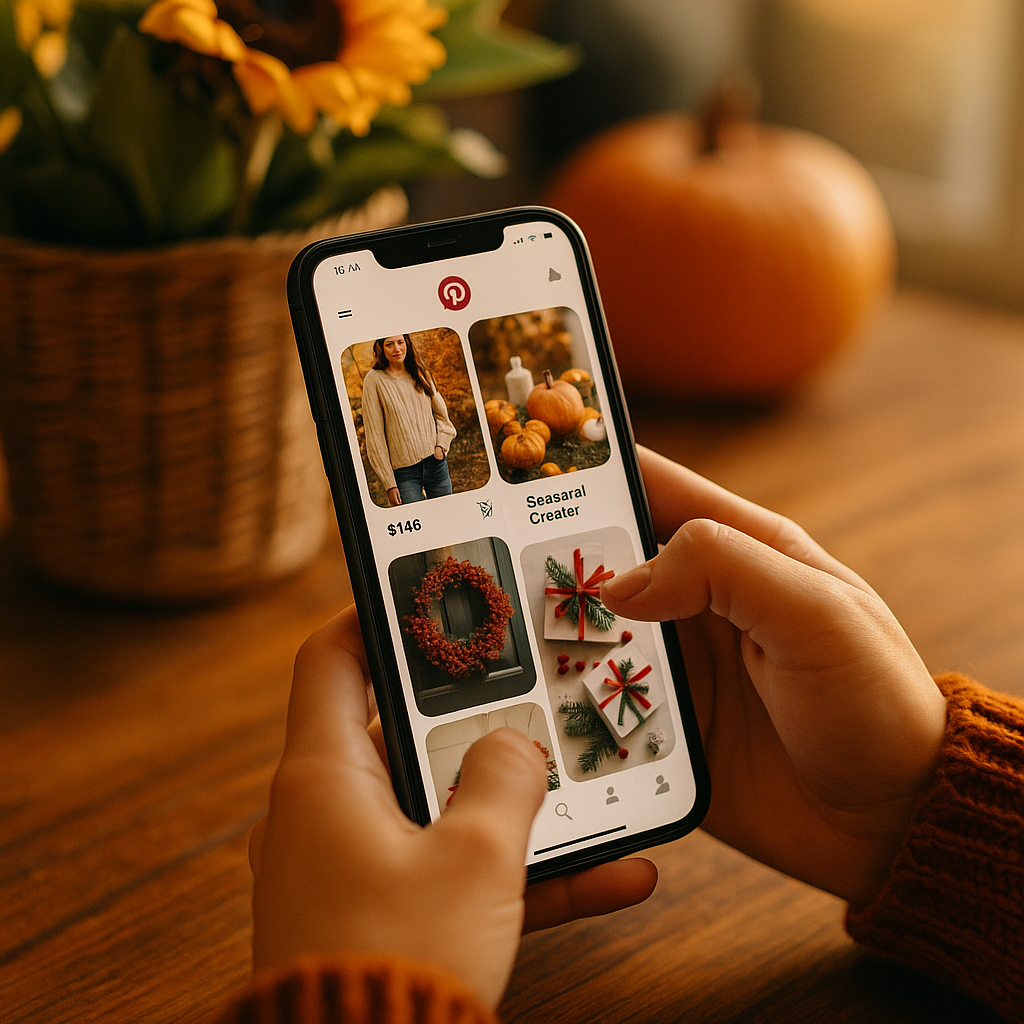
Half of Pinterest’s holiday searches start before Halloween. Read that again. If your Pinterest Shopping Ads strategy still runs on a four-week campaign clock borrowed from Meta or TikTok, you’re launching into a discovery window that already closed. Home decor buyers on Pinterest plan in seasons, not sprints, and the brands winning this channel structure creator boards accordingly.
Why Pinterest Runs on a Different Clock
Pinterest isn’t a social feed. It’s a visual search engine that happens to have a follow button. That distinction matters more than most media plans account for. A pin saved in July can still drive traffic in December, and Pinterest’s own data has repeatedly shown that searches for holiday and seasonal home content spike months before the actual season starts.
Compare that to Instagram or TikTok, where a Reel’s relevance window is measured in days. Pinterest content compounds. A well-tagged fall entryway board can keep surfacing in search results for a full year, gaining fresh impressions every time someone searches “cozy autumn decor” or “Thanksgiving tablescape ideas.” That’s not a hypothetical — it’s the entire reason Pinterest Shopping Ads work differently from paid social elsewhere.
Pinterest content doesn’t decay the way social content does — it compounds, which means a creator board launched too late has already lost most of its earned discovery value before the campaign even starts.
The Structural Mistake Most Home Decor Brands Make
Most brands treat Pinterest like a distribution channel for assets already made for Instagram. Wrong move. They repurpose a Reel thumbnail, slap it on a board, run Shopping Ads against it for three weeks around the actual holiday, then wonder why performance craps out by mid-season.
The problem is timing, not creative quality. Pinterest users researching “spring living room refresh” are searching in February and March, not April when the product actually ships to shelves. If your creator boards go live when the season starts, you’ve missed the discovery window entirely. You’re advertising to people who already bought.
Here’s the uncomfortable part: fixing this isn’t about spending more. It’s about restructuring your creator calendar to front-load discovery content 60-90 days before peak search intent, then layering Shopping Ads on top once organic saves start building momentum.
What “Long Discovery Window” Actually Means for Budget Planning
Long discovery windows change how you allocate spend across a quarter. Instead of a single burst campaign, home decor brands should think in three phases:
- Seeding phase (10-12 weeks out): Creator boards go live with organic-style pins, minimal paid amplification, focused on getting saves and search indexing.
- Amplification phase (6-8 weeks out): Shopping Ads layer onto the top-performing pins from the seeding phase, targeting warm search terms.
- Conversion phase (2-4 weeks out): Retargeting and catalog ads push hard on purchase intent, using the audience data built during the first two phases.
This isn’t drastically different from how B2B teams think about content hubs for long sales cycles — the logic mirrors what we’ve seen work in LinkedIn showcase pages built as product hubs, where early-stage content earns discovery before a purchase decision ever gets made.
Choosing Creators Who Understand Seasonal Pinning
Not every home decor creator understands Pinterest’s mechanics. Plenty are excellent on Instagram or TikTok but treat Pinterest as an afterthought, cross-posting the same square image with no keyword-rich descriptions, no board strategy, no attention to seasonal search behavior.
You want creators who already run active, well-organized boards with strong repin rates. Check their Pinterest analytics before signing anything — impressions and saves matter more than follower count here. A creator with 40,000 Pinterest followers but genuinely high monthly board views is worth more than one with 300,000 Instagram followers and a neglected Pinterest account.
Brief creators to build boards around use-cases and moods, not just products. “Cozy reading nook” outperforms “our new armchair collection” because it matches how people actually search. This is the same shift we discussed in the Pinterest board collaboration playbook for home and wedding brands — intent-based framing beats product-first framing almost every time.
Building the Seasonal Board Architecture
Structure matters as much as timing. A single mega-board titled “Fall Home Decor” is lazy and underperforms against a cluster of tightly themed sub-boards. Pinterest’s algorithm rewards specificity because specific boards match specific search queries.
Instead of one board, brief creators to build three to five interconnected boards per season:
- A broad seasonal board (e.g., “Fall Living Room Ideas”)
- A room-specific board (e.g., “Fall Entryway Styling”)
- A trend-specific board (e.g., “Warm Minimalist Autumn Decor”)
- A budget or DIY-angle board, which tends to over-index on saves
- A gifting or hosting board if the season includes a holiday
Each board should have its own product tagging strategy tied to your catalog feed. Shopping Ads perform best when the underlying organic board already has strong engagement signals — Pinterest’s ad auction rewards pins with existing save velocity, similar to how TikTok’s ad delivery favors organic watch-time signals discussed in TikTok’s watch-time algorithm shift. Different platform, same underlying principle: paid performs better when it’s amplifying something already working organically.
The Keyword Layer Nobody Briefs Correctly
Pin descriptions and board titles are search real estate. Most creator briefs skip this entirely, leaving creators to write generic captions like “loving this vibe 🍂” with zero keyword value. That’s a wasted placement.
Brief creators with a specific keyword list pulled from Pinterest Trends and your own catalog data. Require board descriptions, not just pin captions, to include seasonal search terms naturally. This is tedious to QA but it’s the difference between a board that surfaces in search for months and one that disappears after the initial push.
According to eMarketer, Pinterest’s ad revenue growth has consistently outpaced the broader social ad market in recent years, driven largely by retail and home categories leaning into shopping-specific formats. That growth isn’t happening because brands are running better 30-day campaigns — it’s happening because the platform rewards sustained, search-optimized presence.
Measuring Success Without the Wrong Attribution Window
Here’s where a lot of media buyers get burned. If you measure Pinterest Shopping Ads with a 7-day click attribution window borrowed from Meta reporting, you will systematically undervalue the channel. Pinterest’s own conversion reporting supports longer windows because that’s how the platform actually converts — someone saves a pin in September and buys in November.
Work with your analytics team to model a 30-day or even 90-day view-through window specifically for Pinterest seasonal campaigns. If your MMM (marketing mix modeling) setup can’t account for that lag, you’re going to keep cutting budget from a channel that’s actually working, just slowly.
Judging Pinterest Shopping Ads on a 7-day attribution window is like judging a garden’s growth after one week — you’re measuring the wrong timescale for the mechanism actually driving results.
Cross-reference Pinterest Analytics with your Google Analytics or catalog-level Shopify data to catch delayed conversions. Some brands also run brand-lift surveys during peak season to capture the awareness contribution that last-click attribution misses entirely. It’s worth checking Google’s attribution documentation for guidance on setting up multi-touch models that can incorporate Pinterest’s longer conversion tail.
Budget Pacing Across the Three Phases
A common allocation for a seasonal push: 20% of budget in the seeding phase, 35% in amplification, 45% in conversion. That’s a starting point, not gospel — brands with strong repeat-purchase catalogs (think seasonal decor refreshed every year) can shift more weight to seeding since the long-tail value compounds year over year.
One home goods brand we tracked shifted from a single 30-day Q4 push to this three-phase model and saw meaningful lift in November-December conversion, largely because search impressions on their boards were already climbing through September and October before any paid amplification hit. The ads weren’t creating demand from scratch — they were harvesting demand that organic seeding had already built.
Compliance and Disclosure, Still Non-Negotiable
None of this seasonal-board strategy exempts creators from disclosure requirements. Sponsored pins and Shopping Ads featuring paid creator partnerships still need clear disclosure per FTC endorsement guidelines, and that applies whether the pin was posted in July for a December campaign or the week of launch. Pinterest’s ad policies require the same disclosure standards as its more heavily scrutinized social counterparts, and regulators haven’t shown any leniency for platforms with longer content lifespans.
If anything, long discovery windows raise the compliance bar. A pin surfacing in search eighteen months after posting still needs to carry accurate, undated-but-compliant disclosure language, since “paid partnership” tags and FTC-compliant hashtags don’t expire even when the seasonal relevance does.
Brief legal or compliance review into the creator contract stage, not as an afterthought before launch. Build disclosure language into the board description and the first line of each pin caption, since Pinterest’s UI doesn’t always surface Instagram-style paid-partnership badges as prominently.
What to Do Differently Next Season
Stop briefing Pinterest creators on the same timeline as your Instagram or TikTok campaigns. Push creator content live 10-12 weeks before peak seasonal search, structure boards around use-case clusters instead of single mega-boards, and extend your attribution window before you judge performance. Do that, and Pinterest Shopping Ads stop being a rounding error in your Q4 report and start becoming one of the more efficient channels on the plan.
FAQs
How far in advance should home decor creator boards go live before a season starts?
Ten to twelve weeks ahead of peak seasonal search is the general benchmark, based on Pinterest’s own reporting on when holiday and seasonal searches typically start climbing. For major holidays like Christmas, some brands push even earlier, seeding boards in late summer.
Do Pinterest Shopping Ads work without an existing organic board presence?
They can run without one, but performance is typically weaker. Pinterest’s ad delivery favors pins with existing engagement signals, so campaigns layered on top of boards that already have saves and repins tend to outperform cold-start ad-only pins.
What attribution window should brands use for Pinterest seasonal campaigns?
A 30-day window is a reasonable minimum, and many home decor brands benefit from modeling out to 90 days given Pinterest’s long content lifespan. Standard 7-day click windows borrowed from other platforms tend to undervalue the channel significantly.
How many boards should a creator build per seasonal campaign?
Three to five interconnected boards, moving from broad seasonal themes down to room-specific and trend-specific angles, tends to outperform a single mega-board because it matches a wider range of specific search queries.
Does creator disclosure still apply to pins that stay live for over a year?
Yes. FTC disclosure requirements apply regardless of how long content remains discoverable. Brands should build disclosure language directly into board descriptions and pin captions rather than relying solely on platform-native paid-partnership tags.
Top Influencer Marketing Agencies
The leading agencies shaping influencer marketing in 2026
Agencies ranked by campaign performance, client diversity, platform expertise, proven ROI, industry recognition, and client satisfaction. Assessed through verified case studies, reviews, and industry consultations.
Moburst

-
2

The Shelf
Boutique Beauty & Lifestyle Influencer AgencyA data-driven boutique agency specializing exclusively in beauty, wellness, and lifestyle influencer campaigns on Instagram and TikTok. Best for brands already focused on the beauty/personal care space that need curated, aesthetic-driven content.Clients: Pepsi, The Honest Company, Hims, Elf Cosmetics, Pure LeafVisit The Shelf → -
3

Audiencly
Niche Gaming & Esports Influencer AgencyA specialized agency focused exclusively on gaming and esports creators on YouTube, Twitch, and TikTok. Ideal if your campaign is 100% gaming-focused — from game launches to hardware and esports events.Clients: Epic Games, NordVPN, Ubisoft, Wargaming, Tencent GamesVisit Audiencly → -
4

Viral Nation
Global Influencer Marketing & Talent AgencyA dual talent management and marketing agency with proprietary brand safety tools and a global creator network spanning nano-influencers to celebrities across all major platforms.Clients: Meta, Activision Blizzard, Energizer, Aston Martin, WalmartVisit Viral Nation → -
5

The Influencer Marketing Factory
TikTok, Instagram & YouTube CampaignsA full-service agency with strong TikTok expertise, offering end-to-end campaign management from influencer discovery through performance reporting with a focus on platform-native content.Clients: Google, Snapchat, Universal Music, Bumble, YelpVisit TIMF → -
6

NeoReach
Enterprise Analytics & Influencer CampaignsAn enterprise-focused agency combining managed campaigns with a powerful self-service data platform for influencer search, audience analytics, and attribution modeling.Clients: Amazon, Airbnb, Netflix, Honda, The New York TimesVisit NeoReach → -
7

Ubiquitous
Creator-First Marketing PlatformA tech-driven platform combining self-service tools with managed campaign options, emphasizing speed and scalability for brands managing multiple influencer relationships.Clients: Lyft, Disney, Target, American Eagle, NetflixVisit Ubiquitous → -
8

Obviously
Scalable Enterprise Influencer CampaignsA tech-enabled agency built for high-volume campaigns, coordinating hundreds of creators simultaneously with end-to-end logistics, content rights management, and product seeding.Clients: Google, Ulta Beauty, Converse, AmazonVisit Obviously →