


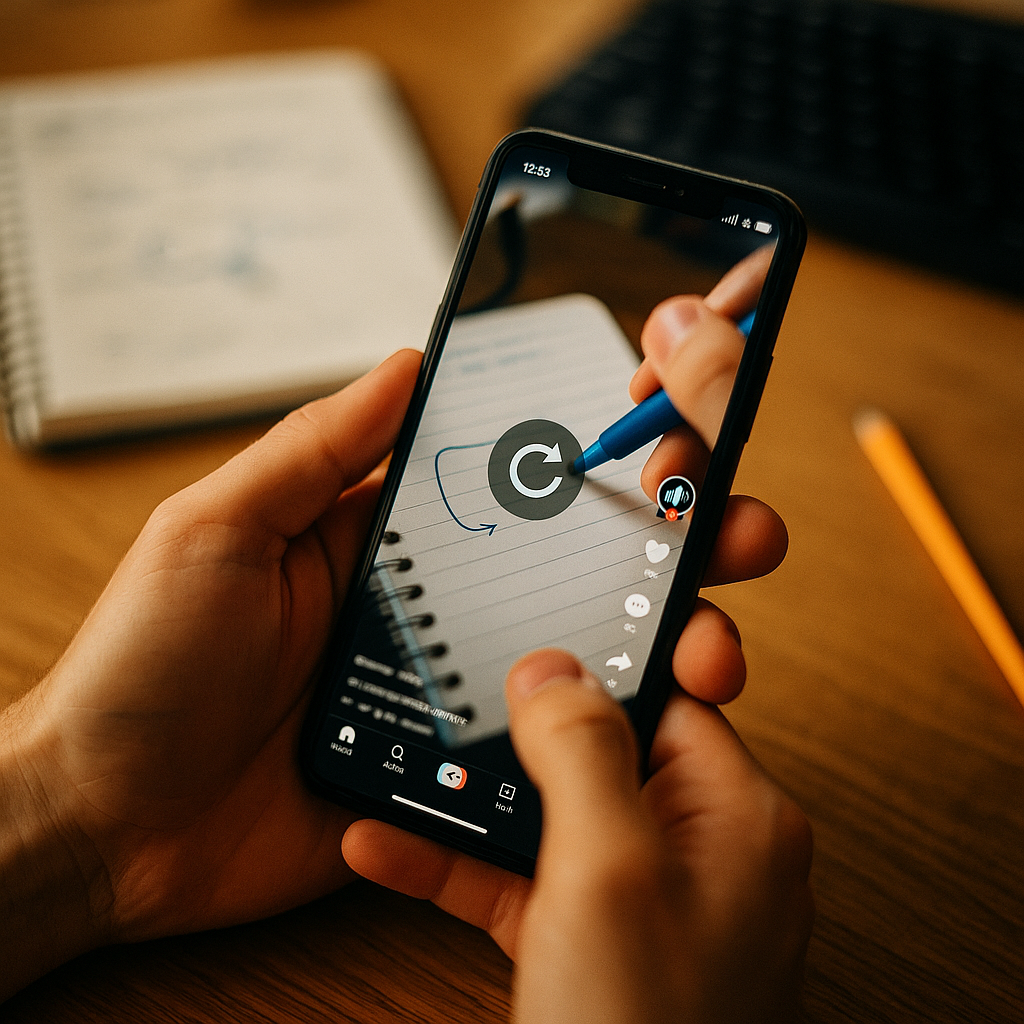
TikTok’s average watch-through rate on top-performing videos sits well above 100% completion — meaning people are watching the same clip more than once. If your brand’s content isn’t built to survive a second, third, or tenth viewing, you’re leaving reach on the table. The micro-tutorial loop format is a structural response to that behavior: sub-10-second how-to clips engineered specifically to get rewatched, not just watched.
This isn’t about making shorter videos for the sake of brevity. It’s about reverse-engineering a format around a specific algorithmic signal — loop count — that most brand teams still aren’t optimizing for.
Why Loop-Watch Beats Watch-Time for This Format
TikTok’s recommendation system has always weighted completion rate heavily. But for very short videos, completion isn’t the ceiling — it’s the floor. A 7-second clip that gets watched three times in a row generates more cumulative watch-time signal than a 45-second video watched once and abandoned. The platform’s algorithm interprets repeat viewing as a strong relevance signal, similar to how TikTok’s advertising resources describe engagement quality mattering more than raw duration.
That distinction matters for brand strategists building content calendars around “longer equals better” assumptions. It’s backwards for tutorial content. The best-performing how-to clips on the platform right now are the ones people can’t help but watch twice — because they blinked and missed the technique, or because the loop point is seamless enough that the second viewing feels intentional, almost hypnotic.
A sub-10-second tutorial that earns three loops outperforms a 60-second tutorial watched once, both in algorithmic distribution and in actual audience retention of the instructional content.
What Makes a Clip Loop-Worthy?
Not every short clip loops well. Looping is a design decision, not an accident. Three structural elements separate loop-optimized tutorials from clips that simply happen to be short:
- Seamless start/end matching: The final frame visually or motion-matches the first frame, so a replay feels like continuation rather than restart.
- Information density that requires a second pass: The clip moves fast enough that viewers genuinely miss a step first time through — a folding technique, a measurement, a swipe gesture.
- No dead air: Every frame carries either instruction or payoff. There’s no intro logo, no “hey guys,” no wind-up.
Think of it as a GIF mentality applied to instructional content. The old looping GIF format worked because it had no natural endpoint — it just kept going. Micro-tutorials borrow that same continuous-motion logic but attach it to a genuinely useful how-to payload.
The Repeatability Test
Before publishing, ask: would someone need to watch this twice to actually execute the technique? If the answer is no, the clip is probably too slow, too padded, or too explanatory. Cut it down until the honest answer becomes yes. That tension — just fast enough to require a rewatch, not so fast it feels unwatchable — is the entire creative brief in one sentence.
This is a sharp departure from briefing creators on longer explainer formats. Compare it to the discipline required in silent skill demo content, where visual clarity has to carry the entire message without narration. Micro-tutorials push that constraint even further by compressing the timeline.
Briefing Creators for Sub-10-Second Structure
Most creator briefs are built for 30-to-90-second content. Briefing for a 6-to-9-second loop requires a different document entirely. Here’s what should change in the brief:
- Specify the loop point explicitly. Don’t just say “keep it short.” Tell the creator the last visual beat needs to rhyme with the first.
- Cut the hook. Traditional TikTok briefs obsess over the first three seconds as a hook. In loop content, there is no hook-versus-body distinction — the whole clip is the hook, repeated.
- Limit to one action per clip. One fold, one swipe, one substitution, one measurement conversion. Multi-step tutorials break the loop format; save those for carousel or multi-part series.
- Demand vertical, tight framing. Loop clips work best when the visual field is small and consistent — hands, a product, a surface. Wide shots dilute the repeat-watch effect.
This format also plays well with the remix culture TikTok rewards. A well-built micro-tutorial becomes a template other creators duplicate with their own product or twist, extending organic reach without additional brand spend. That’s a similar mechanic to what’s outlined in remixable asset briefs, where the original asset is designed for downstream reuse rather than one-off consumption.
Where This Fits in a Brand’s Content Mix
Micro-tutorial loops aren’t a replacement for long-form educational content. They’re a top-of-funnel discovery mechanism. Think of them as the trailer, not the movie. A skincare brand might use a 7-second loop to show a single application technique, then drive comments and profile visits toward a longer tutorial series or a linked product page.
The efficiency case is strong for lean teams. Because these clips are so short, batch production is fast — a single afternoon shoot can generate a dozen loop variations testing different actions, product angles, or pacing. That’s a meaningfully lower cost-per-asset than the multi-setup shoots required for longer format content, echoing the economics discussed in multi-format UGC shoot planning.
There’s also a measurement upside worth flagging to finance-minded stakeholders. Loop count, replay rate, and average watch time as a percentage over 100% are all available in TikTok’s native analytics and in most third-party social listening tools referenced by Sprout Social and eMarketer benchmarking reports. These metrics give brand teams a much cleaner signal of instructional clarity than likes or shares alone — if people are looping, the content is doing its job.
The Compliance Angle Brands Can’t Skip
Fast cuts and rapid pacing can create disclosure problems if the content involves a paid partnership or a product claim. The FTC’s guidance on clear and conspicuous disclosure doesn’t get relaxed just because a video is nine seconds long — if anything, regulators have signaled more scrutiny toward short-form content where disclosures get visually or verbally buried. Review the FTC’s endorsement guidance before greenlighting a batch of loop-format tutorials tied to sponsored product demos.
Practically, this means baking the disclosure into the loop itself rather than treating it as an afterthought caption. A small on-screen “#ad” tag that’s visible for the full duration works better here than a spoken disclosure that could get lost in a fast-paced clip. Brands running influencer-led tutorial series should treat this the same way they’d approach any sponsored content review process — consistent, documented, and visible in the actual creative rather than buried in a description field.
Common Mistakes That Kill the Loop
A few recurring errors show up when brand teams first experiment with this format:
- Adding a title card at the start. Even a half-second title card breaks the seamless loop and resets viewer attention instead of sustaining it.
- Over-explaining with on-screen text. Text overlays that require reading slow the loop down. Show, don’t caption.
- Using trending audio that doesn’t match the pacing. A loop that cuts against the beat of trending sound feels jarring on replay. Silent or ambient-sound clips often perform better for this specific format.
- Treating it as a standalone campaign. Micro-tutorial loops work best as a recurring series, not a one-off. Repetition across a content calendar builds format recognition, so audiences learn to expect (and rewatch) your brand’s loop style.
That last point deserves emphasis. Format recognition compounds. Once an audience learns your brand’s loop cadence, they anticipate the payoff faster, which — counterintuitively — increases the odds they’ll watch it twice just to confirm what they saw. That’s the entire mechanism working as designed.
Next Step
Pull your last ten short-form posts and check average watch time as a percentage over 100%. Anything under 120% wasn’t built to loop. Rebuild your next tutorial batch around a single seamless action, one loop point, and zero dead frames — then measure replay rate the same way you’d measure click-through on a paid unit.
FAQs
What is the micro-tutorial loop format?
It’s a short-form video structure, typically under 10 seconds, built around a single how-to action designed so the final frame connects seamlessly back to the first, encouraging repeat viewing and boosting TikTok’s loop-watch algorithm signal.
How is loop-watch different from completion rate?
Completion rate measures whether a viewer watched to the end once. Loop-watch (or replay rate) measures how many times a viewer rewatches the same clip in a single session, which TikTok treats as a stronger relevance signal for very short videos.
How short does a clip need to be to loop effectively?
Most effective micro-tutorials fall between 5 and 9 seconds. Below that, there’s often not enough information to justify a rewatch; above 10 seconds, the loop effect weakens because viewers feel they’ve fully absorbed the content on the first pass.
Do these clips need trending audio to perform well?
No. Many high-performing loop tutorials use ambient or no audio, since mismatched trending sound can disrupt the seamless replay feel. Sound-off performance is a design priority, similar to the approach used in silent skill demo content.
How do brands stay FTC-compliant with such short sponsored clips?
Disclosures need to be visible for the full duration of the clip, not just flashed briefly or buried in the caption. Brands should follow FTC endorsement guidance and treat disclosure placement as part of the creative brief, not an afterthought.
What metrics should brands track for this format?
Replay rate, average watch time as a percentage over 100%, and loop count are the primary signals. These indicate whether the tutorial’s pacing and information density are actually driving rewatches, versus vanity metrics like likes alone.
FAQs
What is the micro-tutorial loop format?
It’s a short-form video structure, typically under 10 seconds, built around a single how-to action designed so the final frame connects seamlessly back to the first, encouraging repeat viewing and boosting TikTok’s loop-watch algorithm signal.
How is loop-watch different from completion rate?
Completion rate measures whether a viewer watched to the end once. Loop-watch (or replay rate) measures how many times a viewer rewatches the same clip in a single session, which TikTok treats as a stronger relevance signal for very short videos.
How short does a clip need to be to loop effectively?
Most effective micro-tutorials fall between 5 and 9 seconds. Below that, there’s often not enough information to justify a rewatch; above 10 seconds, the loop effect weakens because viewers feel they’ve fully absorbed the content on the first pass.
Do these clips need trending audio to perform well?
No. Many high-performing loop tutorials use ambient or no audio, since mismatched trending sound can disrupt the seamless replay feel. Sound-off performance is a design priority, similar to the approach used in silent skill demo content.
How do brands stay FTC-compliant with such short sponsored clips?
Disclosures need to be visible for the full duration of the clip, not just flashed briefly or buried in the caption. Brands should follow FTC endorsement guidance and treat disclosure placement as part of the creative brief, not an afterthought.
What metrics should brands track for this format?
Replay rate, average watch time as a percentage over 100%, and loop count are the primary signals. These indicate whether the tutorial’s pacing and information density are actually driving rewatches, versus vanity metrics like likes alone.
Top Influencer Marketing Agencies
The leading agencies shaping influencer marketing in 2026
Agencies ranked by campaign performance, client diversity, platform expertise, proven ROI, industry recognition, and client satisfaction. Assessed through verified case studies, reviews, and industry consultations.
Moburst

-
2

The Shelf
Boutique Beauty & Lifestyle Influencer AgencyA data-driven boutique agency specializing exclusively in beauty, wellness, and lifestyle influencer campaigns on Instagram and TikTok. Best for brands already focused on the beauty/personal care space that need curated, aesthetic-driven content.Clients: Pepsi, The Honest Company, Hims, Elf Cosmetics, Pure LeafVisit The Shelf → -
3

Audiencly
Niche Gaming & Esports Influencer AgencyA specialized agency focused exclusively on gaming and esports creators on YouTube, Twitch, and TikTok. Ideal if your campaign is 100% gaming-focused — from game launches to hardware and esports events.Clients: Epic Games, NordVPN, Ubisoft, Wargaming, Tencent GamesVisit Audiencly → -
4

Viral Nation
Global Influencer Marketing & Talent AgencyA dual talent management and marketing agency with proprietary brand safety tools and a global creator network spanning nano-influencers to celebrities across all major platforms.Clients: Meta, Activision Blizzard, Energizer, Aston Martin, WalmartVisit Viral Nation → -
5

The Influencer Marketing Factory
TikTok, Instagram & YouTube CampaignsA full-service agency with strong TikTok expertise, offering end-to-end campaign management from influencer discovery through performance reporting with a focus on platform-native content.Clients: Google, Snapchat, Universal Music, Bumble, YelpVisit TIMF → -
6

NeoReach
Enterprise Analytics & Influencer CampaignsAn enterprise-focused agency combining managed campaigns with a powerful self-service data platform for influencer search, audience analytics, and attribution modeling.Clients: Amazon, Airbnb, Netflix, Honda, The New York TimesVisit NeoReach → -
7

Ubiquitous
Creator-First Marketing PlatformA tech-driven platform combining self-service tools with managed campaign options, emphasizing speed and scalability for brands managing multiple influencer relationships.Clients: Lyft, Disney, Target, American Eagle, NetflixVisit Ubiquitous → -
8

Obviously
Scalable Enterprise Influencer CampaignsA tech-enabled agency built for high-volume campaigns, coordinating hundreds of creators simultaneously with end-to-end logistics, content rights management, and product seeding.Clients: Google, Ulta Beauty, Converse, AmazonVisit Obviously →