


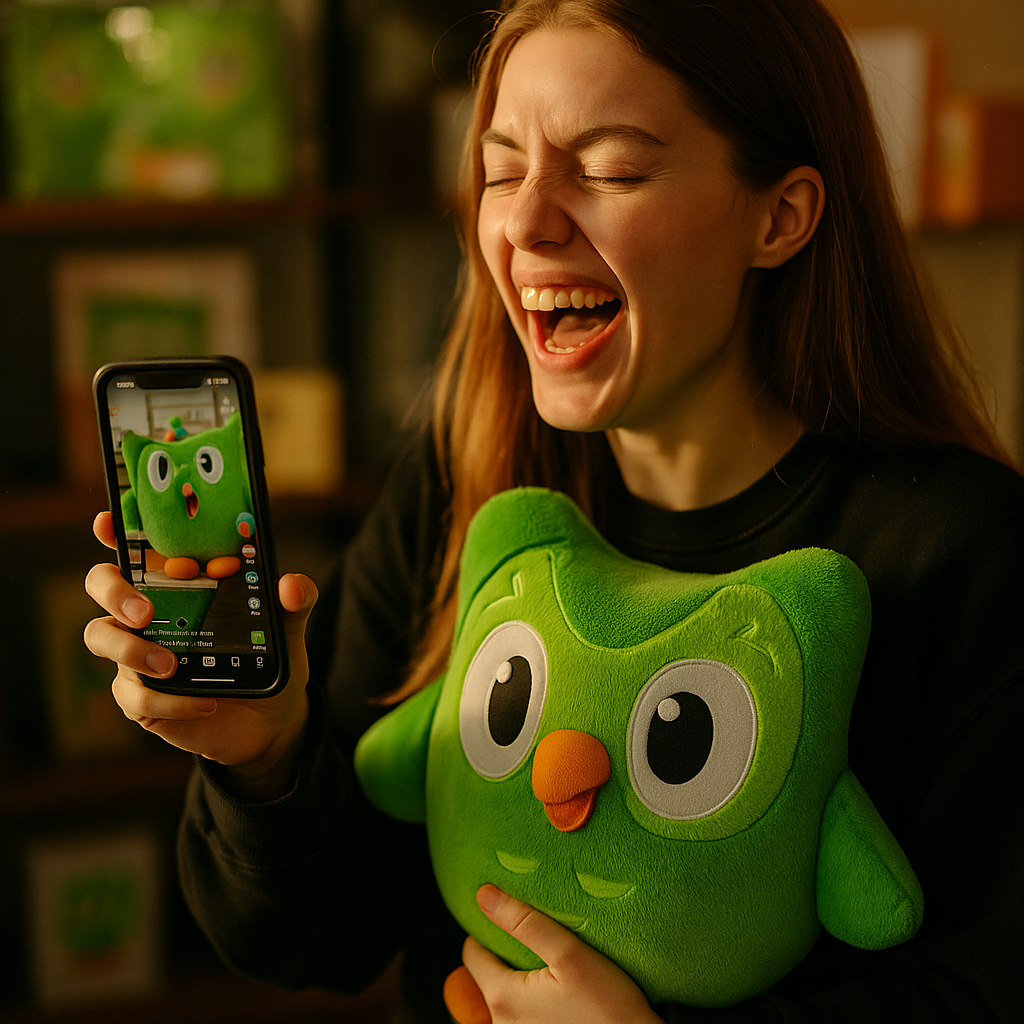
Duolingo’s owl has threatened, cried, and died on camera more times than any brand mascot should reasonably survive. Yet TikTok Shop merch sales tied to Duo keep climbing, and the app still sits atop education charts. The lesson for brand teams isn’t “be weird.” It’s that unhinged comedy, when engineered correctly, is a distribution mechanic with measurable commerce output.
This isn’t a fluke born from one intern’s chaotic Slack access. It’s a repeatable content format. Let’s break down how it actually works, and what’s transferable to brands without a green owl or a billion-dollar app to promote.
Why a Language App Sells Plushies at All
Duolingo doesn’t need merch revenue. The company’s core business is subscriptions and ad-supported lessons. So why run a TikTok Shop storefront full of owl plushies, apparel, and novelty items? Because merch has become the physical proof point of a bit. When the owl “dies,” fans don’t just laugh, they want a dead-owl plushie to put on their desk. The content creates the demand; the storefront just has to be there to catch it.
This is fundamentally different from typical influencer-driven commerce, where a creator demos a product and drives a purchase decision. Duolingo flips the sequence: the joke comes first, the product is the souvenir. It’s closer to how a comedy bit becomes a t-shirt slogan than how a review becomes a sale.
Duolingo’s merch isn’t selling a product. It’s selling participation in a joke that millions of people are already in on.
The Format Breakdown: What Actually Makes It Work
Strip away the absurdism and you find a tight structural formula repeating across Duolingo’s TikTok output. Marketing teams trying to reverse-engineer this shouldn’t focus on “being funny.” They should focus on the mechanics.
- Cold open shock: No brand intro, no logo bumper. The video starts mid-chaos, usually with the owl already in a compromising or threatening posture.
- Escalation, not resolution: Most branded content tries to land a clean punchline. Duolingo’s format escalates until it breaks the fourth wall entirely, often referencing the brand’s own past memes.
- Trend-jacking with a two-day window: The content team reacts to audio trends and formats within 24-48 hours, a speed most brand approval chains simply cannot match.
- Recurring lore: The owl has a persistent “personality arc” — obsession, threats, fake deaths, fake resurrections — that rewards long-time followers and gives new viewers a reason to scroll back through the account.
- Merch as punchline payoff: The product drop is often the joke’s final beat, not a separate ad. A shirt that says something only fans of a specific meme would understand functions as an in-group signal, not a discount-driven purchase.
Compare this to the comedic-but-controlled format used by Chubbies’ absurdist creator briefs, which similarly reward brand-literate humor over generic gags. The throughline across successful comedy-driven commerce: specificity beats broad appeal every time.
Why This Isn’t Just “Brand Voice”
A lot of marketing leads hear “unhinged owl” and think it’s a tone-of-voice exercise. It’s not. It’s a production and governance system. Duolingo has previously detailed how it uses an AI-assisted content pipeline to scale TikTok chaos safely, meaning the “chaos” you see is downstream of a very deliberate operational process: rapid trend detection, script drafting, legal/brand-safety review compressed into hours instead of weeks, and a small dedicated team empowered to publish without ten layers of sign-off.
That’s the uncomfortable truth for most enterprise marketing orgs. The format is copyable. The org structure that makes it possible usually isn’t, unless leadership is willing to shrink the approval chain.
From Views to Cart: How the Commerce Loop Actually Closes
Comedy views don’t automatically become TikTok Shop revenue. There’s a bridge, and Duolingo has built it deliberately.
- Pinned comment or caption CTA pointing directly to the shop tab, not an external link that adds friction.
- Limited-run drops tied to specific memes (a “dead owl” era plushie, for example), which creates urgency without needing a discount code.
- Cross-posting the same bit across TikTok, Instagram Reels, and sometimes YouTube Shorts, multiplying discovery surface without multiplying production cost.
- Creator amplification, where nano and micro creators duet or react to the original bit, extending reach into audiences the brand account itself doesn’t touch.
That last point matters more than most brand teams give it credit for. Duolingo’s owl content works partly because thousands of unaffiliated creators repost, react, and remix it for free. It’s earned media stacked on top of owned content, which is a far cheaper acquisition loop than paid ads chasing the same audience. Compare that efficiency to Grubhub’s shift away from celebrity spend toward micro-creators — different category, same underlying principle: audience-native content beats top-down advertising on cost-per-engagement.
Is This Actually Measurable, or Just Vibes?
Fair question, and one every CMO should ask before greenlighting a “let’s be more like Duolingo” initiative. The format is measurable, just not through last-click attribution alone. Brand teams tracking similar comedy-to-commerce loops typically watch:
- TikTok Shop conversion rate on videos tagged with specific meme/character content versus straight product demos.
- Share rate and duet/stitch volume as a proxy for organic amplification (views alone undercount reach).
- Search lift for branded terms following a viral moment, tracked via Google Trends or platform-native search insights.
- Merch sell-through velocity on limited drops, a much better health signal than raw revenue since it shows demand outpacing supply.
eMarketer has repeatedly flagged social commerce, and TikTok Shop specifically, as one of the fastest-growing retail channels for younger demographics, which is exactly the audience this comedic format targets. The format isn’t unmeasurable chaos. It’s a different attribution model, one built around organic amplification signals rather than paid media reporting.
What Brands Without a Mascot Can Actually Steal
Not every brand has 15 years of owl lore to draw from. But the transferable pieces of this playbook don’t require a mascot at all:
- Build a recurring character or bit, even a small one, that gives your account a “lore” viewers can follow over time. Consistency beats novelty.
- Compress your approval process for social content specifically. If your legal review takes five days, you cannot compete on trend-timing.
- Tie merch drops to content moments, not calendar dates. Scarcity that follows a joke performs differently than scarcity that follows a sale cycle.
- Let nano-creators react and remix instead of trying to control every piece of branded content. Solo Stove’s nano-creator seeding model shows how a steady drip of small creator content compounds into a year-round engine rather than a one-off viral spike.
None of this requires an outsized content budget. It requires a willingness to loosen brand control in exchange for cultural relevance, which is precisely the tradeoff most legal and compliance teams resist. That resistance is worth pressure-testing against the FTC’s endorsement guidelines, since faster publishing cycles still need disclosure discipline built in, not bolted on after a video goes viral. Brands like Chubbies have shown this is solvable; see how Chubbies built FTC compliance into nano-creator drops without slowing down its comedic output.
The Risk Side Nobody Talks About
Unhinged comedy is high-variance by design. For every viral hit, there’s a bit that lands flat, or worse, gets read as tone-deaf. Duolingo has occasionally caught minor backlash for jokes perceived as too aggressive or repetitive. The brand’s risk tolerance is high because the downside (a mildly annoyed comment section) is small relative to the upside (tens of millions of views).
That calculus doesn’t transfer cleanly to every category. A fintech brand or a healthcare company copying this exact tone risks a very different kind of backlash, the kind covered in pieces like Sephora’s tween beauty backlash, where creator and content vetting gaps turned playful marketing into a genuine trust problem. Comedy-forward formats need a brand-specific risk ceiling defined before launch, not discovered after a bad news cycle.
Run this format through a simple filter before greenlighting: does the joke reinforce the brand’s core value proposition, or does it just borrow attention unrelated to what you sell? Duolingo’s owl jokes are absurd, but they consistently loop back to language learning obsession, guilt, and habit-building. That’s not incidental. It’s the brand promise wearing a costume.
Next Step
If your brand wants a version of this, start small: pick one recurring bit, compress your review cycle to 48 hours, and tie your next limited merch drop directly to that content moment instead of a calendar sale. Measure share and duet rates before revenue, the commerce follows the culture, not the other way around.
FAQs
Why does Duolingo use an owl mascot for TikTok Shop sales instead of traditional product ads?
The owl generates recurring, story-driven content that builds anticipation and in-group humor. This makes merch feel like a collectible souvenir of a joke rather than a standard product purchase, which increases perceived value without requiring discounts.
Can smaller brands replicate Duolingo’s unhinged comedy format?
Yes, but the mascot itself isn’t the transferable part. The transferable elements are recurring characters or bits, compressed approval timelines, and merch drops timed to content moments rather than sales calendars.
How does Duolingo measure success on comedic TikTok content?
Beyond views, teams typically track share rate, duet/stitch volume, merch sell-through velocity, and branded search lift, since organic amplification metrics tell a fuller story than last-click attribution alone.
What’s the biggest risk in copying this content format?
Tone mismatch. Categories like finance, healthcare, or children’s products carry higher reputational risk from edgy humor, and creator or content vetting gaps can turn a joke into a genuine trust issue.
Does this format require an internal team, or can agencies run it?
Either can work, but speed is the deciding factor. Whoever runs it needs authority to publish within a 24-48 hour trend window, which usually means a small, empowered team rather than a lengthy multi-stakeholder approval chain.
Top Influencer Marketing Agencies
The leading agencies shaping influencer marketing in 2026
Agencies ranked by campaign performance, client diversity, platform expertise, proven ROI, industry recognition, and client satisfaction. Assessed through verified case studies, reviews, and industry consultations.
Moburst

-
2

The Shelf
Boutique Beauty & Lifestyle Influencer AgencyA data-driven boutique agency specializing exclusively in beauty, wellness, and lifestyle influencer campaigns on Instagram and TikTok. Best for brands already focused on the beauty/personal care space that need curated, aesthetic-driven content.Clients: Pepsi, The Honest Company, Hims, Elf Cosmetics, Pure LeafVisit The Shelf → -
3

Audiencly
Niche Gaming & Esports Influencer AgencyA specialized agency focused exclusively on gaming and esports creators on YouTube, Twitch, and TikTok. Ideal if your campaign is 100% gaming-focused — from game launches to hardware and esports events.Clients: Epic Games, NordVPN, Ubisoft, Wargaming, Tencent GamesVisit Audiencly → -
4

Viral Nation
Global Influencer Marketing & Talent AgencyA dual talent management and marketing agency with proprietary brand safety tools and a global creator network spanning nano-influencers to celebrities across all major platforms.Clients: Meta, Activision Blizzard, Energizer, Aston Martin, WalmartVisit Viral Nation → -
5

The Influencer Marketing Factory
TikTok, Instagram & YouTube CampaignsA full-service agency with strong TikTok expertise, offering end-to-end campaign management from influencer discovery through performance reporting with a focus on platform-native content.Clients: Google, Snapchat, Universal Music, Bumble, YelpVisit TIMF → -
6

NeoReach
Enterprise Analytics & Influencer CampaignsAn enterprise-focused agency combining managed campaigns with a powerful self-service data platform for influencer search, audience analytics, and attribution modeling.Clients: Amazon, Airbnb, Netflix, Honda, The New York TimesVisit NeoReach → -
7

Ubiquitous
Creator-First Marketing PlatformA tech-driven platform combining self-service tools with managed campaign options, emphasizing speed and scalability for brands managing multiple influencer relationships.Clients: Lyft, Disney, Target, American Eagle, NetflixVisit Ubiquitous → -
8

Obviously
Scalable Enterprise Influencer CampaignsA tech-enabled agency built for high-volume campaigns, coordinating hundreds of creators simultaneously with end-to-end logistics, content rights management, and product seeding.Clients: Google, Ulta Beauty, Converse, AmazonVisit Obviously →