


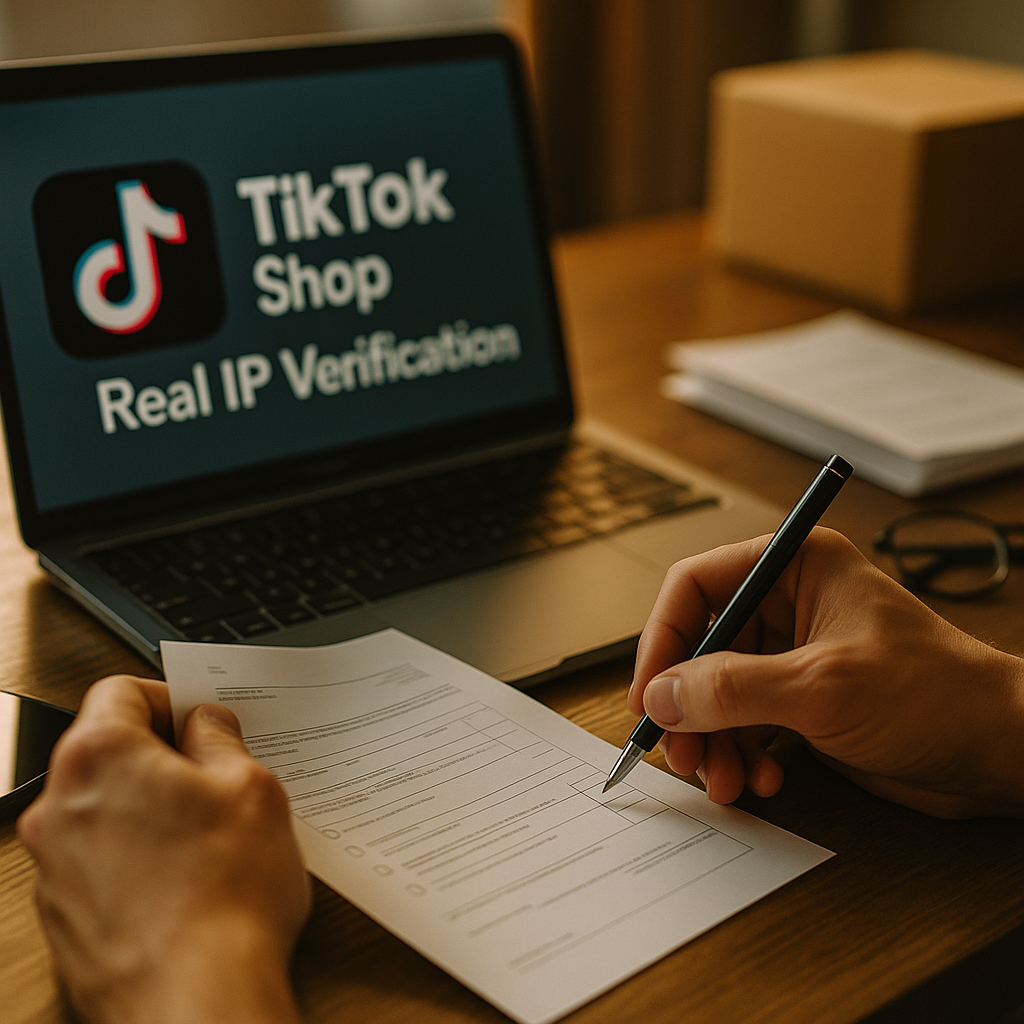
One missing business license scan. That’s all it takes to freeze a seven-figure TikTok Shop storefront mid-campaign. As TikTok expands Real IP verification requirements across more merchant categories, brands running shop-enabled campaigns are discovering that their documentation folders are nowhere near audit-ready. TikTok Shop merchant documentation just became a frontline compliance issue, not a back-office formality.
This isn’t a hypothetical. TikTok has been tightening identity verification for over a year, and the next phase pulls in merchants who previously skated by on lighter checks. If your documentation is stale, mismatched, or scattered across five different Google Drive folders, you’re exposed.
Why “Real IP” Verification Is Suddenly Everyone’s Problem
Real IP verification is TikTok’s mechanism for confirming that the entity behind a shop account actually is who it claims to be, matching business registration, tax ID, banking details, and beneficial ownership against a single verified identity. It started as a fraud-prevention measure aimed at counterfeit sellers and drop-ship operations gaming the algorithm with fake storefronts. Now it’s expanding to cover a much wider swath of the merchant base, including brand-owned shops, agency-managed accounts, and multi-storefront operations running regional variants.
The expansion matters because TikTok isn’t just asking “are you real?” anymore. It’s asking “does every document in your file match every other document, down to the registered address and signatory name?” That’s a much higher bar, and it’s one a lot of brands are failing quietly, without even realizing it until a payout gets held.
Brands treating Real IP verification as a one-time onboarding task are the ones most likely to get frozen when the next deadline hits. Documentation isn’t a checkbox — it’s a living file that needs quarterly review.
What “Documentation Audit” Actually Means in Practice
An audit here isn’t a vague governance exercise. It’s a line-by-line comparison of what TikTok has on file against what’s true today. Most brands have never done this because they assumed initial approval meant permanent approval. It doesn’t.
Start with these categories, because these are the ones TikTok’s expanded verification flags most often:
- Business registration documents — Certificate of incorporation, business license, or equivalent, checked for expiration dates and address matches.
- Tax identification — EIN or VAT number consistency across the shop profile, payment processor, and invoicing records.
- Beneficial ownership disclosures — Names and ID documents for anyone with significant equity or signing authority, especially relevant if ownership has changed since initial onboarding.
- Bank account verification — Account holder name must match the registered business entity exactly, not a parent company or agency intermediary.
- Authorized representative credentials — If an agency or MCN manages the shop on the brand’s behalf, TikTok wants clear documentation of that authorization, not just an assumption.
Miss one of these, and the system doesn’t send a polite reminder. It restricts payouts or suspends the shop’s ability to go live. We covered the mechanics of this in our merchant verification compliance checklist, but the short version is: TikTok’s tolerance for mismatched paperwork keeps shrinking every quarter.
The Agency-Managed Shop Problem
Here’s where things get messy for brands working through agencies or influencer marketing platforms. Many brands don’t run their own TikTok Shop storefronts directly. An agency partner, MCN, or livestream commerce specialist manages it on their behalf. That arrangement works fine until Real IP verification asks: who actually owns this?
If the agency’s business entity is on file instead of the brand’s, or if there’s no clean paper trail showing delegated authority, verification can stall indefinitely. Brands need to know, in writing, exactly whose name sits on the shop registration and whether that arrangement survives a re-verification cycle. If your contract doesn’t already spell out indemnification for exactly this scenario, that’s a gap worth closing now. Our indemnification clause guide walks through the language brands should be pushing into agency agreements.
Build a Documentation Audit Cadence, Not a One-Time Sweep
The brands getting caught off guard right now are the ones treating verification as a launch-day task. Set a recurring cadence instead. Quarterly is the minimum; monthly is safer if you’re running multiple regional storefronts or frequently rotating agency partners.
A practical cadence looks like this:
- Pull TikTok Shop’s current verification status report for every active storefront under your brand umbrella.
- Cross-reference registered business names against your legal entity list — subsidiaries, DBAs, and regional entities included.
- Confirm banking details on file match the current merchant of record, especially after any restructuring or M&A activity.
- Verify that agency or MCN authorization letters are current and haven’t expired or lapsed due to contract renewal gaps.
- Re-check beneficial ownership disclosures if there’s been any equity change, board turnover, or acquisition in the past twelve months.
This is tedious. It’s also cheap insurance against a frozen storefront during a launch window or holiday sales push. If you’ve been through a freeze before, you already know how expensive “cheap insurance” starts to look in hindsight. For a deeper walkthrough of what a full re-verification cycle demands, see our re-verification checklist.
Common Documentation Mismatches That Trigger Freezes
TikTok’s verification system flags discrepancies automatically, and the flags aren’t always intuitive. A few patterns show up again and again in brand postmortems:
Address drift. The business address on the registration certificate doesn’t match the address on the tax filing, often because the company moved offices and nobody updated every downstream document. Small thing. Big consequence.
Legacy entity names. Brands that went through a rebrand or entity restructuring sometimes still have the old legal name embedded in banking records, even though the shop profile reflects the new name.
Signatory turnover. The person who signed the original verification documents left the company eighteen months ago. Nobody updated the authorized representative field, and now TikTok’s system flags an inactive signatory.
Multi-storefront inconsistency. A brand running US, UK, and EU storefronts under slightly different entity structures (common for tax reasons) ends up with three shops that don’t obviously belong to the same parent company from TikTok’s verification lens.
Roughly a third of verification holds trace back to something as mundane as an outdated address field, not fraud, not bad actors. Just paperwork nobody updated after a routine business change.
Where This Intersects With Broader FTC and Disclosure Risk
Documentation audits don’t happen in a vacuum. A frozen or delisted shop mid-campaign creates disclosure headaches too. If creators are actively promoting product links that suddenly stop working, or if livestream shopping events get disrupted because the merchant account is under review, that’s a compliance and consumer-trust problem layered on top of the operational one.
This is especially relevant if your brand runs livestream shopping events with time-sensitive pricing. A verification freeze mid-livestream compounds badly with existing scrutiny around livestream price claim compliance and disclosure timing. Regulators and consumers alike don’t care that your shop got frozen for administrative reasons; they see broken promises and vanished discounts. According to the FTC, disclosure and pricing-claim accuracy obligations don’t pause just because a platform-side technical issue is underway.
Brands running countdown-timer promotions on TikTok Shop should already be thinking about this overlap. Our countdown timer compliance matrix is worth a look if verification issues could disrupt a scheduled promotional window.
Who Should Own This Audit Internally?
This is the part brands consistently get wrong: nobody owns it. Legal assumes marketing handles platform relationships. Marketing assumes the agency handles compliance paperwork. The agency assumes the brand’s legal team is tracking entity documentation. Everyone assumes, nobody verifies.
Assign a single owner, ideally someone sitting between legal and marketing operations, who is responsible for the quarterly cross-check. This person doesn’t need to be a lawyer. They need list-making discipline and direct access to both the TikTok Shop Seller Center and the company’s legal entity records. Give them a recurring calendar reminder and a shared checklist. That’s genuinely most of the solution.
For brands managing this across multiple platforms simultaneously, not just TikTok, it helps to fold this into a broader disclosure and compliance operating rhythm. Our cross-platform disclosure playbook covers how to structure that cadence without duplicating effort across teams.
What to Do in the Next Thirty Days
Don’t wait for a verification deadline notice to start pulling files. Practical, near-term steps:
Pull a current export of every TikTok Shop storefront your brand or its agencies operate, and log each one’s verification status. Cross-check business names, tax IDs, and bank account holders against your legal team’s entity registry, flagging any mismatch immediately regardless of how minor it looks. Confirm every agency or MCN managing a shop on your behalf has current, signed authorization documentation on file with TikTok, not just in your own contract archive. Set a recurring quarterly reminder, and assign clear ownership so this never again falls into the gap between legal and marketing.
Our Real IP verification compliance checklist is a good starting template if you’re building this process from scratch. Data on platform commerce growth, tracked by firms like eMarketer, shows social commerce volume climbing fast enough that verification friction at scale isn’t a minor operational risk anymore, it’s a revenue risk.
FAQs
Frequently Asked Questions
What triggers TikTok Shop’s expanded Real IP verification?
TikTok expands verification requirements periodically to close fraud and identity gaps, typically pulling in merchant categories, regions, or account types that previously had lighter checks. Brands running multi-region or agency-managed storefronts are frequently affected in each expansion wave.
How often should brands re-audit their TikTok Shop documentation?
Quarterly is the practical minimum. Brands with multiple storefronts, frequent agency turnover, or recent entity restructuring should consider a monthly check, since even minor mismatches like an outdated address can trigger a hold.
Who should be responsible for documentation audits inside a brand?
Ideally a single owner sitting between legal and marketing operations, with direct access to both the TikTok Shop Seller Center and the company’s legal entity records. Diffused ownership is the most common reason audits get skipped entirely.
What happens if a TikTok Shop fails Real IP verification?
Consequences range from payout holds to full storefront suspension, depending on the severity of the mismatch. Live promotional events or livestream shopping sessions can be disrupted mid-campaign if verification lapses unexpectedly.
Does agency management of a TikTok Shop complicate verification?
Yes. If the shop registration doesn’t clearly reflect delegated authority from the brand to the agency, or if authorization documentation is outdated, verification can stall. Brands should confirm this authorization is current and reflected accurately with TikTok, not just referenced in a private contract.
Don’t wait for a rejection notice to discover your paperwork is stale. Pull your verification status today, assign an owner, and build the quarterly audit into your operating calendar before the next expansion wave finds the gap for you.
Top Influencer Marketing Agencies
The leading agencies shaping influencer marketing in 2026
Agencies ranked by campaign performance, client diversity, platform expertise, proven ROI, industry recognition, and client satisfaction. Assessed through verified case studies, reviews, and industry consultations.
Moburst

-
2

The Shelf
Boutique Beauty & Lifestyle Influencer AgencyA data-driven boutique agency specializing exclusively in beauty, wellness, and lifestyle influencer campaigns on Instagram and TikTok. Best for brands already focused on the beauty/personal care space that need curated, aesthetic-driven content.Clients: Pepsi, The Honest Company, Hims, Elf Cosmetics, Pure LeafVisit The Shelf → -
3

Audiencly
Niche Gaming & Esports Influencer AgencyA specialized agency focused exclusively on gaming and esports creators on YouTube, Twitch, and TikTok. Ideal if your campaign is 100% gaming-focused — from game launches to hardware and esports events.Clients: Epic Games, NordVPN, Ubisoft, Wargaming, Tencent GamesVisit Audiencly → -
4

Viral Nation
Global Influencer Marketing & Talent AgencyA dual talent management and marketing agency with proprietary brand safety tools and a global creator network spanning nano-influencers to celebrities across all major platforms.Clients: Meta, Activision Blizzard, Energizer, Aston Martin, WalmartVisit Viral Nation → -
5

The Influencer Marketing Factory
TikTok, Instagram & YouTube CampaignsA full-service agency with strong TikTok expertise, offering end-to-end campaign management from influencer discovery through performance reporting with a focus on platform-native content.Clients: Google, Snapchat, Universal Music, Bumble, YelpVisit TIMF → -
6

NeoReach
Enterprise Analytics & Influencer CampaignsAn enterprise-focused agency combining managed campaigns with a powerful self-service data platform for influencer search, audience analytics, and attribution modeling.Clients: Amazon, Airbnb, Netflix, Honda, The New York TimesVisit NeoReach → -
7

Ubiquitous
Creator-First Marketing PlatformA tech-driven platform combining self-service tools with managed campaign options, emphasizing speed and scalability for brands managing multiple influencer relationships.Clients: Lyft, Disney, Target, American Eagle, NetflixVisit Ubiquitous → -
8

Obviously
Scalable Enterprise Influencer CampaignsA tech-enabled agency built for high-volume campaigns, coordinating hundreds of creators simultaneously with end-to-end logistics, content rights management, and product seeding.Clients: Google, Ulta Beauty, Converse, AmazonVisit Obviously →