


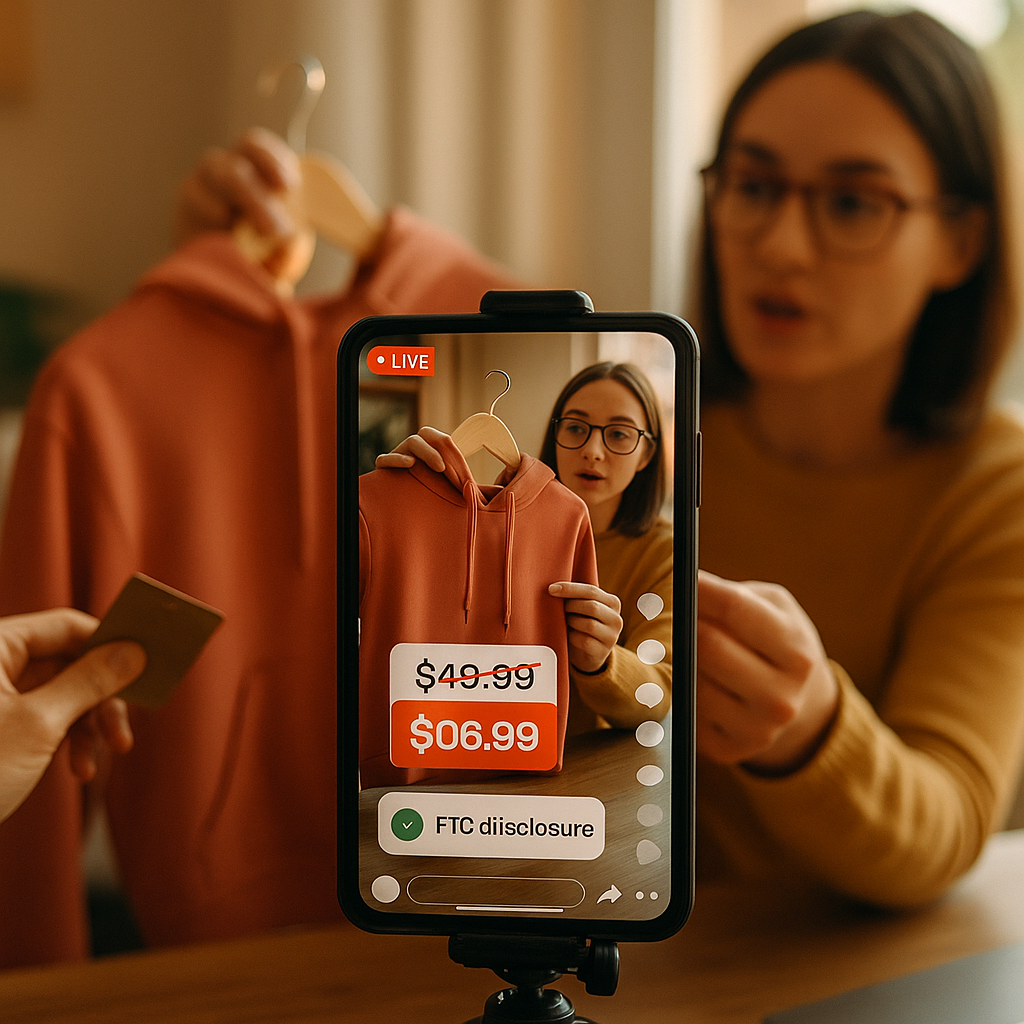
A price that changes three times in ten minutes isn’t just a sales tactic — it’s a disclosure problem. When the FTC’s endorsement guidance was written, nobody was pricing products in real time to a chat window screaming “buy now.” FTC disclosure language for livestream shopping has to work differently than a static caption, because the offer itself is a moving target.
TikTok Shop and Amazon Live have both leaned hard into flash pricing as a conversion driver. Hosts count down, prices drop, carts sell out, timers reset. It’s great theater. It’s also a compliance minefield if your disclosure strategy was built for a world where the price on screen matched the price at checkout for the whole broadcast.
Why Static Disclosures Fail in a Dynamic-Price Environment
Most brands still treat disclosure as a one-and-done event: drop “#ad” in the caption, maybe have the host say “this is sponsored” in the first thirty seconds, and move on. That model assumes the material terms of the offer don’t change after the disclosure runs.
Livestream shopping breaks that assumption completely. A price that drops from $49 to $29 mid-broadcast isn’t a cosmetic detail — it’s a material fact that affects whether a viewer’s purchase decision was made with accurate information. The FTC has been explicit for years that disclosures must be clear, conspicuous, and presented in a way consumers can’t miss. A disclosure buried in a video’s opening seconds, while a new price flashes across the screen twenty minutes later, doesn’t meet that bar anymore.
If the price a viewer sees at minute 22 differs from the price disclosed at minute 1, and your compliance language never refreshed, you’ve effectively created a new, undisclosed offer.
This matters more on TikTok Shop and Amazon Live than almost anywhere else in influencer marketing, because both platforms actively encourage limited-time pricing as an engagement mechanic. The platforms benefit from urgency. Your legal exposure grows with it.
The Regulatory Gap Nobody’s Talking About
Neither TikTok Shop nor Amazon Live has built native tooling that re-triggers a disclosure banner every time a price updates. That’s on the brand and the creator to manage manually, and most scripts simply weren’t written with that requirement in mind. Compare this to the countdown timer scrutiny already hitting TikTok Shop scarcity claims — state regulators are already skeptical of manufactured urgency, and a shifting price adds a second layer of risk on top of it.
State attorneys general have historically gone after pricing claims harder than endorsement claims, because pricing touches deceptive trade practice statutes in nearly every state, not just FTC rules. Stack that with an undisclosed material change, and you’ve got two regulators potentially interested in the same thirty-second clip.
What “Clear and Conspicuous” Means When the Offer Keeps Moving
The FTC doesn’t require a specific font size or exact wording. It requires that a reasonable consumer, viewing the content the way it’s normally consumed, would notice and understand the disclosure. Apply that standard to a livestream where pricing changes, and you get a few concrete obligations:
- Disclosure must repeat near every material price change, not just once at the start.
- Verbal and on-screen disclosure should both refresh together — audio alone isn’t enough if viewers are watching muted, which social platform behavior data suggests is a large share of mobile viewers.
- The relationship disclosure (“paid partnership,” “#ad”) and the pricing disclosure (“price valid only during this segment,” “price shown is time-limited”) need to be treated as two separate obligations, not folded into one caption line.
Brands that get this wrong tend to make the same mistake: they disclose the paid relationship once, correctly, and assume that covers everything else happening in the stream. It doesn’t. A paid partnership disclosure tells viewers “this host is compensated.” It says nothing about whether the price they’re seeing right now is accurate, temporary, or already expired by the time they click the shop tab.
Building a Disclosure Script That Survives a Price Drop
Here’s the operational fix. Treat every livestream shopping event as a series of discrete “offer states” rather than one continuous broadcast. Each time the price changes, you have a new offer state, and each offer state needs its own disclosure moment.
In practice, that means scripting disclosure checkpoints tied to pricing cues, not just tied to the top of the show. A workable structure looks like this:
- Opening disclosure: Paid partnership and sponsorship status, verbal and on-screen, within the first 15 seconds.
- Pre-drop disclosure: Immediately before any announced price change, state the current price and that it’s time-limited.
- Post-drop confirmation: After the price changes, restate the new price on screen for at least 5-10 seconds, paired with a verbal callout from the host.
- Close-out disclosure: At the end of the segment, confirm which price applied to which time window, especially if VOD replay is enabled.
That fourth point trips up more brands than any other. TikTok Shop and Amazon Live both allow replay viewing after the live event ends. If a VOD viewer sees a $29 price flash during the original stream but the live cart now shows $49, and there’s no disclosure explaining the discrepancy, that’s a deceptive pricing claim sitting on your brand’s shop page indefinitely. This is the same durability problem covered in our livestream price claim audit framework — a disclosure that was accurate live can become misleading the moment the clip outlives the offer.
Who Owns the Script: Brand, Creator, or Platform?
None of the three parties wants to own this alone, and that’s exactly why it falls through. Platforms build the pricing tools but disclaim responsibility for how they’re disclosed. Creators run the show live and often improvise pricing announcements without a compliance review. Brands set the promotional strategy but rarely sit in on the actual broadcast.
The fix is contractual, not aspirational. Your creator agreement needs a specific clause requiring the host to follow a pre-approved pricing disclosure script, with defined checkpoints tied to promotional beats. This is the same logic laid out in our influencer contract checklist for disclosure timing — livestream shopping just compresses the timeline from “review before posting” to “review before going live,” which means your legal and brand teams need to be in the pre-production call, not just the post-mortem.
A disclosure script that lives only in a brand deck and never reaches the live production run sheet isn’t a compliance control. It’s a liability waiver you wrote for yourself and forgot to file.
TikTok Shop vs. Amazon Live: Different Mechanics, Same Obligation
TikTok Shop’s pricing tools (flash sales, coupon stacking, live-exclusive discounts) tend to change price via host-triggered promotions during the broadcast, often paired with on-screen coupon banners that TikTok itself generates. That native banner is useful, but it’s not a substitute for your own disclosure — it tells viewers a discount exists, not that the discount is time-boxed to this specific broadcast or that the host is compensated.
Amazon Live works a bit differently. Pricing there is more frequently tied to Lightning Deals or existing Amazon promotions that the host references rather than triggers directly. That actually raises a distinct risk: hosts sometimes describe a price as exclusive to the stream when it’s really a sitewide deal running independently. That’s not just a disclosure gap, it edges into a false scarcity or false exclusivity claim, which regulators treat as a pricing violation separate from endorsement rules.
Either way, the brand’s obligation doesn’t change based on which platform’s pricing engine is doing the work. If you’re running livestream campaigns across both, your cross-platform disclosure approach needs a shared baseline standard, with platform-specific adjustments layered on top, not two completely separate compliance frameworks built by two different teams.
Documentation: Your Best Defense If Something Goes Wrong
Assume, for planning purposes, that a regulator or plaintiff’s attorney will eventually pull a recording of one of your livestream events. What do you want them to find?
At minimum, keep a record of the approved disclosure script, the run sheet showing when price changes were scheduled, a timestamped recording of the actual broadcast, and confirmation that the creator followed the approved language. If the creator deviated from script during a live event (and they will, eventually), you want a paper trail showing what was approved versus what happened, because that distinction matters enormously in an FTC inquiry.
This is also where livestream price claim audits earn their keep. Running a quarterly audit against your archived livestream recordings, checking disclosure timing against actual price change timestamps, catches drift before a regulator does. Most brands only build this habit after a near-miss. Build it before one.
Per eMarketer’s live commerce forecasts, U.S. livestream shopping continues to grow at a pace outstripping most other retail media formats — which means the volume of these broadcasts, and the surface area for disclosure errors, is only expanding. Treating this as a niche edge case rather than a core compliance workflow is a bet against your own growth numbers.
Next Step
Build a standing pricing-disclosure checkpoint into every livestream run sheet, require creator sign-off on the script before broadcast, and audit VOD replays monthly to confirm expired prices don’t linger without context. Treat every price change as a new disclosure event, and you’ll be ahead of nearly every competitor still running static #ad captions.
FAQs
Does the FTC require a new disclosure every time a livestream price changes?
The FTC doesn’t specify an exact frequency, but its clear-and-conspicuous standard means any material change to the offer, including price, should be disclosed at the time it happens. A single opening disclosure typically won’t cover a price that changes multiple times during a broadcast.
Is TikTok’s automatic coupon banner enough to satisfy disclosure requirements?
No. Platform-generated pricing banners communicate that a discount exists but don’t disclose the paid relationship between the brand and host, nor do they clarify whether the price is exclusive to that broadcast. Brands still need their own disclosure language layered on top.
What happens if a VOD replay shows an expired livestream price?
If the replay displays a price that’s no longer valid without any disclosure explaining the discrepancy, it can constitute a deceptive pricing claim, separate from any endorsement disclosure issue. Brands should add end-of-segment disclosures clarifying which price applied to which time window.
Who is legally responsible if a creator skips the disclosure script during a live shopping event?
The FTC generally holds brands responsible for ensuring proper disclosure, even when a creator fails to follow instructions. Contracts should require adherence to a pre-approved script, with documentation showing what was approved, to help demonstrate reasonable oversight.
How is livestream price disclosure different from standard sponsored content disclosure?
Standard sponsored content disclosure addresses the paid relationship between brand and creator. Livestream price disclosure addresses the accuracy and timing of the offer itself. Both are required, and neither substitutes for the other.
FAQs
Does the FTC require a new disclosure every time a livestream price changes?
The FTC doesn’t specify an exact frequency, but its clear-and-conspicuous standard means any material change to the offer, including price, should be disclosed at the time it happens. A single opening disclosure typically won’t cover a price that changes multiple times during a broadcast.
Is TikTok’s automatic coupon banner enough to satisfy disclosure requirements?
No. Platform-generated pricing banners communicate that a discount exists but don’t disclose the paid relationship between the brand and host, nor do they clarify whether the price is exclusive to that broadcast. Brands still need their own disclosure language layered on top.
What happens if a VOD replay shows an expired livestream price?
If the replay displays a price that’s no longer valid without any disclosure explaining the discrepancy, it can constitute a deceptive pricing claim, separate from any endorsement disclosure issue. Brands should add end-of-segment disclosures clarifying which price applied to which time window.
Who is legally responsible if a creator skips the disclosure script during a live shopping event?
The FTC generally holds brands responsible for ensuring proper disclosure, even when a creator fails to follow instructions. Contracts should require adherence to a pre-approved script, with documentation showing what was approved, to help demonstrate reasonable oversight.
How is livestream price disclosure different from standard sponsored content disclosure?
Standard sponsored content disclosure addresses the paid relationship between brand and creator. Livestream price disclosure addresses the accuracy and timing of the offer itself. Both are required, and neither substitutes for the other.
Top Influencer Marketing Agencies
The leading agencies shaping influencer marketing in 2026
Agencies ranked by campaign performance, client diversity, platform expertise, proven ROI, industry recognition, and client satisfaction. Assessed through verified case studies, reviews, and industry consultations.
Moburst

-
2

The Shelf
Boutique Beauty & Lifestyle Influencer AgencyA data-driven boutique agency specializing exclusively in beauty, wellness, and lifestyle influencer campaigns on Instagram and TikTok. Best for brands already focused on the beauty/personal care space that need curated, aesthetic-driven content.Clients: Pepsi, The Honest Company, Hims, Elf Cosmetics, Pure LeafVisit The Shelf → -
3

Audiencly
Niche Gaming & Esports Influencer AgencyA specialized agency focused exclusively on gaming and esports creators on YouTube, Twitch, and TikTok. Ideal if your campaign is 100% gaming-focused — from game launches to hardware and esports events.Clients: Epic Games, NordVPN, Ubisoft, Wargaming, Tencent GamesVisit Audiencly → -
4

Viral Nation
Global Influencer Marketing & Talent AgencyA dual talent management and marketing agency with proprietary brand safety tools and a global creator network spanning nano-influencers to celebrities across all major platforms.Clients: Meta, Activision Blizzard, Energizer, Aston Martin, WalmartVisit Viral Nation → -
5

The Influencer Marketing Factory
TikTok, Instagram & YouTube CampaignsA full-service agency with strong TikTok expertise, offering end-to-end campaign management from influencer discovery through performance reporting with a focus on platform-native content.Clients: Google, Snapchat, Universal Music, Bumble, YelpVisit TIMF → -
6

NeoReach
Enterprise Analytics & Influencer CampaignsAn enterprise-focused agency combining managed campaigns with a powerful self-service data platform for influencer search, audience analytics, and attribution modeling.Clients: Amazon, Airbnb, Netflix, Honda, The New York TimesVisit NeoReach → -
7

Ubiquitous
Creator-First Marketing PlatformA tech-driven platform combining self-service tools with managed campaign options, emphasizing speed and scalability for brands managing multiple influencer relationships.Clients: Lyft, Disney, Target, American Eagle, NetflixVisit Ubiquitous → -
8

Obviously
Scalable Enterprise Influencer CampaignsA tech-enabled agency built for high-volume campaigns, coordinating hundreds of creators simultaneously with end-to-end logistics, content rights management, and product seeding.Clients: Google, Ulta Beauty, Converse, AmazonVisit Obviously →