


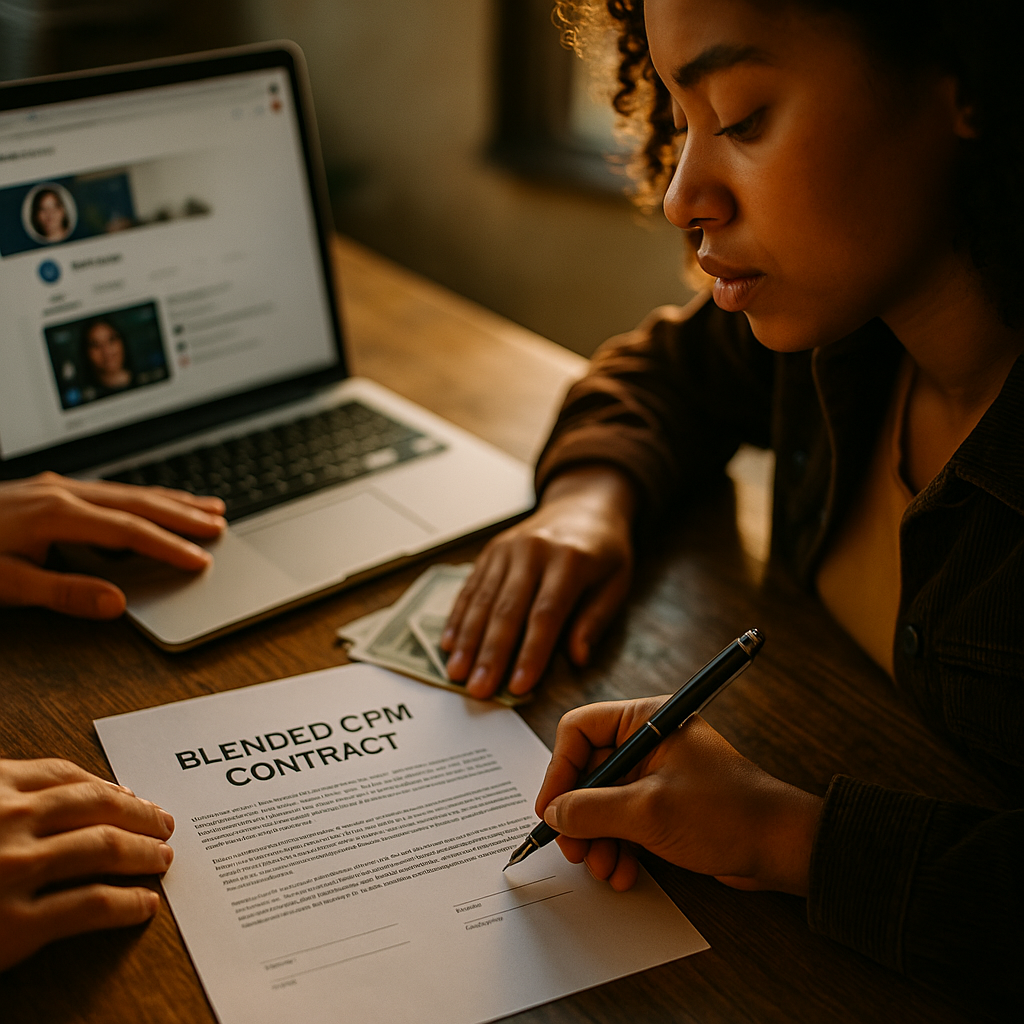
A federal court doesn’t care that you called it a “flat creative fee.” If a blended CPM contract functions like an hourly wage with minimum guarantees, mandatory hours, and brand control over how work gets done, a judge can reclassify your creator as an employee. Back pay, overtime, and penalties follow. Suddenly your influencer program looks like a payroll audit nightmare.
Blended CPM contracts have become the default structure for always-on creator programs, and for good reason. They let brands pay for performance while giving creators predictable income. But the structure itself is now under scrutiny from plaintiffs’ attorneys who’ve figured out that “performance-based” pay models can still smell like wages if the paperwork and practice don’t match.
What a Blended CPM Contract Actually Is
A blended CPM contract pays creators a single cost-per-thousand-impressions rate that averages across multiple platforms, content formats, or placement tiers. Instead of negotiating separate rates for a TikTok video, an Instagram Reel, and a YouTube Short, the brand and creator agree on one blended number, say $18 CPM, that applies regardless of where the content lands or how it performs individually.
Agencies like blended CPM because it simplifies budgeting across a roster of fifty or a hundred creators. Creators like it because it smooths out the variance between a video that flops and one that goes viral. Everybody wins, in theory.
The trouble starts when brands layer in features that look less like a licensing or performance deal and more like employment. Minimum monthly payouts regardless of impressions delivered. Mandatory posting schedules tied to specific hours. Required use of brand-provided equipment or software. Exclusive, open-ended commitments that prevent the creator from working with anyone else. Stack enough of these together and the blended CPM contract starts resembling a disguised hourly wage arrangement, which is exactly what wage and hour statutes were built to catch.
The IRS and Department of Labor use overlapping but distinct tests for worker classification, and a contract that passes one can still fail the other. Brands structuring blended CPM deals need to satisfy both, not just the one their lawyer mentioned first.
Why Wage and Hour Law Even Applies to Creators
Most marketers assume creators are obviously independent contractors. They own their equipment, set their own schedule, work with multiple brands, and operate under their own LLC. All true for the majority of the creator economy. But the Fair Labor Standards Act and state equivalents (California’s ABC test under AB5 being the strictest example) don’t care what the contract calls the relationship. They care about control.
If a brand dictates when a creator films, how many takes they shoot, what software they use, and penalizes them for working with competitors, that’s control. Add a guaranteed minimum payment that isn’t tied to actual deliverables and you’ve built a de facto salary. Multiple state labor agencies have opened investigations into agencies that treat full-time “ambassador” creators like employees while paying them through 1099s.
This isn’t theoretical. The National Labor Relations Board and state labor departments have both signaled increased interest in gig economy misclassification, and influencer marketing sits squarely in that crosshairs because the dollar volumes have gotten large enough to matter. According to eMarketer, influencer marketing spend in the US has climbed past $9 billion annually, and blended CPM deals now account for a growing share of always-on retainer relationships, the exact kind of long-term, high-control arrangement that invites scrutiny.
The Four Contract Elements That Create Risk
Not every blended CPM clause is dangerous. But four show up repeatedly in misclassification complaints, and brands should audit their standard creator agreement template against each one.
- Guaranteed minimums decoupled from output. Paying a floor amount regardless of whether the creator posts anything functions like a salary, not a performance fee. If you guarantee pay, tie it explicitly to a defined minimum number of deliverables, not to time elapsed.
- Mandated working hours or availability windows. Requiring a creator to be “on call” for brand requests during specific business hours is a classic employment marker. Blended CPM deals should specify deliverable deadlines, not clock-in windows.
- Exclusivity without proportional compensation. Locking a creator out of competing brands for an extended term, especially unpaid or underpaid exclusivity, pushes the relationship toward dependency, a factor courts weigh heavily.
- Brand-provided tools, training, and direct supervision. If the brand supplies cameras, editing software, scripts, and a managing producer who directs every shot, the creator looks more like a contracted employee than an independent business.
Strip these out, or at least soften them, and most blended CPM contracts fall back into safely independent contractor territory.
Structuring the Deal to Stay on the Right Side of the Line
The fix isn’t abandoning blended CPM. It’s building contracts that preserve the financial predictability brands want without recreating an employment relationship. A few structural moves do most of the heavy lifting.
Tie all payment strictly to measurable output, impressions delivered, posts completed, or verified engagement, never to time worked. If you want to offer income stability, use a minimum guaranteed deliverable count rather than a minimum guaranteed paycheck. “We’ll pay for at least four posts per month at the blended rate” is defensible. “We’ll pay you $4,000 per month regardless of output” is not.
Give creators genuine autonomy over execution. Specify the deliverable (a 60-second product demo, say) and the brand guidelines, but let the creator choose their own filming schedule, equipment, and editing approach. Document this autonomy in the contract language itself, not just in practice, because written terms are what a court or labor board reviews first.
Limit exclusivity terms and compensate them properly. If you need category exclusivity, pay a specific, separate exclusivity fee rather than burying it inside the blended CPM rate. This creates a paper trail showing the payment structure maps to a real, bargained-for restriction rather than general control over the creator’s time.
Brands that separate “pay for content” from “pay for exclusivity” and “pay for guaranteed minimums” into distinct, clearly labeled contract line items build a much stronger defense than those who bundle everything into one blended number and hope nobody asks questions.
Finally, avoid providing brand equipment, brand-mandated software subscriptions, or direct day-to-day supervision unless the campaign genuinely requires it (think: proprietary AR filters or branded hardware for an unboxing). When you must provide tools, document the business reason and keep the arrangement narrow and campaign-specific rather than ongoing.
Agencies Carry Their Own Exposure Here
Brands aren’t the only ones on the hook. Agencies that manage rosters of creators and administer blended CPM payouts can face vicarious liability if a creator is misclassified under their management structure, even when the brand is the one setting campaign terms. This is especially relevant for agencies running influencer-of-record programs where the agency, not the brand, signs the contract and cuts the check. Our deep dive on agency vicarious liability breaks down how responsibility gets allocated between brand and agency when disclosure or classification problems surface.
Agencies should also build audit trails into their creator management systems, timestamps, deliverable logs, and payment records that demonstrate the output-based nature of the relationship. This documentation matters just as much for audit readiness as it does for domestic wage and hour defense, especially as more jurisdictions formalize record-keeping requirements for creator payments.
International Complications
Blended CPM contracts get messier once creators cross borders. A US brand running a blended CPM program with creators in the UK, Canada, and Australia needs to account for each country’s own worker classification tests, which don’t mirror the American ABC test or FLSA standards. The UK’s IR35 rules, for instance, scrutinize control and substitution rights in ways that overlap with but aren’t identical to US wage and hour analysis.
Brands running international NIL-style deals or cross-border creator programs should treat classification as a country-by-country exercise, not a single global template. Our coverage of international NIL deals and foreign creator payments walks through how tax and visa compliance intersect with contract structure, which is a useful companion read for any program scaling past domestic creators.
What Insurance and Legal Review Should Catch
Standard media liability or E&O policies rarely cover wage and hour claims, which fall under employment practices liability instead. Brands relying on creator marketing insurance for disclosure and content risk should confirm, in writing, whether misclassification exposure is excluded. Many policies explicitly carve it out, leaving the brand fully exposed if a court reclassifies a batch of creators.
Legal review of blended CPM templates should happen at least annually, not just at signing. Labor department guidance shifts, state laws change, and a contract that was defensible two years ago may now contain clauses regulators actively flag. Treat your creator contract template the way you’d treat an employee handbook: a living document, not a one-time deliverable.
A Quick Internal Audit Checklist
- Does payment scale strictly with delivered output, with no unconditional minimum?
- Does the contract avoid specifying working hours or availability windows?
- Is exclusivity, if present, compensated as a distinct, separate fee?
- Does the creator supply their own equipment and editing tools in most cases?
- Is brand supervision limited to approval of final deliverables rather than process control?
- Does your insurance policy explicitly address or exclude misclassification claims?
If you can’t check most of these boxes, your blended CPM program has more exposure than your budget spreadsheet suggests. Resources like HubSpot’s contract management guidance and the FTC’s endorsement guidance (adjacent but relevant to how creator relationships get documented) are worth cross-referencing when you rebuild templates.
Frequently Asked Questions
Visible FAQ Section
What makes a blended CPM contract risky from a wage and hour perspective?
Risk increases when the contract includes guaranteed minimum payments unrelated to output, mandatory working hours, brand-supplied equipment, or heavy supervision over how content gets made. These elements resemble employment control rather than independent contractor status.
Can brands still offer income guarantees to creators under a blended CPM structure?
Yes, but guarantees should be tied to a minimum number of deliverables rather than a flat payment regardless of output. A guarantee of four posts per month at the blended rate is defensible, a flat monthly salary regardless of activity is not.
Does the ABC test apply to all creator contracts?
It applies in states like California that have adopted it, generally through legislation like AB5. Other states and federal law use different multi-factor tests, so brands with creators across multiple states need to check each jurisdiction’s standard rather than assuming one test covers everyone.
Who is liable if a creator is misclassified, the brand or the agency?
It depends on who controls the day-to-day relationship and who signs the contract. Agencies managing creator rosters can carry vicarious liability even when the brand sets campaign terms, which is why contract language needs to clearly define each party’s role.
Does creator marketing insurance cover misclassification claims?
Usually not. Standard media liability or errors and omissions policies typically exclude employment-related claims, which fall under employment practices liability coverage instead. Brands should confirm this explicitly with their broker.
How often should a blended CPM contract template be reviewed?
At least annually, and sooner if state labor laws change or a brand expands into new jurisdictions. Treat the template as a living document rather than something finalized once and forgotten.
Pull your current blended CPM template this week and run it against the four risk factors above. If a guaranteed minimum, mandatory hours, exclusivity, or brand-supplied tools show up without separate compensation or clear documentation, fix the language before your next renewal cycle, not after a claim lands.
Top Influencer Marketing Agencies
The leading agencies shaping influencer marketing in 2026
Agencies ranked by campaign performance, client diversity, platform expertise, proven ROI, industry recognition, and client satisfaction. Assessed through verified case studies, reviews, and industry consultations.
Moburst

-
2

The Shelf
Boutique Beauty & Lifestyle Influencer AgencyA data-driven boutique agency specializing exclusively in beauty, wellness, and lifestyle influencer campaigns on Instagram and TikTok. Best for brands already focused on the beauty/personal care space that need curated, aesthetic-driven content.Clients: Pepsi, The Honest Company, Hims, Elf Cosmetics, Pure LeafVisit The Shelf → -
3

Audiencly
Niche Gaming & Esports Influencer AgencyA specialized agency focused exclusively on gaming and esports creators on YouTube, Twitch, and TikTok. Ideal if your campaign is 100% gaming-focused — from game launches to hardware and esports events.Clients: Epic Games, NordVPN, Ubisoft, Wargaming, Tencent GamesVisit Audiencly → -
4

Viral Nation
Global Influencer Marketing & Talent AgencyA dual talent management and marketing agency with proprietary brand safety tools and a global creator network spanning nano-influencers to celebrities across all major platforms.Clients: Meta, Activision Blizzard, Energizer, Aston Martin, WalmartVisit Viral Nation → -
5

The Influencer Marketing Factory
TikTok, Instagram & YouTube CampaignsA full-service agency with strong TikTok expertise, offering end-to-end campaign management from influencer discovery through performance reporting with a focus on platform-native content.Clients: Google, Snapchat, Universal Music, Bumble, YelpVisit TIMF → -
6

NeoReach
Enterprise Analytics & Influencer CampaignsAn enterprise-focused agency combining managed campaigns with a powerful self-service data platform for influencer search, audience analytics, and attribution modeling.Clients: Amazon, Airbnb, Netflix, Honda, The New York TimesVisit NeoReach → -
7

Ubiquitous
Creator-First Marketing PlatformA tech-driven platform combining self-service tools with managed campaign options, emphasizing speed and scalability for brands managing multiple influencer relationships.Clients: Lyft, Disney, Target, American Eagle, NetflixVisit Ubiquitous → -
8

Obviously
Scalable Enterprise Influencer CampaignsA tech-enabled agency built for high-volume campaigns, coordinating hundreds of creators simultaneously with end-to-end logistics, content rights management, and product seeding.Clients: Google, Ulta Beauty, Converse, AmazonVisit Obviously →