


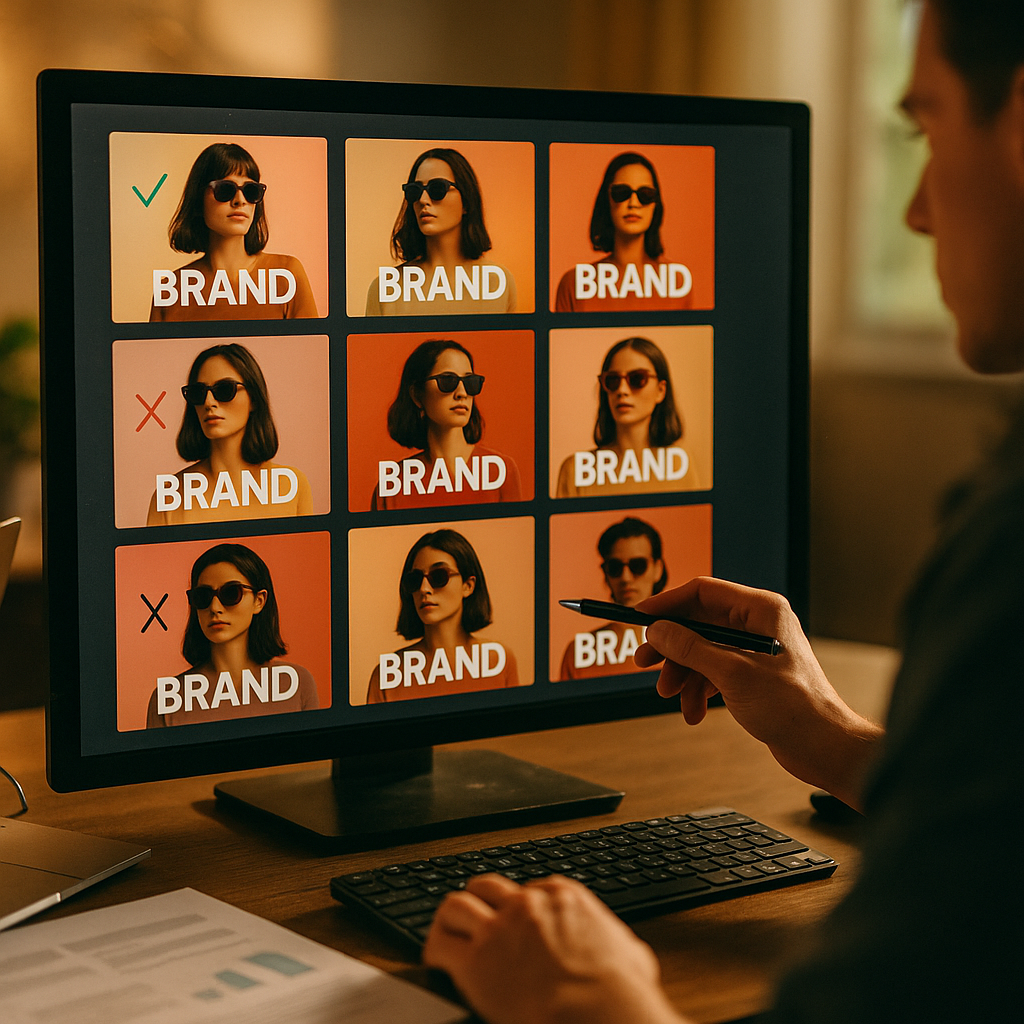
One creator shoot. Forty-two ad variants. Zero reshoots. That’s not a pitch deck fantasy anymore — it’s the workflow inside brands using an AI content-variation engine to stretch a single day of production across an entire quarter’s media plan. The question keeping legal and brand teams up at night: are all forty-two actually compliant?
Influencer content used to have a shelf life measured in weeks. Now performance teams are treating every shoot as raw material for dozens of downstream cuts — different hooks, different CTAs, different regulatory disclosures for different markets. The economics are obvious. The risk math is not. Here’s what brands evaluating these platforms actually need to check before signing a contract.
Why This Category Exploded
Creator production costs haven’t dropped. Talent day rates, usage fees, and licensing terms have all crept upward over the past two years, according to industry benchmarking from Sprout Social. Meanwhile, paid social demands more creative volume than ever — Meta’s own guidance has long pushed advertisers toward dozens of ad variations per campaign to feed algorithmic delivery. Brands were stuck between rising input costs and rising output demands.
AI content-variation engines solved the math. Feed the system one licensed creator video, and it generates language variants, aspect-ratio recuts, platform-specific edits, and offer-swapped versions — all without calling the talent back for a reshoot.
The category sits adjacent to tools covered in our look at avatar-led product video production, but the use case is distinct. Variation engines don’t synthesize a new presenter. They remix real creator footage into compliant, on-brand derivatives — swapping captions, reframing shots, localizing claims, and adjusting disclosures per region.
The real value isn’t the volume of cuts. It’s the ability to produce compliant volume without routing every single edit through legal review.
What These Engines Actually Do
Strip away the marketing language and most platforms in this space perform four core functions:
- Segmentation and re-cutting: breaking a single long-form creator video into shorter hooks, mid-rolls, and CTAs that can be reassembled in different sequences.
- Dynamic text and voice overlay: swapping on-screen captions, lower thirds, and sometimes AI-dubbed voiceover to localize or A/B test messaging.
- Aspect ratio and platform formatting: auto-converting a single shoot into 9:16, 1:1, and 16:9 cuts sized for TikTok, Reels, YouTube Shorts, and connected TV.
- Compliance-layer injection: automatically inserting required disclosures (#ad, FTC-mandated language, region-specific disclaimers) based on where the asset will run.
That last function is the one brands underestimate. It’s also where most of the actual risk lives.
The Compliance Layer Is the Whole Ballgame
Here’s the uncomfortable truth: generating forty-two creative cuts is trivial. Generating forty-two cuts that all carry the correct disclosure language, comply with the original creator contract’s usage terms, and don’t drift into an unapproved health or financial claim — that’s the hard part.
The FTC’s endorsement guidelines don’t care that an edit was machine-generated. If a variant strips out a required disclosure during an automated recut, the brand is still on the hook. Same logic applies internationally — the UK’s ICO and equivalent bodies in the EU treat automated content the same as manually produced content for advertising standards purposes.
We’ve written before about how hallucination risk in creator briefs creates downstream liability. Variation engines introduce a similar but distinct risk: not fabricated claims, but dropped or mismatched compliance elements during automated remixing. A caption swap that removes “sponsored” text. A voice-dub localization that translates a product claim into language that’s no longer regulator-approved in that market. These aren’t hypotheticals — they’re the exact failure modes vendors in this space are racing to solve.
Evaluating Vendors: The Questions That Actually Matter
Most vendor demos look impressive. They show you a slick before-and-after: one shoot in, twenty polished cuts out. That’s the easy 80%. Here’s what to interrogate before you sign anything.
Does the engine understand usage rights, or just pixels?
Ask directly: does the platform ingest and enforce the underlying creator contract’s usage terms, or does it treat every uploaded clip as unrestricted raw material? Some engines will happily generate a paid-media cut from footage that was only licensed for organic use. That’s a contract breach the AI doesn’t know it’s committing — and one your legal team will be cleaning up months later.
Can it localize disclosures automatically, and can you audit that it did?
Look for a system that maps output market to required disclosure language, not a static template. Better platforms maintain a rules engine tied to jurisdiction, and — critically — log which disclosure version was applied to which asset. If a vendor can’t produce that audit trail on demand, treat it as a dealbreaker, not a minor gap.
What happens when the source claim itself is regulated?
Beauty, supplements, financial services, and health brands face an added layer: even a well-disclosed ad can violate substantiation requirements if a variant subtly rewords a claim. Some vendors now integrate claim-checking similar to what’s emerging in RAG-based content accuracy tools, cross-referencing generated captions against an approved claims library before publishing. If your category is regulated, this isn’t optional — it’s table stakes.
How does the tool handle brand safety at scale?
Generating forty variants means forty chances for something to look off-brand: a caption font that clashes, a CTA that references a promotion that’s already expired, a cut that inadvertently frames a competitor’s product in-shot. The same brand-safety logic used in shoppable short-form video filtering is now being bolted onto variation engines as a pre-publish gate. Ask vendors whether that gate exists, and whether it blocks publishing or just flags for review.
Every additional variant is another surface area for a compliance miss. Scale without a governance layer isn’t efficiency — it’s distributed risk.
What This Costs, and What It Saves
Pricing in this category is fragmented. Some platforms charge per source asset ingested, others per output variant generated, and a growing number use token-based consumption models tied to processing time — a pricing structure that behaves a lot like what we’ve flagged in token-based AI pricing for marketing tools. Budget holders should model worst-case output volume, not the demo scenario, before committing to a contract tier.
The savings case is still strong even with disciplined pricing. A brand running a single creator shoot into 30-40 compliant cuts, versus commissioning that same volume from separate production runs, is routinely cutting content costs by well over half — a figure consistent with broader creative-efficiency trends tracked by eMarketer on rising creative-testing volume in paid social. But the math only holds if compliance failures don’t erase the savings through remediation costs, wasted ad spend, or regulatory exposure.
Governance Isn’t a Bolt-On, It’s the Product
Brands that get this right treat the variation engine as a governed system, not a creative toy. That means:
- A pre-approved claims and disclosure library the engine references before generating any variant.
- Human review checkpoints for high-risk categories (health, finance, kids’ products) even when the platform auto-approves.
- An asset provenance record tying every generated cut back to its source shoot and license terms — similar in spirit to the tracking approaches outlined in our piece on AI model registries for asset provenance.
- Scheduled audits comparing a sample of live variants against the original creator agreement.
None of this is glamorous. All of it is what separates a brand quietly scaling creative output from one drafting a statement after a regulator inquiry.
Where This Is Headed
Expect consolidation. The vendors treating compliance as a feature bolt-on will get squeezed by platforms building it in as core infrastructure — much the same pattern we’ve seen play out in adjacent categories like AI fraud detection for influencer audiences, where governance capability became the actual differentiator once the novelty wore off. Brand and legal teams evaluating this space in the next procurement cycle should weight compliance architecture as heavily as output quality, if not more.
Next step: before your next creator shoot, ask your production or agency partner one question — can this footage be legally and safely repurposed into thirty variants without a human reviewing every disclosure? If nobody has a confident answer, that’s your starting point.
FAQs
What is an AI content-variation engine?
It’s a platform that takes a single piece of licensed creator or brand video and automatically generates multiple edited versions — different lengths, aspect ratios, captions, languages, or CTAs — for use across paid and organic channels.
Are AI-generated content variants covered by the original creator contract?
Only if the contract’s usage terms explicitly permit derivative or AI-assisted edits. Brands should confirm licensing scope before generating paid-media variants from organic-use footage, since this is one of the most common compliance gaps.
Do disclosure requirements still apply to automatically generated ad cuts?
Yes. Regulators including the FTC treat automated variants the same as manually produced ads. If a variation engine strips or alters a required disclosure during editing, the brand remains liable.
How much can brands realistically save using these tools?
Savings vary by category and volume, but many brands report cutting content production costs by more than half when replacing multiple separate shoots with one shoot repurposed into dozens of compliant cuts.
What’s the biggest risk when scaling creative with these engines?
Compliance drift: a variant that loses a required disclosure, subtly misstates a regulated claim, or violates the original creator’s usage terms. Volume without a governance layer multiplies risk faster than it multiplies output.
FAQs
What is an AI content-variation engine?
It’s a platform that takes a single piece of licensed creator or brand video and automatically generates multiple edited versions — different lengths, aspect ratios, captions, languages, or CTAs — for use across paid and organic channels.
Are AI-generated content variants covered by the original creator contract?
Only if the contract’s usage terms explicitly permit derivative or AI-assisted edits. Brands should confirm licensing scope before generating paid-media variants from organic-use footage, since this is one of the most common compliance gaps.
Do disclosure requirements still apply to automatically generated ad cuts?
Yes. Regulators including the FTC treat automated variants the same as manually produced ads. If a variation engine strips or alters a required disclosure during editing, the brand remains liable.
How much can brands realistically save using these tools?
Savings vary by category and volume, but many brands report cutting content production costs by more than half when replacing multiple separate shoots with one shoot repurposed into dozens of compliant cuts.
What’s the biggest risk when scaling creative with these engines?
Compliance drift: a variant that loses a required disclosure, subtly misstates a regulated claim, or violates the original creator’s usage terms. Volume without a governance layer multiplies risk faster than it multiplies output.
Top Influencer Marketing Agencies
The leading agencies shaping influencer marketing in 2026
Agencies ranked by campaign performance, client diversity, platform expertise, proven ROI, industry recognition, and client satisfaction. Assessed through verified case studies, reviews, and industry consultations.
Moburst

-
2

The Shelf
Boutique Beauty & Lifestyle Influencer AgencyA data-driven boutique agency specializing exclusively in beauty, wellness, and lifestyle influencer campaigns on Instagram and TikTok. Best for brands already focused on the beauty/personal care space that need curated, aesthetic-driven content.Clients: Pepsi, The Honest Company, Hims, Elf Cosmetics, Pure LeafVisit The Shelf → -
3

Audiencly
Niche Gaming & Esports Influencer AgencyA specialized agency focused exclusively on gaming and esports creators on YouTube, Twitch, and TikTok. Ideal if your campaign is 100% gaming-focused — from game launches to hardware and esports events.Clients: Epic Games, NordVPN, Ubisoft, Wargaming, Tencent GamesVisit Audiencly → -
4

Viral Nation
Global Influencer Marketing & Talent AgencyA dual talent management and marketing agency with proprietary brand safety tools and a global creator network spanning nano-influencers to celebrities across all major platforms.Clients: Meta, Activision Blizzard, Energizer, Aston Martin, WalmartVisit Viral Nation → -
5

The Influencer Marketing Factory
TikTok, Instagram & YouTube CampaignsA full-service agency with strong TikTok expertise, offering end-to-end campaign management from influencer discovery through performance reporting with a focus on platform-native content.Clients: Google, Snapchat, Universal Music, Bumble, YelpVisit TIMF → -
6

NeoReach
Enterprise Analytics & Influencer CampaignsAn enterprise-focused agency combining managed campaigns with a powerful self-service data platform for influencer search, audience analytics, and attribution modeling.Clients: Amazon, Airbnb, Netflix, Honda, The New York TimesVisit NeoReach → -
7

Ubiquitous
Creator-First Marketing PlatformA tech-driven platform combining self-service tools with managed campaign options, emphasizing speed and scalability for brands managing multiple influencer relationships.Clients: Lyft, Disney, Target, American Eagle, NetflixVisit Ubiquitous → -
8

Obviously
Scalable Enterprise Influencer CampaignsA tech-enabled agency built for high-volume campaigns, coordinating hundreds of creators simultaneously with end-to-end logistics, content rights management, and product seeding.Clients: Google, Ulta Beauty, Converse, AmazonVisit Obviously →