


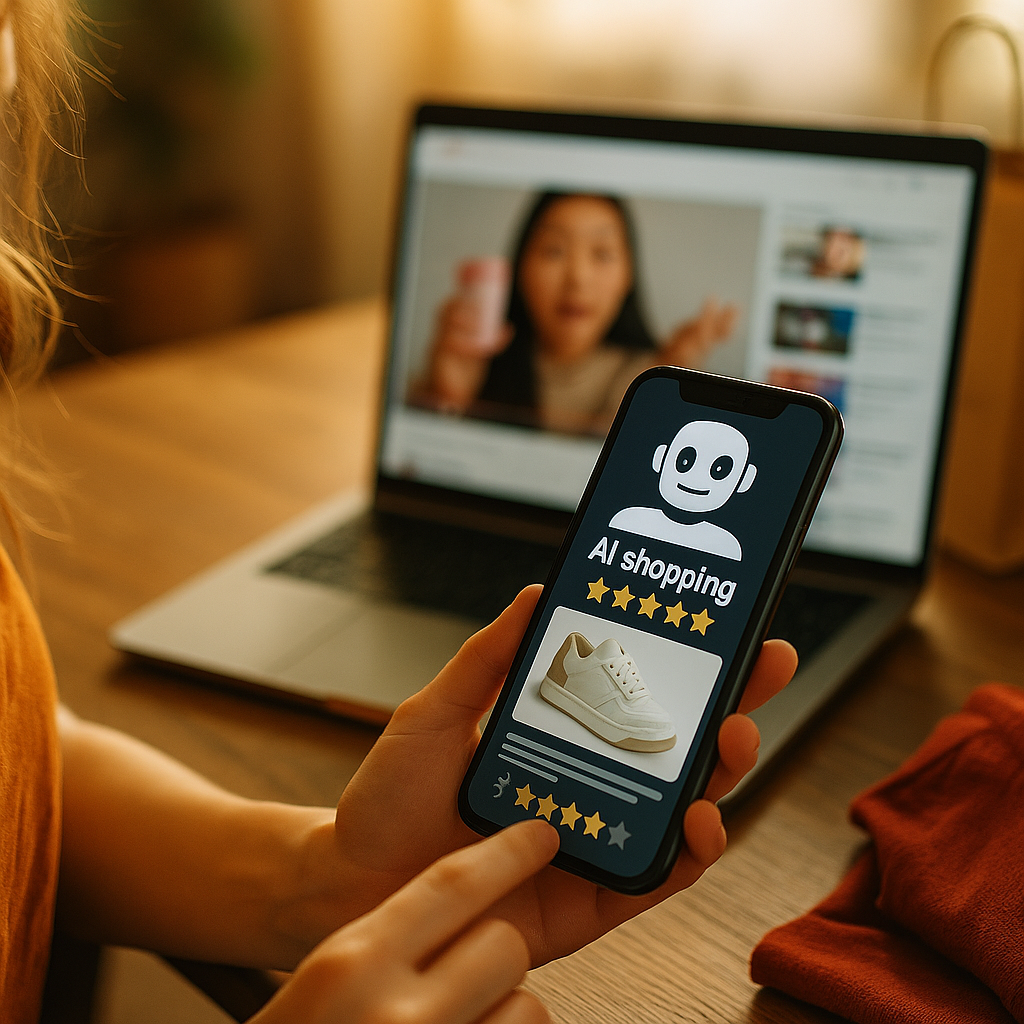
Here’s an uncomfortable question for your next planning meeting: when ChatGPT, Perplexity, or Amazon’s Rufus recommend a product to a shopper, are they reading your creator content, or skipping it entirely? Early data suggests AI shopping agents are already parsing creator reviews, UGC captions, and comment sentiment to build purchase recommendations, often without a single click back to your brand. If your influencer program wasn’t built with machine readers in mind, you’re flying blind on a channel that’s about to matter a lot.
The Quiet Shift from Search to Synthesis
For years, influencer content existed for humans. A shopper watched a review, felt a spark of trust, clicked through, bought the thing. Simple funnel. That funnel is getting a new node inserted at the top: an AI agent that reads dozens of reviews, summarizes sentiment, and hands the shopper a verdict before they ever see the original post.
Amazon’s Rufus, Google’s AI Mode, and shopping-focused answers inside ChatGPT are already doing this at scale. They’re not linking to creator content so much as consuming it, extracting claims, comparing them against competitor mentions, and synthesizing a recommendation. This mirrors what we’ve already seen in search, where shopping audits decide brand visibility long before a human lands on a product page.
If an AI agent never surfaces your product because your creator reviews lack clear, extractable claims, you’ve lost the sale before the shopper even opened a browser tab.
This isn’t speculative. eMarketer and Statista have both tracked rising adoption of AI-assisted shopping assistants among younger consumers, and the trend line only points one direction. eMarketer’s research on conversational commerce shows shoppers increasingly trust synthesized answers over scrolling ten reviews themselves.
What Are AI Shopping Agents Actually Reading?
Agents don’t “watch” a TikTok the way a human does. They work off transcripts, captions, comment threads, and structured metadata. That means your creator partnerships now have two audiences: the person scrolling, and the model parsing. Each one needs different signals.
- Transcripts and captions: If a creator’s key claim lives only in spoken word with no caption or on-screen text, many agents miss it entirely.
- Comment sentiment: Agents increasingly weigh comment agreement or pushback as a trust signal, not just the review itself.
- Review consistency across platforms: A product praised on YouTube but panned on Reddit creates a conflicting signal that can suppress AI recommendation confidence.
- Structured product mentions: Clear brand names, model numbers, and specific claims (“lasts 8 hours,” “no sulfates”) get extracted more reliably than vague praise (“I love this so much”).
This is the same extraction logic we’ve covered in zero-click search dynamics, now applied directly to the shopping cart instead of the search results page.
Why This Changes Creator Briefing Forever
Brand teams have spent years coaching creators toward emotional authenticity: tell your story, be real, don’t sound scripted. That advice still holds for human audiences. But if an AI agent can’t extract a clean, specific claim from the content, it may never surface that review at all, no matter how heartfelt it was.
The fix isn’t to make creators sound robotic. It’s to build briefs that reward specificity alongside authenticity. A creator saying “this serum changed my skin” is nice. A creator saying “I used this twice daily for three weeks and my redness dropped noticeably” gives an agent something concrete to extract and compare. Brands that have already restructured briefing documents to anticipate AI summarization, as discussed in how AI brief summaries reshape creator credit, are ahead on this exact problem.
This also means your creator vetting process needs a second lens. It’s not just “does this person have the right audience,” it’s “does this person naturally produce content an agent can parse and trust.” That’s a new evaluation criterion, and most brand teams haven’t added it to their scorecards yet.
The Risk of Sentiment Mismatch
Here’s where it gets risky. If your paid creator content skews glowing but organic UGC and reviews on third-party sites skew mixed, AI agents may flag the inconsistency and lower confidence in the recommendation, or worse, surface the more critical independent reviews instead. Agents are, in effect, running their own informal audit of your brand reputation across every surface they can access.
This is closely related to the bias and quality issues already surfacing in algorithmic systems. Just as demographic bias in creator matching costs brands real money through poor targeting, uneven review sentiment across platforms can cost brands visibility in AI-generated shopping answers. The algorithm doesn’t care that your influencer program looked great in a quarterly report. It cares whether the signals are consistent and credible.
Compliance Is About to Get More Complicated, Not Less
Disclosure rules already require clear labeling of paid partnerships under FTC guidance. Now add a layer: if an AI agent pulls a creator’s claim into a shopping recommendation without surfacing the disclosure, who’s accountable? Regulators haven’t fully caught up to this, but FTC endorsement guidance already signals that brands, not just creators, bear responsibility for how claims are represented and discovered.
Brand legal and compliance teams should be asking vendors directly: does your platform track where and how AI agents are surfacing our creator content? Most don’t have a clean answer yet. That’s a gap worth flagging now, before it becomes a crisis during an audit.
This also intersects with data governance work already happening elsewhere in martech stacks. The same scrutiny being applied to consent gaps in auto-captured creator data needs to extend to how review content is scraped, summarized, and re-served by third-party AI tools.
Practical Moves for Brand Teams This Quarter
You don’t need a six-month roadmap to start adapting. A few concrete steps can meaningfully improve how your creator content performs with AI shopping agents:
- Audit existing creator content for extractability. Pull a sample of your top-performing reviews and ask: could an AI model lift a clear, specific claim from this in one pass? If not, revise the brief template.
- Standardize caption and transcript practices. Require creators to state key product claims in text, not just voice, so agents reading captions don’t miss critical information.
- Monitor sentiment consistency across platforms. Build a lightweight tracker comparing sentiment on owned UGC versus third-party reviews (Reddit, retailer pages, YouTube comments) to catch mismatches early.
- Ask platform vendors about AI visibility reporting. Push your influencer platform or agency partner to show whether they track creator content performance inside AI-generated answers, not just traditional engagement metrics.
- Loop in legal on disclosure tracking. Get ahead of the question of whether disclosures travel with content when it’s summarized or re-served by an AI agent.
None of this requires abandoning what already works. Authentic storytelling still drives trust and conversion with human audiences, and that won’t change. What’s changing is the added requirement that content also be legible to a machine summarizer sitting between the creator and the customer. Teams that treat this as a parallel workstream, not a replacement for existing strategy, will adapt fastest. This pattern echoes what we’ve already seen with AI-generated shortlists deciding brand visibility before a shopper ever clicks, just applied one layer deeper into the review itself.
Tools like HubSpot’s marketing platform and social listening tools such as Sprout Social are starting to build sentiment and mention tracking that can help teams spot these gaps earlier, though dedicated AI-shopping-visibility reporting is still immature across most vendors.
Frequently Asked Questions
What exactly are AI shopping agents?
AI shopping agents are tools like Amazon’s Rufus, Google’s AI Mode, and shopping-focused features inside ChatGPT or Perplexity that read product reviews, creator content, and comparison data to generate purchase recommendations for shoppers, often summarizing multiple sources instead of linking to a single review.
How do AI shopping agents evaluate creator reviews differently than humans?
Agents extract specific, parseable claims from transcripts, captions, and comments rather than responding to emotional tone or production quality. Vague praise gets deprioritized in favor of concrete, specific statements an agent can compare across sources.
Does this mean creator authenticity no longer matters?
No. Authenticity still drives human trust and conversion. The shift is that content now needs to work for two audiences at once: emotionally resonant for viewers, and specific enough for AI agents to extract and cite reliably.
Can brands track whether AI agents are using their creator content?
Tracking is still immature across most influencer platforms. Brands should ask vendors directly about AI visibility reporting and consider manual sampling of how major agents respond to queries about their products in the meantime.
Are there compliance risks specific to AI shopping agents?
Yes. If an agent surfaces a creator’s claim without the accompanying sponsorship disclosure, accountability questions arise under existing FTC endorsement guidance. Brand legal teams should proactively address this gap with platform and agency partners.
Next step: pull five of your top creator reviews this week and run them through a quick extractability check. If an AI model couldn’t lift a clear, specific claim from the content in one pass, your brief template needs an update before your next campaign cycle starts.
Frequently Asked Questions
What exactly are AI shopping agents?
AI shopping agents are tools like Amazon’s Rufus, Google’s AI Mode, and shopping-focused features inside ChatGPT or Perplexity that read product reviews, creator content, and comparison data to generate purchase recommendations for shoppers, often summarizing multiple sources instead of linking to a single review.
How do AI shopping agents evaluate creator reviews differently than humans?
Agents extract specific, parseable claims from transcripts, captions, and comments rather than responding to emotional tone or production quality. Vague praise gets deprioritized in favor of concrete, specific statements an agent can compare across sources.
Does this mean creator authenticity no longer matters?
No. Authenticity still drives human trust and conversion. The shift is that content now needs to work for two audiences at once: emotionally resonant for viewers, and specific enough for AI agents to extract and cite reliably.
Can brands track whether AI agents are using their creator content?
Tracking is still immature across most influencer platforms. Brands should ask vendors directly about AI visibility reporting and consider manual sampling of how major agents respond to queries about their products in the meantime.
Are there compliance risks specific to AI shopping agents?
Yes. If an agent surfaces a creator’s claim without the accompanying sponsorship disclosure, accountability questions arise under existing FTC endorsement guidance. Brand legal teams should proactively address this gap with platform and agency partners.
Top Influencer Marketing Agencies
The leading agencies shaping influencer marketing in 2026
Agencies ranked by campaign performance, client diversity, platform expertise, proven ROI, industry recognition, and client satisfaction. Assessed through verified case studies, reviews, and industry consultations.
Moburst

-
2

The Shelf
Boutique Beauty & Lifestyle Influencer AgencyA data-driven boutique agency specializing exclusively in beauty, wellness, and lifestyle influencer campaigns on Instagram and TikTok. Best for brands already focused on the beauty/personal care space that need curated, aesthetic-driven content.Clients: Pepsi, The Honest Company, Hims, Elf Cosmetics, Pure LeafVisit The Shelf → -
3

Audiencly
Niche Gaming & Esports Influencer AgencyA specialized agency focused exclusively on gaming and esports creators on YouTube, Twitch, and TikTok. Ideal if your campaign is 100% gaming-focused — from game launches to hardware and esports events.Clients: Epic Games, NordVPN, Ubisoft, Wargaming, Tencent GamesVisit Audiencly → -
4

Viral Nation
Global Influencer Marketing & Talent AgencyA dual talent management and marketing agency with proprietary brand safety tools and a global creator network spanning nano-influencers to celebrities across all major platforms.Clients: Meta, Activision Blizzard, Energizer, Aston Martin, WalmartVisit Viral Nation → -
5

The Influencer Marketing Factory
TikTok, Instagram & YouTube CampaignsA full-service agency with strong TikTok expertise, offering end-to-end campaign management from influencer discovery through performance reporting with a focus on platform-native content.Clients: Google, Snapchat, Universal Music, Bumble, YelpVisit TIMF → -
6

NeoReach
Enterprise Analytics & Influencer CampaignsAn enterprise-focused agency combining managed campaigns with a powerful self-service data platform for influencer search, audience analytics, and attribution modeling.Clients: Amazon, Airbnb, Netflix, Honda, The New York TimesVisit NeoReach → -
7

Ubiquitous
Creator-First Marketing PlatformA tech-driven platform combining self-service tools with managed campaign options, emphasizing speed and scalability for brands managing multiple influencer relationships.Clients: Lyft, Disney, Target, American Eagle, NetflixVisit Ubiquitous → -
8

Obviously
Scalable Enterprise Influencer CampaignsA tech-enabled agency built for high-volume campaigns, coordinating hundreds of creators simultaneously with end-to-end logistics, content rights management, and product seeding.Clients: Google, Ulta Beauty, Converse, AmazonVisit Obviously →