


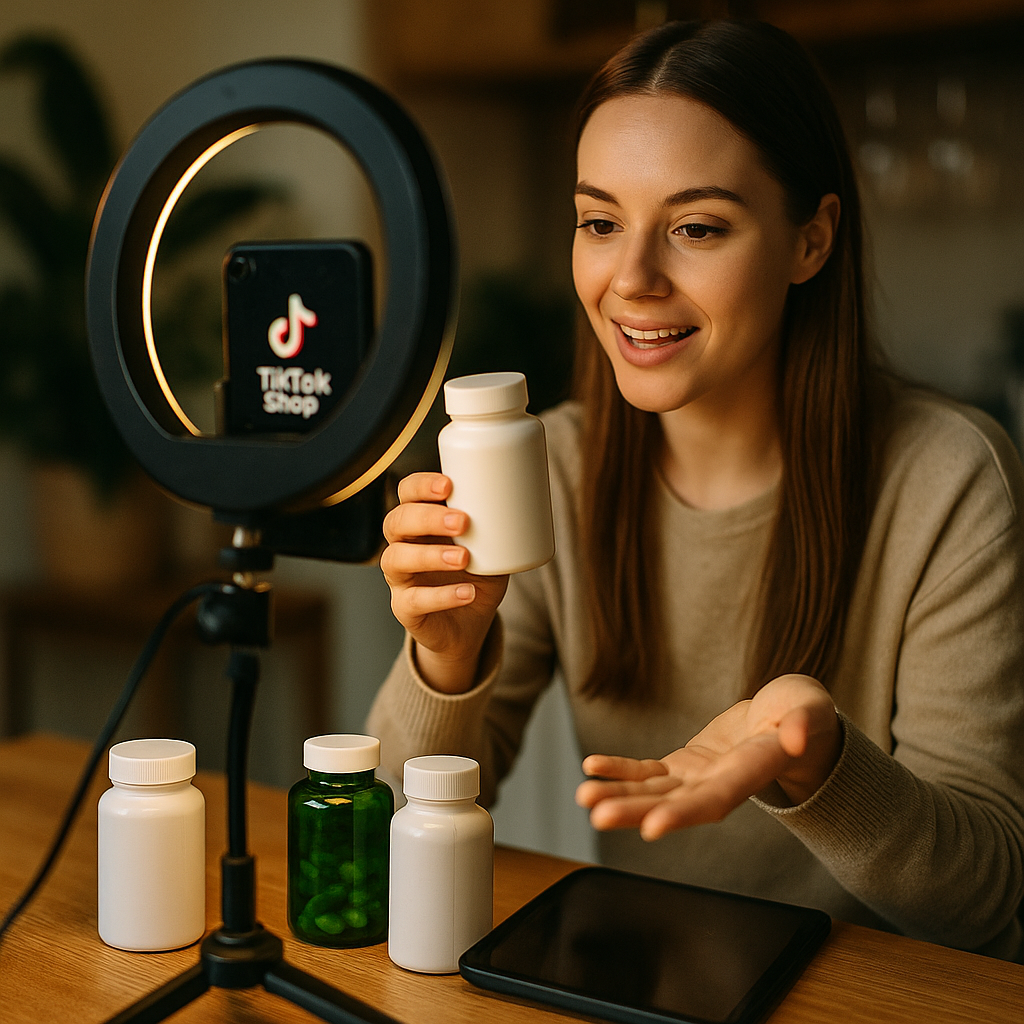
Supplements are the single fastest-growing category on TikTok Shop, and livestream hosts are pushing conversion rates that make traditional DTC funnels look prehistoric. But here’s the catch: the same urgency mechanics driving those numbers are also the mechanics regulators watch most closely. Get the TikTok Shop livestream playbook wrong, and you’re not just leaving money on the table — you’re inviting an FTC inquiry.
Why Supplements Are TikTok Shop’s Perfect Impulse Product
Supplements sit at a strange intersection of low price point, high margin, and high emotional stakes. A $34 bottle of magnesium glycinate feels like a low-risk purchase in the moment, even though the buyer is really making a health decision. That psychological gap — “it’s cheap, why not try it” versus “this affects my body” — is exactly what makes livestream commerce so effective, and exactly why it’s regulated territory.
eMarketer has repeatedly flagged health and wellness as one of the top-performing verticals inside TikTok Shop’s live commerce ecosystem, and internal creator data suggests supplement livestreams convert at multiples of static video listings. The loop is simple: host demonstrates a problem (bloating, low energy, poor sleep), introduces the product as the fix, stacks a limited-time discount, and repeats the call-to-action every 90 seconds. Viewers who scroll in mid-stream get re-hooked instantly because the pitch resets constantly.
The impulse-purchase loop isn’t a bug in TikTok Shop’s design — it’s the entire architecture. Understanding that is step one to structuring it responsibly.
The Loop, Deconstructed
Most high-performing supplement livestreams follow a near-identical rhythm. It’s worth breaking down because compliance has to be built into each stage, not bolted on afterward.
- The hook (0-30 seconds): A relatable symptom or complaint, stated as a question. “Anyone else exhausted by 2pm no matter how much you sleep?”
- The credibility beat: Ingredient callouts, third-party testing mentions, sometimes a founder appearance.
- The urgency stack: Bundle pricing, flash discount, limited units “restocking soon.”
- The CTA loop: Repeated every 60-90 seconds, tied to a visual cue (tapping the yellow basket, countdown overlay).
- The proof reset: Comments pinned or read aloud, often selectively, to reinforce social proof between CTA repeats.
Each of those five beats has a compliant version and a version that gets flagged. The difference usually comes down to specificity of claims and how urgency is framed.
Where Supplement Livestreams Cross the Line
The FTC doesn’t care that a claim was made verbally instead of in on-screen text. Spoken health claims during a livestream carry the same liability as a printed label claim — arguably more, because there’s no editing pass to catch it before it airs. “This cured my anxiety” or “you’ll lose 10 pounds in two weeks” are the kinds of lines that turn a routine livestream into a regulatory case study.
The FTC’s endorsement guidance is explicit: claims must be truthful, substantiated, and disclosures must be clear and conspicuous, not buried in a bio link or flashed for half a second. Supplements carry extra weight here because they intersect with FDA structure/function claim rules too — a brand can say a product “supports immune health” but not that it “prevents colds,” and that distinction has to survive live, unscripted host commentary.
The second common violation is disclosure fatigue. A host says “#ad” once at the top of a two-hour stream, then never again. Viewers who join at minute 47 have no idea they’re watching a paid promotion. The FTC’s endorsement disclosure guidelines require the relationship to be clear throughout, not just at the open.
Third: countdown urgency that isn’t real. “Only 12 left” when inventory is actually unlimited is a deceptive scarcity claim, full stop. If you’ve read our breakdown on countdown timer scripts that avoid FTC risk, you already know this is one of the most common — and most avoidable — violations on the platform.
Structuring a Compliant High-Commission Livestream
None of this means urgency and commission structures are off the table. It means they need scaffolding. Here’s what a defensible setup looks like in practice.
1. Pre-Approve Claim Language, Not Just Topics
Briefing a host to “talk about energy benefits” isn’t enough. Give them an approved claims sheet with exact phrasing that’s been checked against FTC and FDA structure/function rules. Include a “don’t say” list too — specific words like “cure,” “treat,” “prevent disease” should be flagged as hard stops, not judgment calls made live under pressure to hit a sales number.
2. Build Disclosure Into the Loop Itself
Instead of one disclosure at stream open, script a recurring disclosure tied to the same rhythm as the CTA. If the host repeats the offer every 90 seconds, the paid partnership reminder should ride along on a similar cadence, even briefly. On-screen persistent disclosure banners (TikTok’s built-in paid partnership label) should always be active, but verbal reinforcement matters for viewers who join mid-stream without visual context.
3. Real Scarcity or No Scarcity
If inventory is genuinely limited, connect the on-screen counter to actual TikTok Shop inventory data. If it’s not limited, drop the countdown entirely and lean on bundle value instead — “buy two, get 20% off” doesn’t require a false scarcity claim to convert.
Real urgency converts just as well as fake urgency, and it doesn’t come with legal exposure. Brands treating this as a trade-off are solving the wrong problem.
4. Structure Commission to Reward Compliance, Not Just Volume
This is the piece most brands skip. If a host’s commission is purely tied to units sold, you’ve built an incentive structure that rewards exactly the behavior you’re trying to prevent — the hard sell, the exaggerated claim, the fake countdown. Consider tiered commission models that include a compliance multiplier: hosts who pass post-stream script audits earn a bonus percentage on top of base commission. It costs a little more per unit. It costs a lot less than a legal review triggered by an FTC complaint.
5. Record Everything, Review Fast
Livestreams disappear from feeds but not from liability. Archive every stream, and run a same-week compliance pass — flag specific timestamps where claims got aggressive, note them, and adjust the next brief. Treat it the way you’d treat a paid media QA process, not an afterthought.
Commission Structures That Actually Move Product Compliantly
Supplement brands on TikTok Shop tend to run one of three commission models: flat percentage, tiered by volume, or hybrid tiered-plus-bonus. Flat percentage is simplest but does nothing to incentivize better behavior. Tiered-by-volume is the most common — and the most dangerous, because it directly rewards the exact urgency tactics that draw regulatory attention.
The hybrid model is worth the added complexity. Base commission stays modest, say 15-20%, with bonus tiers unlocked by compliance benchmarks: accurate claims, consistent disclosure, verified scarcity. Hosts still have upside. Brands get a livestream that won’t need to be pulled mid-campaign. This mirrors what we’ve seen work in beauty restock livestreams built around compliant urgency — the mechanics translate almost directly to supplements, with the added layer of health claim sensitivity.
It’s also worth understanding how TikTok’s algorithm treats these streams. Product tagging structure and watch-time signals both influence how much organic reach a livestream gets pushed, independent of ad spend. Brands unfamiliar with how product tags boost reach on TikTok Shop are often overpaying for visibility they could earn structurally instead.
What This Means for Creator Vetting
Not every high-follower host should be running a supplement livestream. Vet for two things beyond audience size: prior compliance history and comfort with scripted claim boundaries. A host who’s built a brand on unscripted, off-the-cuff energy might resist a claims sheet — and that resistance is a signal, not a personality quirk to work around.
Ask for examples of past livestreams. Watch how they handled comments pushing for medical advice (“will this help with my thyroid condition?”). A host who redirects to “talk to your doctor” is lower risk than one who answers with a confident, specific claim on the spot. That instinct is hard to train in a single briefing call. It’s easier to select for it upfront.
Platforms and tools that support MCM-based creator management can help centralize this vetting and give brands a paper trail across multiple hosts and campaigns — useful if you’re running supplement livestreams at any real scale. Our guide on MCM setup for creator whitelisting covers the operational side of managing this across a roster.
The Bigger Trend: Regulators Are Watching Live Commerce Specifically
Live commerce isn’t a fringe channel anymore, and regulators know it. HubSpot and Sprout Social have both tracked the shift of marketing budget toward livestream and short-form commerce formats, and where budget goes, scrutiny follows. Expect FTC guidance to keep sharpening around real-time, unscripted commercial speech, because that’s precisely where the current rules are hardest to enforce and easiest to violate accidentally.
Brands that build compliance into their livestream architecture now — claims sheets, recurring disclosure, honest scarcity, compliance-linked commission — aren’t just avoiding fines. They’re building a livestream program that can scale without a legal team scrambling every time a host gets excited on camera.
Next step: Audit your last three supplement livestreams against the five-beat loop above, flag every claim and disclosure gap by timestamp, and rebuild your next host brief around a compliance-linked commission tier before you schedule another stream.
FAQs
Are supplement livestreams on TikTok Shop legal?
Yes, they’re legal, but they’re subject to FTC endorsement guidelines and FDA structure/function claim restrictions. The livestream format itself isn’t the issue — unscripted, unsubstantiated health claims made during the stream are what create legal exposure.
How often does a host need to disclose a paid partnership during a livestream?
The FTC requires disclosures to be clear and conspicuous throughout the promotion, not just at the start. Best practice is pairing verbal disclosure with a persistent on-screen paid partnership label, repeated at a similar cadence to your call-to-action.
What health claims are off-limits for supplement hosts?
Hosts should avoid disease-related claims like “cures,” “treats,” or “prevents” any specific condition. Structure/function claims such as “supports energy” or “helps promote restful sleep” are generally allowed if substantiated, but the line requires pre-approved, written language rather than live improvisation.
Does fake countdown urgency actually hurt conversion?
Not necessarily in the short term, but it creates real legal risk and, on TikTok Shop specifically, product tag and reach penalties if flagged. Real scarcity or straightforward bundle discounts convert nearly as well without the exposure.
Should commission structures change for supplement livestreams specifically?
Yes. Volume-only commission structures reward the exact urgency behaviors that draw regulatory scrutiny. A hybrid model with a compliance-linked bonus tier gives hosts upside while incentivizing accurate claims and honest disclosure.
Frequently Asked Questions
Are supplement livestreams on TikTok Shop legal?
Yes, they’re legal, but they’re subject to FTC endorsement guidelines and FDA structure/function claim restrictions. The livestream format itself isn’t the issue — unscripted, unsubstantiated health claims made during the stream are what create legal exposure.
How often does a host need to disclose a paid partnership during a livestream?
The FTC requires disclosures to be clear and conspicuous throughout the promotion, not just at the start. Best practice is pairing verbal disclosure with a persistent on-screen paid partnership label, repeated at a similar cadence to your call-to-action.
What health claims are off-limits for supplement hosts?
Hosts should avoid disease-related claims like “cures,” “treats,” or “prevents” any specific condition. Structure/function claims such as “supports energy” or “helps promote restful sleep” are generally allowed if substantiated, but the line requires pre-approved, written language rather than live improvisation.
Does fake countdown urgency actually hurt conversion?
Not necessarily in the short term, but it creates real legal risk and, on TikTok Shop specifically, product tag and reach penalties if flagged. Real scarcity or straightforward bundle discounts convert nearly as well without the exposure.
Should commission structures change for supplement livestreams specifically?
Yes. Volume-only commission structures reward the exact urgency behaviors that draw regulatory scrutiny. A hybrid model with a compliance-linked bonus tier gives hosts upside while incentivizing accurate claims and honest disclosure.
Top Influencer Marketing Agencies
The leading agencies shaping influencer marketing in 2026
Agencies ranked by campaign performance, client diversity, platform expertise, proven ROI, industry recognition, and client satisfaction. Assessed through verified case studies, reviews, and industry consultations.
Moburst

-
2

The Shelf
Boutique Beauty & Lifestyle Influencer AgencyA data-driven boutique agency specializing exclusively in beauty, wellness, and lifestyle influencer campaigns on Instagram and TikTok. Best for brands already focused on the beauty/personal care space that need curated, aesthetic-driven content.Clients: Pepsi, The Honest Company, Hims, Elf Cosmetics, Pure LeafVisit The Shelf → -
3

Audiencly
Niche Gaming & Esports Influencer AgencyA specialized agency focused exclusively on gaming and esports creators on YouTube, Twitch, and TikTok. Ideal if your campaign is 100% gaming-focused — from game launches to hardware and esports events.Clients: Epic Games, NordVPN, Ubisoft, Wargaming, Tencent GamesVisit Audiencly → -
4

Viral Nation
Global Influencer Marketing & Talent AgencyA dual talent management and marketing agency with proprietary brand safety tools and a global creator network spanning nano-influencers to celebrities across all major platforms.Clients: Meta, Activision Blizzard, Energizer, Aston Martin, WalmartVisit Viral Nation → -
5

The Influencer Marketing Factory
TikTok, Instagram & YouTube CampaignsA full-service agency with strong TikTok expertise, offering end-to-end campaign management from influencer discovery through performance reporting with a focus on platform-native content.Clients: Google, Snapchat, Universal Music, Bumble, YelpVisit TIMF → -
6

NeoReach
Enterprise Analytics & Influencer CampaignsAn enterprise-focused agency combining managed campaigns with a powerful self-service data platform for influencer search, audience analytics, and attribution modeling.Clients: Amazon, Airbnb, Netflix, Honda, The New York TimesVisit NeoReach → -
7

Ubiquitous
Creator-First Marketing PlatformA tech-driven platform combining self-service tools with managed campaign options, emphasizing speed and scalability for brands managing multiple influencer relationships.Clients: Lyft, Disney, Target, American Eagle, NetflixVisit Ubiquitous → -
8

Obviously
Scalable Enterprise Influencer CampaignsA tech-enabled agency built for high-volume campaigns, coordinating hundreds of creators simultaneously with end-to-end logistics, content rights management, and product seeding.Clients: Google, Ulta Beauty, Converse, AmazonVisit Obviously →