


42% of TikTok Shop purchases happen on impulse — no wishlist, no cart abandonment, no second-guessing. Just a scroll, a hook, and a tap to buy. If your livestream script still follows a product-demo-then-pitch structure, you’re leaving nearly half your conversion potential on the table. The TikTok Shop impulse-purchase behavior isn’t a quirk of the platform. It’s the platform.
Brands treating livestream commerce like a QVC rerun are missing what makes TikTok Shop different: viewers aren’t shopping with intent. They’re being converted mid-scroll, in real time, by hosts who understand pacing better than most media buyers understand attribution windows.
What the 42% Number Actually Means
The stat comes from aggregated TikTok Shop purchase-behavior data showing that a plurality of buyers make their decision within seconds of seeing a product featured live, without prior research or search intent. That’s fundamentally different from Amazon-style shopping, where someone arrives already knowing what they want. TikTok Shop customers often don’t know they want something until a host holds it up, uses it, and creates urgency around it.
This matters for how you brief creators. A script built for consideration-stage buyers (features, comparisons, specs) actively works against impulse conversion. Impulse buyers respond to emotional triggers, social proof, and scarcity, not spec sheets.
If 42% of your buyers are deciding in the moment, your first 15 seconds of livestream content matter more than your entire product catalog.
Compare this to how TikTok Shop videos are structured to convert outside of livestreams — the same urgency principles apply, just compressed into a real-time format with no editing safety net.
Structuring the Livestream Around the Impulse Window
Most brands still build livestreams like linear infomercials: intro, product walkthrough, Q&A, close. That structure assumes viewers watch start to finish. They don’t. TikTok Shop viewers drop in and out constantly, which means every few minutes needs to function as its own mini pitch with its own hook, proof point, and call to action.
The fix is a looping structure, not a linear one.
- Micro-hook every 90 seconds: Restate the offer, show the product in use, and give a reason to buy right now.
- Visual proof over verbal claims: Impulse buyers trust what they see (texture, fit, reaction) more than what they hear a host say.
- Stacked urgency cues: Limited stock counters, live comment call-outs (“someone just grabbed the last size”), and countdown timers reinforce the “buy now or miss it” frame.
- Low-friction CTA repetition: “Tap the yellow basket” said too infrequently loses buyers who tuned in mid-stream and don’t know how to purchase.
This is where compliant urgency scripting becomes non-negotiable. If you’re using countdowns or stock alerts, they need to reflect reality. Brands scaling this across categories should study the countdown timer scripts built to avoid FTC risk, since fabricated scarcity is one of the fastest ways to draw regulatory attention.
For a category-specific example of how urgency and compliance intersect, the approach used in beauty restock livestreams shows how real inventory data can be turned into believable urgency without inventing false scarcity.
Why Product Tagging Timing Changes Everything
Here’s something brands underestimate: when you tag a product during a livestream affects how the algorithm distributes that stream to new viewers. Tag too early and you signal a sales pitch before you’ve built any watch-time credibility. Tag too late and impulse viewers who dropped in mid-stream have no purchase path when the urge hits.
The data on this is worth studying closely — see how product tags affect reach for the mechanics behind tag timing and algorithmic reward.
Generally, the sweet spot is tagging within the first two minutes of a segment, then re-anchoring the tag verbally every time a new wave of viewers is likely to join (you can watch this in real time via concurrent viewer counts on TikTok LIVE Studio).
The Host Matters More Than the Script
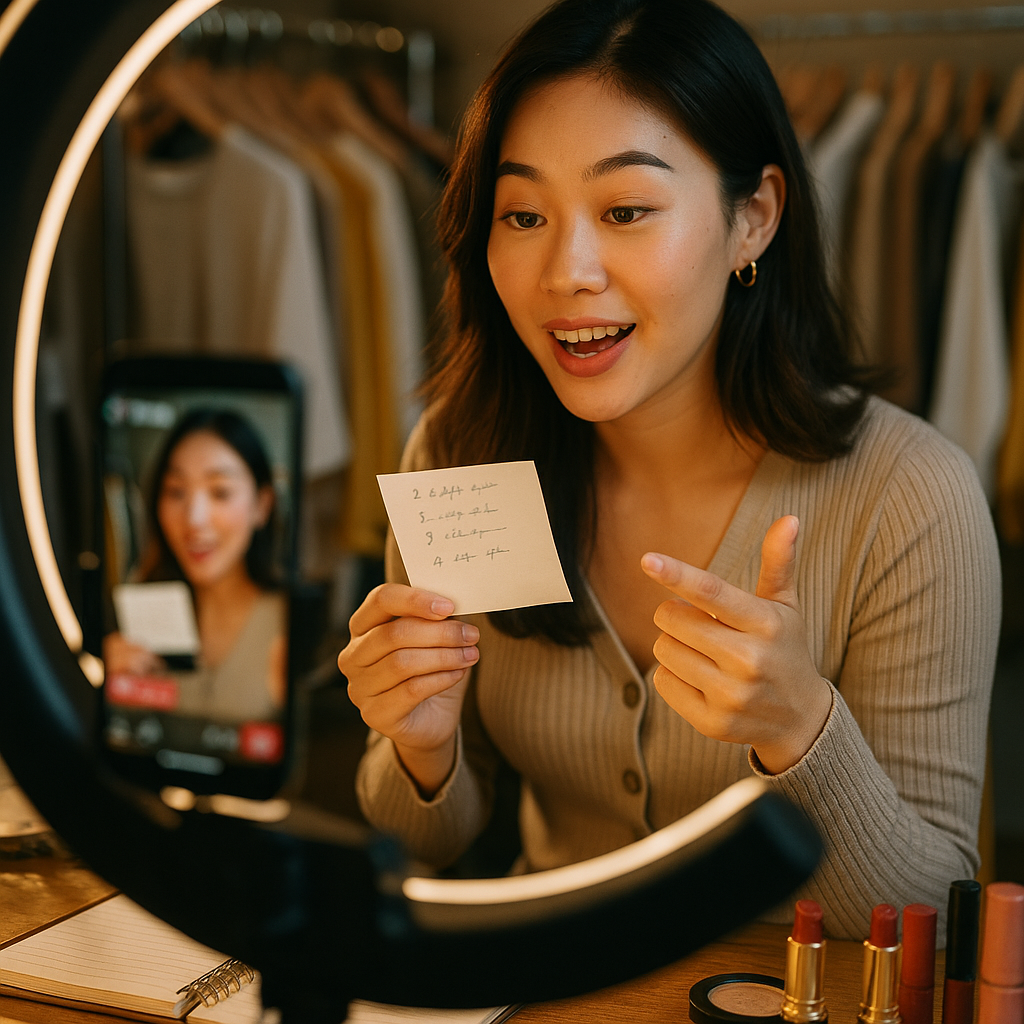
You can write the tightest urgency script in the world and still flop if the host reads it like a script. Impulse buying is emotional, and emotion doesn’t respond well to a teleprompter cadence. The best-performing TikTok Shop hosts sound like they’re genuinely excited, mildly chaotic, and reacting to comments in real time, not reciting bullet points.
This is a casting problem as much as a content problem. Brands vetting creators for livestream work should prioritize hosts who’ve proven they can improvise around a framework, not just deliver lines. TikTok’s algorithm already favors casual, unpolished content over produced ads, and livestream is the most extreme version of that preference. A stiff, over-rehearsed host actively suppresses impulse conversion because the energy that triggers spontaneous buying just isn’t there.
Some brands solve this by giving hosts a “beat sheet” instead of a script: five things that must happen in each ten-minute block, in any order, in the host’s own words. It’s a small shift, but it changes everything about how natural the urgency feels.
What About Regulated Categories?
Supplements, skincare with active ingredients, and anything making health claims can’t lean on pure impulse mechanics without legal review. The FTC has been explicit about disclosure requirements for livestream commerce, and “spontaneous buy” framing doesn’t exempt brands from substantiating claims made on camera.
If you’re operating in these categories, the impulse playbook still applies, but with tighter guardrails. Review the framework in structuring supplement livestreams without FTC risk before greenlighting any urgency-heavy script for a regulated product. The FTC’s own guidance on endorsements and testimonials, available at ftc.gov, is worth bookmarking for your compliance team regardless of category.
Measuring What Actually Drove the Purchase
Attribution in livestream commerce is messier than in traditional paid social, mostly because the purchase decision often happens faster than your tracking pixel can contextualize it. Standard e-commerce metrics (time on page, cart additions, session duration) don’t map cleanly onto a format where someone can go from first view to purchase in under 30 seconds.
Instead, track these livestream-specific signals:
- Segment-level conversion rate: Which 90-second block of the stream drove the most tagged-product clicks?
- Comment-to-purchase lag: How quickly do purchases follow spikes in live comments mentioning the product?
- Re-entry conversion: Do viewers who leave and rejoin convert at different rates than those who stay the whole time?
- Host-specific lift: Run the same script structure with two different hosts and compare conversion, isolating delivery from content.
Platforms like Sprout Social and TikTok’s native analytics through TikTok Ads Manager can help you break this down, but most brands still need a manual review of stream recordings against sales timestamps to really understand what triggered a purchase spike. It’s tedious. It’s also the only way to isolate signal from noise in a format this fast-moving.
Data from eMarketer continues to show social commerce growing faster than traditional e-commerce channels, and TikTok Shop specifically is outpacing category averages in the U.S. and UK. That growth trajectory makes now the time to build repeatable livestream infrastructure, not just one-off campaigns.
Building a Repeatable Livestream Framework
Once you’ve identified which structural elements drive impulse conversion for your category, codify them. Build a template brief that specifies hook timing, tag placement, urgency cue frequency, and host energy level, then let creators fill in their own voice around that skeleton. This is the same brief-first approach that’s proven effective across other formats — see how it’s applied in structuring TikTok Shop videos for conversion — and it scales far better than reinventing the wheel for every livestream.
Brands rebuilding trust with TikTok Shop after a pause or reputational hit should also look at the re-entry playbook for advertiser confidence, since impulse-heavy formats carry more brand-safety risk if execution slips.
Next Step
Don’t rewrite your entire livestream strategy overnight. Pick one upcoming stream, restructure it into 90-second looping segments with a tighter tag-timing window, and measure segment-level conversion against your last three streams. The 42% impulse-buy signal isn’t a theory to debate; it’s a structural problem to solve, one stream at a time.
FAQs
What does the 42% impulse-purchase stat actually measure?
It reflects the share of TikTok Shop purchases made without prior search intent or research, where the buying decision happens in real time during exposure to the product, typically within a livestream or short-video format.
How long should a livestream segment be to capture impulse buyers?
Most brands see better results with 90-second to two-minute looping segments, each containing its own hook, proof point, and call to action, since viewers drop in and out constantly rather than watching start to finish.
Is urgency messaging in livestreams legally risky?
It can be if the scarcity or countdown claims aren’t accurate. The FTC requires that urgency cues reflect real inventory or time constraints, so scripts should be built around verified stock data rather than fabricated pressure tactics.
Does host personality really affect conversion rates?
Yes. Impulse buying is driven by emotional response, and hosts who sound natural and reactive tend to outperform those reading from a rigid script, since TikTok’s audience generally favors casual delivery over polished presentation.
What’s the best way to measure livestream ROI given how fast purchases happen?
Track segment-level conversion, comment-to-purchase lag, and host-specific lift rather than relying solely on standard e-commerce metrics like session duration, which don’t capture the speed of impulse-driven buying behavior.
Top Influencer Marketing Agencies
The leading agencies shaping influencer marketing in 2026
Agencies ranked by campaign performance, client diversity, platform expertise, proven ROI, industry recognition, and client satisfaction. Assessed through verified case studies, reviews, and industry consultations.
Moburst

-
2

The Shelf
Boutique Beauty & Lifestyle Influencer AgencyA data-driven boutique agency specializing exclusively in beauty, wellness, and lifestyle influencer campaigns on Instagram and TikTok. Best for brands already focused on the beauty/personal care space that need curated, aesthetic-driven content.Clients: Pepsi, The Honest Company, Hims, Elf Cosmetics, Pure LeafVisit The Shelf → -
3

Audiencly
Niche Gaming & Esports Influencer AgencyA specialized agency focused exclusively on gaming and esports creators on YouTube, Twitch, and TikTok. Ideal if your campaign is 100% gaming-focused — from game launches to hardware and esports events.Clients: Epic Games, NordVPN, Ubisoft, Wargaming, Tencent GamesVisit Audiencly → -
4

Viral Nation
Global Influencer Marketing & Talent AgencyA dual talent management and marketing agency with proprietary brand safety tools and a global creator network spanning nano-influencers to celebrities across all major platforms.Clients: Meta, Activision Blizzard, Energizer, Aston Martin, WalmartVisit Viral Nation → -
5

The Influencer Marketing Factory
TikTok, Instagram & YouTube CampaignsA full-service agency with strong TikTok expertise, offering end-to-end campaign management from influencer discovery through performance reporting with a focus on platform-native content.Clients: Google, Snapchat, Universal Music, Bumble, YelpVisit TIMF → -
6

NeoReach
Enterprise Analytics & Influencer CampaignsAn enterprise-focused agency combining managed campaigns with a powerful self-service data platform for influencer search, audience analytics, and attribution modeling.Clients: Amazon, Airbnb, Netflix, Honda, The New York TimesVisit NeoReach → -
7

Ubiquitous
Creator-First Marketing PlatformA tech-driven platform combining self-service tools with managed campaign options, emphasizing speed and scalability for brands managing multiple influencer relationships.Clients: Lyft, Disney, Target, American Eagle, NetflixVisit Ubiquitous → -
8

Obviously
Scalable Enterprise Influencer CampaignsA tech-enabled agency built for high-volume campaigns, coordinating hundreds of creators simultaneously with end-to-end logistics, content rights management, and product seeding.Clients: Google, Ulta Beauty, Converse, AmazonVisit Obviously →