


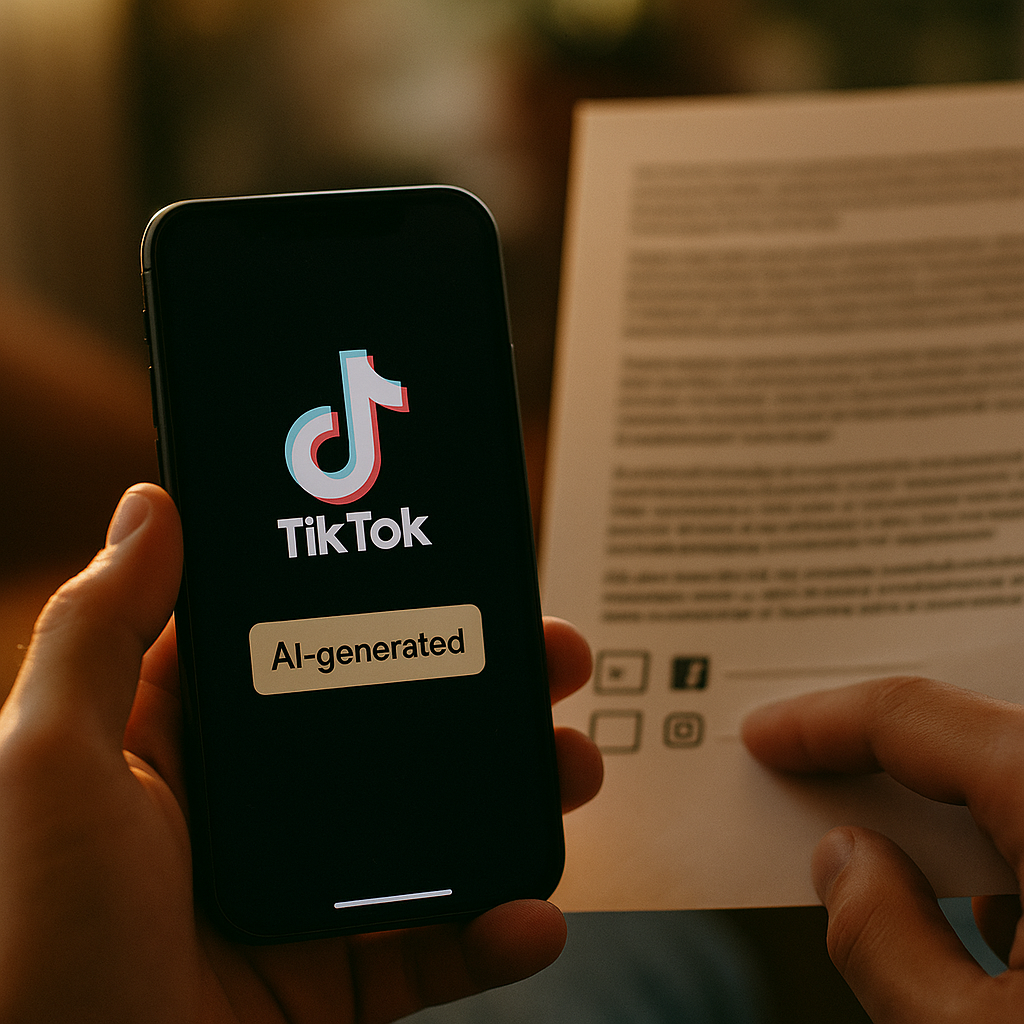
Seventy-three percent of TikTok’s “AI-generated” labels get slapped onto content automatically, whether the creator wants them or not. Now stack that against the FTC’s expanded material connection standard, and you’ve got two disclosure systems talking past each other on the same post. Getting material connection compliance right on TikTok now means managing a regulatory requirement and a platform-imposed label that don’t always say the same thing, in the same place, or for the same reason.
If your legal team thinks a platform label satisfies the FTC, you have a problem. If your creators think the label is optional, you have a bigger one.
Why This Collision Is Happening Now
The FTC’s updated guidance broadened what counts as a “material connection” well beyond cash payments. Free products, affiliate commissions, equity stakes, family relationships with a brand founder, even early access to a product — all of it can trigger disclosure obligations now. That expansion was already forcing brands to rewrite creator contracts and disclosure templates. We covered how equity arrangements specifically complicate this in our creator equity disclosure audit.
Then TikTok layered its own AI-content labeling system on top, largely to comply with platform-level transparency pushes and emerging state AI-disclosure laws. The label triggers automatically when TikTok’s detection systems flag AI-generated or AI-edited elements, voice clones, synthetic backgrounds, generative filters, whatever the algorithm catches.
Here’s the friction: TikTok’s label answers the question “was AI used to make this?” The FTC’s disclosure requirement answers a completely different question: “does the creator have a financial or personal relationship with the brand that would affect how a viewer interprets this content?” A post can trigger one without the other. A post can trigger both and still fail to communicate either clearly.
An AI-content label is a technical disclosure about production method. A material connection disclosure is a legal disclosure about financial relationship. Compliance teams that conflate the two are building risk into every sponsored post that uses AI tools.
Where Brands Actually Get This Wrong
Three failure patterns show up repeatedly in creator content audits.
- Assuming the AI label covers the sponsorship disclosure. It doesn’t. TikTok’s label says nothing about payment, gifting, or affiliate relationships. A viewer seeing “AI-generated content” has no reason to infer “this creator was paid by the brand.”
- Letting the AI label crowd out or bury the #ad disclosure. TikTok places its automatic label in a fairly prominent spot, often above the caption. If the creator’s manual #ad or “Paid Partnership” tag ends up buried in a caption cut off by TikTok’s UI, the FTC’s “clear and conspicuous” standard is at risk. We’ve seen this exact dynamic play out with cropping tools elsewhere; see how auto-crop erases FTC disclosures for the parallel problem on paid media.
- Treating AI-label triggers as random. They’re not fully random, but they’re also not fully predictable. A creator using a trending AI voice filter for entertainment value, unrelated to the sponsored message, can still trigger the platform label. Compliance teams need to plan for this, not react to it.
None of this is theoretical. Agencies running high-volume TikTok Shop programs are already fielding creator questions about which disclosure goes where, and in what order. Get it wrong at scale and you’re not looking at one bad post — you’re looking at a pattern across hundreds of creators that regulators can screenshot in bulk.
The Compliance Checklist
This is the sequence we recommend running on every sponsored post that touches AI tools, whether that’s a generative avatar, an AI voiceover, a synthetic background, or an AI-editing filter.
1. Confirm the material connection exists and classify it
Before you even think about labels, document the relationship. Cash payment, gifted product, affiliate link, equity, family tie, employment — classify it precisely. The FTC’s expanded definition means “no money changed hands” is no longer a valid excuse to skip disclosure.
2. Determine if AI tools were used anywhere in production
This includes tools the brand didn’t require but the creator chose independently. Script generation, voice cloning, AI-upscaled video, background replacement. If TikTok’s detection systems can plausibly flag it, assume they will.
3. Map both disclosures to placement, separately
Don’t let one disclosure serve double duty. The FTC disclosure (#ad, “Paid Partnership with [Brand],” or TikTok’s built-in branded content toggle) needs to be unavoidable, ideally in the first two lines of the caption and reinforced verbally or on-screen in the video itself. The AI label is largely out of your control once TikTok’s system applies it, but you should verify it isn’t visually overlapping or replacing your sponsorship disclosure in the rendered post.
4. Use TikTok’s branded content toggle, not just hashtags
TikTok’s native paid partnership label creates a structured, platform-logged disclosure that’s harder to dispute than a caption hashtag a viewer might miss. Pair it with the manual disclosure. Redundancy is your friend here, not a compliance failure.
5. Pre-screen AI-heavy content for label conflicts before publishing
Run a preview. Check where TikTok’s automatic label lands relative to your caption and any on-screen text disclosure. If the label pushes your #ad tag below the “see more” fold, restructure the caption. This takes five minutes and prevents a documentation nightmare later.
6. Log everything, including screenshots at time of posting
Labels can change. TikTok updates its detection models regularly, and a post that didn’t trigger an AI label at launch might get flagged retroactively, or vice versa. Screenshot the live post, the label state, and the disclosure placement at publication. This creates your audit trail if the FTC or a state AG comes asking.
7. Train creators on the difference, explicitly
Most creators genuinely don’t know that an AI label and a paid disclosure are answering different questions. Build this into onboarding. A one-page explainer beats a 40-page contract clause nobody reads.
8. Audit on a rolling basis, not just at campaign launch
TikTok’s labeling logic isn’t static. Platforms adjust detection thresholds constantly as new generative tools emerge. A quarterly re-audit of live sponsored content catches drift before it becomes a pattern regulators notice.
The FTC has made clear it doesn’t care whose system applied a label. It cares whether the average viewer understood the financial relationship. Platform automation doesn’t transfer legal responsibility away from the brand.
What Enforcement Risk Actually Looks Like Here
The FTC doesn’t need to prove intent to bring an enforcement action, only that a reasonable consumer would have been misled or wasn’t given adequate information to evaluate the endorsement. Cases against brands for inadequate disclosure have relied heavily on screenshots and platform metadata. That means TikTok’s own label history, timestamps, and caption-rendering data can become evidence, for or against you.
Compare this to the pattern we’ve tracked with disclosure placement issues on YouTube: platform feature changes routinely break disclosure compliance without brands realizing it in real time. TikTok’s AI labeling system is a new version of the same structural risk. Feature changes on the platform side can silently undermine a compliance program that was airtight when it was built.
Agencies managing multi-platform creator rosters should also look at how this interacts with contract language. If your creator agreements don’t specify who’s responsible for verifying disclosure placement after platform UI changes, you’re exposed. Similar contract gaps have already caused disputes in adjacent areas, like the indemnification issues raised in algorithm suppression cases. The lesson generalizes: platform behavior changes, and your contracts need to anticipate that instead of assuming static conditions.
For brands running TikTok Shop programs specifically, this compounds with other active compliance workstreams — age verification, shipping-subsidy audits, surveillance pricing disclosures. If your team is already tracking the TikTok Shop algorithm audit requirements, add AI-label reconciliation to the same review cycle rather than treating it as a separate project. Consolidating these audits saves headcount and reduces the odds something slips through.
Building This Into Your Workflow, Not Just Your Policy Doc
A checklist in a compliance binder does nothing if creators and campaign managers aren’t running it in real time. The brands handling this well have built the eight-step process above into their content approval tooling, not just their creator contracts.
Practically, that means: disclosure placement checks happen at the same stage as brand safety review, not after. AI-tool usage gets flagged in the creator brief upfront, not discovered after publish. And someone, a named person, owns the quarterly re-audit.
That last part matters more than it sounds. Diffuse ownership is how compliance gaps survive for months. Assign it, calendar it, and treat the AI-label reconciliation as a standing line item, not a one-time fire drill.
According to FTC guidance, endorsers and brands share responsibility for clear disclosure regardless of platform-provided tools. Industry benchmarking from eMarketer shows creator-led commerce continuing to scale on TikTok, which means the volume of posts touching both disclosure systems is only going up. Platforms like TikTok’s ad platform document their branded content requirements, but they stop short of reconciling those requirements with FTC standards — that reconciliation work is on you.
Frequently Asked Questions
FAQs
Does TikTok’s automatic AI-content label count as an FTC material connection disclosure?
No. TikTok’s AI label discloses production method, not financial relationship. Brands still need a separate, clear disclosure like #ad or the platform’s paid partnership toggle to meet FTC requirements.
What triggers TikTok’s automatic AI-generated content label?
TikTok’s detection systems flag synthetic voice, AI-edited video, generative backgrounds, and similar production elements. The label can apply even when AI was used for a small creative element unrelated to the sponsored message.
Can an AI label push a paid disclosure out of compliance?
Yes, if it shifts caption text below TikTok’s “see more” cutoff or visually overlaps an on-screen disclosure. Brands should preview posts before publishing to confirm both labels remain visible and unambiguous.
Who is legally responsible if a platform label creates a disclosure gap?
The brand and the creator, not the platform. The FTC holds both parties accountable for whether the average viewer could reasonably understand the material connection, regardless of automated platform features.
How often should brands audit AI-label and disclosure interactions?
At minimum, quarterly. TikTok updates its detection models regularly, so a compliant post today may render differently after a platform update. Rolling audits catch drift before it becomes a pattern.
Run the eight-step checklist on your next AI-assisted TikTok campaign before it goes live, not after a creator flags a confused comment section. The gap between platform labeling and FTC disclosure won’t close on its own, and the brands that document their reconciliation process now will be the ones with an answer ready when regulators start asking.
Top Influencer Marketing Agencies
The leading agencies shaping influencer marketing in 2026
Agencies ranked by campaign performance, client diversity, platform expertise, proven ROI, industry recognition, and client satisfaction. Assessed through verified case studies, reviews, and industry consultations.
Moburst

-
2

The Shelf
Boutique Beauty & Lifestyle Influencer AgencyA data-driven boutique agency specializing exclusively in beauty, wellness, and lifestyle influencer campaigns on Instagram and TikTok. Best for brands already focused on the beauty/personal care space that need curated, aesthetic-driven content.Clients: Pepsi, The Honest Company, Hims, Elf Cosmetics, Pure LeafVisit The Shelf → -
3

Audiencly
Niche Gaming & Esports Influencer AgencyA specialized agency focused exclusively on gaming and esports creators on YouTube, Twitch, and TikTok. Ideal if your campaign is 100% gaming-focused — from game launches to hardware and esports events.Clients: Epic Games, NordVPN, Ubisoft, Wargaming, Tencent GamesVisit Audiencly → -
4

Viral Nation
Global Influencer Marketing & Talent AgencyA dual talent management and marketing agency with proprietary brand safety tools and a global creator network spanning nano-influencers to celebrities across all major platforms.Clients: Meta, Activision Blizzard, Energizer, Aston Martin, WalmartVisit Viral Nation → -
5

The Influencer Marketing Factory
TikTok, Instagram & YouTube CampaignsA full-service agency with strong TikTok expertise, offering end-to-end campaign management from influencer discovery through performance reporting with a focus on platform-native content.Clients: Google, Snapchat, Universal Music, Bumble, YelpVisit TIMF → -
6

NeoReach
Enterprise Analytics & Influencer CampaignsAn enterprise-focused agency combining managed campaigns with a powerful self-service data platform for influencer search, audience analytics, and attribution modeling.Clients: Amazon, Airbnb, Netflix, Honda, The New York TimesVisit NeoReach → -
7

Ubiquitous
Creator-First Marketing PlatformA tech-driven platform combining self-service tools with managed campaign options, emphasizing speed and scalability for brands managing multiple influencer relationships.Clients: Lyft, Disney, Target, American Eagle, NetflixVisit Ubiquitous → -
8

Obviously
Scalable Enterprise Influencer CampaignsA tech-enabled agency built for high-volume campaigns, coordinating hundreds of creators simultaneously with end-to-end logistics, content rights management, and product seeding.Clients: Google, Ulta Beauty, Converse, AmazonVisit Obviously →