


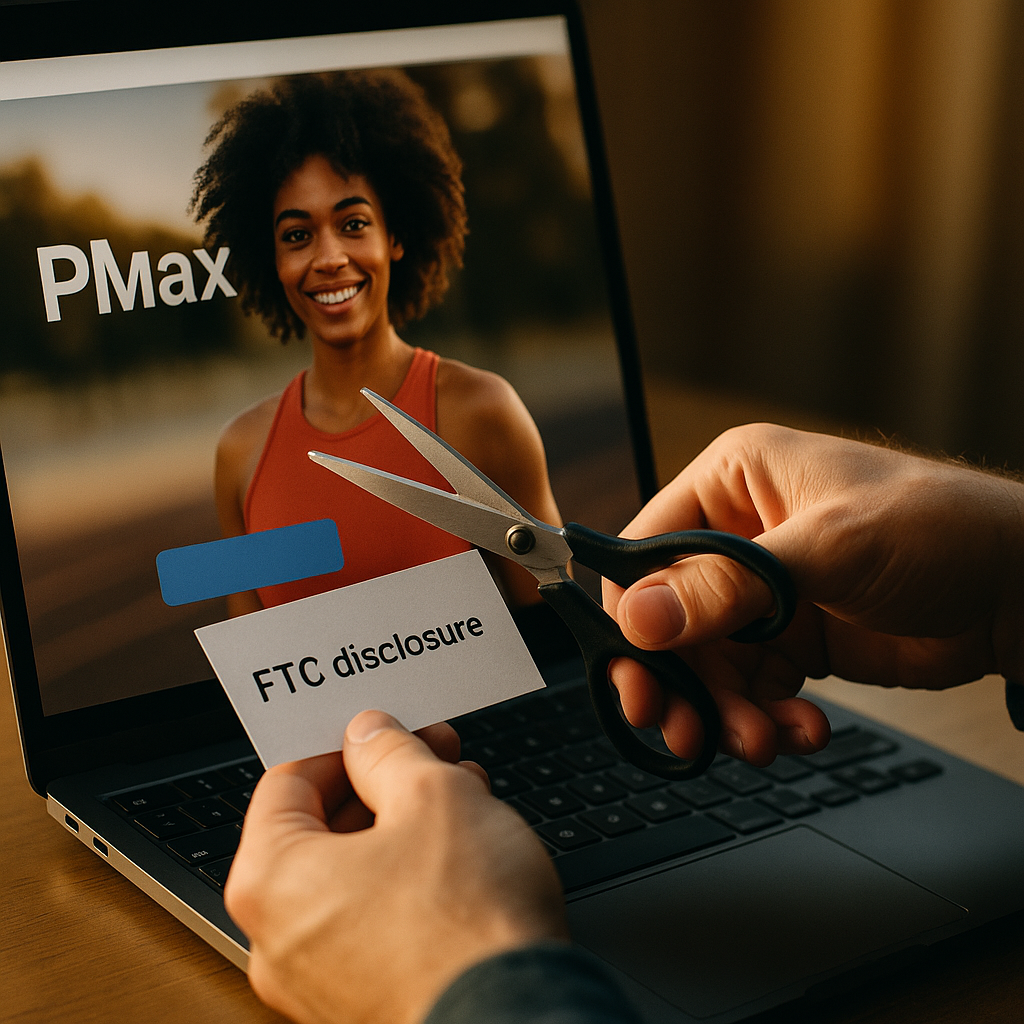
Performance Max reformats your video assets automatically, across every placement, without asking permission. One agency review found that nearly a third of auto-cropped variants clipped or fully removed on-screen disclosure text. If your compliance team hasn’t audited a single AI-resized asset this quarter, you already have a problem you don’t know about.
Google’s Performance Max campaigns pull in video, image, and text assets, then let machine learning decide how they get combined, cropped, and served across Search, Display, YouTube, Discover, Gmail, and Maps. It’s efficient. It’s also opaque. And for brands running influencer or creator-sourced video through PMax, that opacity is now a legal exposure problem, not just a creative one.
What auto-crop actually does to your creative
Performance Max doesn’t just resize video to fit different aspect ratios. It reframes. The system uses saliency detection to guess which part of the frame matters most, then builds new crops around that guess: square for Display, vertical for Shorts and Reels-style placements, horizontal for YouTube in-stream. That’s useful when the “important” part is a product or a face. It’s disastrous when the important part is a text overlay reading “#ad” sitten in the corner of the original frame.
Here’s the part most marketing teams miss: Google’s asset pipeline doesn’t understand disclosure text as a protected element. To the algorithm, “#ad” or “Paid partnership with [Brand]” is just pixels. If it’s not in the zone the saliency model prioritizes, it gets cropped out. No warning. No flag. The ad simply ships without it.
An AI system optimizing for click-through rate has zero incentive to preserve a disclosure disclaimer — and every incentive to crop toward the product shot that converts.
We covered the mechanics of this in detail in our breakdown of how PMax cropping erases disclosures. The short version: this isn’t a hypothetical edge case. It’s a structural feature of how the product works, and it scales with every video asset you upload.
Why this is a compliance issue, not a creative one
The FTC doesn’t grade on intent. A brand that unknowingly ships a cropped ad missing its disclosure is still liable for a deceptive advertising claim under Section 5 of the FTC Act. The agency’s own endorsement guidance is explicit: disclosures must be “clear and conspicuous” in every version of an ad that a consumer might encounter. “We disclosed it in the original file” is not a defense if the version that actually ran didn’t carry it.
This gets worse when you layer in platform-specific placement issues. YouTube’s evolving watch-time and player behavior has already created disclosure timing problems separate from PMax cropping — we detailed that in our piece on YouTube watch time changes. Now add an AI reformatting layer on top, and you’ve got two independent failure points stacking on the same asset.
The audit gap most brands don’t realize they have
Ask your media buying team a simple question: how many auto-generated crop variants does a single video asset produce inside a Performance Max campaign? Most can’t answer. That’s the gap. Google doesn’t surface every variant in a tidy review queue. Asset reporting in PMax shows performance by asset group, not a frame-by-frame preview of every cropped permutation actually served to a user.
That means compliance review, if it happens at all, typically happens on the source file before upload. Nobody’s watching what comes out the other end.
- Source video reviewed by legal: usually yes.
- Every auto-cropped variant reviewed before it serves: almost never.
- Ongoing spot-checks after launch: rare, and usually only triggered by a complaint or platform notice.
That last point matters. Most brands only discover a disclosure problem after something goes wrong — a regulator inquiry, a watchdog screenshot circulating on social media, or an internal audit triggered by an unrelated review. By then, the ad may have run for weeks.
Safety compliance is the second, quieter risk
Disclosure is the headline risk, but it’s not the only one. Auto-crop can also introduce brand safety problems that have nothing to do with the FTC. Consider:
- Context collapse. A crop that removes a warning label, age-gate notice, or safety disclaimer (think supplements, financial products, or age-restricted categories) creates regulatory exposure well beyond advertising law.
- Unintended framing. Saliency-based cropping can center on something awkward — a background element, a competing logo, or a gesture that reads differently out of context.
- Caption and subtitle mismatch. If your video relies on burned-in captions for accessibility or comprehension, cropping can cut them off mid-sentence, which raises both usability and, in some jurisdictions, accessibility compliance issues.
None of these are edge cases dreamed up for a worst-case scenario. They’re the predictable output of a system trained to optimize attention, not compliance. If your video assets involve influencer talent, sponsorship language, or health/finance claims, treat every PMax-generated crop as a new piece of creative that needs its own review, not a resized copy of one you already approved.
Building an actual audit process
You don’t need to boil the ocean here. You need a repeatable checklist that a media buyer or compliance analyst can run in under 30 minutes per campaign launch. Here’s a workable structure:
- Pull every served creative variant, not just the source. Use Google Ads’ asset-level reporting combined with manual preview tools to see how each aspect ratio actually renders. If your team can’t access this easily, that’s itself a red flag worth escalating to your Google account rep.
- Check disclosure placement in each crop. Is “#ad” or “Paid partnership” visible for the platform’s required minimum exposure time, in every reformatted version? Vertical crops are the highest-risk format — they cut the most from the original horizontal frame.
- Verify safety and warning text survives the crop. For regulated categories (supplements, alcohol, finance, gambling-adjacent products), confirm mandatory disclaimers remain legible and fully visible.
- Document the review. Screenshot each variant, timestamp the check, and log who approved it. If a regulator or platform ever asks, you want a paper trail showing active oversight, not a one-time sign-off from launch day.
- Re-audit on any creative refresh. Every time you swap an asset in a Performance Max asset group, the cropping engine re-runs. Old approvals don’t carry forward automatically.
This is essentially the same discipline brands are being forced to apply across other AI-mediated ad surfaces. We’ve written about the parallel governance gap for Meta’s automated budget systems in our governance charter piece for AI ad budget decisions — the underlying lesson is the same: when a platform’s AI makes creative or spend decisions autonomously, brands need a documented human review layer sitting on top of it, or they inherit all the risk with none of the control.
Where to bake disclosure protection into the source file
Prevention beats detection. A few production-level habits reduce how much damage auto-crop can do before it ever reaches your audit stage:
- Place disclosure text in the center-safe zone of the frame, not near edges that get trimmed in vertical or square crops.
- Use larger, higher-contrast disclosure text than you think you need. What’s legible at 1080p horizontal may shrink to unreadable in a cropped 9:16 thumbnail.
- Repeat the disclosure verbally in the audio track where possible. Audio survives cropping even when visual text doesn’t.
- Extend the disclosure’s on-screen duration beyond the platform minimum, giving cropped variants a buffer if a few seconds get trimmed from either end.
None of these guarantee a clean crop. But they materially reduce the odds that Performance Max’s saliency model decides your disclosure is disposable.
What agencies should be contracting for
If you’re running influencer-sourced video through an agency’s PMax buys, put audit responsibility in the statement of work. Explicitly. “Agency will conduct disclosure review” is meaningless without specifying frequency, scope (every crop variant, not just the source), and documentation requirements.
This mirrors a pattern showing up across the influencer compliance landscape generally — platforms shift creative decisions to automated systems, and contracts haven’t caught up. We’ve seen the same dynamic with algorithmic suppression clauses, detailed in our piece on why platform algorithm risk needs contract indemnification. Performance Max’s auto-crop is just another instance of the same underlying issue: an AI system making decisions that carry legal weight, with no human sign-off built into the workflow by default.
Marketing and legal teams should treat this as a standing agenda item, not a one-off fire drill. According to eMarketer, Performance Max now accounts for a growing share of Google Ads spend among mid-market and enterprise advertisers, meaning the volume of auto-cropped creative in market is only increasing. The bigger your PMax footprint, the bigger your undetected disclosure gap is likely to be.
FAQs
Frequently Asked Questions
Does Google’s Performance Max notify advertisers when it crops out disclosure text?
No. Performance Max’s asset reporting shows performance metrics by asset group, not a visual audit of every cropped variant served. There is no built-in alert for missing or obscured disclosure text.
Who is legally responsible if an auto-cropped ad loses its disclosure?
The advertiser. The FTC holds brands responsible for deceptive advertising regardless of whether the omission was intentional or caused by an automated platform tool. Agencies and platforms are not a substitute for advertiser accountability under current FTC guidance.
Can brands opt out of Performance Max’s automatic cropping?
Not fully. Advertisers can control which assets are uploaded and, to a limited degree, exclude specific automatically generated assets after the fact, but the underlying reformatting engine runs by default across supported placements. Manual review after launch remains necessary.
How often should brands audit AI-resized video ads for compliance?
At minimum, at every campaign launch and every creative refresh. High-risk categories — supplements, finance, alcohol, and other regulated verticals — should audit on a recurring schedule, such as biweekly, given how frequently PMax can regenerate asset combinations.
Does this issue affect platforms other than Google’s Performance Max?
The specific auto-crop mechanism is unique to Performance Max’s asset pipeline, but the broader risk — AI-driven creative reformatting stripping disclosures — applies anywhere platforms automatically resize or recombine video assets without human review.
The next step
Don’t wait for a regulator or a screenshot to force this review. Pull your last 90 days of Performance Max video variants, check disclosure visibility on each crop, and build the audit checklist into your standard campaign launch workflow starting with your next asset upload.
Frequently Asked Questions
Does Google’s Performance Max notify advertisers when it crops out disclosure text?
No. Performance Max’s asset reporting shows performance metrics by asset group, not a visual audit of every cropped variant served. There is no built-in alert for missing or obscured disclosure text.
Who is legally responsible if an auto-cropped ad loses its disclosure?
The advertiser. The FTC holds brands responsible for deceptive advertising regardless of whether the omission was intentional or caused by an automated platform tool. Agencies and platforms are not a substitute for advertiser accountability under current FTC guidance.
Can brands opt out of Performance Max’s automatic cropping?
Not fully. Advertisers can control which assets are uploaded and, to a limited degree, exclude specific automatically generated assets after the fact, but the underlying reformatting engine runs by default across supported placements. Manual review after launch remains necessary.
How often should brands audit AI-resized video ads for compliance?
At minimum, at every campaign launch and every creative refresh. High-risk categories — supplements, finance, alcohol, and other regulated verticals — should audit on a recurring schedule, such as biweekly, given how frequently PMax can regenerate asset combinations.
Does this issue affect platforms other than Google’s Performance Max?
The specific auto-crop mechanism is unique to Performance Max’s asset pipeline, but the broader risk — AI-driven creative reformatting stripping disclosures — applies anywhere platforms automatically resize or recombine video assets without human review.
Top Influencer Marketing Agencies
The leading agencies shaping influencer marketing in 2026
Agencies ranked by campaign performance, client diversity, platform expertise, proven ROI, industry recognition, and client satisfaction. Assessed through verified case studies, reviews, and industry consultations.
Moburst

-
2

The Shelf
Boutique Beauty & Lifestyle Influencer AgencyA data-driven boutique agency specializing exclusively in beauty, wellness, and lifestyle influencer campaigns on Instagram and TikTok. Best for brands already focused on the beauty/personal care space that need curated, aesthetic-driven content.Clients: Pepsi, The Honest Company, Hims, Elf Cosmetics, Pure LeafVisit The Shelf → -
3

Audiencly
Niche Gaming & Esports Influencer AgencyA specialized agency focused exclusively on gaming and esports creators on YouTube, Twitch, and TikTok. Ideal if your campaign is 100% gaming-focused — from game launches to hardware and esports events.Clients: Epic Games, NordVPN, Ubisoft, Wargaming, Tencent GamesVisit Audiencly → -
4

Viral Nation
Global Influencer Marketing & Talent AgencyA dual talent management and marketing agency with proprietary brand safety tools and a global creator network spanning nano-influencers to celebrities across all major platforms.Clients: Meta, Activision Blizzard, Energizer, Aston Martin, WalmartVisit Viral Nation → -
5

The Influencer Marketing Factory
TikTok, Instagram & YouTube CampaignsA full-service agency with strong TikTok expertise, offering end-to-end campaign management from influencer discovery through performance reporting with a focus on platform-native content.Clients: Google, Snapchat, Universal Music, Bumble, YelpVisit TIMF → -
6

NeoReach
Enterprise Analytics & Influencer CampaignsAn enterprise-focused agency combining managed campaigns with a powerful self-service data platform for influencer search, audience analytics, and attribution modeling.Clients: Amazon, Airbnb, Netflix, Honda, The New York TimesVisit NeoReach → -
7

Ubiquitous
Creator-First Marketing PlatformA tech-driven platform combining self-service tools with managed campaign options, emphasizing speed and scalability for brands managing multiple influencer relationships.Clients: Lyft, Disney, Target, American Eagle, NetflixVisit Ubiquitous → -
8

Obviously
Scalable Enterprise Influencer CampaignsA tech-enabled agency built for high-volume campaigns, coordinating hundreds of creators simultaneously with end-to-end logistics, content rights management, and product seeding.Clients: Google, Ulta Beauty, Converse, AmazonVisit Obviously →