


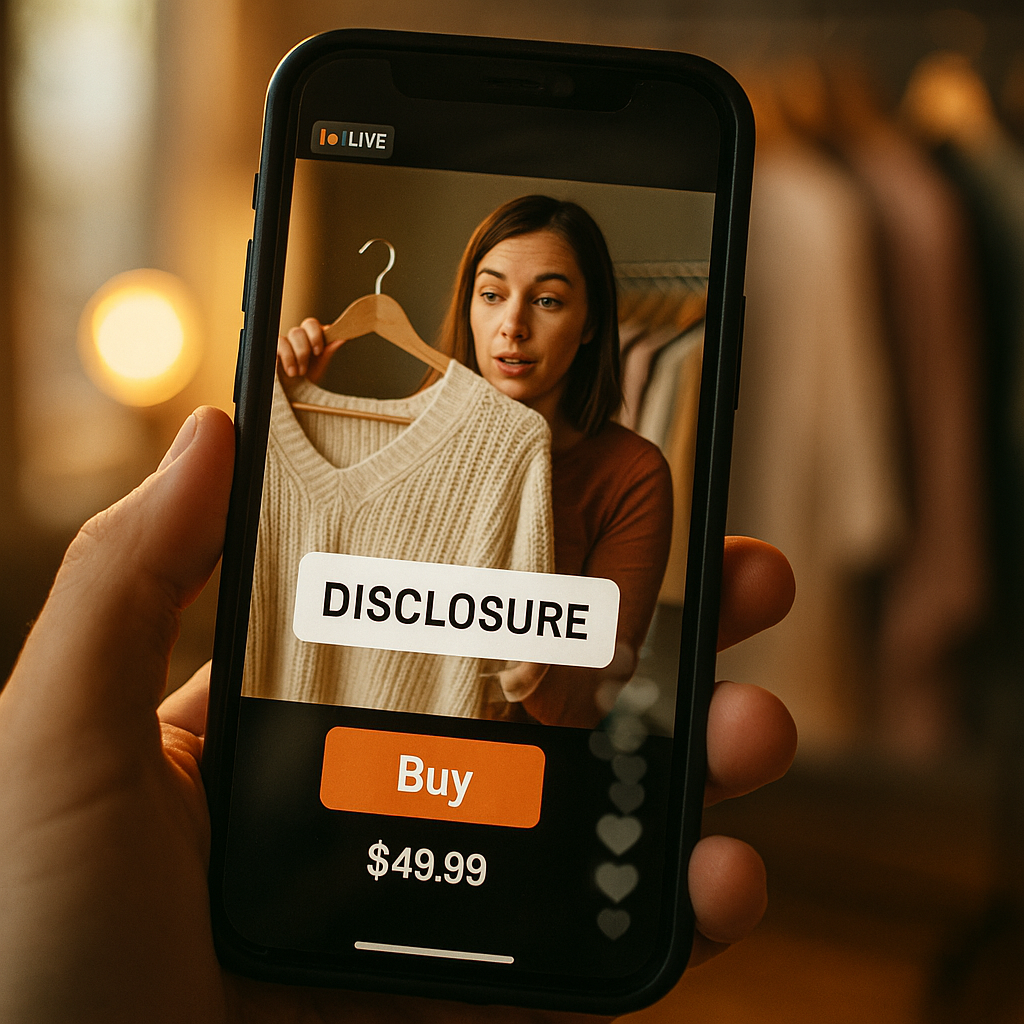
Shoppable livestreams move fast. A host can go from unboxing to “link in bio, swipe up now” in under ten seconds, and the FTC doesn’t care that you didn’t have time to flash a disclosure. Real-time disclosure isn’t optional anymore, it’s the price of admission for brands running live commerce. With TikTok Shop, Amazon Live, and Instagram Live checkout features scaling fast, the compliance gap is widening just as quickly as the revenue opportunity.
Live commerce sales in the United States are projected to climb well past the tens of billions in coming years, according to eMarketer’s live commerce forecasts. That growth is exactly why regulators are paying closer attention. A pretaped ad gets reviewed before it airs. A livestream doesn’t. There’s no legal team sitting between the creator’s mouth and the viewer’s purchase button, which means your disclosure strategy has to be baked into the format itself, not bolted on afterward.
Why Livestream Commerce Breaks the Old Disclosure Playbook
Most brand compliance programs were built around static assets: a sponsored post, a YouTube video with a description box, maybe a swipe-up story. Those formats give you time to review, edit, and approve before anything goes public. Livestream shopping removes that buffer entirely.
Think about what actually happens during a two-hour shoppable livestream. The host might mention a dozen different products, several of which are paid placements and some of which are genuine personal picks. Viewers drop in and out constantly, so a disclosure made in minute three means nothing to someone who joined at minute forty. The FTC’s own endorsement guidance is clear that disclosures must be clear, conspicuous, and repeated throughout content where viewers may not see the beginning. That standard was written with evergreen video in mind, but it applies with even more force to live, ephemeral formats.
A single disclosure at the top of a livestream protects nobody. If a viewer joins mid-stream and buys a product without ever seeing that one disclaimer, the brand is still on the hook.
This is the same structural problem we’ve covered when brands try to unify requirements across platforms. If you haven’t already built a baseline, our breakdown of cross platform disclosure rules is a useful starting point before you layer live commerce on top.
The Real-Time Disclosure Compliance Checklist
Here’s the operational checklist we recommend brands run through before greenlighting any shoppable livestream, whether it’s hosted by an in-house team member or an external creator.
- Pre-stream disclosure script approval. Require creators to submit the exact disclosure language they’ll use, not just a general agreement to “follow FTC rules.” Vague contract language is where most disputes start.
- Recurring on-screen disclosure overlay. Static text badges (“Paid Partnership,” “#Ad”) should persist throughout the stream, not just appear once at the start. Platforms like TikTok Shop and Instagram Live support persistent overlays for this exact reason.
- Verbal disclosure at natural segment breaks. Every time the host introduces a new product or returns from a pause, the paid relationship should be restated verbally. This covers viewers who join late.
- Product-level tagging accuracy. If only some products in the stream are sponsored, each one needs its own clear tag. Blanket disclosures that cover an entire stream when only three of fifteen products are paid placements can mislead viewers about which recommendations are genuine.
- Live moderation for off-script claims. Hosts improvise. Someone monitoring chat and audio in real time needs the authority to flag or correct unsubstantiated claims before they spiral, especially for health, finance, or efficacy statements.
- Archived recording with timestamped disclosures. Once the stream ends, the replay becomes evergreen content. The disclosures that worked live need to still function in the recorded version, which often means adding permanent captions or on-screen text in post-production.
- Documented proof of compliance. Screenshots, recordings, and chat logs should be archived for a minimum retention period in case of an FTC inquiry or platform audit.
That last point matters more than most brands realize. If a complaint surfaces months later, “we’re pretty sure the host said it was an ad” isn’t a defense. You need a record. For teams building out retention policies, the considerations in creator data retention policy planning translate directly to livestream archives.
Platform Rules Aren’t Interchangeable
Here’s where brands get tripped up: they assume a disclosure method that satisfies one platform automatically satisfies another. It doesn’t.
TikTok Shop requires creators to use the platform’s built-in branded content toggle, which generates a persistent disclosure label throughout the livestream. Relying solely on verbal disclosure without activating that toggle violates both TikTok’s advertising policies and FTC guidance simultaneously.
Instagram Live shopping, run through Meta’s business tools, has its own paid partnership label system, but it doesn’t automatically repeat throughout long streams the way some brands assume. You often need to manually prompt hosts to restate the label at intervals.
Amazon Live operates under its own influencer program terms, which layer Amazon’s affiliate disclosure requirements on top of FTC rules, creating a double disclosure obligation that trips up creators moving from other platforms.
If your influencer program spans multiple platforms, and most do, you can’t run a single disclosure template and call it done. We’ve written extensively about building one unified matrix instead of chasing platform-by-platform rules; see our quarterly audit cadence approach for a model you can adapt to live formats specifically.
Who Actually Gets Blamed When It Goes Wrong?
This is the question legal teams ask first, and the honest answer is: often both parties, but brands usually absorb the bigger reputational hit. The FTC has shown it will pursue brands directly, not just creators, when sponsored content lacks adequate disclosure. Contracts that push all disclosure responsibility onto the creator don’t actually shield the brand from regulatory action, though they do matter for internal indemnification.
This is where the overlap with broader liability frameworks becomes relevant. If a livestream host makes an unsubstantiated product claim during a sponsored segment, you’re looking at the same attribution questions we cover in creator attribution liability. Who approved the script? Who monitored the live feed? Who has the documentation proving reasonable oversight? Those answers determine how exposure gets allocated.
Brands that treat livestream disclosure as a creator-only responsibility are building their compliance program on a contract clause, not a control system. Clauses don’t catch problems in real time. Monitoring does.
There’s also an insurance angle worth flagging. Standard media liability policies weren’t written with live, unscripted commerce in mind, and gaps are showing up as claims increase. If you haven’t reviewed your coverage against this specific risk, the analysis in influencer marketing insurance is worth a read before your next campaign cycle.
Building a Monitoring Workflow That Doesn’t Slow Down Commerce
Compliance teams sometimes assume real-time monitoring means slowing the stream down or adding friction that kills conversion. It doesn’t have to.
The practical model most mature brands use looks like this: a dedicated compliance observer (sometimes a junior team member, sometimes a third-party monitoring service) watches the stream live with a checklist open, not editing or interrupting, just flagging. If a verbal disclosure gets skipped after a product transition, they ping the host’s producer immediately through a side channel, like a producer headset or chat backend, so it gets corrected within the next segment rather than after the fact.
This is cheaper and faster than post-stream legal review, and it catches problems while they’re still fixable. Platforms increasingly support this kind of real-time producer communication specifically because live commerce brands demanded it.
For evergreen replay content pulled from these streams, don’t assume the job is done once the live broadcast ends. Our piece on evergreen affiliate content audits covers exactly this handoff point, where live disclosures need to be converted into permanent, visible text for anyone watching the recording later.
One more operational note: track disclosure compliance the same way you’d track any other campaign KPI. Tools like Sprout Social and similar social listening platforms can help flag mentions and comments where viewers express confusion about whether something was sponsored, which is often an early warning sign that your disclosure wasn’t conspicuous enough.
FAQs
Frequently Asked Questions
What counts as a “clear and conspicuous” disclosure during a live shoppable stream?
The FTC requires disclosures that a reasonable viewer can’t miss or misinterpret, meaning they need to be visually persistent (not a one-time flash) and verbally repeated at natural breaks, especially since viewers join and leave at different times throughout a live broadcast.
Do platform-native disclosure tools satisfy FTC requirements on their own?
Not always. Platform labels like TikTok’s branded content toggle help, but they don’t automatically cover every FTC requirement, particularly around repetition for late-joining viewers and accuracy when only some products in a stream are sponsored.
Who is legally responsible if a livestream host fails to disclose a paid partnership?
Both the creator and the brand can face scrutiny. The FTC has pursued brands directly in past enforcement actions, so contractual language shifting responsibility to the creator doesn’t fully protect the brand from regulatory exposure.
How long should brands retain recordings and disclosure records from shoppable livestreams?
Most compliance teams retain livestream recordings, chat logs, and disclosure documentation for at least two to three years, though retention periods should align with your broader creator data retention policy and any applicable state record-keeping requirements.
Does a replayed livestream need different disclosures than the original live broadcast?
Yes. Once a stream becomes an archived replay, it functions as evergreen content, so verbal disclosures made once during the live broadcast often need to be converted into permanent on-screen text or captions for viewers watching the recording later.
The brands winning in live commerce right now treat disclosure as a production requirement, not a legal afterthought. Build the checklist into your pre-stream runbook, assign a live monitor, and archive everything. Do that consistently, and you’ll spend far less time explaining yourself to regulators later.
Top Influencer Marketing Agencies
The leading agencies shaping influencer marketing in 2026
Agencies ranked by campaign performance, client diversity, platform expertise, proven ROI, industry recognition, and client satisfaction. Assessed through verified case studies, reviews, and industry consultations.
Moburst

-
2

The Shelf
Boutique Beauty & Lifestyle Influencer AgencyA data-driven boutique agency specializing exclusively in beauty, wellness, and lifestyle influencer campaigns on Instagram and TikTok. Best for brands already focused on the beauty/personal care space that need curated, aesthetic-driven content.Clients: Pepsi, The Honest Company, Hims, Elf Cosmetics, Pure LeafVisit The Shelf → -
3

Audiencly
Niche Gaming & Esports Influencer AgencyA specialized agency focused exclusively on gaming and esports creators on YouTube, Twitch, and TikTok. Ideal if your campaign is 100% gaming-focused — from game launches to hardware and esports events.Clients: Epic Games, NordVPN, Ubisoft, Wargaming, Tencent GamesVisit Audiencly → -
4

Viral Nation
Global Influencer Marketing & Talent AgencyA dual talent management and marketing agency with proprietary brand safety tools and a global creator network spanning nano-influencers to celebrities across all major platforms.Clients: Meta, Activision Blizzard, Energizer, Aston Martin, WalmartVisit Viral Nation → -
5

The Influencer Marketing Factory
TikTok, Instagram & YouTube CampaignsA full-service agency with strong TikTok expertise, offering end-to-end campaign management from influencer discovery through performance reporting with a focus on platform-native content.Clients: Google, Snapchat, Universal Music, Bumble, YelpVisit TIMF → -
6

NeoReach
Enterprise Analytics & Influencer CampaignsAn enterprise-focused agency combining managed campaigns with a powerful self-service data platform for influencer search, audience analytics, and attribution modeling.Clients: Amazon, Airbnb, Netflix, Honda, The New York TimesVisit NeoReach → -
7

Ubiquitous
Creator-First Marketing PlatformA tech-driven platform combining self-service tools with managed campaign options, emphasizing speed and scalability for brands managing multiple influencer relationships.Clients: Lyft, Disney, Target, American Eagle, NetflixVisit Ubiquitous → -
8

Obviously
Scalable Enterprise Influencer CampaignsA tech-enabled agency built for high-volume campaigns, coordinating hundreds of creators simultaneously with end-to-end logistics, content rights management, and product seeding.Clients: Google, Ulta Beauty, Converse, AmazonVisit Obviously →