


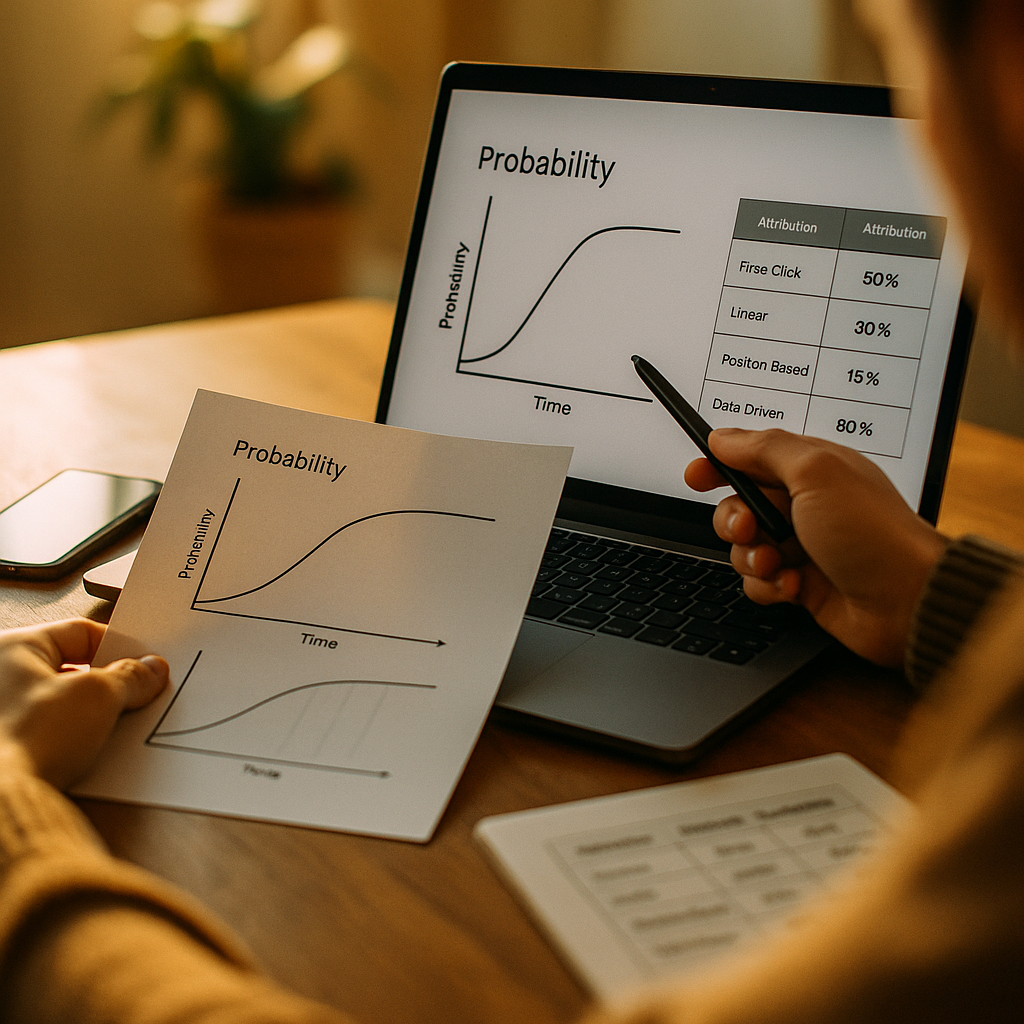
Someone asks ChatGPT for skincare advice on a Tuesday. Your creator’s product gets name-checked. The conversion happens three weeks later, on a different device, through a branded search. Your attribution model sees none of it. If this sounds familiar, you’re not alone — a probabilistic attribution model built for creator-driven conversions is quickly becoming table stakes, not a nice-to-have.
Last-click attribution was already broken before answer engines entered the picture. Now it’s not just broken, it’s blind. AI answer engines like ChatGPT, Perplexity, and Google’s AI Overviews are inserting themselves into the consideration window in ways that leave almost no clickstream trace. A creator’s product mention gets surfaced in an LLM response, the user closes the tab, and nothing fires. No UTM. No referrer. No cookie. Then, seventeen days later, that same user converts through organic search or a direct visit. Your dashboard calls it “unattributed.” Your CFO calls it a wasted budget line.
Why Delayed Conversions Break Deterministic Models
Deterministic attribution needs a clean, unbroken chain: click, session, identifier, conversion. It was designed for an era when the browser was the primary interface between a person and a brand. Answer engines don’t work that way. They compress research into a single conversational exchange, often stripping out the links, tracking parameters, and session continuity that deterministic models depend on.
The result is a growing “dark middle” — a stretch of the funnel where influence clearly happened but evidence doesn’t survive the trip.
This isn’t a hypothetical problem. Referral traffic from AI assistants has been climbing fast, and most GA4 setups still misclassify or bucket it as direct or unassigned. If you haven’t looked closely at how your analytics stack handles this traffic, start there — our breakdown on building dashboards that prove ROI from AI assistant traffic is a useful first diagnostic.
When the gap between exposure and conversion stretches past 14 days, deterministic attribution doesn’t just undercount influence — it actively misattributes it to whatever channel happened to be present at the moment of purchase.
What a Probabilistic Model Actually Requires
Probabilistic attribution doesn’t try to prove a single path caused a conversion. It estimates the likelihood that a given exposure contributed, based on patterns across many similar journeys. Think of it less like a receipt and more like a weather forecast — you’re not claiming certainty, you’re quantifying probability with enough rigor that decisions can be made confidently.
Building one for creator content surfaced through answer engines requires four core inputs.
- Exposure logging at the content level. You need to know which creator content is being indexed, cited, or summarized by AI answer engines, and roughly when. This means monitoring not just your owned channels but how LLMs are ingesting and referencing creator posts, reviews, and videos.
- A durable identity layer. Since session-based tracking breaks down, you need identity resolution that works across devices and time. This is where match rate quality becomes existential — if your identity graph resolves at 60%, you’re building probability estimates on a foundation with a 40% blind spot. Our piece on why a 60% match rate still fragments data is worth revisiting before you build anything on top of it.
- Time-decay and lag-window modeling. Conversions surfacing two, three, or four weeks out need their own decay curves, distinct from the 24-48 hour windows most platforms default to.
- A control group or holdout methodology. Without some form of incrementality testing, probabilistic models risk becoming elaborate justification engines rather than honest measurement tools.
None of this works if your underlying customer data is fragmented across six systems that don’t talk to each other. That’s not a creator-marketing problem, it’s a data architecture problem, and it deserves attention first.
Start With the Identity Graph, Not the Model
Marketers love to jump straight to model architecture — Markov chains, Shapley value, multi-touch weighting schemes — before fixing the plumbing underneath. That’s backwards. A probabilistic model is only as good as the identity resolution feeding it.
If you can’t reliably connect “person exposed to creator content on mobile” with “person who converted on desktop three weeks later,” no amount of statistical sophistication saves you.
This is why AI-driven identity graphs have become foundational infrastructure rather than a nice add-on. They stitch together fragmented signals — email hashes, device IDs, CRM records, loyalty program data — into a probabilistic identity itself, before you even get to attribution modeling. Get this layer wrong and everything downstream inherits the error.
Get it right, and you’ve got a real shot at closing the gap between exposure and delayed conversion.
Designing the Lag-Window Architecture
Standard attribution windows (7-day click, 1-day view) were built for paid social, not answer-engine discovery. Creator-driven conversions surfacing weeks later need a different temporal model entirely.
Here’s a practical approach:
- Segment by content type and typical consideration cycle. A creator review of a $40 skincare product has a different lag profile than a creator breakdown of a $2,000 mattress. Build separate decay curves for high-consideration vs. low-consideration categories.
- Extend your lookback window to 30-45 days for AI-influenced segments. This feels uncomfortable if you’re used to 7-day attribution, but the data justifies it. Answer engine exposure functions more like upper-funnel brand awareness than a direct-response click.
- Weight exposure recency logarithmically, not linearly. A conversion 3 days after exposure should carry meaningfully more weight than one at 25 days, but the drop-off shouldn’t be a cliff — LLM-surfaced information tends to linger in a user’s decision-making longer than a paid ad impression does.
- Cross-reference with branded search lift. If branded search volume spikes in a market where a creator’s AI-surfaced content was heavily cited, that’s a strong probabilistic signal worth weighting into the model even without a direct click path.
This is essentially what warehouse-native attribution approaches are built for — running these calculations against raw, unified data rather than relying on a vendor’s black-box logic. If you’re still leaning on a platform that won’t show its methodology, that’s a real limitation. See our analysis on how warehouse-native attribution replaces black-box tools for a deeper look at why this matters for exactly this kind of modeling.
The Statistical Backbone: Which Method Actually Fits
You don’t need a PhD in statistics to run this, but you do need to pick a method deliberately rather than defaulting to whatever your MTA platform ships with.
- Markov chain modeling works well when you have enough volume to map realistic multi-touch paths, including AI-exposure touchpoints as a distinct node type. It handles removal-effect analysis cleanly, showing you what conversion rate drops if you strip creator/AI exposure out of the path entirely.
- Shapley value attribution distributes credit fairly across touchpoints based on marginal contribution, which is useful when creator content and paid media are both present in a journey and you need to avoid over- or under-crediting either.
- Bayesian structural time-series models (similar to what’s used in geo-lift testing) are strong for measuring aggregate lift from a creator campaign at the market level, sidestepping individual-level tracking gaps entirely. This is often the most honest option when identity resolution is genuinely weak.
Most mature teams end up running a hybrid: Bayesian lift modeling for the broad “did this campaign work” question, and Markov or Shapley for the granular “which creators and content pieces deserve budget” question.
Where Governance Fits In
A probabilistic model that nobody trusts is worse than no model at all — it just adds false confidence to bad decisions. This is where governance discipline matters as much as the statistics.
Document your assumptions. Show your work on decay curves. Set a re-validation cadence, quarterly at minimum, since answer engine behavior and citation patterns are still shifting fast.
Gartner’s recent guidance on AI marketing tooling has been blunt about this: governance needs to come before scale, not after. Our summary of Gartner’s AI marketing hype cycle lays out why teams that skip this step tend to build models that look sophisticated but collapse under audit.
Data contracts matter here too. If the teams feeding your attribution pipeline (analytics, CRM, creator platform data) aren’t operating under clear schema agreements, your model will silently break every time someone changes a field name. We’ve covered this risk in depth in our piece on stopping AI-driven data breakage — it’s a less glamorous problem than model architecture, but it causes more attribution failures in practice.
A model built on a 60% identity match rate and undocumented decay assumptions isn’t measurement — it’s a guess with better formatting.
Testing the Model Without Fooling Yourself
Run holdout tests. Pull a comparable audience segment, suppress creator content exposure (or measure a market where it wasn’t run), and compare conversion lift against your model’s predicted contribution. If your probabilistic model says creator exposure drove 18% of conversions in a category but your holdout shows a 4% actual lift, the model is overcrediting and needs recalibration.
This isn’t a one-time exercise. Run it quarterly, especially as answer engines change how they cite and summarize creator content — a shift in an LLM’s citation behavior can quietly invalidate your exposure logging without any obvious signal that it happened.
Industry data on this is still catching up to the pace of change. eMarketer’s research on emerging attribution methods and Statista’s tracking of AI-assisted search adoption are both useful benchmarks for sanity-checking your assumptions against broader market trends, even if neither has category-specific data for your exact use case yet.
Practical Starting Point for Teams With Limited Data Science Resources
Not every brand has a data science team on staff, and that’s fine. A simplified version of this model still beats last-click. Start by tagging creator content with consistent identifiers across platforms, extend your GA4 lookback windows for campaigns you suspect have AI-answer-engine influence, and manually cross-reference branded search spikes against creator posting dates and AI citation events. It’s not elegant. But it’s directionally honest, which is more than most last-click dashboards can claim right now.
As your data maturity grows, layer in the identity resolution and statistical modeling described above. The goal isn’t perfection on day one — it’s building a measurement discipline that gets more accurate every quarter instead of staying stuck at “we think it worked.”
Start small: pick one high-consideration product category, build a 30-day lag window model for it this quarter, and validate against a holdout before rolling the approach out further.
FAQs
What is probabilistic attribution and how does it differ from multi-touch attribution?
Probabilistic attribution estimates the likelihood that a touchpoint contributed to a conversion using statistical modeling across aggregated patterns, rather than tracing a deterministic, individual-level path. Multi-touch attribution typically requires a traceable click or identifier at every step, which breaks down when conversions surface weeks after an untracked exposure like an AI answer engine citation.
Why do AI answer engines create attribution blind spots for creator content?
Answer engines like ChatGPT and Perplexity often summarize or cite creator content conversationally, without generating a click, UTM parameter, or referrer that traditional analytics tools can capture. The user’s next action, sometimes weeks later, then gets attributed to whatever channel is visible at conversion time, even though the AI-surfaced creator content was the actual influence.
How long should attribution windows be for creator-driven conversions?
Most teams need to extend lookback windows well beyond the standard 7-day click window, often to 30-45 days for high-consideration categories where AI-assisted research is common. The right window depends on your product’s typical consideration cycle and should be validated against actual observed lag data rather than assumed.
Can probabilistic attribution work without perfect identity resolution?
Yes, but accuracy suffers proportionally to your identity gaps. Bayesian lift modeling at the market or geo level can sidestep individual-level identity requirements entirely, making it a more reliable fallback when your identity graph has low match rates.
How often should a probabilistic attribution model be revalidated?
Quarterly at minimum, and more frequently if you’re in a category where AI answer engine citation behavior is changing fast. Run holdout tests each cycle to confirm the model’s predicted lift roughly matches observed lift in a suppressed or comparable segment.
FAQs
What is probabilistic attribution and how does it differ from multi-touch attribution?
Probabilistic attribution estimates the likelihood that a touchpoint contributed to a conversion using statistical modeling across aggregated patterns, rather than tracing a deterministic, individual-level path. Multi-touch attribution typically requires a traceable click or identifier at every step, which breaks down when conversions surface weeks after an untracked exposure like an AI answer engine citation.
Why do AI answer engines create attribution blind spots for creator content?
Answer engines like ChatGPT and Perplexity often summarize or cite creator content conversationally, without generating a click, UTM parameter, or referrer that traditional analytics tools can capture. The user’s next action, sometimes weeks later, then gets attributed to whatever channel is visible at conversion time, even though the AI-surfaced creator content was the actual influence.
How long should attribution windows be for creator-driven conversions?
Most teams need to extend lookback windows well beyond the standard 7-day click window, often to 30-45 days for high-consideration categories where AI-assisted research is common. The right window depends on your product’s typical consideration cycle and should be validated against actual observed lag data rather than assumed.
Can probabilistic attribution work without perfect identity resolution?
Yes, but accuracy suffers proportionally to your identity gaps. Bayesian lift modeling at the market or geo level can sidestep individual-level identity requirements entirely, making it a more reliable fallback when your identity graph has low match rates.
How often should a probabilistic attribution model be revalidated?
Quarterly at minimum, and more frequently if you’re in a category where AI answer engine citation behavior is changing fast. Run holdout tests each cycle to confirm the model’s predicted lift roughly matches observed lift in a suppressed or comparable segment.
Top Influencer Marketing Agencies
The leading agencies shaping influencer marketing in 2026
Agencies ranked by campaign performance, client diversity, platform expertise, proven ROI, industry recognition, and client satisfaction. Assessed through verified case studies, reviews, and industry consultations.
Moburst

-
2

The Shelf
Boutique Beauty & Lifestyle Influencer AgencyA data-driven boutique agency specializing exclusively in beauty, wellness, and lifestyle influencer campaigns on Instagram and TikTok. Best for brands already focused on the beauty/personal care space that need curated, aesthetic-driven content.Clients: Pepsi, The Honest Company, Hims, Elf Cosmetics, Pure LeafVisit The Shelf → -
3

Audiencly
Niche Gaming & Esports Influencer AgencyA specialized agency focused exclusively on gaming and esports creators on YouTube, Twitch, and TikTok. Ideal if your campaign is 100% gaming-focused — from game launches to hardware and esports events.Clients: Epic Games, NordVPN, Ubisoft, Wargaming, Tencent GamesVisit Audiencly → -
4

Viral Nation
Global Influencer Marketing & Talent AgencyA dual talent management and marketing agency with proprietary brand safety tools and a global creator network spanning nano-influencers to celebrities across all major platforms.Clients: Meta, Activision Blizzard, Energizer, Aston Martin, WalmartVisit Viral Nation → -
5

The Influencer Marketing Factory
TikTok, Instagram & YouTube CampaignsA full-service agency with strong TikTok expertise, offering end-to-end campaign management from influencer discovery through performance reporting with a focus on platform-native content.Clients: Google, Snapchat, Universal Music, Bumble, YelpVisit TIMF → -
6

NeoReach
Enterprise Analytics & Influencer CampaignsAn enterprise-focused agency combining managed campaigns with a powerful self-service data platform for influencer search, audience analytics, and attribution modeling.Clients: Amazon, Airbnb, Netflix, Honda, The New York TimesVisit NeoReach → -
7

Ubiquitous
Creator-First Marketing PlatformA tech-driven platform combining self-service tools with managed campaign options, emphasizing speed and scalability for brands managing multiple influencer relationships.Clients: Lyft, Disney, Target, American Eagle, NetflixVisit Ubiquitous → -
8

Obviously
Scalable Enterprise Influencer CampaignsA tech-enabled agency built for high-volume campaigns, coordinating hundreds of creators simultaneously with end-to-end logistics, content rights management, and product seeding.Clients: Google, Ulta Beauty, Converse, AmazonVisit Obviously →