


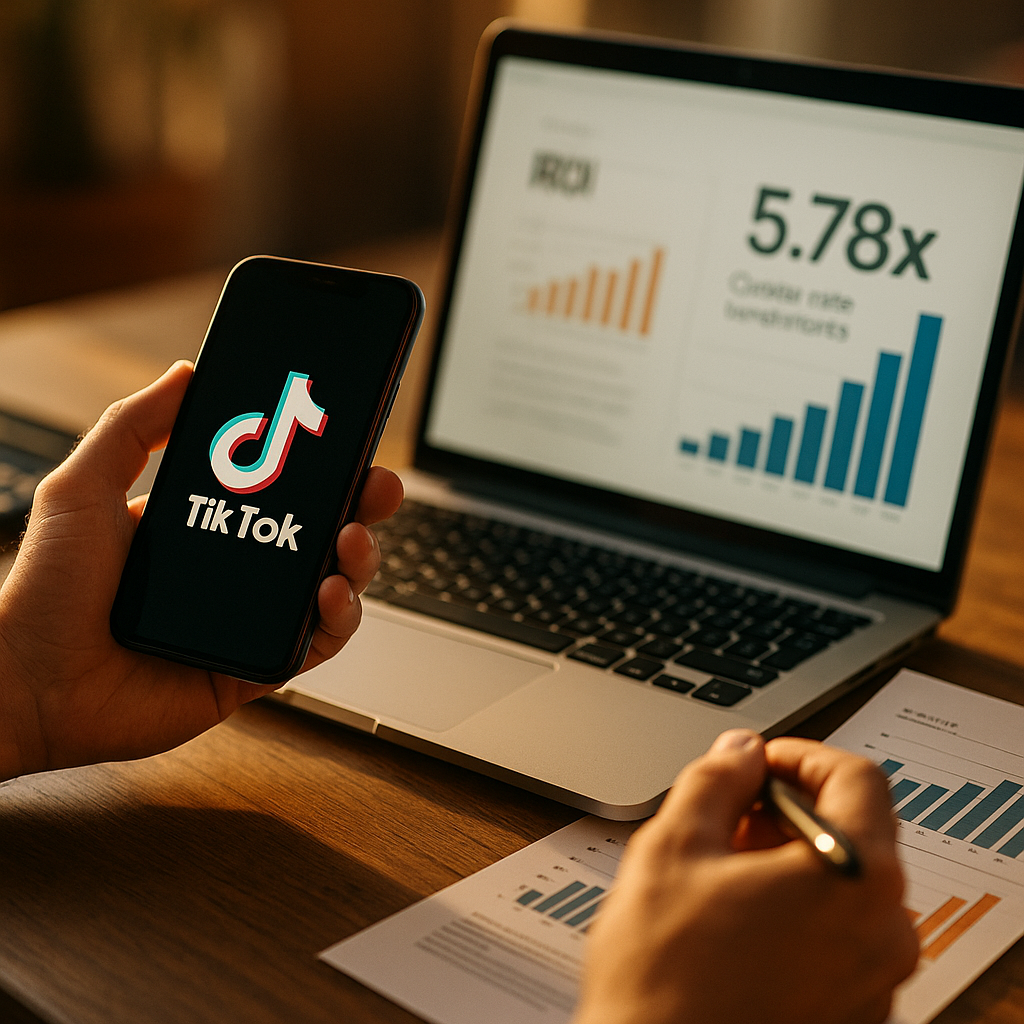
A $5.78 return for every dollar spent sounds like a slam dunk. So why are so many brands still overpaying for TikTok creator content? The latest TikTok creator rate benchmarks expose a widening gap between what agencies quote and what performance data actually justifies — and that gap is now the single best renegotiation lever brand teams have going into next quarter.
If you’re running multi-creator iteration campaigns (the “test fifteen creators, scale the three that work” model), this data changes your math. Let’s get into what’s actually happening with rates, why the $5.78 figure is more nuanced than it looks, and how to use it at the negotiating table.
The $5.78 Number, Unpacked
The figure comes from aggregated performance data across mid-tier and micro creator campaigns run through TikTok’s creator marketplace tooling, cross-referenced against brand-reported attribution. It represents blended ROI across an entire iteration cycle — not a single creator, not a single video. That distinction matters enormously, and it’s the first thing most media buyers gloss over when they cite the stat in a pitch deck.
Here’s the nuance: the $5.78 average masks a brutal power-law distribution. A handful of creators in any given test batch drive the overwhelming majority of that return. The rest hover near breakeven or lose money. If you’ve read our iteration budget framework, you already know this pattern. What’s new is that we now have harder rate data showing exactly how much brands are overpaying for the creators in that long tail.
Across recent campaign audits, brands paid flat rates to underperforming creators that were, on average, 40-60% higher than what performance-based pricing would have justified — meaning the $5.78 blended ROI could be closer to $7-8 if rate cards matched actual output.
Why Rate Cards Haven’t Caught Up
Most agency rate cards are still built on follower count and historical engagement rate. That’s a relic. TikTok’s own algorithm shifts — see the Andromeda update and the more recent watch-time algorithm changes — have made follower count nearly irrelevant to actual reach. A creator with 40,000 followers can outperform one with 400,000 if their hook rate and completion rate are strong. Yet rate cards haven’t moved. Agencies are still selling reach that the platform itself no longer rewards.
This is where renegotiation conversations get productive fast. You’re not asking creators to work for less. You’re asking for pricing structures that reflect how TikTok actually distributes content in 2026.
What Multi-Creator Iteration Campaigns Actually Cost
Let’s talk real numbers. A typical iteration campaign — 12 to 20 creators, single-video briefs, two-week test window — runs anywhere from $18,000 to $65,000 depending on tier mix. Nano and micro creators (10K-100K followers) still command $150-$600 per video. Mid-tier (100K-500K) run $800-$2,500. That’s not dramatically different from a year ago.
What has changed is the variance in output per dollar. Brands running structured tests through platforms like TikTok’s Creator Marketplace or via agencies report that the top 20% of creators in any batch deliver 70-80% of total conversions. That’s not a new insight in influencer marketing broadly, but the size of the gap on TikTok specifically has grown as the algorithm has gotten better at matching content to niche audiences.
So if you’re paying flat, undifferentiated rates across a 15-creator test batch, you’re subsidizing failure. That’s fine during a true discovery phase — you don’t know who’ll win yet. But it’s indefensible once you have performance data and you’re still paying legacy rates for creator #2 through #12.
The Renegotiation Window
Here’s the practical move: renegotiate at the iteration-to-scale transition, not before. When a creator graduates from test batch to scaled retainer, that’s your leverage point. You have data. They want the bigger, recurring deal. Use both.
- Shift from flat fees to hybrid models — a smaller base fee plus performance bonuses tied to CTR, GMV, or completion rate.
- Tier your rate card by iteration-cycle performance, not follower count or past brand deals.
- Negotiate content usage rights separately from the base fee — many creators will lower upfront cost if you’re not asking for six months of paid whitelisting rights.
- Bundle iteration testing and scale phases into one contract with performance-triggered rate changes built in, so you’re not renegotiating from scratch every cycle.
This isn’t about squeezing creators. Fair pricing tied to performance actually benefits your best creators — they earn more when they win, instead of being capped at the same rate as the bottom performers in the batch.
Where the ROI Data Breaks Down (And What to Watch For)
No benchmark is bulletproof, and the $5.78 figure has real limitations you should flag before quoting it to your CFO.
First, attribution methodology varies wildly across brands reporting this data. Some are using last-click attribution on TikTok Shop; others are blending in multi-touch models that include organic lift. We’ve written before about how inflated view counts force KPI rebuilds on other platforms — the same caution applies here. Treat the $5.78 as directional, not gospel.
Second, category matters enormously. Beauty and fashion brands running TikTok Shop livestream campaigns see different ROI curves than B2B SaaS brands running awareness plays. If your category isn’t retail or DTC, don’t assume this number transfers cleanly. Check our livestream selling playbook for category-specific benchmarks before you build a renegotiation case around a generic average.
Third — and this is the one most brand teams miss — the ROI figure reflects campaigns that already had a disciplined testing budget separate from scale spend. Brands that skip the dedicated iteration phase and jump straight to scale tend to see far weaker returns, because they never isolate which creators are actually driving the number. Our budget framework for multi-creator testing covers exactly how to structure that separation.
If your iteration budget and scale budget are the same line item, you cannot isolate creator-level ROI — and you have no real basis to renegotiate rates with data. Separate the budgets first.
Building the Renegotiation Brief
Assuming you’ve got clean data, here’s how to structure the actual conversation with agencies or creator management teams.
Start with the iteration cycle results, not the rate card. Show completion rate, hook rate (three-second retention), and conversion metrics per creator. Then show the blended CAC or ROAS for the batch. Most agencies expect a rate conversation to start with “your prices are too high.” Flip it: start with performance data, and let the rate conversation follow naturally. It’s harder to argue with numbers than with vibes.
Second, propose the hybrid structure in writing before the call. Agencies negotiate better against a concrete proposal than an open-ended ask. Something like: base fee reduced 20%, plus a bonus structure tied to GMV per video for TikTok Shop-linked content. This mirrors what’s happening industry-wide — see how TikTok Shop’s own algorithm now rewards structure over followers. Your commercial terms should mirror the platform’s logic.
Third, lock in a review cadence. Rates shouldn’t be renegotiated monthly — that’s exhausting for everyone — but quarterly reviews tied to a rolling performance average give you a defensible, repeatable process instead of a one-off argument.
What Agencies Will Push Back On
Expect resistance on two fronts. Agencies will argue that performance-based models shift too much risk onto creators, especially nano and micro creators who don’t have the volume to absorb variance. That’s a fair point, and it’s why the base-plus-bonus hybrid works better than pure performance pay — it protects creator downside while still rewarding results.
They’ll also argue that TikTok Shop attribution isn’t reliable enough to base pay on. That’s partially true. Attribution windows, platform reporting changes, and the ongoing effects of data localization changes under Oracle have made some reporting noisier than brands would like. Your counter: use directional bonuses (tiers based on GMV ranges) rather than penny-precise performance pay. It sidesteps the attribution-precision argument entirely.
A Quick Gut Check Before You Renegotiate
Before you walk into any rate conversation, ask yourself three questions. Do you have at least one full iteration cycle of clean, creator-level data? Is your iteration budget separate from your scale budget, so the numbers aren’t muddied? And have you benchmarked your category specifically, rather than borrowing the $5.78 average wholesale?
If you answered no to any of those, spend the next cycle fixing that before you try to renegotiate anything. Rate conversations backed by half-clean data tend to backfire — agencies will find the gaps in your logic faster than you’d like.
According to eMarketer’s creator economy tracking and TikTok’s own advertising platform data, brands that separate testing and scale budgets consistently outperform blended-budget approaches on cost-per-acquisition. That’s not a TikTok-specific quirk — it’s basic media discipline applied to a newer channel.
The Next Step
Pull your last two iteration cycles, isolate creator-level performance against what you actually paid, and bring that spreadsheet — not the industry average — into your next agency call. The $5.78 benchmark is a useful headline, but your own iteration data is the only number that will actually move your rate card.
Frequently Asked Questions
What does the $5.78 ROI figure actually measure?
It’s a blended return-on-ad-spend figure aggregated across multiple brand-reported TikTok creator campaigns, typically combining creator fees, content production, and attributed sales or conversions. It reflects an average across an entire creator batch, not any single creator’s performance, so it should be treated as directional rather than a guaranteed outcome.
How often should brands renegotiate creator rates during an iteration campaign?
Renegotiate at the transition point between testing and scaling, then review on a quarterly cadence after that. Renegotiating mid-test, before you have performance data, wastes leverage and creates friction with creators who haven’t yet proven anything either way.
Should nano and micro creators be paid the same performance-based structure as mid-tier creators?
Not exactly. Nano and micro creators generally can’t absorb heavy performance-pay risk because their content volume is lower. A hybrid model — reduced base fee plus tiered bonuses — protects their downside while still rewarding standout performance.
Does this rate benchmark apply outside TikTok Shop and retail campaigns?
Not directly. The $5.78 figure is heavily influenced by TikTok Shop-linked, retail and DTC campaigns where attribution is cleaner. B2B, awareness-focused, or app-install campaigns typically show different ROI curves and need category-specific benchmarking.
What’s the biggest mistake brands make when trying to use this data to renegotiate?
Citing the industry average instead of their own campaign data. Agencies will (rightly) push back on a generic benchmark. The stronger move is bringing creator-level performance data from your own iteration cycles to the table.
Visible FAQ (duplicate for schema parity)
What does the $5.78 ROI figure actually measure?
It’s a blended return-on-ad-spend figure aggregated across multiple brand-reported TikTok creator campaigns, typically combining creator fees, content production, and attributed sales or conversions. It reflects an average across an entire creator batch, not any single creator’s performance, so it should be treated as directional rather than a guaranteed outcome.
How often should brands renegotiate creator rates during an iteration campaign?
Renegotiate at the transition point between testing and scaling, then review on a quarterly cadence after that. Renegotiating mid-test, before you have performance data, wastes leverage and creates friction with creators who haven’t yet proven anything either way.
Should nano and micro creators be paid the same performance-based structure as mid-tier creators?
Not exactly. Nano and micro creators generally can’t absorb heavy performance-pay risk because their content volume is lower. A hybrid model — reduced base fee plus tiered bonuses — protects their downside while still rewarding standout performance.
Does this rate benchmark apply outside TikTok Shop and retail campaigns?
Not directly. The $5.78 figure is heavily influenced by TikTok Shop-linked, retail and DTC campaigns where attribution is cleaner. B2B, awareness-focused, or app-install campaigns typically show different ROI curves and need category-specific benchmarking.
What’s the biggest mistake brands make when trying to use this data to renegotiate?
Citing the industry average instead of their own campaign data. Agencies will (rightly) push back on a generic benchmark. The stronger move is bringing creator-level performance data from your own iteration cycles to the table.
Top Influencer Marketing Agencies
The leading agencies shaping influencer marketing in 2026
Agencies ranked by campaign performance, client diversity, platform expertise, proven ROI, industry recognition, and client satisfaction. Assessed through verified case studies, reviews, and industry consultations.
Moburst

-
2

The Shelf
Boutique Beauty & Lifestyle Influencer AgencyA data-driven boutique agency specializing exclusively in beauty, wellness, and lifestyle influencer campaigns on Instagram and TikTok. Best for brands already focused on the beauty/personal care space that need curated, aesthetic-driven content.Clients: Pepsi, The Honest Company, Hims, Elf Cosmetics, Pure LeafVisit The Shelf → -
3

Audiencly
Niche Gaming & Esports Influencer AgencyA specialized agency focused exclusively on gaming and esports creators on YouTube, Twitch, and TikTok. Ideal if your campaign is 100% gaming-focused — from game launches to hardware and esports events.Clients: Epic Games, NordVPN, Ubisoft, Wargaming, Tencent GamesVisit Audiencly → -
4

Viral Nation
Global Influencer Marketing & Talent AgencyA dual talent management and marketing agency with proprietary brand safety tools and a global creator network spanning nano-influencers to celebrities across all major platforms.Clients: Meta, Activision Blizzard, Energizer, Aston Martin, WalmartVisit Viral Nation → -
5

The Influencer Marketing Factory
TikTok, Instagram & YouTube CampaignsA full-service agency with strong TikTok expertise, offering end-to-end campaign management from influencer discovery through performance reporting with a focus on platform-native content.Clients: Google, Snapchat, Universal Music, Bumble, YelpVisit TIMF → -
6

NeoReach
Enterprise Analytics & Influencer CampaignsAn enterprise-focused agency combining managed campaigns with a powerful self-service data platform for influencer search, audience analytics, and attribution modeling.Clients: Amazon, Airbnb, Netflix, Honda, The New York TimesVisit NeoReach → -
7

Ubiquitous
Creator-First Marketing PlatformA tech-driven platform combining self-service tools with managed campaign options, emphasizing speed and scalability for brands managing multiple influencer relationships.Clients: Lyft, Disney, Target, American Eagle, NetflixVisit Ubiquitous → -
8

Obviously
Scalable Enterprise Influencer CampaignsA tech-enabled agency built for high-volume campaigns, coordinating hundreds of creators simultaneously with end-to-end logistics, content rights management, and product seeding.Clients: Google, Ulta Beauty, Converse, AmazonVisit Obviously →