


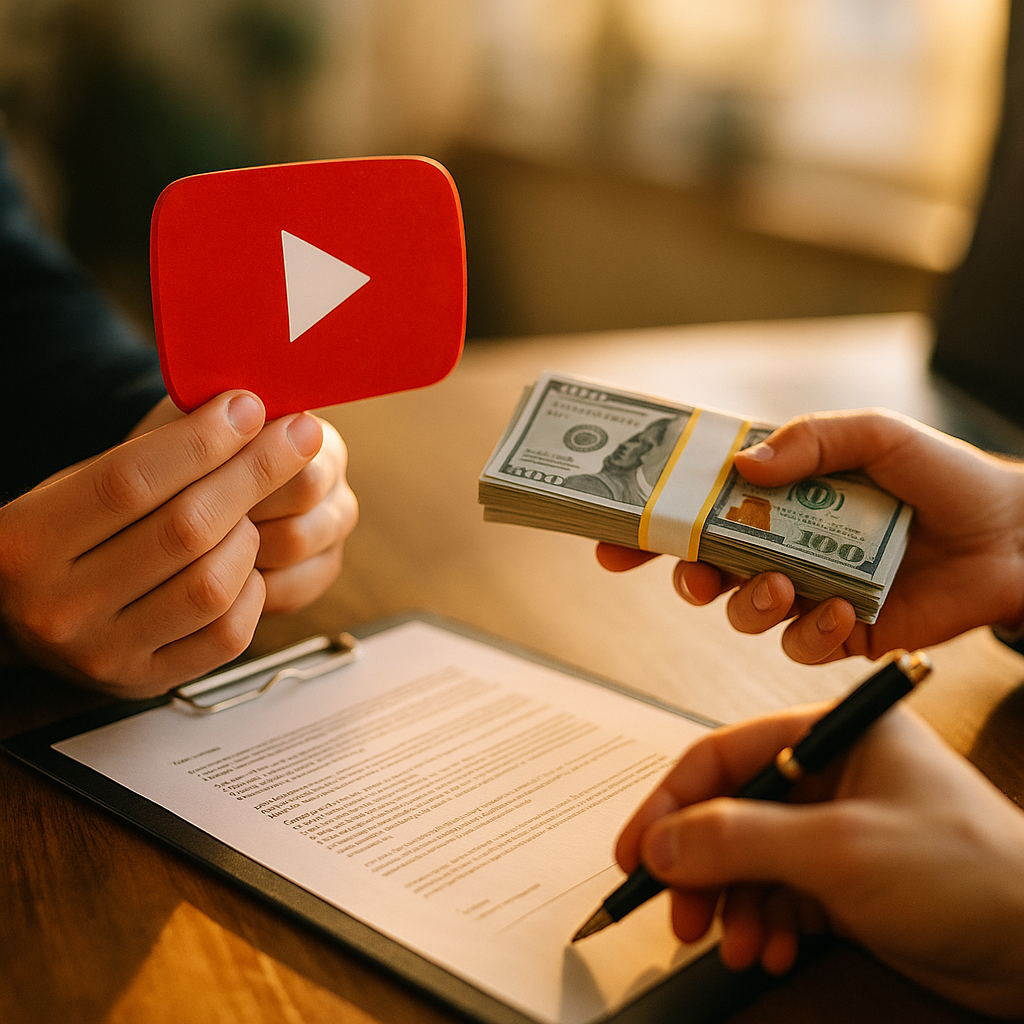
A creator with 40,000 subscribers just quoted a brand $18,000 for a single integration with 12-month paid usage rights. A creator with 400,000 subscribers quoted $4,000 for the same deliverable, organic-only. Both numbers are defensible. That gap is the entire story of YouTube usage rights pricing right now, and if your team is still building offers off subscriber tiers alone, you’re overpaying some creators and lowballing others without realizing it.
Subscriber count used to be the anchor for every rate card conversation. It isn’t anymore. Format, licensing scope, and where the content travels after publish now do more to set price than audience size ever did.
Why subscriber count stopped being the pricing anchor
Subscriber count still matters. It’s just no longer the primary lever. View count inflation and shifting engagement patterns have made raw audience size an unreliable proxy for reach, let alone value. Brands that priced deals purely on subscribers got burned when videos underperformed against inflated expectations, and creators got burned when brands lowballed based on niche audience size that converted far better than the numbers suggested.
What’s replaced it is a layered model. Subscriber count sets a baseline. Everything else — format, usage term, platform spread — multiplies from there. Think of it less like a rate card and more like a pricing matrix with three or four variables stacked on top of each other.
A 60,000-subscriber creator with a 12-month whitelisting license and cross-platform cutdown rights can legitimately out-earn a 500,000-subscriber creator doing an organic-only integration. Scale isn’t the multiplier anymore. Usage scope is.
Format still drives the base rate
Before you even get to usage rights, format sets the floor. This part hasn’t changed much, but it’s worth restating because brands still misjudge it constantly.
- Dedicated video: highest base rate. Full creative control sits with the creator, production time is longer, and the brand typically gets the entire runtime. Expect this to run 3-5x the cost of an integration for the same channel.
- Integration (60-90 second mid-roll mention): the most common format for mid-market budgets. Lower cost, faster turnaround, but shorter brand exposure and less narrative control.
- Shorts: priced lowest per-unit but often bought in bundles of three to six. Usage rights on Shorts are cheaper to license but the content decays fast, so brands buying long usage windows on Shorts specifically are often paying for shelf life the format doesn’t have.
Our earlier breakdown of dedicated video versus integration by funnel stage covers which format actually performs where in the funnel — worth pairing with this pricing framework before you brief.
The licensing scope conversation nobody frames correctly
Here’s where most brand teams still get it wrong. Usage rights aren’t a single line item. They’re a bundle of separate permissions, and each one has its own price tag:
- Organic-only: the content lives on the creator’s channel, no paid amplification. Cheapest tier.
- Whitelisting / spark ads equivalent: the brand can run the creator’s content through its own ad account, using the creator’s handle and social proof. This typically adds 40-80% on top of the base production fee.
- Usage term: 30 days, 90 days, six months, 12 months, perpetual. Perpetual licensing on YouTube content, particularly from creators with strong SEO-optimized channels, can cost 2-3x a standard 90-day term because the brand is effectively buying evergreen search traffic, not just a campaign flight.
- Cross-platform repurposing: the right to cut the video down and run it on Meta, TikTok, or connected TV. This is the fastest-growing line item on rate cards, and it’s frequently underpriced because brands ask for it as an afterthought rather than negotiating it upfront.
Each of these compounds. A creator quoting a flat number without breaking out these components is either underpricing themselves or building in enough padding that you’re overpaying for rights you may not use. Neither serves the deal.
What cross-platform promotion actually costs
This is the variable driving the biggest year-over-year rate increases. Brands aren’t just buying a YouTube video anymore — they’re buying a content asset that gets sliced into six formats and distributed across four platforms. That’s a fundamentally different commercial ask than it was three years ago.
Consider how this plays out in practice. A skincare brand licenses a 10-minute YouTube integration, then wants a 60-second cutdown for Instagram Reels, a vertical crop for TikTok, and a static carousel pulled from video stills for Meta feed. That’s four distinct usage contexts from one shoot. Smart creators price this as a package with per-platform add-ons rather than a single all-rights buy, because it lets brands scale spend to actual usage instead of overpaying for platforms they never touch.
This mirrors what’s happening on the paid social side, too — our coverage of Instagram whitelisting changes and the shift toward unified upfront creator buys both point to the same trend: platforms are converging on how they price and license the same underlying content, and brands need one negotiation framework that works across all of them, not a separate one per channel.
If your cross-platform usage terms aren’t itemized in the contract, you don’t have cross-platform rights. You have a verbal understanding that will not hold up when legal or the creator’s manager disputes scope six months in.
Building your own rate card benchmark
Rather than relying on published rate cards (most are outdated within a quarter), build an internal benchmark using four inputs:
- CPM-equivalent baseline. Divide the quoted rate by average views over the last 10 videos in the same format. Compare against your paid media CPMs. If influencer CPM is running 3-5x your paid social CPM, the usage rights premium needs to justify that gap.
- Engagement rate relative to niche. A finance or B2B SaaS channel with 3% engagement is outperforming most lifestyle channels at 6%, because purchase-intent audiences convert differently. Weight your benchmark by category, not a flat industry average.
- Historical usage utilization. Pull your last eight campaigns. How much of the licensed usage window did you actually use? If you’re consistently licensing 12 months and archiving the asset at month four, you’re overpaying on term length across your entire program.
- Format decay rate. Shorts and Reels lose relevance fast. Dedicated videos with strong SEO titles keep generating views for years. Price your usage term to match the actual half-life of the format, not a standardized company policy.
This is the same discipline that’s reshaping rate-setting on other platforms — see how TikTok rate benchmarking uses ROI leverage ratios instead of flat follower-based pricing. The underlying logic transfers directly to YouTube.
Where compliance and rights overlap
Usage rights aren’t just a pricing question, they’re a compliance one. The FTC’s endorsement guidance requires clear disclosure regardless of how content is licensed or repurposed, and that obligation travels with the content across every platform you push it to. If you whitelist a creator’s video and run it as a paid ad on Meta, the disclosure requirement doesn’t disappear just because the placement changed. This is especially relevant for regulated categories — see our breakdown of the YouTube health claims crackdown for how scrutiny is intensifying on repurposed wellness content specifically.
Build disclosure and FTC compliance language into the usage rights clause itself, not as a separate addendum. Legal teams that treat these as two negotiations tend to lose track of which platform-specific disclosure rules apply where.
What this means for budget planning
Stop building YouTube budgets as a flat per-video line item. Build them as a base production fee plus a rights matrix, and let the matrix flex based on which platforms and terms a given campaign actually needs. Data from eMarketer continues to show creator content outperforming traditional display on engagement metrics, but that outperformance only translates to ROI if you’re not overpaying for usage scope you’ll never activate.
Run a quarterly audit: pull every active usage license, check utilization against what was licensed, and renegotiate future deals based on what you actually use, not what felt safe to buy upfront.
FAQs
Frequently Asked Questions
How much do YouTube usage rights typically add to a base rate?
Whitelisting or paid amplification rights typically add 40-80% on top of the base production fee. Perpetual usage terms can add 2-3x versus a standard 90-day license, particularly for creators with strong search-optimized channels.
Does subscriber count still matter for YouTube pricing?
Yes, but as a baseline rather than the primary driver. Format, licensing scope, and cross-platform usage rights now account for more rate variance than subscriber count alone.
What’s the difference between organic and whitelisted usage rights?
Organic usage means the content only lives on the creator’s own channel with no paid support. Whitelisting allows the brand to run paid ads through the creator’s handle, which requires a separate, higher-priced license.
Should brands negotiate cross-platform rights upfront or as needed?
Upfront. Negotiating cross-platform repurposing rights after the fact almost always costs more and creates contract ambiguity around disclosure and usage term, especially when content moves to paid placements.
How long should a typical usage license run?
It depends on format decay. Dedicated long-form videos can justify 6-12 month terms since they retain search value. Shorts and short-form cutdowns rarely justify anything beyond 90 days given how fast engagement drops off.
The brands winning on YouTube in the next budget cycle won’t be the ones with the biggest creator rosters. They’ll be the ones with a rights matrix that prices format, term, and platform separately, and the discipline to audit usage against what they actually paid for.
Top Influencer Marketing Agencies
The leading agencies shaping influencer marketing in 2026
Agencies ranked by campaign performance, client diversity, platform expertise, proven ROI, industry recognition, and client satisfaction. Assessed through verified case studies, reviews, and industry consultations.
Moburst

-
2

The Shelf
Boutique Beauty & Lifestyle Influencer AgencyA data-driven boutique agency specializing exclusively in beauty, wellness, and lifestyle influencer campaigns on Instagram and TikTok. Best for brands already focused on the beauty/personal care space that need curated, aesthetic-driven content.Clients: Pepsi, The Honest Company, Hims, Elf Cosmetics, Pure LeafVisit The Shelf → -
3

Audiencly
Niche Gaming & Esports Influencer AgencyA specialized agency focused exclusively on gaming and esports creators on YouTube, Twitch, and TikTok. Ideal if your campaign is 100% gaming-focused — from game launches to hardware and esports events.Clients: Epic Games, NordVPN, Ubisoft, Wargaming, Tencent GamesVisit Audiencly → -
4

Viral Nation
Global Influencer Marketing & Talent AgencyA dual talent management and marketing agency with proprietary brand safety tools and a global creator network spanning nano-influencers to celebrities across all major platforms.Clients: Meta, Activision Blizzard, Energizer, Aston Martin, WalmartVisit Viral Nation → -
5

The Influencer Marketing Factory
TikTok, Instagram & YouTube CampaignsA full-service agency with strong TikTok expertise, offering end-to-end campaign management from influencer discovery through performance reporting with a focus on platform-native content.Clients: Google, Snapchat, Universal Music, Bumble, YelpVisit TIMF → -
6

NeoReach
Enterprise Analytics & Influencer CampaignsAn enterprise-focused agency combining managed campaigns with a powerful self-service data platform for influencer search, audience analytics, and attribution modeling.Clients: Amazon, Airbnb, Netflix, Honda, The New York TimesVisit NeoReach → -
7

Ubiquitous
Creator-First Marketing PlatformA tech-driven platform combining self-service tools with managed campaign options, emphasizing speed and scalability for brands managing multiple influencer relationships.Clients: Lyft, Disney, Target, American Eagle, NetflixVisit Ubiquitous → -
8

Obviously
Scalable Enterprise Influencer CampaignsA tech-enabled agency built for high-volume campaigns, coordinating hundreds of creators simultaneously with end-to-end logistics, content rights management, and product seeding.Clients: Google, Ulta Beauty, Converse, AmazonVisit Obviously →