


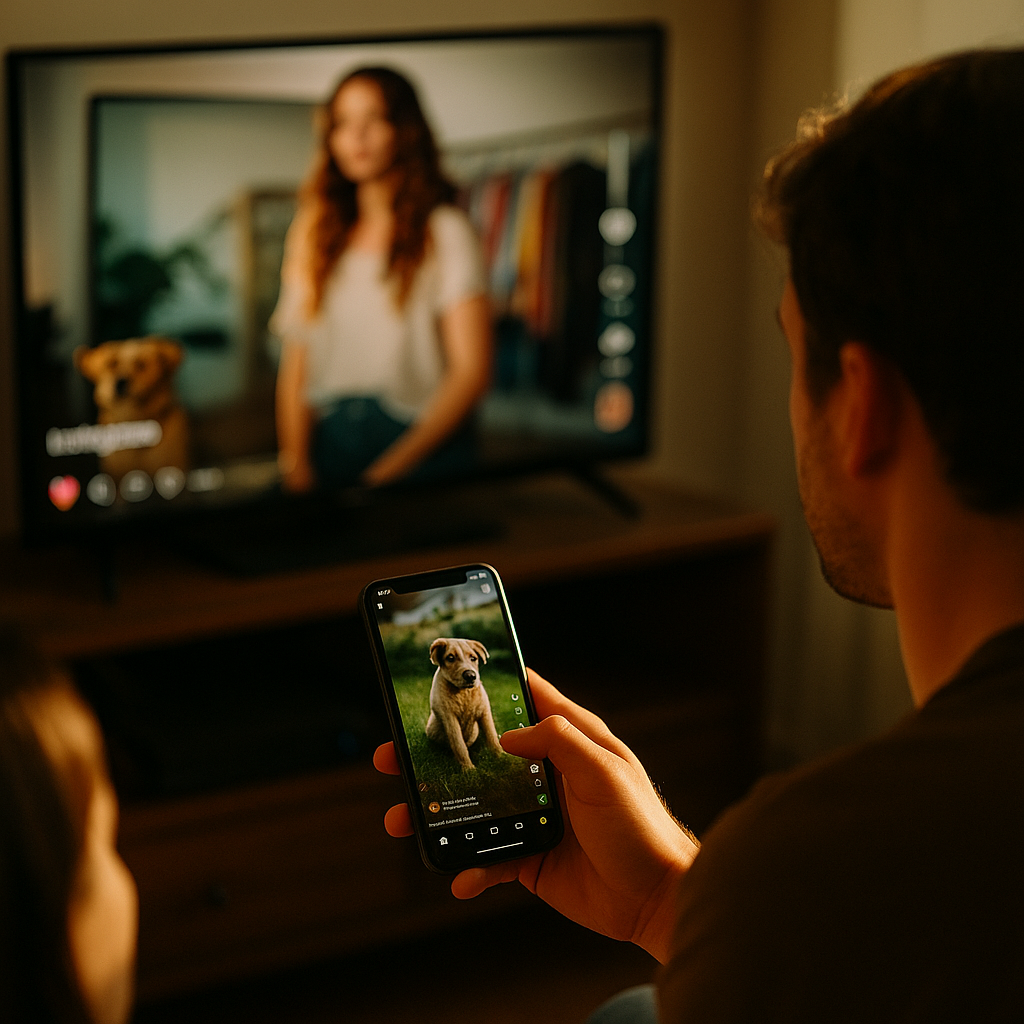
Sixty-two percent of Gen Z now watches connected TV and scrolls a second screen simultaneously, according to Nielsen. Instagram just decided to stop fighting that behavior and build a product around it. The platform’s new Instagram shared-scrolling TV format lets multiple people browse Reels together on a living room screen, turning a solitary phone habit into a group activity. If you run brand or creator campaigns, this isn’t a minor UI tweak. It’s a signal about where the platform, and the ad dollars chasing it, are headed next.
What Shared-Scrolling Actually Is
Instagram’s shared-scrolling TV experience lets two or more users, each on their own phone, control and view the same Reels feed on a connected television in real time. Think of it as a synchronized watch party, except instead of a movie, it’s an algorithmic feed of short-form content. One person swipes, everyone sees it. Anyone can react, comment, or take over the scroll. Meta has been testing this on Fire TV and other CTV devices as part of its broader push to get Instagram content onto bigger screens.
It sounds simple. It isn’t. Building a shared, low-latency, multi-user feed experience that works across device types and network conditions is a real engineering lift. Meta wouldn’t invest in that unless it saw a strategic opening worth the cost.
Why Meta Is Betting on the Living Room
Short-form video has plateaued as a phone-only habit. Everyone who was going to download TikTok or Reels already has. The next growth vector isn’t new users, it’s new screens and new occasions. Meta’s own data, echoed in eMarketer’s connected TV research, shows CTV ad spend climbing steadily as linear TV budgets shrink. Instagram wants a piece of that budget, and shared-scrolling is the wedge.
There’s also a retention play here. Group viewing increases session length and creates social pressure to stay engaged. If your cousin is scrolling and everyone’s laughing at a Reel, you’re not leaving to check TikTok. That’s sticky by design.
Shared-scrolling isn’t just a feature launch, it’s Instagram testing whether short-form video can survive the jump from a personal habit to a group, living-room occasion.
What a Real Campaign Taught Us
A handful of brands and agencies have already run early creator campaigns built specifically for this format, seeding content designed to be watched in groups rather than swiped through alone by an individual. The results are instructive, and a little humbling for teams that assumed a Reel is a Reel regardless of screen.
- Completion rates behave differently. Content that performs well on mobile doesn’t automatically translate to a shared TV context. Group viewers are more forgiving of longer intros because someone else is holding the phone and there’s social cost to skipping.
- Reactions become part of the creative. Live commentary and group laughter changed how brands measured “engagement.” A quiet solo scroll and a loud group reaction are not the same signal, but current analytics dashboards treat them identically.
- Creator selection shifted. Creators whose content sparks conversation (reaction-bait, debate-style hooks, relatable family or friend-group scenarios) outperformed purely aesthetic or product-demo content.
That last point matters most for brief-writing. If your creator brief was optimized for the solo scroll, thumb-stopping in the first half-second, it may need a second layer built for group viewing, where the goal is sparking a shared reaction rather than stopping a thumb.
A Format, Not Just a Feature
It’s tempting to file shared-scrolling under “interesting but niche.” Resist that. Meta has a pattern of quietly testing a feature, refining it with a small cohort, then rolling it into ad products once behavior data supports it. Stories, Reels, and even the original News Feed ad units followed this exact path. Treat shared-scrolling the way you’d treat any pre-monetization format: worth a small test budget now, before CPMs catch up to demand.
We covered the testing mechanics in detail in how brands should test and budget for this format, and the companion piece on measuring Instagram for TV breaks down the metrics gap in more depth. Worth reading both before you brief a single creator.
The Measurement Problem Nobody’s Solved Yet
Here’s the uncomfortable part: none of the standard influencer marketing KPIs map cleanly onto a shared, multi-viewer screen. Views-per-device breaks down when three people are watching one screen. Click-through rate assumes a single person with a single thumb; in a group setting, who’s clicking, and are they even holding the remote?
Brands need to think about this the same way they had to rethink metrics after YouTube’s view count changes forced sponsors to rebuild CPV models. New surfaces demand new counting logic, and if you wait for Meta to hand you a clean dashboard, you’ll be a year behind competitors who built their own proxy metrics now.
In the interim, agencies running early tests are leaning on qualitative signals: comment sentiment, screen-recording panels, and small-sample diary studies with families or friend groups. It’s not scalable, but it’s directionally useful, and it beats guessing.
Where This Fits in the Bigger CTV Land Grab
Instagram isn’t alone in chasing the living room. TikTok has its own TV app push, YouTube has owned CTV viewing time for years, and FAST channels are carving out inventory that looks increasingly like a hybrid between streaming and social. If you’re already structuring deals for FAST channel sponsorships on Roku and Tubi, or watching the CreatorFronts convergence of upfront buys, shared-scrolling is part of the same macro trend: creator content migrating onto the biggest screen in the house, competing directly with traditional TV ad budgets.
That convergence changes who you’re competing against for attention. It’s no longer just other Reels in a feed. It’s the show someone was already watching before they picked up their phone.
What Brands Should Actually Do Right Now
You don’t need a six-figure pilot to start learning. A few practical moves:
- Run a small creator test with content explicitly designed for group viewing, not repurposed mobile-first assets. Budget it like an experiment, not a flagship campaign.
- Brief for reaction, not just retention. Ask creators to build in a beat designed to make a room react out loud, a punchline, a twist, a relatable callback.
- Build your own measurement proxy now. Don’t wait for Meta’s official CTV analytics suite. Track comment velocity, shares, and any available watch-time data you can pull manually.
- Watch the ad product roadmap. Meta will eventually monetize this. Early testers typically get preferential CPMs and more flexible placement before the format goes to full auction, similar to what happened with early Reels ad inventory.
None of this requires a massive reallocation. It requires curiosity and a willingness to look a little early, a little unpolished, in exchange for learning before your competitors do.
The Skepticism Is Fair, But Don’t Wait Too Long
Plenty of practitioners will (rightly) point out that most “TV meets social” experiments have underdelivered. Facebook Watch didn’t kill YouTube. IGTV barely made a dent. Skepticism is healthy. But shared-scrolling is different in one important way: it’s not trying to be a video destination, it’s trying to make an existing habit, group phone scrolling on the couch, native to Instagram rather than incidental to it. That’s a lower bar to clear, and it’s already happening organically in living rooms whether Meta builds for it or not.
For deeper context on how Instagram’s broader platform shifts are reshaping brand strategy, the creator campaign guide for Instagram for TV is a useful next read, and it’s worth cross-referencing against Sprout Social’s platform benchmarking data to see how engagement patterns are shifting across formats industry-wide.
Start small, brief for group reactions instead of solo scroll-stopping, and build your own measurement proxy before Meta ships an official one, that’s the only way to stay ahead of the CPM curve.
Frequently Asked Questions
What is Instagram’s shared-scrolling TV format?
It’s a feature that lets multiple users browse the same Reels feed together on a connected TV screen, with each person able to control the scroll from their own phone in real time.
Is shared-scrolling available for ad campaigns yet?
Not as a formal, purchasable ad product yet. Brands are currently testing it through organic creator content and seeded campaigns rather than paid placements, similar to how early Reels inventory rolled out before official ad units existed.
How is engagement measured differently on a shared screen?
Standard per-device metrics like views and click-through rate don’t account for multiple viewers on one screen. Brands are supplementing with comment sentiment, screen-recording studies, and qualitative group-reaction tracking until Meta releases dedicated analytics.
Should brands change creator briefs for this format?
Yes. Content built for solo mobile scrolling doesn’t automatically perform in a group viewing context. Briefs should prioritize shareable, reaction-driving moments over pure thumb-stopping hooks.
How does this compare to other CTV and social-TV convergence trends?
It’s part of a broader shift that includes FAST channel sponsorships, YouTube’s dominance in CTV viewing, and upfront-style CreatorFronts deals. Shared-scrolling is Instagram’s specific entry into that competition for living-room attention.
Top Influencer Marketing Agencies
The leading agencies shaping influencer marketing in 2026
Agencies ranked by campaign performance, client diversity, platform expertise, proven ROI, industry recognition, and client satisfaction. Assessed through verified case studies, reviews, and industry consultations.
Moburst

-
2

The Shelf
Boutique Beauty & Lifestyle Influencer AgencyA data-driven boutique agency specializing exclusively in beauty, wellness, and lifestyle influencer campaigns on Instagram and TikTok. Best for brands already focused on the beauty/personal care space that need curated, aesthetic-driven content.Clients: Pepsi, The Honest Company, Hims, Elf Cosmetics, Pure LeafVisit The Shelf → -
3

Audiencly
Niche Gaming & Esports Influencer AgencyA specialized agency focused exclusively on gaming and esports creators on YouTube, Twitch, and TikTok. Ideal if your campaign is 100% gaming-focused — from game launches to hardware and esports events.Clients: Epic Games, NordVPN, Ubisoft, Wargaming, Tencent GamesVisit Audiencly → -
4

Viral Nation
Global Influencer Marketing & Talent AgencyA dual talent management and marketing agency with proprietary brand safety tools and a global creator network spanning nano-influencers to celebrities across all major platforms.Clients: Meta, Activision Blizzard, Energizer, Aston Martin, WalmartVisit Viral Nation → -
5

The Influencer Marketing Factory
TikTok, Instagram & YouTube CampaignsA full-service agency with strong TikTok expertise, offering end-to-end campaign management from influencer discovery through performance reporting with a focus on platform-native content.Clients: Google, Snapchat, Universal Music, Bumble, YelpVisit TIMF → -
6

NeoReach
Enterprise Analytics & Influencer CampaignsAn enterprise-focused agency combining managed campaigns with a powerful self-service data platform for influencer search, audience analytics, and attribution modeling.Clients: Amazon, Airbnb, Netflix, Honda, The New York TimesVisit NeoReach → -
7

Ubiquitous
Creator-First Marketing PlatformA tech-driven platform combining self-service tools with managed campaign options, emphasizing speed and scalability for brands managing multiple influencer relationships.Clients: Lyft, Disney, Target, American Eagle, NetflixVisit Ubiquitous → -
8

Obviously
Scalable Enterprise Influencer CampaignsA tech-enabled agency built for high-volume campaigns, coordinating hundreds of creators simultaneously with end-to-end logistics, content rights management, and product seeding.Clients: Google, Ulta Beauty, Converse, AmazonVisit Obviously →