


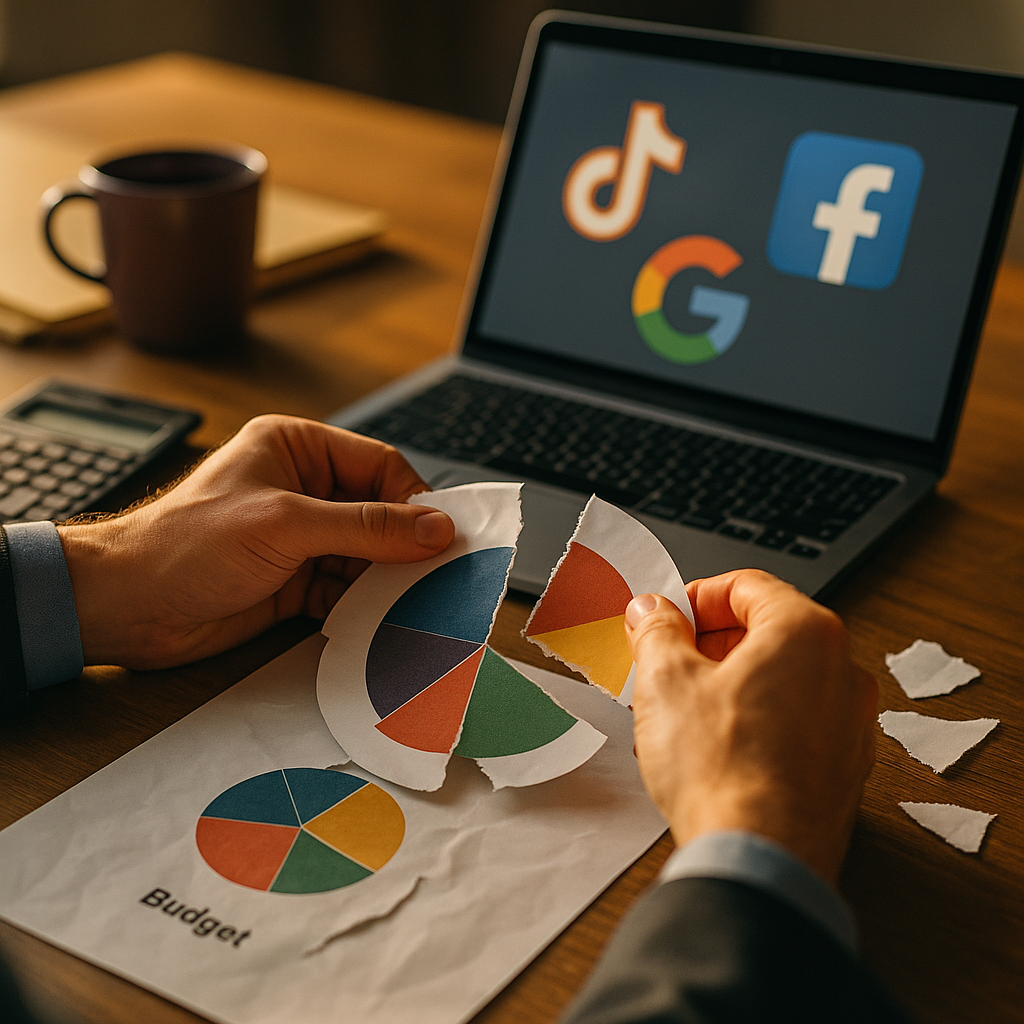
Nearly a third of surveyed advertisers now say they’ve shifted budget away from a top platform specifically to reduce “single-app exposure,” according to recent buyer sentiment tracked by eMarketer. That’s not a rounding error — it’s a structural shift. Reddit-style video and ByteDance alternatives are pulling real dollars away from legacy platforms, and the fragmentation is only accelerating.
If your media plan still treats Meta, YouTube, and TikTok as the only three boxes worth checking, you’re already behind. The question isn’t whether budgets are fragmenting — it’s whether your team has a plan for where the pieces land.
Why the Fragmentation Is Happening Now
Three forces converged at once. TikTok’s ownership uncertainty dragged on long enough that procurement teams started building contingency line items as standard practice, not crisis response. Reddit quietly became a video platform worth buying against, with watch-time and ad engagement metrics that finally justify dedicated budget. And a wave of ByteDance-style short-form apps — think Whatnot’s live commerce push, Triller’s resurgence attempts, and regional players like Josh and Moj gaining share outside the US — gave buyers actual alternatives instead of theoretical ones.
None of this happened in isolation. Our earlier coverage of how Reddit video gains ad budget as brands cut ByteDance risk laid out the early signals. What’s changed since is scale. This isn’t a hedge anymore. It’s a reallocation.
Nearly a third of advertisers have already shifted spend away from a top platform to reduce single-app exposure — fragmentation has moved from theory to line item.
The ByteDance Risk Premium Is Real, and It’s Priced In
Ask any media buyer what “platform risk” meant three years ago and they’d probably shrug. Ask them now and you’ll get a spreadsheet. The prolonged uncertainty around TikTok’s US ownership structure forced brands to quantify what was previously an abstract concern: what happens to your influencer contracts, your pixel data, your always-on campaigns if the app disappears or changes hands overnight?
Our analysis of the TikTok Shop ownership change showed merchants scrambling to renegotiate terms mid-contract. That’s not a hypothetical risk anymore — it’s operational reality for anyone running commerce integrations on the platform. Add in the Oracle deal’s IP verification requirements, and you’ve got a platform where compliance overhead has genuinely increased even as the app remains dominant for reach.
That premium — the extra diligence, the contract renegotiation, the contingency planning — is now baked into how sophisticated buyers approach ByteDance properties. It doesn’t mean brands are leaving. It means they’re no longer putting 60% of short-form budget in one place without a backup plan.
Reddit’s Video Push Isn’t Cute Anymore
Reddit spent years being the platform marketers respected but didn’t fund. That’s changed. The company’s push into video ad formats, combined with its community-first targeting model, gives buyers something TikTok and Instagram increasingly can’t: high-intent audiences that aren’t scrolling past ads, they’re actively participating in threads related to your category.
Compare that to the autoplay-driven reach models under threat elsewhere. The ongoing Instagram autoplay lawsuit has brands nervous about a core mechanic they’ve relied on for years. Reddit doesn’t have that overhang. Its ad product is newer, smaller, but structurally less exposed to the kind of litigation risk rattling Meta’s properties right now — a risk we’ve covered in depth in Meta litigation risk and the case for a Plan B.
Is Reddit going to replace TikTok budget dollar-for-dollar? No. But it’s absorbing overflow, especially from B2B brands and categories where community trust outperforms viral reach — software, finance, health, and gaming all show outsized Reddit ad growth relative to platform size.
Where the Dollars Are Actually Going
Fragmentation sounds chaotic, but the pattern is fairly consistent across buyers we’ve tracked. Budget isn’t vanishing. It’s redistributing along three tracks:
- Vertical media diversification. Short-form video spend outside the big three now represents a meaningful share of total social budget, part of the broader trend where vertical media has hit $150 billion in ad spend globally.
- Regional platform bets. Growth outside China-linked apps is accelerating fast — vertical media growth is running at 42% outside China, forcing global brands to build region-specific media plans instead of one global TikTok strategy.
- Reddit and community-driven platforms. Smaller dollar amounts, but rising fast, particularly for brands that already read our breakdown of the platform-property paradox and decided the ROI tax of diversification was worth paying for reduced risk.
None of these tracks alone replaces legacy platform scale. Together, they’re starting to matter.
What This Means for Budget Planning, Practically
Here’s where it gets operational. If you’re building next quarter’s media plan, fragmentation isn’t an abstract trend — it’s a resourcing problem. Every new platform you add means new creative specs, new measurement setups, new compliance checks, new creator relationships. That’s expensive in a way that raw CPMs don’t capture.
Smart teams are handling this a few ways. First, they’re building modular creative systems rather than platform-specific campaigns from scratch. The approach outlined in one creator shoot, one anchor, a dozen amplifier clips is exactly the kind of efficiency play that makes multi-platform diversification affordable instead of a budget drain.
Second, they’re scenario-planning instead of forecasting a single number. The creator economy forecast gap framework — building three budget scenarios instead of betting on one platform trajectory — is becoming standard practice for teams that got burned by over-indexing on a single app in prior cycles.
Third, and this is the one teams skip: they’re auditing measurement infrastructure before they chase reach. Adding Reddit or a regional vertical app to your mix means nothing if you can’t attribute performance consistently across platforms. That’s an identity persistence problem as much as a media buying problem.
Diversifying platforms without diversifying your measurement stack just creates five blind spots instead of one.
Is This a Temporary Hedge or a Permanent Shift?
Reasonable people disagree here, and it’s worth being honest about the uncertainty. Some buyers treat this fragmentation as a temporary risk-management posture — once TikTok’s ownership situation stabilizes fully, they’ll consolidate back. Others see something more structural: audience attention was always going to fragment as more vertical, niche, and community-driven platforms matured, and ByteDance risk just accelerated a shift that was coming anyway.
The data leans toward the latter. Platform-specific squeezed budgets among mid-market brands, detailed in our piece on how the squeezed middle class fuels vertical media strategy, show this isn’t just enterprise brands hedging bets. It’s happening at every budget tier, which suggests durability rather than a temporary blip.
Consider too how AI is changing platform economics generally. As covered in our look at Meta’s AI-native ad buying, the largest platforms are automating buying decisions in ways that reduce the marginal cost of testing new channels. That actually makes fragmentation easier to sustain, not harder — AI-assisted buying tools lower the operational burden of running campaigns across six platforms instead of two.
The Compliance Angle Nobody’s Pricing In Correctly
Every new platform in your mix is a new compliance surface. Data handling, ad disclosure rules, regional privacy law — it all multiplies with platform count. The FTC’s endorsement guidelines apply regardless of platform, but enforcement patterns and disclosure UX differ by app, and that’s before you factor in region-specific rules tracked by bodies like the ICO in the UK.
Brands adding Reddit, regional apps, or Whatnot-style live commerce to their mix need compliance review baked into the platform evaluation, not bolted on after launch. This is especially true given how quickly AI governance rules are converging across jurisdictions — a disclosure practice that’s fine on one platform might trigger scrutiny on another simply because of how that platform’s ad formats are structured.
FAQs
Frequently Asked Questions
Why are brands moving ad budget away from TikTok and other legacy platforms?
Ownership uncertainty around TikTok, rising compliance overhead tied to data and IP verification requirements, and genuine performance gains on alternative platforms like Reddit have combined to make diversification a rational risk-management strategy rather than a fringe move.
Is Reddit actually a viable ad platform for performance marketing, or just brand awareness?
Reddit’s video ad push has shown strong results specifically in high-intent categories like software, finance, and gaming, where community engagement translates into lower-funnel action. It’s not yet a replacement for TikTok-scale reach, but it performs well for targeted, community-aligned campaigns.
What are the biggest ByteDance alternatives brands are testing right now?
Beyond Reddit video, brands are testing Whatnot for live commerce, regional short-form apps like Josh and Moj in specific markets, and expanding presence on YouTube Shorts as a lower-risk short-form video option within an existing platform relationship.
How should a mid-size brand budget for platform diversification without overspending on operations?
Use modular creative production so one shoot generates assets for multiple platforms, build measurement infrastructure that works across channels before adding new ones, and run scenario-based budget planning instead of committing fixed percentages to unproven platforms.
Does platform fragmentation increase legal and compliance risk?
Yes. Each new platform introduces its own disclosure UX, data handling practices, and regional compliance considerations. Brands should build compliance review into platform evaluation rather than treating it as a post-launch fix.
The brands winning this fragmentation cycle aren’t the ones chasing every new app. They’re the ones treating platform diversification as an infrastructure investment — measurement, compliance, and modular creative first, new platform spend second.
Top Influencer Marketing Agencies
The leading agencies shaping influencer marketing in 2026
Agencies ranked by campaign performance, client diversity, platform expertise, proven ROI, industry recognition, and client satisfaction. Assessed through verified case studies, reviews, and industry consultations.
Moburst

-
2

The Shelf
Boutique Beauty & Lifestyle Influencer AgencyA data-driven boutique agency specializing exclusively in beauty, wellness, and lifestyle influencer campaigns on Instagram and TikTok. Best for brands already focused on the beauty/personal care space that need curated, aesthetic-driven content.Clients: Pepsi, The Honest Company, Hims, Elf Cosmetics, Pure LeafVisit The Shelf → -
3

Audiencly
Niche Gaming & Esports Influencer AgencyA specialized agency focused exclusively on gaming and esports creators on YouTube, Twitch, and TikTok. Ideal if your campaign is 100% gaming-focused — from game launches to hardware and esports events.Clients: Epic Games, NordVPN, Ubisoft, Wargaming, Tencent GamesVisit Audiencly → -
4

Viral Nation
Global Influencer Marketing & Talent AgencyA dual talent management and marketing agency with proprietary brand safety tools and a global creator network spanning nano-influencers to celebrities across all major platforms.Clients: Meta, Activision Blizzard, Energizer, Aston Martin, WalmartVisit Viral Nation → -
5

The Influencer Marketing Factory
TikTok, Instagram & YouTube CampaignsA full-service agency with strong TikTok expertise, offering end-to-end campaign management from influencer discovery through performance reporting with a focus on platform-native content.Clients: Google, Snapchat, Universal Music, Bumble, YelpVisit TIMF → -
6

NeoReach
Enterprise Analytics & Influencer CampaignsAn enterprise-focused agency combining managed campaigns with a powerful self-service data platform for influencer search, audience analytics, and attribution modeling.Clients: Amazon, Airbnb, Netflix, Honda, The New York TimesVisit NeoReach → -
7

Ubiquitous
Creator-First Marketing PlatformA tech-driven platform combining self-service tools with managed campaign options, emphasizing speed and scalability for brands managing multiple influencer relationships.Clients: Lyft, Disney, Target, American Eagle, NetflixVisit Ubiquitous → -
8

Obviously
Scalable Enterprise Influencer CampaignsA tech-enabled agency built for high-volume campaigns, coordinating hundreds of creators simultaneously with end-to-end logistics, content rights management, and product seeding.Clients: Google, Ulta Beauty, Converse, AmazonVisit Obviously →