


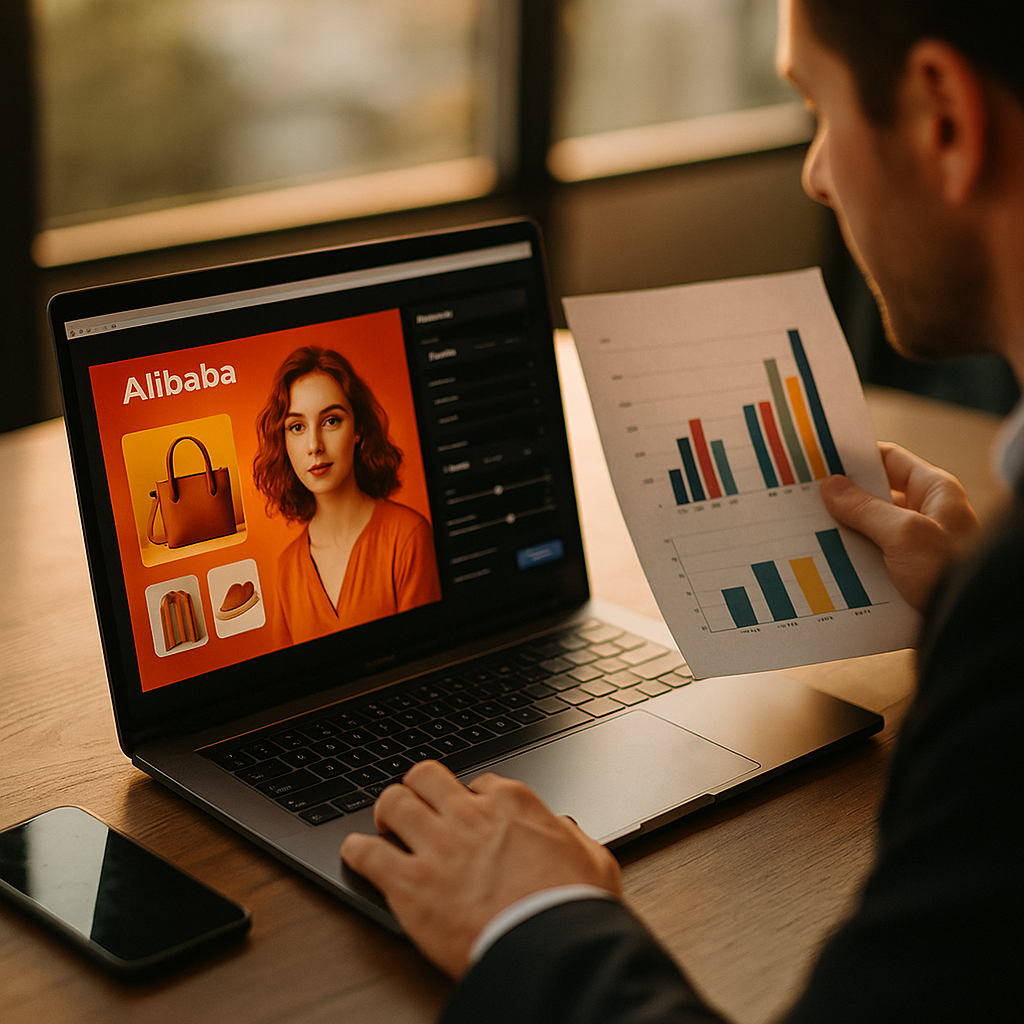
Alibaba says its generative AI ad tools now touch over a million merchants across its network. That’s not a vanity metric — it’s a signal that Alibaba’s generative AI ad suite has moved from beta curiosity to default infrastructure for anyone selling into China, Southeast Asia, or beyond. The question for cross-border brands isn’t whether to look at it. It’s whether the hype matches the operational reality.
What’s Actually Inside the Suite
Alibaba’s generative AI stack for advertisers isn’t one product. It’s a bundle: Wanxiang (Tongyi Wanxiang) for image and video generation, AI-powered copywriting tools baked into Alimama (Alibaba’s ad platform), and automated creative-to-placement pipelines that plug directly into Taobao, Tmall, and AliExpress inventory. There’s also a growing layer of agentic tools that auto-generate product listings, translate them, and A/B test creative variants without a human touching Photoshop.
For a brand entering APAC cold, that’s appealing on paper. You skip the localization agency. You skip the six-week creative turnaround. In theory, you upload a product feed and get market-ready ad creative in hours, not weeks.
In practice, it’s more nuanced. The suite is deeply optimized for Alibaba’s own commerce ecosystem — which is a strength if you’re selling on Tmall Global, and a limitation if your strategy spans TikTok Shop, Shopee, and Lazada too. Alibaba’s tools generate assets tuned for its own algorithm and placement logic, not a universal creative asset you can drop anywhere.
Treating Alibaba’s AI suite as a full-funnel creative solution is the fastest way to end up with assets that perform beautifully on Tmall and fall flat everywhere else.
Why APAC Entry Makes This Urgent, Not Optional
APAC retail e-commerce is projected to keep outpacing North America and Europe in growth rate, according to eMarketer’s regional forecasts. Brands that wait for a “safe” moment to enter are watching competitors lock in supplier relationships, seller ratings, and algorithmic trust scores that take months to build. Generative AI tools compress the timeline for creative production, which is exactly the bottleneck that’s historically slowed cross-border launches.
But speed without localization accuracy is a liability, not an advantage. Machine-generated copy that nails Mandarin syntax but misses regional slang in Indonesia or the Philippines will underperform, no matter how fast it was produced. This is the tension every brand evaluating the suite needs to sit with: production speed and cultural precision are not the same variable, and Alibaba’s tools optimize hard for the former.
The Localization Gap Nobody Talks About
Alibaba’s generative models are trained overwhelmingly on Mandarin-language commerce data and mainland shopping behavior. That’s a strength for China-first strategies. It’s a weakness the moment you expand into Vietnam, Thailand, or India through the same tooling. Several agency partners we’ve spoken with report needing a secondary localization layer — human review plus supplementary AI dubbing or transcreation tools — to make Alibaba-generated assets credible outside Greater China.
If you’re already evaluating dubbing and localization vendors, it’s worth benchmarking Alibaba’s native output against dedicated tools covered in our guide to AI localization engines. The gap between “technically translated” and “culturally fluent” is where campaigns quietly lose conversion.
Cost Per Usable Asset: The Number That Actually Matters
Every AI ad generator vendor will show you a dazzling per-image cost. The number that matters isn’t cost-per-generation, it’s cost-per-usable-asset after your team rejects the 60% that don’t meet brand or compliance standards. Alibaba’s suite, bundled into Alimama ad spend, doesn’t always itemize this cleanly, which makes true ROI comparison harder than it should be.
We’ve broken down this exact calculation methodology in our piece on cost per usable ad across generators. Apply that framework here before you commit spend. Ask your Alibaba rep directly: what’s the rejection rate on generated creative among comparable cross-border merchants? If they can’t answer, that’s data you should be tracking yourself from day one.
For brands weighing Alibaba against Western alternatives like Runway or Google’s ad AI stack, the comparative breakdown in our platform comparison is a useful starting point — particularly on turnaround time and multi-market flexibility, where the three platforms diverge sharply.
Compliance Is Where This Gets Complicated
Cross-border data flow is the quiet risk factor most creative teams skip past. Generative AI tools operating on Alibaba’s infrastructure process product data, customer behavior signals, and sometimes creative briefs through servers subject to Chinese data governance rules. For brands headquartered in the EU or handling UK customer data, this raises real questions under GDPR-adjacent frameworks.
Before greenlighting the suite for anything beyond creative generation, legal and compliance teams should ask:
- Where is training data and generated output stored, and for how long?
- Does the platform’s terms of service permit brand IP to be used in future model training?
- What happens to customer PII if it’s fed into personalization or dynamic creative tools?
- Is there a documented process for data deletion requests, consistent with standards regulators like the UK’s ICO expect?
These aren’t hypothetical concerns. Regulatory scrutiny of AI-generated advertising and cross-border data handling has intensified globally, and the FTC’s guidance on AI and advertising practices signals that US regulators are watching this space closely too, even for platforms based outside the country. If your legal team hasn’t reviewed Alibaba’s data processing addendum specifically for generative AI features (separate from standard e-commerce terms), that’s a gap to close before scaling spend.
The data governance question isn’t “can Alibaba’s AI generate good ads” — it’s “who owns and controls the data pipeline feeding those ads,” and that answer changes depending on your headquarters’ jurisdiction.
Where the Suite Genuinely Outperforms
None of this means skip it. For merchants already committed to Tmall Global or AliExpress as primary channels, the integration depth is hard to replicate elsewhere. Creative generation ties directly into product catalog data, historical conversion patterns, and platform-specific ad auction dynamics. That’s a level of closed-loop optimization that third-party tools generally can’t match because they don’t have access to Alibaba’s first-party signal.
Speed is real, too. Brands report cutting initial creative production time by more than half when using Alibaba’s automated pipeline for standard product listing ads, compared to briefing an external agency. For SKU-heavy catalogs — apparel, electronics accessories, home goods — that’s a legitimate operational win, not marketing spin.
It’s a similar dynamic to what we’ve documented in our mapping of the AI-native creative production stack: platform-native tools tend to win on speed and integration, while independent tools win on flexibility and cross-channel portability. Alibaba sits firmly in the first camp.
A Practical Evaluation Framework
Rather than treating this as an all-or-nothing platform bet, run a structured pilot:
- Segment by market. Test Alibaba’s suite exclusively on mainland China and Hong Kong campaigns first, where its training data is strongest.
- Benchmark rejection rates. Track how many generated assets pass brand review versus need rework, over a minimum 90-day window.
- Run parallel creative. Compare Alibaba-generated assets against a human or hybrid-AI control group on identical SKUs.
- Audit data flows before scaling. Loop in legal before expanding beyond pilot budget, not after.
- Layer in localization tools for any market outside Greater China, rather than relying on native output.
This mirrors due-diligence approaches we’ve recommended for other AI martech vendors — see our contract due-diligence checklist for the kind of vendor accountability clauses worth demanding before committing to annual spend.
The Verdict for Marketing Leaders
Alibaba’s generative AI ad suite is a strong default for brands whose APAC strategy centers on Alibaba’s own marketplaces. It’s a weaker fit as a universal creative engine for multi-platform, multi-market expansion. Treat it as one tool in a broader stack, not the whole stack. Resources like HubSpot’s marketing benchmarks and Sprout Social’s platform research are worth cross-referencing as you build the comparative business case for leadership.
The brands winning in APAC right now aren’t the ones that picked one AI vendor and walked away. They’re the ones running structured pilots, tracking real cost-per-usable-asset numbers, and keeping legal in the loop before scaling spend past the test phase.
Frequently Asked Questions
Is Alibaba’s generative AI ad suite only useful for brands selling on Tmall or AliExpress?
It’s most powerful there because of deep first-party data integration, but the underlying creative generation tools can produce assets exportable to other channels — though quality and cultural fit outside Alibaba’s own ecosystem varies and typically needs human review.
How does Alibaba’s AI ad suite compare to Western tools like Runway or Google’s ad AI?
Alibaba’s suite is stronger on Chinese-market commerce integration and speed for SKU-heavy catalogs, while Western tools generally offer broader multi-market flexibility and more transparent data governance for brands headquartered outside APAC.
What compliance risks should cross-border brands check before adopting the suite?
Data residency, cross-border data transfer terms, IP usage rights in model training, and PII handling in personalization features are the four areas legal teams should review before scaling beyond a pilot.
Does using Alibaba’s AI tools guarantee better ad performance in APAC?
No. It guarantees faster creative production and tighter platform integration, but performance still depends on localization accuracy, market-specific testing, and whether the generated creative resonates with regional audiences outside mainland China.
Should smaller brands with limited budgets pilot this suite?
Yes, but on a limited scope: test it on a single high-volume SKU category within mainland China first, track rejection and conversion rates for at least one quarter, then decide before expanding spend regionally.
Top Influencer Marketing Agencies
The leading agencies shaping influencer marketing in 2026
Agencies ranked by campaign performance, client diversity, platform expertise, proven ROI, industry recognition, and client satisfaction. Assessed through verified case studies, reviews, and industry consultations.
Moburst

-
2

The Shelf
Boutique Beauty & Lifestyle Influencer AgencyA data-driven boutique agency specializing exclusively in beauty, wellness, and lifestyle influencer campaigns on Instagram and TikTok. Best for brands already focused on the beauty/personal care space that need curated, aesthetic-driven content.Clients: Pepsi, The Honest Company, Hims, Elf Cosmetics, Pure LeafVisit The Shelf → -
3

Audiencly
Niche Gaming & Esports Influencer AgencyA specialized agency focused exclusively on gaming and esports creators on YouTube, Twitch, and TikTok. Ideal if your campaign is 100% gaming-focused — from game launches to hardware and esports events.Clients: Epic Games, NordVPN, Ubisoft, Wargaming, Tencent GamesVisit Audiencly → -
4

Viral Nation
Global Influencer Marketing & Talent AgencyA dual talent management and marketing agency with proprietary brand safety tools and a global creator network spanning nano-influencers to celebrities across all major platforms.Clients: Meta, Activision Blizzard, Energizer, Aston Martin, WalmartVisit Viral Nation → -
5

The Influencer Marketing Factory
TikTok, Instagram & YouTube CampaignsA full-service agency with strong TikTok expertise, offering end-to-end campaign management from influencer discovery through performance reporting with a focus on platform-native content.Clients: Google, Snapchat, Universal Music, Bumble, YelpVisit TIMF → -
6

NeoReach
Enterprise Analytics & Influencer CampaignsAn enterprise-focused agency combining managed campaigns with a powerful self-service data platform for influencer search, audience analytics, and attribution modeling.Clients: Amazon, Airbnb, Netflix, Honda, The New York TimesVisit NeoReach → -
7

Ubiquitous
Creator-First Marketing PlatformA tech-driven platform combining self-service tools with managed campaign options, emphasizing speed and scalability for brands managing multiple influencer relationships.Clients: Lyft, Disney, Target, American Eagle, NetflixVisit Ubiquitous → -
8

Obviously
Scalable Enterprise Influencer CampaignsA tech-enabled agency built for high-volume campaigns, coordinating hundreds of creators simultaneously with end-to-end logistics, content rights management, and product seeding.Clients: Google, Ulta Beauty, Converse, AmazonVisit Obviously →