


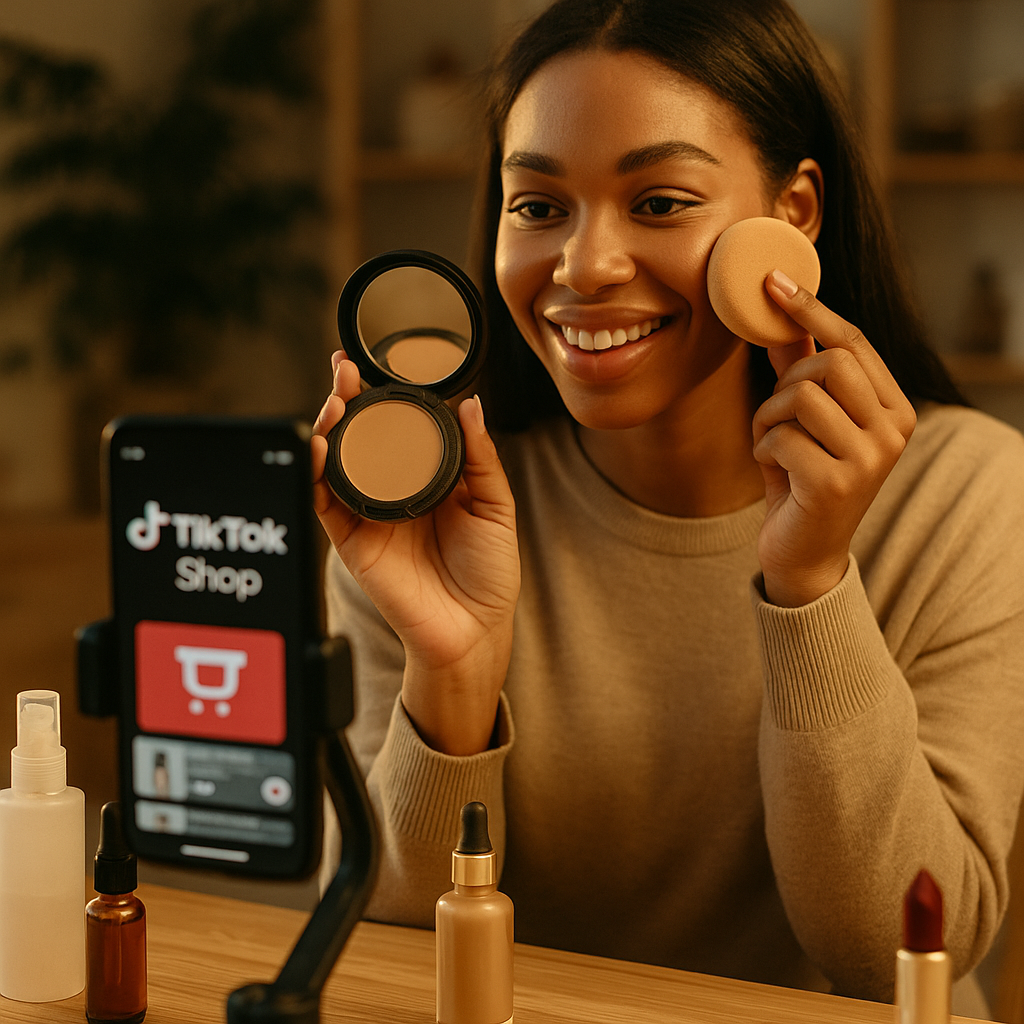
107 percent. That’s the year-over-year growth beauty brands posted on TikTok Shop, at a time when most retail categories would kill for double-digit gains. If your brand still treats TikTok Shop beauty as an experimental line item instead of a core channel, this is the number that should change your budget conversation.
Beauty didn’t grow because TikTok Shop got more ad-friendly. It grew because the category is uniquely built for discovery-led commerce — the kind where someone isn’t searching for a product, they’re watching a video and suddenly need what’s on screen. Understanding why beauty won this hard is the actual playbook, not the growth number itself.
Why Beauty Wins on a Discovery Platform
Search-based commerce assumes intent. Someone types “vitamin C serum” into Amazon because they already decided to buy one. TikTok Shop assumes nothing. It shows you a video first, and the buying decision forms in real time, often inside fifteen seconds. Beauty products are perfectly shaped for that mechanic.
Think about what makes a beauty purchase easy to trigger impulsively: visible, immediate results (a color-correcting concealer, a glass-skin serum), low price points relative to considered purchases like electronics, and a category culture already built around demonstration. People have watched makeup tutorials for over a decade. TikTok just collapsed the tutorial and the checkout button into the same screen.
Beauty’s 107% YoY growth isn’t a fluke of algorithm timing — it’s what happens when a category’s natural content format (demonstration, transformation, before/after) matches a platform’s native discovery mechanic exactly.
Compare that to categories still lagging on TikTok Shop: furniture, electronics, big-ticket apparel. These require research, comparison, sometimes financing. Discovery commerce doesn’t reward research-heavy categories nearly as well, at least not yet. Beauty had almost no friction to overcome.
The Mechanics Behind the Number
Three structural factors explain most of that growth, and each one has a direct operational implication for brand teams.
- Livestream velocity. Beauty converts disproportionately well in live formats because hosts can demonstrate texture, blendability, and shade range in real time — things static product images can’t communicate. Brands running consistent livestream slots are seeing repeat-purchase lift that outpaces single-video campaigns.
- Micro and nano creator density. Beauty has one of the deepest creator ecosystems on the platform. There are thousands of mid-tier creators with tight, trusting niche audiences (skincare-for-acne-prone-skin, drugstore dupes, K-beauty routines) who convert better per-follower than mega-influencers.
- Algorithm reinforcement loops. TikTok’s recommendation system rewards watch time and completion rate, and beauty transformation content (the reveal, the swipe test, the “wait for it”) is engineered for exactly that. For more on how the underlying algorithm shapes content strategy, see our breakdown of the watch-time algorithm shift and what it means for brief structure.
None of this is accidental. It’s the product of thousands of brands and creators iterating on what works, then TikTok’s system amplifying the winners faster than any other platform currently does.
What This Means for Brand Budget Allocation
If you’re a brand strategist looking at next year’s budget, the beauty category data isn’t just industry trivia — it’s a proof point for reallocating spend away from static commerce toward video-first discovery formats. Here’s the uncomfortable part: most beauty brands are still running TikTok Shop as a bolt-on to their existing influencer program instead of a standalone commerce channel with its own creator roster, content cadence, and testing budget.
That’s a mistake. Discovery commerce needs volume. You can’t win with three sponsored videos a month. Brands seeing outsized returns are running dozens of creator partnerships simultaneously, treating each as a micro-test rather than a hero campaign.
This is where a rapid-testing mindset matters more than a big-budget hero campaign mindset. We’ve covered this shift in detail in our rapid-testing model breakdown — the short version is that brands need an iteration budget separate from their hero content budget, because discovery commerce rewards volume and speed over polish.
Livestreams Are Not Optional Anymore
If your beauty brand isn’t running regular livestream selling sessions, you’re leaving conversion on the table. Livestream is where TikTok Shop’s beauty growth concentrates hardest, because it combines the trust signals of a creator relationship with real-time product demonstration and time-limited offers. Our livestream selling playbook walks through how to structure creator testing specifically for live formats, which behave very differently from pre-recorded video in terms of pacing and offer structure.
The operational lift here is real. Livestream selling needs a different briefing process, different creator vetting (can they actually hold a live audience for 30-60 minutes?), and different measurement (watch time, GMV per stream, repeat viewership) than standard content deals.
Spark Ads, Creator Rates, and the Real Cost of Scaling
Growth this fast attracts spend, and spend attracts markup. Brands are now weighing whether TikTok Shop’s premium ad products are worth the added cost of amplifying organic-performing content through paid channels. We looked closely at this tradeoff in our analysis of the Spark Ads premium markup, and the short answer is: it depends heavily on whether the underlying organic content is already converting before you pay to boost it.
Creator rate inflation is the other side of this. As beauty brands pile into TikTok Shop, creator rates in the category have moved noticeably. Our creator rate benchmark data shows beauty creators commanding some of the highest ROI multiples on the platform right now, precisely because demand is outpacing the supply of creators who can reliably drive Shop conversions rather than just impressions.
That’s the risk side of this growth story. Beauty CPMs and creator rates on TikTok Shop are rising fast enough that brands entering late may not see the same ROI early movers captured. Budget planning needs to account for rate inflation, not just growth potential.
What Other Categories Can (and Can’t) Borrow
Marketing teams outside beauty keep asking the same question: can we replicate this? Partially. The tactics transfer — livestream demonstration, nano-creator density, transformation-style content — but the underlying product fit doesn’t always exist. Home goods and fashion apparel are seeing meaningful traction using the same playbook, largely because they share beauty’s visual-demonstration advantage. Categories requiring long consideration cycles are struggling to replicate similar growth, no matter how good the creator content is.
If you’re outside beauty and want a comparative view of how commerce is splitting between platforms, our piece on TikTok Shop vs. Instagram Shopping is a useful starting point for deciding where discovery-led formats make sense for your category and where they don’t.
Compliance and Disclosure Still Matter at This Speed
Rapid scaling always increases compliance risk, and TikTok Shop is no exception. As creator volume increases, so does the risk of inconsistent disclosure practices, unclear affiliate labeling, and claims that stray into regulated territory (especially for skincare products making efficacy or health-adjacent claims). Brands should be reviewing creator content against FTC endorsement guidelines as a baseline, and building disclosure checks into their creator onboarding rather than auditing after the fact.
This matters more in beauty specifically because so much content brushes against health claims (acne treatment, anti-aging, dermatologist-adjacent language). Brands scaling creator volume fast need a compliance review step that doesn’t slow down content velocity too much, which is a genuinely hard operational balance to strike.
The Data Context
Industry trackers including eMarketer and Statista have both flagged social commerce as one of the fastest-growing retail channels globally, with beauty and personal care consistently cited as the leading category. That external validation matters for internal budget conversations — this isn’t a TikTok-published vanity metric, it’s a trend showing up across independent measurement sources.
For brands building a business case to shift budget toward TikTok Shop, pairing platform-reported growth with third-party category data gives finance and leadership teams something more credible than a single-source number.
Where Does This Leave Brand Teams Right Now?
The beauty category proved the model works. The next twelve months are about execution discipline: enough creator volume to test fast, enough livestream cadence to convert at scale, and enough compliance rigor to not get burned while scaling. Brands that treat TikTok Shop as a proper commerce channel, with its own budget line and its own testing framework, will keep compounding. Brands still treating it as an influencer marketing side project will watch competitors pull ahead.
Frequently Asked Questions
Why is TikTok Shop beauty growth outpacing other categories?
Beauty products fit TikTok’s discovery-led commerce model because they’re visually demonstrable, low-consideration, and culturally tied to tutorial-style content that TikTok’s algorithm already rewards for watch time and completion rate.
Is TikTok Shop livestream selling worth the operational investment for beauty brands?
Yes, for most beauty brands livestream selling drives disproportionately higher conversion than static video because it combines real-time product demonstration with creator trust signals and time-limited offers, though it requires different creator vetting and measurement than standard content deals.
Are TikTok Shop creator rates in beauty rising too fast to be profitable?
Rates are rising as demand outpaces supply of creators who reliably drive Shop conversions, but ROI remains strong for brands that vet creators on conversion performance rather than follower count or impressions alone.
Can other product categories replicate beauty’s growth on TikTok Shop?
Categories with strong visual-demonstration potential, like fashion apparel and home goods, can partially replicate the model, but categories requiring long consideration cycles or high-ticket decisions tend to see weaker results with the same tactics.
What compliance risks should brands watch as they scale TikTok Shop creator programs?
Brands should monitor disclosure consistency, affiliate labeling, and health or efficacy claims in skincare content, building compliance checks into creator onboarding rather than auditing content only after it publishes.
Top Influencer Marketing Agencies
The leading agencies shaping influencer marketing in 2026
Agencies ranked by campaign performance, client diversity, platform expertise, proven ROI, industry recognition, and client satisfaction. Assessed through verified case studies, reviews, and industry consultations.
Moburst

-
2

The Shelf
Boutique Beauty & Lifestyle Influencer AgencyA data-driven boutique agency specializing exclusively in beauty, wellness, and lifestyle influencer campaigns on Instagram and TikTok. Best for brands already focused on the beauty/personal care space that need curated, aesthetic-driven content.Clients: Pepsi, The Honest Company, Hims, Elf Cosmetics, Pure LeafVisit The Shelf → -
3

Audiencly
Niche Gaming & Esports Influencer AgencyA specialized agency focused exclusively on gaming and esports creators on YouTube, Twitch, and TikTok. Ideal if your campaign is 100% gaming-focused — from game launches to hardware and esports events.Clients: Epic Games, NordVPN, Ubisoft, Wargaming, Tencent GamesVisit Audiencly → -
4

Viral Nation
Global Influencer Marketing & Talent AgencyA dual talent management and marketing agency with proprietary brand safety tools and a global creator network spanning nano-influencers to celebrities across all major platforms.Clients: Meta, Activision Blizzard, Energizer, Aston Martin, WalmartVisit Viral Nation → -
5

The Influencer Marketing Factory
TikTok, Instagram & YouTube CampaignsA full-service agency with strong TikTok expertise, offering end-to-end campaign management from influencer discovery through performance reporting with a focus on platform-native content.Clients: Google, Snapchat, Universal Music, Bumble, YelpVisit TIMF → -
6

NeoReach
Enterprise Analytics & Influencer CampaignsAn enterprise-focused agency combining managed campaigns with a powerful self-service data platform for influencer search, audience analytics, and attribution modeling.Clients: Amazon, Airbnb, Netflix, Honda, The New York TimesVisit NeoReach → -
7

Ubiquitous
Creator-First Marketing PlatformA tech-driven platform combining self-service tools with managed campaign options, emphasizing speed and scalability for brands managing multiple influencer relationships.Clients: Lyft, Disney, Target, American Eagle, NetflixVisit Ubiquitous → -
8

Obviously
Scalable Enterprise Influencer CampaignsA tech-enabled agency built for high-volume campaigns, coordinating hundreds of creators simultaneously with end-to-end logistics, content rights management, and product seeding.Clients: Google, Ulta Beauty, Converse, AmazonVisit Obviously →