


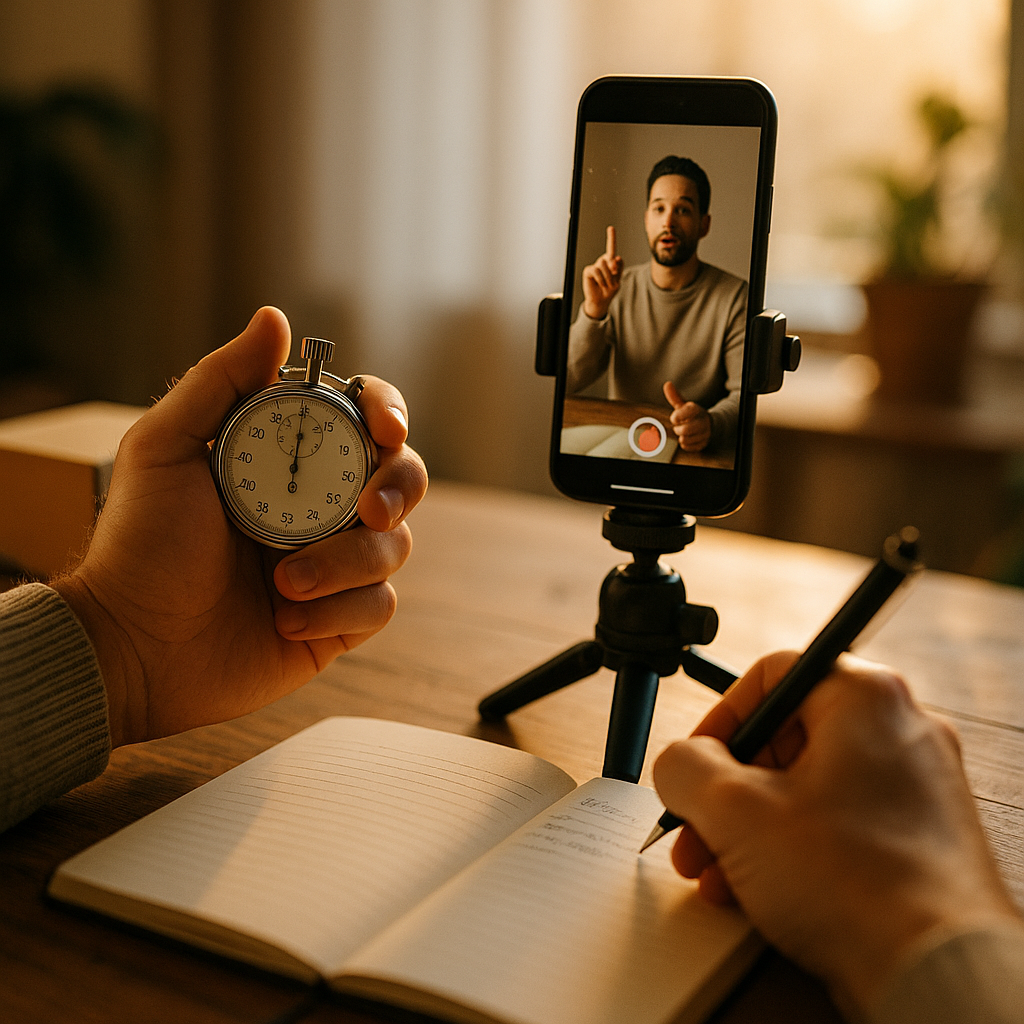
Sixty seconds. One product. No cuts, no do-overs, no cheating with a second bottle off-camera. That’s the entire premise of the time-boxed challenge format, and it’s quietly become one of the highest-retention content structures brands can put in front of a creator. Why does a ticking clock outperform a polished script? Because viewers trust a countdown more than a claim.
Brand marketers have spent years chasing “authenticity” through looser briefs, hoping less direction reads as more real. The time-boxed challenge flips that logic. It’s tightly constrained, brand-owned, and still feels unscripted because the constraint itself — the clock — does the persuading. Get the format right and you get a demo, a stress test, and a piece of entertainment in one shoot. Get it wrong and you get a compliance headache or a creator who quietly ignores your brief on posting day.
What the Format Actually Is
Strip away the editing tricks and a time-boxed challenge is simple: a creator is given a task (assemble something, solve something, transform something, survive something) and a hard time limit, using only the brand’s product to get there. Think a skincare brand challenging a creator to build a full routine in ninety seconds. A kitchen appliance brand daring someone to plate a three-course meal in ten minutes flat. A software brand timing how fast a user can build a working automation.
The task matters less than the constraint. Time pressure creates stakes. Stakes create watch-through. And watch-through, not polish, is what the algorithm and the brand both actually want.
A strict time limit does something a beauty-shot ad never can: it makes the product’s performance the plot, not the pitch.
Why Brands Are Leaning Into Clock-Driven Content
Retention data is the honest reason this format keeps showing up in creator briefs. Short-form platforms reward the first three seconds and punish drop-off hard, and a visible countdown is one of the few narrative devices proven to hold attention because the viewer wants to know: does the product actually deliver, or does the clock win?
There’s also a risk-mitigation angle marketers don’t talk about enough. A time-boxed challenge is inherently self-documenting. The constraint (only this product, only this window) creates a built-in disclosure of what’s being tested and how. That’s a meaningfully cleaner setup than vague “results may vary” framing, and it pairs well with existing FTC-safe content strategies brands are already using in urgency-driven campaigns and countdown overlay formats.
None of this is theoretical. Short-form video consumption keeps climbing across every major platform, and eMarketer has repeatedly flagged watch-time and completion rate as the metrics brands should optimize creative around, not raw view counts. A clock-based structure is one of the few formats that naturally improves completion rate without gimmicky editing.
Building the Brief: What Actually Needs to Be Specified
Loose briefs kill this format faster than anything else. If the time limit isn’t airtight, or the “product-only” rule has loopholes, creators will (understandably) cut corners, and the resulting content will feel staged rather than earned. A solid brief needs to nail down:
- The exact time limit — not “quickly,” not “under a few minutes.” A number, displayed on screen, ideally with a visible timer or clock overlay so viewers can verify it themselves.
- The single-product constraint, defined precisely — does “only the product” include the box it ships in? A charging cable? A companion app? Ambiguity here is where creators go rogue.
- The failure condition — what happens if the creator doesn’t finish in time? Brands need to decide upfront whether a failed attempt gets posted (often more authentic) or reshot (often more brand-safe but less believable).
- Proof-of-authenticity cues — unedited timestamp overlays, a visible phone clock, or a single continuous take. These small details are what separate a challenge that reads as real from one that reads as a rehearsed ad.
- Disclosure placement — #ad or #partner tags need to appear before the challenge starts, not buried in a caption, per FTC endorsement guidance.
This is where a lot of brand teams underestimate the prep work. A brief this specific takes longer to write than a standard integrated placement brief, but it saves enormous time in revisions. Compare it to the structured approach used in hook-structure briefs, where precision upfront reduces the back-and-forth on delivery.
The Creator’s Incentive: Why This Format Isn’t a Hard Sell
Here’s the part brand teams sometimes miss: creators generally like this format. It gives them a built-in narrative arc (setup, tension, payoff) without needing to write clever copy or fake enthusiasm. A time limit is a gift to a creator who’s tired of “just be yourself” briefs that leave them guessing what the brand actually wants.
It also protects creator credibility. Audiences have gotten sharp at spotting inflated claims, and a visible time constraint is one of the few formats that self-verifies. If a creator says a blender crushed ice in fifteen seconds and the clock’s on screen, nobody’s arguing with that. Compare that to a founder simply claiming a product “works fast” with no proof — audiences increasingly discount unverified claims, similar to the trust gap addressed in founder-led demo formats.
Picking the Right Task (Most Brands Get This Wrong)
The task has to be hard enough to create real tension but achievable enough that success feels earned, not scripted. Too easy, and the “challenge” reads as theater. Too hard, and every attempt fails, which either kills the format or forces a brand into uncomfortable editing choices to hide the failure.
A few task categories that consistently perform well in brand-directed challenges:
- Assembly speed tasks — furniture, tech setup, meal prep. Anything with a clear start and finish state.
- Transformation tasks — a makeup look, a room reset, a garment repair. Visually satisfying because before/after is instantly legible.
- Endurance or volume tasks — how many uses, reps, or units can be completed before time runs out. Works well for consumables and fitness products.
- Problem-solving tasks — using software or a tool to fix something under pressure. Strong fit for B2B and SaaS brands trying to make a dry product feel kinetic.
Whatever the category, the task should map directly to a real product benefit. A time-boxed challenge that doesn’t actually stress-test the thing you’re selling is just a stunt with your logo on it, and audiences notice the difference.
Where This Fits Into a Broader Testing Strategy
Smart brands don’t run a single time-boxed challenge and call it a campaign. They treat it as one format inside a testing wave, run across multiple creators with slight variations in task difficulty, product angle, or time limit, and then scale whichever version drives the strongest completion and conversion signal. This mirrors the structured testing approach outlined in multi-creator testing waves, where brief consistency across creators is what makes results comparable in the first place.
It’s also worth planning for reuse. A well-shot time-boxed challenge, with a visible countdown and clean single-take structure, is exactly the kind of asset that repurposes cleanly across paid and organic, provided usage rights are locked in during the brief stage rather than negotiated after the fact. That’s the same discipline covered in usage-rights-ready video briefs.
Common Failure Points
A few things reliably break this format:
- Editing that hides the clock. If a cut happens right when the timer’s about to run out, viewers assume the challenge was faked. Trust evaporates instantly.
- Overly generous product access. If the “single product” constraint quietly includes three backup units, the challenge loses its stakes.
- No fallback plan for failure. Brands need to decide before the shoot whether a failed attempt is postable. Deciding on the fly usually means reshoots, and reshoots usually mean staged-looking content.
- Disclosure as an afterthought. Platforms and regulators expect clear, timely disclosure. Bolting an #ad tag onto the caption after the challenge has already built suspense is a compliance risk, not just a bad look.
Brands that have run comedic or high-stakes constraint formats before — squeeze-bottle stunts, packaging reveals — already know this lesson. As covered in the breakdown of squeeze-bottle comedy briefs, retention only holds up when the constraint feels genuinely enforced, not implied for effect.
Measuring Success Beyond Views
View count tells you almost nothing about whether a time-boxed challenge worked. The metrics that matter: completion rate (did people watch to the buzzer?), replay rate (did people rewatch the final seconds?), and comment sentiment specifically about whether the challenge felt real. Brands running these at scale should also track downstream conversion lift, since the format’s core value proposition is proof, not just entertainment.
For teams benchmarking creative performance more broadly, Sprout Social’s engagement benchmarks and HubSpot’s content performance research are useful reference points for what “good” retention looks like by platform and format type.
Next step: pick one product benefit you can prove under real time pressure, write a brief that locks down the clock, the constraint, and the disclosure placement, and test it with two or three creators before scaling. The format rewards precision in the brief far more than it rewards production budget.
FAQs
What is a time-boxed challenge format in influencer marketing?
It’s a creator brief structure where the creator must complete a specific task using only the brand’s product within a strict, visible time limit, creating built-in tension and proof of performance rather than relying on scripted claims.
Why do time-boxed challenges perform better than standard product demos?
The visible countdown drives higher completion and replay rates because viewers want to see whether the product beats the clock. That tension holds attention longer than a straightforward demonstration or testimonial.
How do brands avoid FTC compliance issues with this format?
Disclosure tags like #ad need to appear before the challenge begins, not buried in captions after the fact. Brands should also avoid implying false scarcity or urgency beyond the actual task constraint, consistent with FTC endorsement guidance.
What happens if the creator fails the challenge?
Brands should decide this before the shoot. A failed attempt can actually build more trust if posted transparently, but many brand teams prefer a reshoot policy. Deciding in advance prevents last-minute, staged-looking edits.
Can this format work for B2B or software products?
Yes. Timed problem-solving tasks, like building a working workflow or fixing a bug under pressure, translate the format well for SaaS and tech brands trying to make abstract products feel tangible and fast.
How many creators should run a time-boxed challenge before scaling?
Most brands test with two to four creators using slightly varied tasks or time limits, then scale the version with the strongest completion rate and conversion signal, similar to standard multi-creator testing wave structures.
FAQs
Top Influencer Marketing Agencies
The leading agencies shaping influencer marketing in 2026
Agencies ranked by campaign performance, client diversity, platform expertise, proven ROI, industry recognition, and client satisfaction. Assessed through verified case studies, reviews, and industry consultations.
Moburst

-
2

The Shelf
Boutique Beauty & Lifestyle Influencer AgencyA data-driven boutique agency specializing exclusively in beauty, wellness, and lifestyle influencer campaigns on Instagram and TikTok. Best for brands already focused on the beauty/personal care space that need curated, aesthetic-driven content.Clients: Pepsi, The Honest Company, Hims, Elf Cosmetics, Pure LeafVisit The Shelf → -
3

Audiencly
Niche Gaming & Esports Influencer AgencyA specialized agency focused exclusively on gaming and esports creators on YouTube, Twitch, and TikTok. Ideal if your campaign is 100% gaming-focused — from game launches to hardware and esports events.Clients: Epic Games, NordVPN, Ubisoft, Wargaming, Tencent GamesVisit Audiencly → -
4

Viral Nation
Global Influencer Marketing & Talent AgencyA dual talent management and marketing agency with proprietary brand safety tools and a global creator network spanning nano-influencers to celebrities across all major platforms.Clients: Meta, Activision Blizzard, Energizer, Aston Martin, WalmartVisit Viral Nation → -
5

The Influencer Marketing Factory
TikTok, Instagram & YouTube CampaignsA full-service agency with strong TikTok expertise, offering end-to-end campaign management from influencer discovery through performance reporting with a focus on platform-native content.Clients: Google, Snapchat, Universal Music, Bumble, YelpVisit TIMF → -
6

NeoReach
Enterprise Analytics & Influencer CampaignsAn enterprise-focused agency combining managed campaigns with a powerful self-service data platform for influencer search, audience analytics, and attribution modeling.Clients: Amazon, Airbnb, Netflix, Honda, The New York TimesVisit NeoReach → -
7

Ubiquitous
Creator-First Marketing PlatformA tech-driven platform combining self-service tools with managed campaign options, emphasizing speed and scalability for brands managing multiple influencer relationships.Clients: Lyft, Disney, Target, American Eagle, NetflixVisit Ubiquitous → -
8

Obviously
Scalable Enterprise Influencer CampaignsA tech-enabled agency built for high-volume campaigns, coordinating hundreds of creators simultaneously with end-to-end logistics, content rights management, and product seeding.Clients: Google, Ulta Beauty, Converse, AmazonVisit Obviously →