


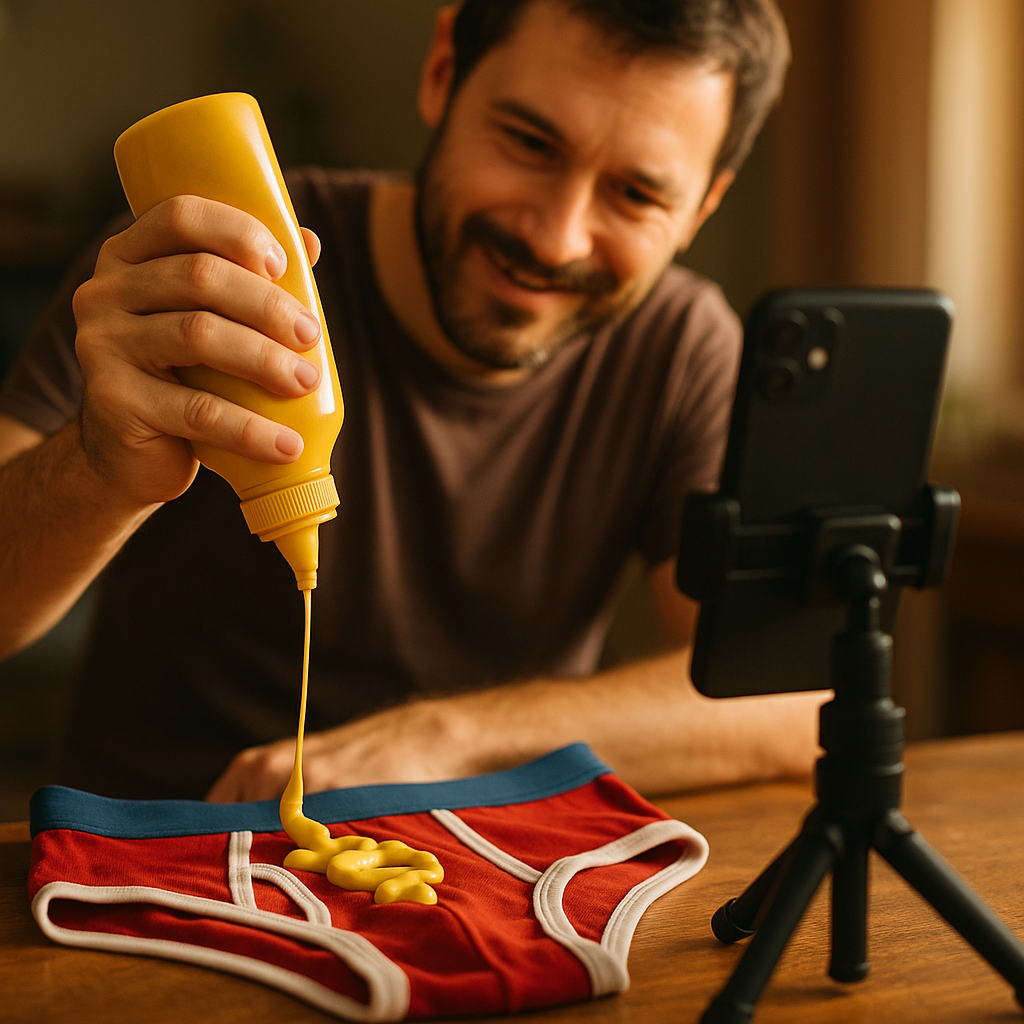
One ketchup bottle, twelve months, forty million views. That’s not a fluke — it’s the squeeze-bottle comedy format, and it might be the cheapest recurring bit your brand hasn’t scripted yet. Mundane packaging is quietly outperforming polished hero shoots on watch time and comment velocity. If your creative brief still treats packaging as a prop instead of a punchline, you’re leaving retention on the table.
Why a Bottle of Mustard Beats Your Hero Shot
Here’s the uncomfortable truth: audiences are exhausted by cinematic product reveals. Slow-motion pours, dramatic lighting, a voiceover that sounds like a luxury car ad — nobody’s stopping their scroll for that anymore. What stops the scroll is a creator fighting with a stubborn cap, or a bottle that farts air when squeezed, or the universal frustration of hitting that last, unreachable inch of sauce.
The squeeze-bottle comedy format works because it’s rooted in shared physical frustration. Everyone has fought a ketchup bottle. Everyone has slapped the bottom of a lotion pump praying for one more pump. That relatability is comedy gold, and it’s renewable — unlike a single clever tagline, a physical gag can be riffed on indefinitely.
Packaging-based comedy formats succeed because they exploit a universal, low-stakes annoyance — and low-stakes annoyance is the most reliable comedy engine on short-form video.
This isn’t new comedic territory, either. Physical-object humor has powered sketch comedy for decades. What’s new is the distribution mechanism: TikTok, Reels, and Shorts reward repeatable formats with recognizable setups, because algorithms and audiences both love pattern recognition. A recurring bit trains the audience to anticipate the payoff, which is exactly the retention signal platforms optimize for.
What Actually Makes a Recurring Bit, Not a One-Off Joke
Brands love the idea of “going viral” with a single clever video. Wrong goal. The real prize is a format — a repeatable structural container that a creator (or a roster of creators) can plug new jokes into every week without reinventing the wheel.
Think of it like a sitcom’s cold open. The audience doesn’t need a new premise every episode; they need a consistent structure with a fresh twist. Apply that logic to packaging comedy and you get a brief built around three fixed elements:
- The recognizable object — your specific bottle, tube, or pump, shot the same way every time so it becomes a visual signature.
- The recurring frustration — a physical tension point (empty-but-not-empty, cap-that-won’t-open, sauce-that-sprays-sideways) that repeats with variation.
- The escalating payoff — a punchline structure that can scale in absurdity over successive episodes without breaking the format’s internal logic.
Compare this to how vertical microdrama series build serialized hooks episode over episode — the mechanics are strikingly similar, just compressed into fifteen seconds instead of ninety. If you want a deeper structural comparison, our piece on briefing a microdrama series covers the same serialized-hook logic applied to scripted content.
The Brief Structure That Doesn’t Kill the Joke
Most brand briefs murder comedy by over-specifying it. If your document tells the creator exactly which words to say and exactly how to frame the shot, you’ve built an ad, not a bit. Comedy needs air to breathe.
A workable squeeze-bottle brief should include:
- The object’s non-negotiables. Logo visibility, label legibility, and any regulatory copy that must stay on screen. Keep this list short — three items max.
- The frustration menu. Give creators three to five real physical pain points to choose from (last-drop syndrome, cap-crack anxiety, pump-fatigue). Let them pick the one that fits their comedic voice.
- The escalation ladder. Episode one is mild annoyance. Episode five might involve a full Rube Goldberg contraption built to extract the last squeeze. Map this out loosely so the series has narrative direction.
- The disclosure line. Non-negotiable, every time, no exceptions — more on this below.
- The reuse clause. Specify upfront which clips the brand can repost, and where. This avoids the usage-rights scramble that kills momentum three episodes in.
For the legal groundwork on that last point, brands should model contracts after the frameworks in usage-rights-ready video briefs, which lay out exactly how to negotiate reuse without renegotiating every single clip.
Casting: Who Actually Sells This Bit?
Not every creator can land physical comedy. It’s a specific skill — closer to prop comedy or slapstick than to talking-head content. Look for creators who already do bit-based humor: recurring characters, catchphrases, physical gags with household objects. Skip creators whose entire feed is aesthetic lifestyle content; they’ll deliver a beautiful shot and a flat joke.
Micro and mid-tier creators tend to outperform mega-influencers here, mostly because their audiences expect scrappy, lo-fi content rather than polished production. A shaky, single-take video of someone yelling at a lotion bottle reads as authentic. The same bit shot with three-point lighting reads as corporate cosplay.
The format’s authenticity is the product. Over-produce it and you’ve killed the exact thing that made it shareable.
This is also where community-specific casting pays off. A creator embedded in a tight-knit niche audience — skincare Reddit refugees, home-cooking TikTok, whatever — will land the joke with cultural specificity that a generalist can’t. Our breakdown of micro-community storytelling briefs covers how to identify and brief those niche-fluent creators effectively.
Frequency and Platform Fit
Squeeze-bottle comedy is a TikTok-and-Reels-native format by default: short, physical, loop-friendly. But don’t ignore YouTube Shorts, where eMarketer data has repeatedly shown short-form video consumption climbing across all major platforms, not just TikTok. A recurring bit benefits from cross-posting because repetition across platforms builds the pattern recognition that makes a running joke actually feel like a running joke.
Cadence matters more than most brands assume. Weekly is the sweet spot — frequent enough to build anticipation, infrequent enough that the joke doesn’t calcify. Daily posting kills a bit fast; audiences need breathing room between episodes to actually miss the format. If you’re structuring a broader always-on content calendar around this, the pacing logic in always-on brand voice briefs is directly applicable.
The Compliance Layer Nobody Wants to Think About
Here’s where marketers get sloppy. A recurring comedy bit still counts as sponsored content, and the FTC’s endorsement guidelines apply exactly the same way they would to a straight product review. The joke format doesn’t exempt you from disclosure requirements.
The risk here is subtle: comedic framing can accidentally obscure the paid relationship if the disclosure gets buried under the bit. A creator screaming at a bottle for fifteen seconds, with “#ad” flashed for half a second in tiny text, is not compliant disclosure — it’s a lawsuit waiting to happen. Build the disclosure into the format itself. Maybe the creator’s catchphrase includes “brand partner” language. Maybe there’s a consistent on-screen graphic that appears every episode. Consistency here actually strengthens the format; audiences start to recognize the disclosure as part of the bit’s rhythm, the same way they recognize the punchline setup.
This same disclosure-integration logic shows up in urgency-driven formats too. See how restock countdown campaigns bake FTC-safe language into the content’s core structure rather than bolting it on as an afterthought.
One more wrinkle: AI-generated or AI-assisted comedic content is under increasing scrutiny, and platforms are getting stricter about labeling. If any part of your squeeze-bottle series uses AI-generated voiceover, animated overlays, or synthetic sound effects, review the labeling requirements carefully — our piece on AI labeling’s impact on ad performance shows how mislabeling (or under-labeling) can tank click-through rates even when the content itself is strong.
Measuring a Bit That Doesn’t Look Like a Campaign
Traditional campaign KPIs don’t map cleanly onto recurring comedy formats. A single video’s view count matters less than series-level metrics: are people commenting “episode 6 when?” Are they tagging friends specifically to reference the running joke? Is watch-through increasing episode over episode as familiarity builds?
Track these specifically:
- Comment-to-view ratio trend across episodes — rising engagement per view suggests the bit is landing, not fatiguing.
- Series completion rate if you’re running the bit as a numbered sequence on platforms that support playlists.
- Branded hashtag reuse by non-paid creators, which signals the bit has escaped containment and become a meme in its own right — the actual best-case outcome.
According to Sprout Social’s engagement benchmarks, comment rate is one of the strongest predictors of algorithmic amplification on short-form platforms, often outweighing raw view count. That’s precisely why a slow-building comedy bit can outperform a bigger, splashier one-off video over a full quarter.
Where This Goes Wrong
Three failure modes show up constantly. First, over-scripting: the brand writes the joke word-for-word, the creator delivers it flat, and the format dies in episode two. Second, inconsistent object framing: if the bottle looks different every video, you never build the visual recognition that makes a recurring bit work. Third, treating it as a single campaign instead of an ongoing content relationship — pulling the plug after three episodes because a marketing director wants to see “results” before the format has had time to build a following.
Patience is the actual differentiator here. Recurring bits take four to six episodes to find their footing. If you’re not willing to commit to that runway, don’t brief this format — go do a one-off instead and save everyone the frustration.
Next step: pick one SKU with a genuinely annoying physical quirk, brief three creators with the same loose frustration-menu structure, and commit to six weekly episodes before you judge results. The format needs runway, not a single viral swing.
FAQs
What is the squeeze-bottle comedy format in influencer marketing?
It’s a recurring short-form comedy bit built around a product’s packaging quirks — like a stubborn cap or hard-to-empty bottle — designed to be repeated with variations across multiple episodes rather than used as a single ad.
Why do recurring comedy bits outperform one-off branded videos?
Recurring bits build pattern recognition and anticipation, which drives higher comment rates and repeat engagement over time. Platforms tend to reward that sustained engagement more than a single high-view moment.
How many episodes does a packaging comedy series need before it works?
Most formats need four to six episodes to build audience familiarity and anticipation. Judging results after one or two episodes usually leads brands to kill formats prematurely.
Does sponsored comedy content still need FTC disclosure?
Yes. Comedic framing does not exempt sponsored content from FTC endorsement guidelines. Disclosure should be built into the format’s recurring structure so it doesn’t get buried under the joke.
What creators are best suited for this format?
Creators who already do bit-based, physical, or prop comedy tend to perform best. Lifestyle-focused creators with heavily produced aesthetics often struggle to land the scrappy, relatable tone this format requires.
Top Influencer Marketing Agencies
The leading agencies shaping influencer marketing in 2026
Agencies ranked by campaign performance, client diversity, platform expertise, proven ROI, industry recognition, and client satisfaction. Assessed through verified case studies, reviews, and industry consultations.
Moburst

-
2

The Shelf
Boutique Beauty & Lifestyle Influencer AgencyA data-driven boutique agency specializing exclusively in beauty, wellness, and lifestyle influencer campaigns on Instagram and TikTok. Best for brands already focused on the beauty/personal care space that need curated, aesthetic-driven content.Clients: Pepsi, The Honest Company, Hims, Elf Cosmetics, Pure LeafVisit The Shelf → -
3

Audiencly
Niche Gaming & Esports Influencer AgencyA specialized agency focused exclusively on gaming and esports creators on YouTube, Twitch, and TikTok. Ideal if your campaign is 100% gaming-focused — from game launches to hardware and esports events.Clients: Epic Games, NordVPN, Ubisoft, Wargaming, Tencent GamesVisit Audiencly → -
4

Viral Nation
Global Influencer Marketing & Talent AgencyA dual talent management and marketing agency with proprietary brand safety tools and a global creator network spanning nano-influencers to celebrities across all major platforms.Clients: Meta, Activision Blizzard, Energizer, Aston Martin, WalmartVisit Viral Nation → -
5

The Influencer Marketing Factory
TikTok, Instagram & YouTube CampaignsA full-service agency with strong TikTok expertise, offering end-to-end campaign management from influencer discovery through performance reporting with a focus on platform-native content.Clients: Google, Snapchat, Universal Music, Bumble, YelpVisit TIMF → -
6

NeoReach
Enterprise Analytics & Influencer CampaignsAn enterprise-focused agency combining managed campaigns with a powerful self-service data platform for influencer search, audience analytics, and attribution modeling.Clients: Amazon, Airbnb, Netflix, Honda, The New York TimesVisit NeoReach → -
7

Ubiquitous
Creator-First Marketing PlatformA tech-driven platform combining self-service tools with managed campaign options, emphasizing speed and scalability for brands managing multiple influencer relationships.Clients: Lyft, Disney, Target, American Eagle, NetflixVisit Ubiquitous → -
8

Obviously
Scalable Enterprise Influencer CampaignsA tech-enabled agency built for high-volume campaigns, coordinating hundreds of creators simultaneously with end-to-end logistics, content rights management, and product seeding.Clients: Google, Ulta Beauty, Converse, AmazonVisit Obviously →