


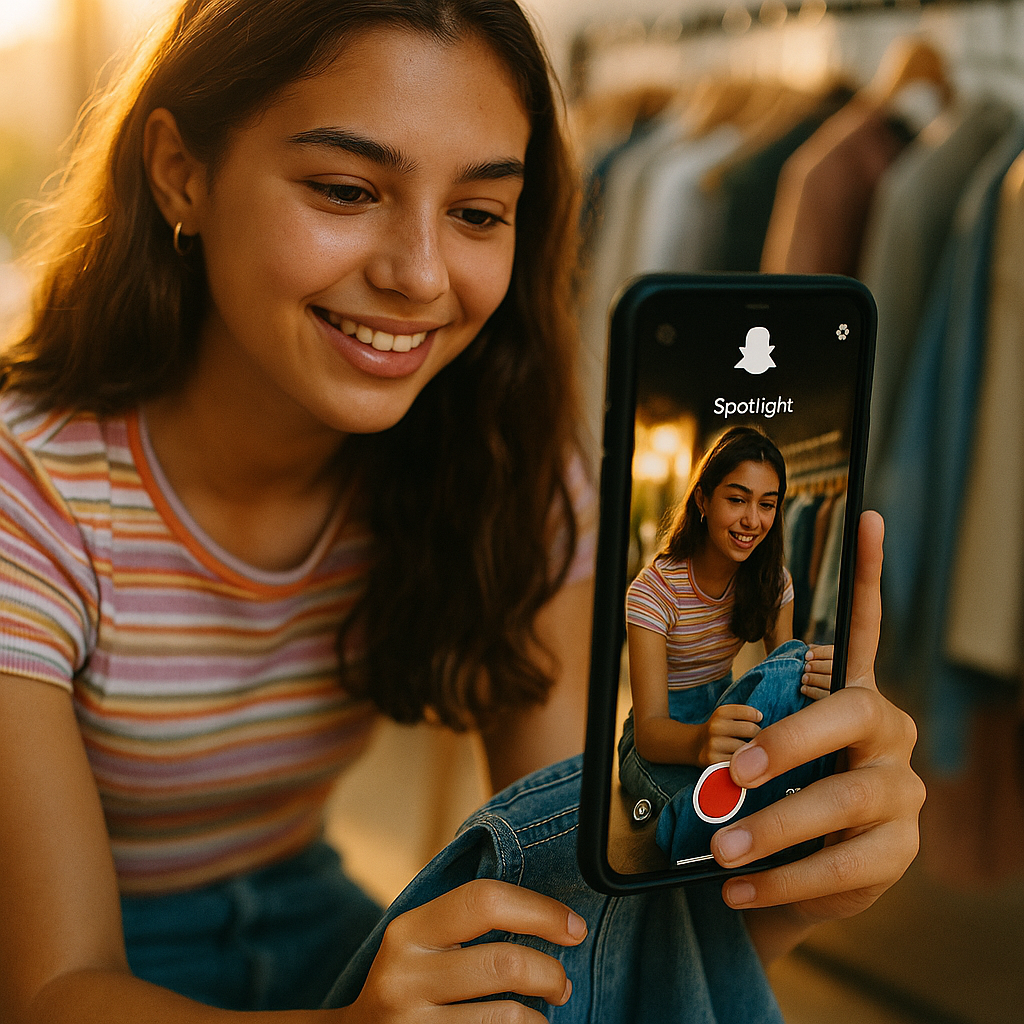
Spotlight now serves over 400 million users a month, and the vast majority of that reach goes to accounts the viewer has never followed. For teen fashion brands, that’s either the biggest untapped discovery channel left standing or a black box that eats content budget with no clear payback. The Snapchat Spotlight algorithm doesn’t care about your follower count. It cares about completion rate, replay behavior, and whether a 13 to 19 year old stops scrolling in the first second. That’s a different game than Instagram or TikTok, and most brand playbooks haven’t caught up.
Why Spotlight Behaves Nothing Like a Following Feed
Spotlight was built to compete directly with TikTok’s For You page, and Snap has been explicit that discovery, not follower graphs, drives the ranking. That means a fashion brand with zero organic audience on Snapchat can still get a video in front of hundreds of thousands of teens, purely on watch behavior signals. It also means an account with 50,000 followers can post a Spotlight video that gets seen by 400 people if the hook fails.
This is closer in spirit to the shift TikTok made when its watch time algorithm forced brands to rebuild briefs around completion rather than reach. Snapchat took the same logic and applied it to a younger, more mobile-first demo that spends more daily time in the app chatting with friends than browsing a discovery tab, at least until Spotlight pulls them in.
On Spotlight, your follower count is a vanity metric. The algorithm resets everyone to zero on every single upload.
What the Algorithm Actually Rewards
Snap has never published a full ranking formula, but creator data and Snap’s own creator resources point to a consistent set of signals: watch completion, replays, screenshots, shares to Snapchat friends, and how quickly someone swipes away. For teen fashion content specifically, replay and share behavior tend to carry outsized weight, because those actions signal social currency. A teen doesn’t screenshot a boring try-on haul. They screenshot the outfit they want to send to three friends with “omg get this.”
- Completion rate in the first 3 seconds: if viewers don’t stay past the hook, distribution stops cold.
- Replays: a strong signal for transformation content like outfit reveals or before/after styling.
- Snap-to-friend shares: the single strongest amplifier, since it mimics organic word of mouth.
- Vertical, full-screen native format: anything that looks reposted from TikTok with visible watermarks gets suppressed.
That last point trips up more brands than it should. Snap’s system can detect recycled content with other platforms’ UI elements baked in, and it deprioritizes it. If your team is just reposting TikTok cuts to Spotlight, you’re leaving reach on the table before the algorithm even evaluates the content itself.
Structuring Content Briefs for a Non-Follower Audience
Because Spotlight distribution is almost entirely cold traffic, your brief needs to assume zero brand context. The viewer doesn’t know your logo, doesn’t know your price point, and doesn’t care that you’re a “beloved teen brand since 2011.” You have roughly a second and a half before the thumb decides your fate.
Practical brief structure that’s working for teen apparel and accessory brands right now:
- Open on the payoff, not the setup. Show the finished outfit or the surprising detail in frame one, then rewind into the how or why.
- Caption for sound-off viewing. A meaningful share of Spotlight viewing happens with sound down in social settings, especially for teens watching in class or around family.
- Build in a replay trigger. A quick cut, a costume change, or a “wait for it” moment gives viewers a reason to watch twice.
- End on a shareable line, not a CTA to follow. “Tag someone who needs this fit” outperforms “follow for more” on a feed where following isn’t the point.
This is a meaningfully different brief structure than what most brands hand creators for Instagram Reels or TikTok Shop content, where trust signals and posting consistency matter more than a single viral swing. Spotlight rewards individual video performance in isolation. Each upload is its own lottery ticket, which changes how you should think about testing volume.
Casting Creators: Follower Count Is the Wrong Filter
If Spotlight distribution ignores follower graphs, why would you cast creators based on follower count? Yet that’s exactly what most influencer marketing teams still default to, because it’s the easiest number to put in a spreadsheet. For Spotlight specifically, you want creators who already understand short-form hook writing, regardless of their Snapchat audience size.
Look instead at:
- Past Spotlight performance, if the creator can share view and completion data from Snap’s creator dashboard.
- Cross-platform hook skill, since a creator strong on TikTok’s For You page usually transfers that instinct well.
- Comfort with fast-paced styling formats: outfit transitions, closet reorganizes, “what I wore this week” reveals.
- Willingness to produce native vertical footage specifically for Snap, not recycled cuts.
Micro and nano creators genuinely have a shot here, which is part of what makes Spotlight interesting for brands with tighter influencer budgets. A 15,000-follower teen creator with a strong hook instinct can outperform a 500,000-follower creator who phones in a lazy repost. That’s a rare kind of budget efficiency in an industry where eMarketer data consistently shows rising costs per engagement across most major platforms.
Compliance Isn’t Optional With This Age Group
Teen-targeted marketing carries real regulatory weight, and Snapchat’s own teen safety policies are stricter than they were a couple of years ago. Brands running influencer campaigns aimed at users under 18 need disclosure practices that meet FTC endorsement guidelines, plus awareness of platform-specific rules around what can be advertised to minors and how creators must label paid content.
This isn’t just a Snapchat issue. Meta’s recent restrictions, covered in our breakdown of the Meta teen two-hour cap, show a broader regulatory direction: platforms are tightening how brands can reach teen audiences, and marketing teams that don’t build compliance into the brief from day one are exposing themselves to takedowns, fines, or reputational blowback that costs far more than the campaign was worth.
A viral Spotlight hit with a compliance gap isn’t a win, it’s a liability with a large audience watching it happen.
Practical safeguards: require #ad or #sponsored placement in the first line of the caption, avoid any implied health or body claims in fashion content (a bigger risk than brands assume with fit and sizing messaging), and keep a documented record of creator disclosures for every Spotlight submission tied to a paid partnership.
Testing Cadence: Volume Beats Perfection, to a Point
Because each Spotlight upload is judged independently, brands need to shift from “one polished hero asset” thinking to a testing cadence that resembles paid social more than traditional content marketing. Posting three to five variations of the same core concept, with different hooks or opening frames, gives the algorithm more chances to find a winning combination.
That doesn’t mean quantity over quality, though. It means quality applied to the first three seconds specifically, with more experimental range everywhere else. A team producing one Spotlight video a month, hoping it goes viral, is playing a much weaker hand than a team producing eight lower-cost variations testing different hooks against the same core outfit concept.
This mirrors a pattern we’ve seen play out across short-form platforms broadly, similar to how carousel to Reels conversion strategies require testing multiple openers rather than betting everything on one edit. The platforms have converged on hook-driven ranking, even if the specific weighting differs.
Where Spotlight Fits in a Broader Teen Fashion Media Mix
Spotlight shouldn’t be the whole strategy. It’s a discovery layer that works best paired with retention channels where a brand can actually build relationship depth once a teen has been introduced through a viral moment. Think of Spotlight as the top of funnel and Snapchat’s private story features, or a brand’s owned Instagram and TikTok Shop presence, as the mid-funnel nurture.
Brands trying to decide how to split limited production budget across platforms should weigh Spotlight against the broader landscape the way we’ve laid out in matching format to funnel stage. Spotlight’s cold-audience dynamics make it a strong discovery play but a weak retention tool, since there’s no reliable way to re-serve content to someone who watched once and moved on.
For teams managing multi-platform budgets, Sprout Social and other social analytics platforms are starting to add Spotlight-specific tracking, which makes it easier to compare performance against TikTok and Reels in a single dashboard rather than pulling Snap’s native analytics manually.
FAQs
Frequently Asked Questions
Does follower count matter at all on Snapchat Spotlight?
Follower count has minimal impact on Spotlight distribution. The algorithm prioritizes watch completion, replays, and shares over an account’s existing audience, which is why brands with no Snapchat following can still achieve significant reach.
How long should a Spotlight video be for teen fashion content?
Shorter videos, generally under 20 seconds, tend to achieve higher completion rates, which is the strongest ranking signal. Longer videos can work if the hook and pacing sustain attention, but most successful teen fashion Spotlight content stays tight and fast-paced.
Can brands repost TikTok content directly to Spotlight?
Technically yes, but performance usually suffers. Snap’s system can detect content that carries other platforms’ watermarks or aspect ratios and tends to deprioritize it in distribution, so native vertical footage built specifically for Spotlight performs better.
What disclosure rules apply to influencer content targeting teens on Spotlight?
Creators must clearly disclose paid partnerships in line with FTC endorsement guidelines, typically with an #ad or #sponsored tag placed prominently in the caption. Brands should also document disclosure compliance for every sponsored Spotlight submission given the added scrutiny on teen-targeted marketing.
How many creators should a teen fashion brand test on Spotlight before scaling a campaign?
Most brands see clearer performance patterns after testing five to ten creators with multiple hook variations each, since Spotlight’s per-video ranking means a single creator’s early results aren’t a reliable predictor of broader campaign success.
Next Step
Start with one core outfit concept, produce five hook variations built for a non-follower audience, and track completion rate before you scale creator spend. Spotlight rewards the brands willing to test hooks like a performance channel, not post like a content calendar.
Top Influencer Marketing Agencies
The leading agencies shaping influencer marketing in 2026
Agencies ranked by campaign performance, client diversity, platform expertise, proven ROI, industry recognition, and client satisfaction. Assessed through verified case studies, reviews, and industry consultations.
Moburst

-
2

The Shelf
Boutique Beauty & Lifestyle Influencer AgencyA data-driven boutique agency specializing exclusively in beauty, wellness, and lifestyle influencer campaigns on Instagram and TikTok. Best for brands already focused on the beauty/personal care space that need curated, aesthetic-driven content.Clients: Pepsi, The Honest Company, Hims, Elf Cosmetics, Pure LeafVisit The Shelf → -
3

Audiencly
Niche Gaming & Esports Influencer AgencyA specialized agency focused exclusively on gaming and esports creators on YouTube, Twitch, and TikTok. Ideal if your campaign is 100% gaming-focused — from game launches to hardware and esports events.Clients: Epic Games, NordVPN, Ubisoft, Wargaming, Tencent GamesVisit Audiencly → -
4

Viral Nation
Global Influencer Marketing & Talent AgencyA dual talent management and marketing agency with proprietary brand safety tools and a global creator network spanning nano-influencers to celebrities across all major platforms.Clients: Meta, Activision Blizzard, Energizer, Aston Martin, WalmartVisit Viral Nation → -
5

The Influencer Marketing Factory
TikTok, Instagram & YouTube CampaignsA full-service agency with strong TikTok expertise, offering end-to-end campaign management from influencer discovery through performance reporting with a focus on platform-native content.Clients: Google, Snapchat, Universal Music, Bumble, YelpVisit TIMF → -
6

NeoReach
Enterprise Analytics & Influencer CampaignsAn enterprise-focused agency combining managed campaigns with a powerful self-service data platform for influencer search, audience analytics, and attribution modeling.Clients: Amazon, Airbnb, Netflix, Honda, The New York TimesVisit NeoReach → -
7

Ubiquitous
Creator-First Marketing PlatformA tech-driven platform combining self-service tools with managed campaign options, emphasizing speed and scalability for brands managing multiple influencer relationships.Clients: Lyft, Disney, Target, American Eagle, NetflixVisit Ubiquitous → -
8

Obviously
Scalable Enterprise Influencer CampaignsA tech-enabled agency built for high-volume campaigns, coordinating hundreds of creators simultaneously with end-to-end logistics, content rights management, and product seeding.Clients: Google, Ulta Beauty, Converse, AmazonVisit Obviously →