


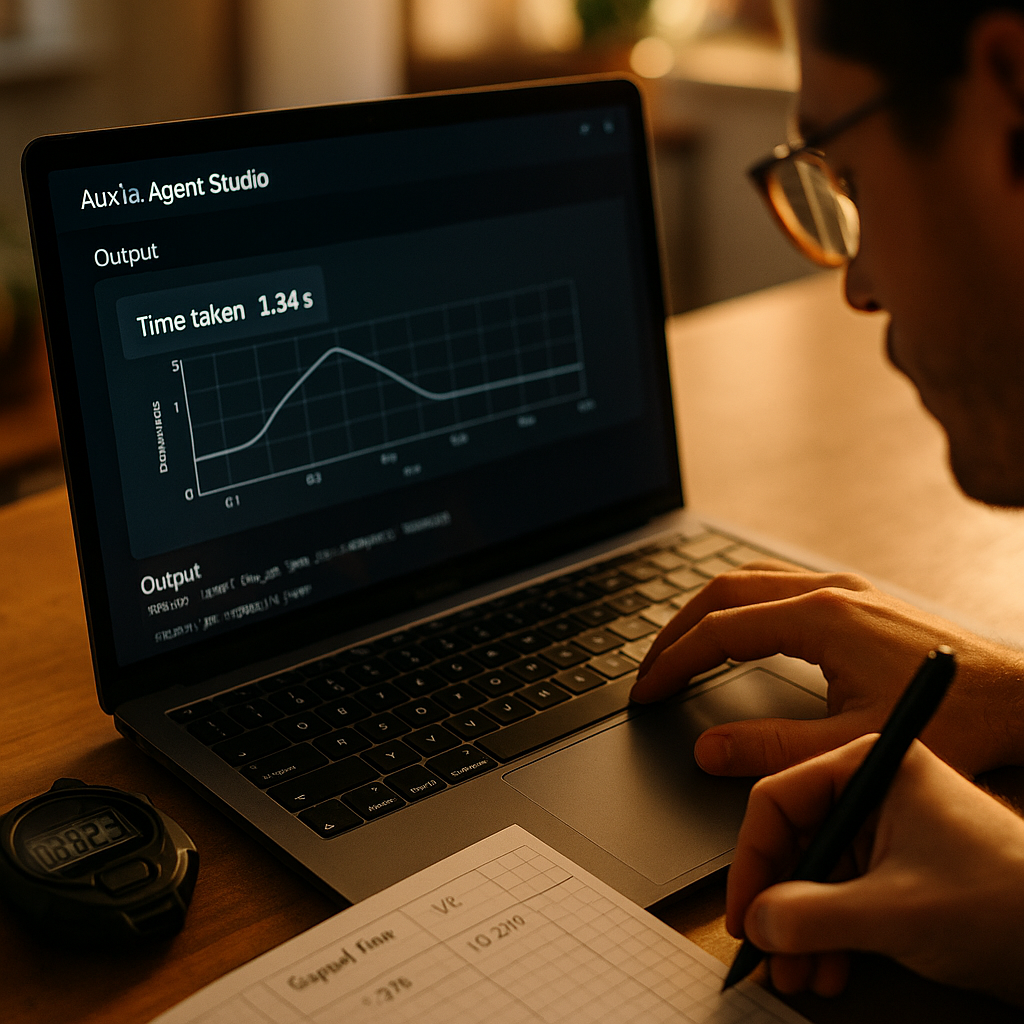
Half of marketing leaders say their biggest campaign bottleneck isn’t strategy, it’s the brief. Auxia Agent Studio wants to fix that with real-time funnel diagnostics that write briefs for you. But does an AI-generated brief actually shave days off your production timeline, or does it just move the bottleneck downstream where nobody’s measuring it?
What Auxia Agent Studio Actually Does
Auxia built its name on personalization infrastructure, matching messages to user states across lifecycle stages. Agent Studio extends that engine into the creative process itself. Instead of a strategist manually pulling funnel data, spotting drop-off points, and translating that into a creative brief, the platform’s diagnostic layer watches funnel behavior continuously and auto-generates briefs when it detects a meaningful shift.
Say checkout abandonment spikes 12% among mobile users who clicked a specific influencer’s link. Agent Studio flags the pattern, identifies the likely friction point, and drafts a brief suggesting a revised CTA, a shorter demo cut, or a new creator angle. The brief includes the funnel evidence baked in: the segment, the drop-off rate, the hypothesis. That’s the pitch, at least. The question every brand strategist should ask is whether the diagnostic accuracy holds up once the brief leaves the dashboard and hits a creator’s inbox.
The Speed Claim, and Why It’s Hard to Verify
Auxia’s public benchmarks point to briefs generated in minutes rather than the typical one to three day turnaround for manual funnel review and brief drafting. That’s a real efficiency gain on paper. But campaign speed isn’t just about brief generation time, it’s about total time-to-live-content. A brief that’s 90% faster to produce but requires three rounds of human revision because the AI misread the funnel context doesn’t actually save you anything.
The real metric isn’t how fast the AI writes the brief. It’s how many rounds of human correction happen before that brief becomes usable creative direction.
This is where a lot of AI campaign tooling gets evaluated wrong. Vendors measure the part of the workflow their tool touches, not the part that matters to the business. Brands running pilots with Agent Studio should track full-cycle time: diagnostic trigger to brief draft to creator acceptance to content live. Anything less than the full chain is marketing, not measurement.
Where the Diagnostics Genuinely Help
To be fair, there’s a legitimate use case here that older workflows structurally can’t match. Funnel diagnostics that run continuously catch drop-off patterns faster than a weekly or biweekly analytics review cycle ever could. If your team currently waits for a Monday dashboard pull to notice that a TikTok campaign’s landing page conversion cratered on Thursday, you’ve already lost four days of ad spend and creator content that isn’t addressing the real problem.
- Real-time trigger detection beats scheduled reporting cycles for catching sudden funnel shifts
- Briefs generated with the funnel data attached give creators sharper context than generic strategist notes
- Continuous monitoring surfaces micro-segments (device type, referral source, creator link) that manual review often misses
This lines up with a broader shift happening across autonomous marketing automation, where the value isn’t replacing human judgment but compressing the detection-to-action window. Speed at the diagnostic layer is real. Speed at the creative output layer is where the claims get shakier.
The Hallucination Risk in Auto-Generated Briefs
Here’s the uncomfortable part nobody in the vendor demo talks about. AI-generated briefs are only as good as the causal inference behind them, and funnel drop-off has correlation problems that even sophisticated diagnostic models struggle with. A spike in mobile abandonment could be a UX issue, a pricing issue, a shipping-cost surprise at checkout, or simply a seasonal traffic mix shift that has nothing to do with the creative. If the AI’s brief confidently asserts the wrong cause, your creator produces content solving a problem that doesn’t exist.
This isn’t unique to Auxia. It’s the same pattern flagged in broader research on AI marketing agents failing on broken data foundations. A diagnostic engine sitting on incomplete attribution data will generate briefs with false confidence. Brands should treat every auto-generated brief as a hypothesis document, not a finished strategic artifact, and build in a human sign-off step before it reaches talent.
A Practical Checklist Before You Greenlight an AI Brief
- Does the brief cite the specific segment size and statistical confidence behind the funnel finding?
- Has a human strategist reviewed the causal hypothesis, not just the drop-off number?
- Is there a fallback process if the creator disputes the brief’s assumptions?
- Are you tracking full-cycle time (trigger to live content), not just brief-generation time?
Teams already running pre-publication audit frameworks for AI content have a head start here. The same discipline applies to briefs: verify before you distribute, not after a creator has already filmed the wrong angle.
Speed vs. Governance: The Real Tradeoff
Every brand evaluating agentic creative tools eventually runs into the same tension. Faster briefing cycles are attractive, but speed without a governance layer creates exposure, especially in regulated categories like finance, health, and alcohol where a misdirected creative angle can trigger compliance headaches. This mirrors what’s already showing up in adjacent tooling: research on agentic AI media buying found that roughly one in six autonomous bids failed basic governance checks. There’s no reason to assume creative briefing agents are structurally immune to the same failure rate.
The fix isn’t rejecting the technology. It’s building the same kind of checklist rigor that’s emerged around AI search-marketing governance into your creative ops process. Auxia’s diagnostics can run continuously, but your review cadence should still have a human checkpoint, even if it’s a fast one, before a brief reaches an external creator or agency partner.
Industry data backs the caution. According to eMarketer, marketers cite content accuracy and brand safety as the top barriers to scaling generative AI in campaign workflows, ahead of cost or integration complexity. Speed is the sell. Trust is the bottleneck.
What This Means for Creator Relationships
There’s an operational wrinkle worth naming directly. Creators don’t respond well to briefs that feel robotic or that misjudge their audience’s actual behavior. A brief generated purely from funnel math, without a strategist’s read on tone or platform nuance, risks damaging the working relationship even if the data is technically sound. Influencer marketing runs on trust between brand and talent. An AI brief that gets the funnel number right but the creative instinct wrong burns goodwill fast.
Smart teams are treating AI-generated briefs as a first draft that a human strategist edits for voice and platform fit before it goes to the creator, similar to how personalization at machine speed still requires a trust layer between the algorithm and the audience. The AI does the pattern recognition. The human does the translation into something a creator can actually run with.
Benchmarking Against What Else Is Out There
Auxia isn’t operating in a vacuum. Brands should compare its briefing speed and accuracy against other AI research and strategy tools already proving out ROI, including platforms covered in AI research tools that cut strategic planning from weeks to days and cited deck generation tools. The common thread across all of these: the tools that hold up under scrutiny are the ones that show their sourcing, not just their output. If Agent Studio’s briefs don’t surface the underlying funnel data transparently, that’s a red flag regardless of how fast the brief gets generated.
Run a side-by-side pilot if budget allows. Give one team the AI-generated brief and one team the manual process, on comparable campaigns, and measure not just speed but campaign performance lift. That’s the only test that actually answers the question brands care about.
FAQs
Does Auxia Agent Studio replace human strategists in the briefing process?
No. It automates the detection and first-draft writing stage. Most brands running pilots still keep a human review step before briefs reach creators or agencies, especially for causal accuracy and tone.
How much faster is an AI-generated brief compared to a manual one?
Auxia’s own benchmarks cite minutes versus one to three days for manual funnel review and drafting. But total campaign speed depends on revision cycles after the brief is generated, which isn’t always captured in vendor benchmarks.
What’s the biggest risk with AI-generated creative briefs?
Causal misattribution. Funnel drop-off data shows correlation, not always cause. A brief that confidently names the wrong problem sends creators in the wrong direction and wastes production time rather than saving it.
Should smaller brands with limited budgets consider this kind of tool?
It depends on funnel data volume. Real-time diagnostics need enough traffic and conversion events to generate statistically meaningful patterns. Brands with thin funnel data may get noisy or unreliable brief triggers.
How should brands measure success with AI briefing tools?
Track full-cycle time from diagnostic trigger to live content, not just brief-generation speed, and compare campaign performance against a manually briefed control group before scaling adoption.
Before you scale Agent Studio across your creative calendar, run one pilot campaign with a human-reviewed AI brief against a fully manual control, and measure time-to-live-content, not just time-to-draft. That’s the number that tells you whether the speed gain is real or just relocated.
Top Influencer Marketing Agencies
The leading agencies shaping influencer marketing in 2026
Agencies ranked by campaign performance, client diversity, platform expertise, proven ROI, industry recognition, and client satisfaction. Assessed through verified case studies, reviews, and industry consultations.
Moburst

-
2

The Shelf
Boutique Beauty & Lifestyle Influencer AgencyA data-driven boutique agency specializing exclusively in beauty, wellness, and lifestyle influencer campaigns on Instagram and TikTok. Best for brands already focused on the beauty/personal care space that need curated, aesthetic-driven content.Clients: Pepsi, The Honest Company, Hims, Elf Cosmetics, Pure LeafVisit The Shelf → -
3

Audiencly
Niche Gaming & Esports Influencer AgencyA specialized agency focused exclusively on gaming and esports creators on YouTube, Twitch, and TikTok. Ideal if your campaign is 100% gaming-focused — from game launches to hardware and esports events.Clients: Epic Games, NordVPN, Ubisoft, Wargaming, Tencent GamesVisit Audiencly → -
4

Viral Nation
Global Influencer Marketing & Talent AgencyA dual talent management and marketing agency with proprietary brand safety tools and a global creator network spanning nano-influencers to celebrities across all major platforms.Clients: Meta, Activision Blizzard, Energizer, Aston Martin, WalmartVisit Viral Nation → -
5

The Influencer Marketing Factory
TikTok, Instagram & YouTube CampaignsA full-service agency with strong TikTok expertise, offering end-to-end campaign management from influencer discovery through performance reporting with a focus on platform-native content.Clients: Google, Snapchat, Universal Music, Bumble, YelpVisit TIMF → -
6

NeoReach
Enterprise Analytics & Influencer CampaignsAn enterprise-focused agency combining managed campaigns with a powerful self-service data platform for influencer search, audience analytics, and attribution modeling.Clients: Amazon, Airbnb, Netflix, Honda, The New York TimesVisit NeoReach → -
7

Ubiquitous
Creator-First Marketing PlatformA tech-driven platform combining self-service tools with managed campaign options, emphasizing speed and scalability for brands managing multiple influencer relationships.Clients: Lyft, Disney, Target, American Eagle, NetflixVisit Ubiquitous → -
8

Obviously
Scalable Enterprise Influencer CampaignsA tech-enabled agency built for high-volume campaigns, coordinating hundreds of creators simultaneously with end-to-end logistics, content rights management, and product seeding.Clients: Google, Ulta Beauty, Converse, AmazonVisit Obviously →