


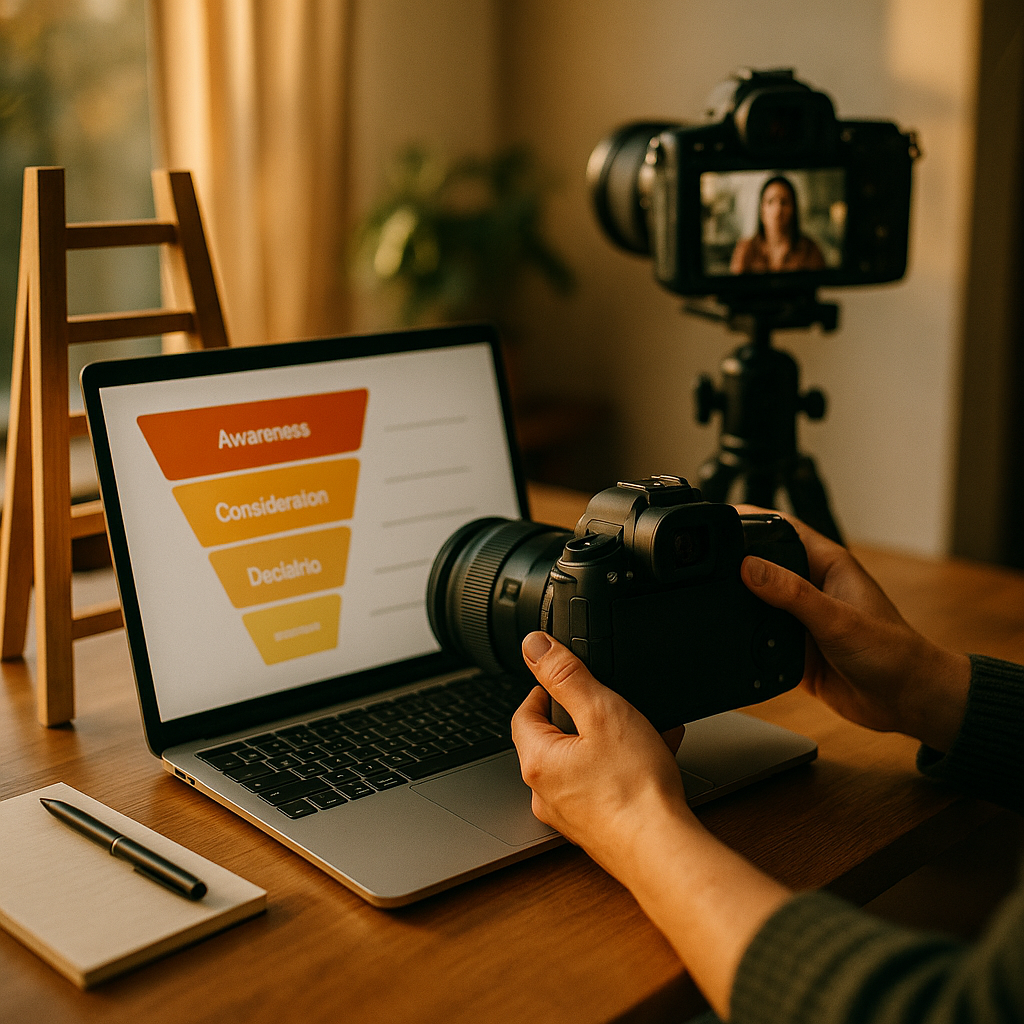
Only 22% of marketers say they systematically map creator content to funnel stage, according to recent Sprout Social benchmarking data, yet full-funnel campaigns consistently outperform single-asset drops on cost per acquisition. If your influencer program produces one hero video and hopes it converts everyone from a cold scroller to a repeat buyer, you’re leaving money on the table. The discovery-to-conversion content ladder fixes that by briefing assets in sequence, not isolation.
The Problem With One-Asset Campaigns
Most briefs still ask a creator for “a video that drives sales.” That’s like asking a salesperson to close a deal with a stranger in the first ten seconds of a cold call. It rarely works, and when it does, it’s expensive luck, not repeatable strategy.
The reality is that awareness, consideration, and conversion require different creative jobs. A hook that stops the scroll rarely carries enough proof to justify a purchase. A detailed demo that builds trust is usually too slow to earn reach in a cold feed. Brands that blend these jobs into a single asset end up with content that’s mediocre at everything and excellent at nothing.
Full-funnel sequencing isn’t about making more content. It’s about making the content you already commission do specific, measurable jobs at each stage of the buyer journey.
Mapping the Ladder: Five Rungs From Scroll to Sale
Think of the content ladder as five distinct rungs, each with its own creative brief, KPI, and distribution logic.
- Rung 1, Interrupt: A pattern-break hook designed purely for reach and watch time. No product pitch, no CTA. Its only job is to earn attention in a saturated feed.
- Rung 2, Curiosity: A short follow-up that names the problem and teases a solution without revealing the brand too heavily. This is where hooks and pacing that rank matter most, since retention here decides whether a viewer moves to the next rung.
- Rung 3, Proof: Demonstration, ingredient breakdowns, or testimonials that build credibility. This is the trust-building stage, and it’s where demo videos consistently outperform lifestyle content.
- Rung 4, Comparison: Content that addresses objections directly, price, alternatives, skepticism. This rung often borrows structure from a storytelling arc built for full-funnel conversion.
- Rung 5, Close: Urgency-driven or offer-specific creative that pushes the final decision, restocks, bundles, limited windows.
Each rung feeds the next. Skip one and you’re asking your audience to jump a gap most won’t cross.
Sequencing Assets Without Duplicating Your Team’s Work
Here’s the part brands get wrong: they assume five rungs mean five separate shoots. It doesn’t. A single, well-briefed production day can generate assets for every stage if the brief is written with sequencing in mind from the start.
This is where studio-style production built for one shoot day earns its keep. You block scenes by funnel stage instead of by scene number, capture broll for repurposing, and direct creators to deliver multiple takes with varying levels of product emphasis. One taste-test setup, for example, can yield an interrupt hook, a proof clip, and a comparison cutdown without reshooting anything.
Efficient briefs also plan for platform variance up front. A hook cut for TikTok’s six-second attention window won’t survive unedited on a Meta feed. Building syndication-ready assets from one shoot means your editing team isn’t scrambling to reformat later, and your media buyers get platform-native creative on day one.
Budget Allocation Across the Ladder
Most brands overspend on Rung 1 and underspend on Rungs 3 and 4, chasing views instead of the assets that actually close deals. A more balanced split looks like this: 30% of budget on interrupt and curiosity content, 45% on proof and comparison assets, and 25% reserved for close-stage creative tied to specific promotional windows. Adjust based on category, but resist the instinct to pour everything into top-of-funnel reach. eMarketer’s spend data consistently shows mid-funnel content underfunded relative to its conversion contribution.
What Goes Wrong When Brands Skip a Rung?
Skipping the proof stage is the most common failure. Brands jump from a flashy hook straight to a discount code, and conversion rates stall because nobody addressed skepticism. Cold audiences don’t buy on charisma alone; they buy after enough proof accumulates to lower perceived risk.
The opposite mistake happens too. Some teams overload every asset with proof and objection handling, which kills reach because the pacing drags and the algorithm buries it before it earns distribution. If you want a gut check on whether your top-of-funnel creative is actually built for reach, revisit creative briefs designed to lower CPMs in saturated feeds before you scale spend against a weak hook.
Another quiet failure point: compliance gaps that surface only after a campaign scales. Disclosure requirements and claims substantiation need to be baked into the brief at every rung, not patched in after legal flags something. The FTC’s endorsement guidance applies equally to a six-second hook and a five-minute proof video, and brands that treat disclosure as a Rung 5 afterthought tend to get burned. Building review steps into sales briefs that pass legal review fast saves weeks of back-and-forth once assets are already scheduled.
Briefing the Ladder in One Document
The single biggest operational win is writing one master brief that maps every rung, rather than issuing separate briefs per stage. A well-structured ladder brief includes:
- The core insight or tension driving the campaign, stated once and referenced at every rung.
- Specific creative direction per rung, including tone, pacing, and CTA presence or absence.
- Platform-specific cutdown instructions so editors know exactly what changes between placements.
- A tagging system that lets performance marketers track which rung each asset belongs to inside ad platforms like TikTok Ads Manager or Meta Business Suite.
- Success metrics unique to each rung: watch time and shares for Rung 1, save rate and comment sentiment for Rung 3, click-through and conversion rate for Rung 5.
This last point matters more than it sounds. If you judge a Rung 1 hook by conversion rate, you’ll kill good top-of-funnel creative for the wrong reason. If you judge a Rung 4 comparison video by reach, you’ll do the opposite. Mismatched metrics are the quiet killer of otherwise sound content ladders.
A content ladder only works if your reporting structure respects the different jobs each rung is doing. One CPA target applied across five funnel stages will misread almost every asset in your campaign.
Teams running affiliate or nano-creator programs alongside paid can apply the same logic. The sampling-to-content brief framework for affiliate seeding works well as a Rung 3 or 4 supplement, since seeded creators often produce credible proof content at a fraction of the cost of a paid shoot.
Testing Before You Scale
Don’t commit full budget to a five-rung sequence untested. Run a smaller version first, three or four asset variants per rung, and watch drop-off between stages before scaling spend. If you’re building serialized content as part of the ladder, the same discipline that governs three-episode test arcs before scaling applies here: validate retention and sentiment early, then commit budget once the sequence proves it holds an audience across stages, not just within one.
Use HubSpot’s attribution reporting or your platform’s native multi-touch attribution to confirm the ladder is actually working as a sequence, not just as five disconnected ads competing for the same budget line.
Next step: Pull your last three campaign briefs and check whether each asset was built for a single funnel job or asked to do everything at once. If it’s the latter, rewrite your next brief as a five-rung ladder before you shoot another frame.
FAQs
What is a discovery-to-conversion content ladder?
It’s a creative framework that sequences campaign assets by funnel stage, awareness, consideration, and conversion, so each piece of content has one clear job instead of trying to accomplish everything at once.
How many assets does a full-funnel ladder actually require?
Most effective ladders use five distinct asset types (interrupt, curiosity, proof, comparison, close), but a single well-planned shoot day can produce all five without separate production budgets.
How do I know which rung an underperforming asset belongs to?
Check the metric it’s being judged against. Assets meant for reach should be measured on watch time and shares, while conversion-stage assets should be judged on click-through and purchase rate. Mismatched metrics usually reveal the real problem.
Can nano or micro creators fill every rung of the ladder?
Yes, particularly for proof and comparison stages, where authenticity outperforms polish. Paid or agency-produced creative often works better for interrupt and close stages that require tighter production control.
How does compliance fit into a multi-stage content ladder?
Disclosure and claims requirements apply at every rung, not just the final conversion asset. Building compliance checks into the master brief avoids costly rework once content is already scheduled across platforms.
Top Influencer Marketing Agencies
The leading agencies shaping influencer marketing in 2026
Agencies ranked by campaign performance, client diversity, platform expertise, proven ROI, industry recognition, and client satisfaction. Assessed through verified case studies, reviews, and industry consultations.
Moburst

-
2

The Shelf
Boutique Beauty & Lifestyle Influencer AgencyA data-driven boutique agency specializing exclusively in beauty, wellness, and lifestyle influencer campaigns on Instagram and TikTok. Best for brands already focused on the beauty/personal care space that need curated, aesthetic-driven content.Clients: Pepsi, The Honest Company, Hims, Elf Cosmetics, Pure LeafVisit The Shelf → -
3

Audiencly
Niche Gaming & Esports Influencer AgencyA specialized agency focused exclusively on gaming and esports creators on YouTube, Twitch, and TikTok. Ideal if your campaign is 100% gaming-focused — from game launches to hardware and esports events.Clients: Epic Games, NordVPN, Ubisoft, Wargaming, Tencent GamesVisit Audiencly → -
4

Viral Nation
Global Influencer Marketing & Talent AgencyA dual talent management and marketing agency with proprietary brand safety tools and a global creator network spanning nano-influencers to celebrities across all major platforms.Clients: Meta, Activision Blizzard, Energizer, Aston Martin, WalmartVisit Viral Nation → -
5

The Influencer Marketing Factory
TikTok, Instagram & YouTube CampaignsA full-service agency with strong TikTok expertise, offering end-to-end campaign management from influencer discovery through performance reporting with a focus on platform-native content.Clients: Google, Snapchat, Universal Music, Bumble, YelpVisit TIMF → -
6

NeoReach
Enterprise Analytics & Influencer CampaignsAn enterprise-focused agency combining managed campaigns with a powerful self-service data platform for influencer search, audience analytics, and attribution modeling.Clients: Amazon, Airbnb, Netflix, Honda, The New York TimesVisit NeoReach → -
7

Ubiquitous
Creator-First Marketing PlatformA tech-driven platform combining self-service tools with managed campaign options, emphasizing speed and scalability for brands managing multiple influencer relationships.Clients: Lyft, Disney, Target, American Eagle, NetflixVisit Ubiquitous → -
8

Obviously
Scalable Enterprise Influencer CampaignsA tech-enabled agency built for high-volume campaigns, coordinating hundreds of creators simultaneously with end-to-end logistics, content rights management, and product seeding.Clients: Google, Ulta Beauty, Converse, AmazonVisit Obviously →