


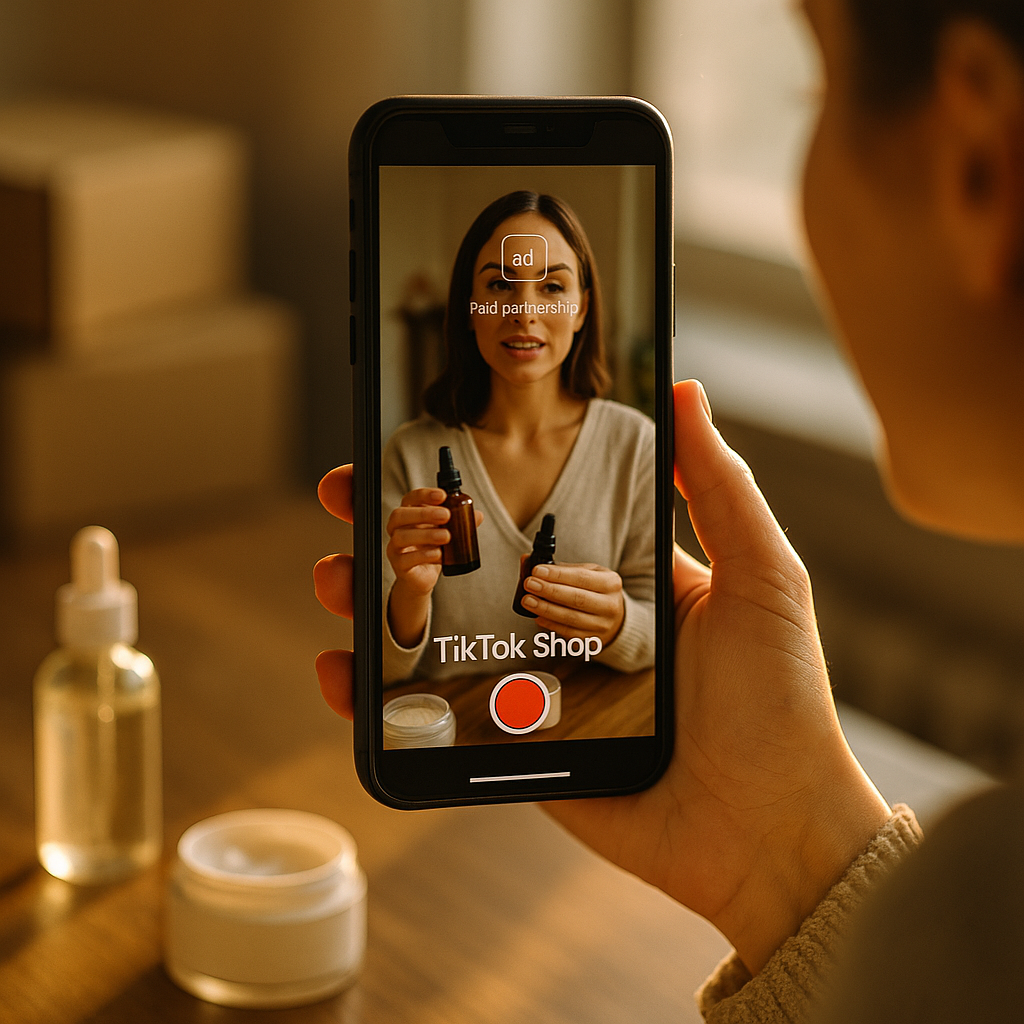
Eighty two percent of TikTok Shop livestream sales now happen without a single visible disclosure label on screen, according to compliance audits circulating among agency legal teams this year. That gap is not an accident. It is a workflow failure. If your brand runs affiliate or seeded product campaigns on TikTok Shop, the TikTok Shop disclosure question is no longer academic: it is the difference between a clean campaign and an FTC inquiry letter.
The Two Disclosure Paths TikTok Shop Actually Requires
TikTok’s Commercial Content policy and the FTC’s Endorsement Guides create overlapping but distinct obligations, and most brand teams treat them as one requirement when they’re actually two. The first is the platform mechanism: TikTok’s built-in Paid Partnership label, which creators toggle on when posting branded video content. The second is behavioral: a verbal, in-the-moment disclosure during livestream selling, where there’s often no static label to lean on at all.
Brands tend to default to whichever one is easiest to enforce. Static video content? Check the label box, move on. Livestream shopping? That’s where things fall apart, because nobody on the brand side is watching the stream in real time to confirm the creator actually said the words.
Paid Partnership Labels: What They Cover (and Where They Fail)
TikTok’s Paid Partnership label is a metadata tag. It appears as an on-screen banner and gets attached to the post’s backend data, which theoretically lets TikTok’s ad systems and Commercial Content API track disclosed content at scale. For pre-recorded video, this works reasonably well. The creator uploads, toggles the setting, and the label persists for the life of the post.
The failure points are structural, not creative. Duets and stitches sometimes strip the original label depending on device and app version. Cross-posted TikTok Shop content republished to Instagram Reels or YouTube Shorts loses the tag entirely, since it’s a TikTok-native feature. And affiliate creators working through TikTok Shop’s open affiliate marketplace, the ones a brand never directly contracts, frequently skip the toggle altogether because nobody is auditing them.
A paid partnership label only protects a brand if someone is verifying it’s actually applied, not assuming a creator remembered the toggle.
This is the same gap we’ve flagged in whitelisted dark post campaigns, where paid amplification strips the visual context that would normally signal a sponsorship to a viewer scrolling their feed.
Verbal Ad Callouts: The Live Shopping Wildcard
Livestream shopping is where TikTok Shop generates a disproportionate share of GMV, and it’s also where disclosure gets genuinely hard to enforce. There’s no persistent on-screen banner running the entire broadcast. TikTok does display a general “Live” indicator and sometimes a shopping cart prompt, but that is not the same as an endorsement disclosure under FTC standards.
The FTC’s position, reiterated across its endorsement guidance, is that disclosures must be clear, conspicuous, and repeated often enough that a viewer joining midstream would still catch them. A single verbal callout at minute two of a ninety minute livestream does not meet that bar. Yet that’s exactly what most brand-contracted livestream talent is doing right now, because nobody wrote the cadence requirement into the creator brief.
Practically, this means verbal callouts need to function like a recurring ad break, not a one time disclaimer. Smart brands are requiring creators to restate the partnership every 10 to 15 minutes, paired with an on-screen graphic overlay where the platform allows it.
Why Brands Get Burned on Livestream Compliance
Three recurring failure patterns show up in state AG sweeps and platform audits:
- No recording retention. Livestreams expire or get archived inconsistently, so when a regulator asks for proof of disclosure six months later, the brand has nothing to show.
- Affiliate creators outside contract scope. TikTok Shop’s open affiliate program lets creators pull products into livestreams without a direct brand relationship, meaning the brand’s disclosure training never reaches them.
- Inconsistent cadence across co-hosted streams. Multi-creator livestream formats often have one host disclosing and a second, silent host benefiting from the same commission structure.
Any one of these looks minor in isolation. Stacked together across a hundred livestream sessions a quarter, they represent a genuine enforcement exposure, and this is precisely the pattern regulators have been scanning for, as we covered in state AG disclosure sweeps.
Building a Disclosure Workflow That Scales Across Creators
The playbook that actually holds up under audit combines platform mechanics with contractual enforcement. Here’s the structure most compliance-mature brands have landed on:
- Contract language mandates both. Require the Paid Partnership label on all video content and a scripted verbal disclosure cadence for any livestream segment featuring the product.
- Pre-flight checklist before every livestream. Confirm the creator has enabled shop tagging, tested the label toggle, and reviewed the disclosure script.
- Recording capture built into the workflow. Use a third-party archiving tool or TikTok’s own creator analytics export to retain proof of disclosure timestamps, not just end-of-campaign screenshots.
- Affiliate marketplace monitoring. Run weekly sweeps of TikTok Shop affiliate content tied to your product SKUs, since open affiliate creators fall outside your direct contracts but still create brand liability.
- Escalation path for missed disclosures. Define what happens on a first miss versus a repeat miss, ideally tied to commission holdbacks, not just a warning email.
This mirrors the audit structure we recommend in creator ad approval workflow audits: build the check into the process, don’t rely on creator goodwill after the fact.
Legal and finance teams should also weigh in on classification risk. A creator who is scripted this tightly, on cadence, on wording, on timing, starts to look less like an independent contractor and more like a directed employee in some jurisdictions. That’s a conversation worth having alongside your disclosure policy, not after a regulator raises it, and it connects directly to the exposure outlined in DOL classification guidance for influencer contracts.
Does AI-Generated Product Content Change the Disclosure Calculus?
TikTok Shop is leaning harder into AI-generated product demos and avatar-hosted livestreams, and that introduces a second disclosure layer entirely. A synthetic host promoting a product isn’t just a paid partnership question, it’s an AI content transparency question too. Brands running avatar-based shop content need to stack the standard Paid Partnership label with the platform’s AI content flag, a requirement we broke down in TikTok’s AI content disclosure mandate. Skipping either one doubles the exposure, not halves it.
What Happens When You Get It Wrong?
Enforcement so far has been platform-level (content removal, creator strikes, reduced distribution) rather than direct FTC action against brands, but that is shifting. The FTC has shown increasing willingness to pursue advertisers directly, not just the creators posting on their behalf, when disclosure failures are systemic rather than isolated. A pattern of missed livestream callouts across dozens of sessions reads as systemic. One missed label on one video does not.
Retailers running TikTok Shop alongside retail media programs should also check consistency across channels. If your retail media disclosure standard is stricter than your TikTok Shop standard, that gap itself becomes evidence of inconsistent practice, a point worth reviewing against the framework in retail media sponsorship disclosure standards.
For a broader read on how disclosure requirements are trending across platforms and jurisdictions, tools like Sprout Social’s platform compliance resources and industry data from eMarketer are useful benchmarks for where enforcement is heading next.
The fix here isn’t complicated, it’s operational discipline: mandate both label and verbal callout in every creator contract, build a recording retention process, and audit your open affiliate exposure monthly instead of quarterly.
Frequently Asked Questions
Is a Paid Partnership label enough to satisfy FTC requirements on TikTok Shop?
Not always. The label satisfies TikTok’s platform policy, but the FTC requires disclosures to be clear and conspicuous in context. On livestreams, a static label alone often isn’t sufficient without a verbal callout repeated at reasonable intervals.
Do affiliate creators in TikTok Shop’s open marketplace need the same disclosure training as contracted talent?
Yes. Any creator earning commission on your products is making a paid endorsement, regardless of whether you signed a direct contract. Brands remain exposed to disclosure failures from open affiliate creators promoting their SKUs.
How often should a livestream host verbally disclose a paid partnership?
Best practice is every 10 to 15 minutes, since viewers join and leave livestreams continuously. A single disclosure at the start of a long stream does not reach viewers who join later.
What records should brands keep to prove disclosure compliance?
Retain livestream recordings with timestamps showing verbal disclosures, screenshots of Paid Partnership label toggles, and creator contracts specifying disclosure cadence. These records matter most if a regulator or platform requests proof after the fact.
Does cross-posting TikTok Shop content to other platforms carry over the disclosure label?
No. The Paid Partnership label is TikTok-native and typically does not transfer when content is repurposed to Instagram, YouTube, or other channels, so each platform’s disclosure requirement must be applied separately.
Top Influencer Marketing Agencies
The leading agencies shaping influencer marketing in 2026
Agencies ranked by campaign performance, client diversity, platform expertise, proven ROI, industry recognition, and client satisfaction. Assessed through verified case studies, reviews, and industry consultations.
Moburst

-
2

The Shelf
Boutique Beauty & Lifestyle Influencer AgencyA data-driven boutique agency specializing exclusively in beauty, wellness, and lifestyle influencer campaigns on Instagram and TikTok. Best for brands already focused on the beauty/personal care space that need curated, aesthetic-driven content.Clients: Pepsi, The Honest Company, Hims, Elf Cosmetics, Pure LeafVisit The Shelf → -
3

Audiencly
Niche Gaming & Esports Influencer AgencyA specialized agency focused exclusively on gaming and esports creators on YouTube, Twitch, and TikTok. Ideal if your campaign is 100% gaming-focused — from game launches to hardware and esports events.Clients: Epic Games, NordVPN, Ubisoft, Wargaming, Tencent GamesVisit Audiencly → -
4

Viral Nation
Global Influencer Marketing & Talent AgencyA dual talent management and marketing agency with proprietary brand safety tools and a global creator network spanning nano-influencers to celebrities across all major platforms.Clients: Meta, Activision Blizzard, Energizer, Aston Martin, WalmartVisit Viral Nation → -
5

The Influencer Marketing Factory
TikTok, Instagram & YouTube CampaignsA full-service agency with strong TikTok expertise, offering end-to-end campaign management from influencer discovery through performance reporting with a focus on platform-native content.Clients: Google, Snapchat, Universal Music, Bumble, YelpVisit TIMF → -
6

NeoReach
Enterprise Analytics & Influencer CampaignsAn enterprise-focused agency combining managed campaigns with a powerful self-service data platform for influencer search, audience analytics, and attribution modeling.Clients: Amazon, Airbnb, Netflix, Honda, The New York TimesVisit NeoReach → -
7

Ubiquitous
Creator-First Marketing PlatformA tech-driven platform combining self-service tools with managed campaign options, emphasizing speed and scalability for brands managing multiple influencer relationships.Clients: Lyft, Disney, Target, American Eagle, NetflixVisit Ubiquitous → -
8

Obviously
Scalable Enterprise Influencer CampaignsA tech-enabled agency built for high-volume campaigns, coordinating hundreds of creators simultaneously with end-to-end logistics, content rights management, and product seeding.Clients: Google, Ulta Beauty, Converse, AmazonVisit Obviously →