


$36.7 billion. That’s the size India’s entertainment and media market is projected to hit, and most global brands still treat the country as a rounding error in their creator budgets. If you’re allocating influencer spend by GDP-per-capita logic instead of engagement-per-dollar logic, you’re already behind competitors who figured this out two upfront cycles ago.
This isn’t a “India is emerging” story anymore. It’s a “India is already priced in for smart operators” story. The brands still debating whether to enter are negotiating from a weaker position every quarter they wait.
Why the Number Actually Matters to Your Budget
A market size figure is easy to skim past. But $36.7 billion in entertainment and media spend signals something specific for anyone buying creator deals: audience attention is consolidating around Indian-language content, regional streaming, and vernacular creators faster than global media buyers are adjusting their plans. India now has one of the largest mobile-first content consumption bases anywhere, and creator-led commerce is riding that wave directly into category leadership for beauty, fintech, D2C food, and mobile gaming brands.
Our own reporting has tracked this shift closely. India’s creator economy has already hit the $36.7 billion mark, and brands are still lagging in how they structure deals, measure ROI, or even identify the right tier of creator to work with. That lag is the opportunity. Every quarter a competitor spends “still evaluating the India market” is a quarter you could spend locking in exclusivity clauses with category-relevant creators before CPMs catch up to demand.
Brands that treat India as a single homogeneous market are leaving money on the table. Language, region, and platform preference fragment the opportunity into a dozen smaller, more targetable ones.
The Deal Structures Nobody’s Talking About
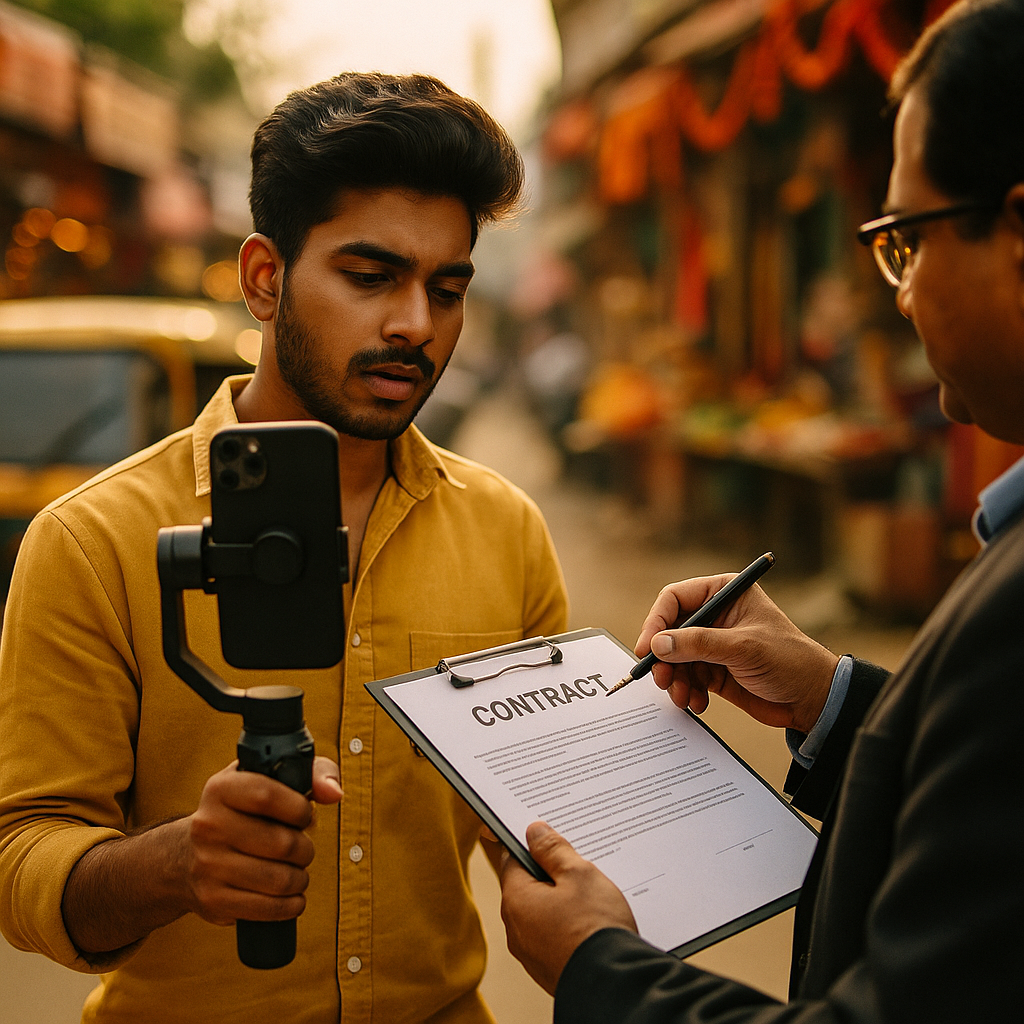
Most Western influencer contracts assume a certain baseline: flat fees, deliverable counts, usage rights measured in months. India’s creator market runs on different economics entirely. Micro and nano creators in tier two and tier three cities often outperform metro-based macro influencers on cost-per-engagement, largely because their audiences trust them as neighbors, not celebrities.
This mirrors a pattern we’ve documented elsewhere in emerging markets. Nano influencer growth in emerging markets is reshaping how budgets get allocated, and India is arguably the clearest case study. A brand running a national campaign with five macro creators in Mumbai and Delhi will likely underperform the same budget split across thirty regional nano creators covering Hindi, Tamil, Telugu, Marathi, and Bengali audiences separately.
What does this mean operationally? Your contract templates need to change. Usage rights, exclusivity windows, and payment structures built for a US or UK market don’t map cleanly onto a fragmented, multilingual creator base where a single “influencer” might mean someone with 8,000 hyper-loyal followers in a specific district.
Platform Selection Is Not a Global Copy-Paste Job
Here’s a mistake we see constantly: brands assume the platform mix that works in North America (Instagram plus TikTok plus YouTube) will translate directly to India. It doesn’t. Regional apps, vernacular YouTube channels, and India-specific short-form platforms carry disproportionate weight. Add in the explosive growth of livestream commerce, and the platform calculus gets more complicated fast.
Livestream shopping in particular deserves attention. Livestream shopping is returning at scale, powered by retail media and AI hosts, and India’s mobile-first consumer base is an ideal environment for this format. Brands running D2C or retail-adjacent products should be testing livestream formats now, not after competitors have already trained the audience to expect it from category leaders.
Retail media is also quietly eating into what used to be pure creator budget. Retail media networks are absorbing creator budget in mature markets, and India’s e-commerce giants are building similar infrastructure. Expect the line between “influencer partnership” and “retail media placement” to blur further as platforms like Flipkart and Amazon India expand creator-adjacent ad products.
Compliance and Risk: The Part Everyone Skips
India’s advertising standards body and consumer protection regulations have gotten sharper about influencer disclosure requirements. Brands that treated compliance as a US and UK-only concern are getting caught flat-footed. This isn’t optional homework. It’s risk mitigation that protects both budget and brand reputation.
The broader industry is already moving toward automated compliance and risk scoring for exactly this reason. Real-time risk scoring tools for creators are becoming standard practice, and any brand scaling India-specific deals should be running creators through similar screening before signing, not after a campaign draws regulatory attention.
Marketing ops teams are already stretched thin on this front globally. Machine readability compliance is burning out ops teams even in mature, single-language markets. Layer in India’s multilingual disclosure requirements and regional advertising codes, and the operational load multiplies. Budget for it now, in headcount or in tooling, rather than discovering the gap mid-campaign.
What ROI Actually Looks Like Here
Forget reach as your primary metric. India’s creator economy rewards brands that measure conversion and lifetime value, not follower counts. This aligns with a shift happening globally anyway. LTV metrics are replacing reach in influencer pay contracts, and India’s price-sensitive, high-volume consumer base makes this shift even more urgent. A creator with modest reach but strong repeat-purchase influence among a loyal regional audience is worth more than a viral macro post that never converts.
The same logic applies to KPI selection. View-through rate is overtaking click-through rate as the core influencer marketing KPI in markets where mobile data costs and app-switching friction suppress click behavior even when purchase intent is high. India, with its mobile-data-conscious consumer base, is a textbook example of where VTR tells a more honest story than CTR ever could.
Conversion data is also reshaping how brands select creator tiers in general. Conversion data is replacing reach as the deciding factor in tier selection, and India’s fragmented, price-conscious market rewards this approach more than most. A brand optimizing purely for follower count in India will overpay for vanity metrics while ignoring the mid-tier and nano creators actually driving sales.
How to Actually Build the Playbook
So what does an operational playbook look like for a brand entering, or scaling, its India creator strategy? A few non-negotiables:
- Segment by language and region first, platform second. Don’t build one national campaign. Build four or five regional ones with shared creative guardrails.
- Rewrite contract templates for local deal norms. Flat-fee, exclusivity, and usage-rights structures need India-specific versions, not global templates with currency swapped.
- Bake in compliance screening from day one. Disclosure rules and regulatory scrutiny are only getting stricter, not looser.
- Shift measurement to VTR and LTV. Reach-based reporting will consistently misrepresent what’s actually working.
- Budget for agency or infrastructure partners with local expertise. This isn’t a market to run purely through a global agency of record with no regional bench strength.
We’ve covered the strategic case for this shift in more depth elsewhere, including why India’s creator economy demands a genuinely new brand playbook rather than an adapted version of a Western one, and the parallel case for why the media market side of the equation requires its own creator strategy. Both pieces make the same underlying point from different angles: incremental adjustments to existing global strategy will underperform a purpose-built India approach.
For broader context on how creator economy data gets tracked and benchmarked globally, resources like Statista’s media market research and eMarketer’s digital ad spend forecasts are useful for triangulating India-specific figures against global trends. Platforms themselves are also worth monitoring directly. Meta’s business platform and TikTok’s advertising hub both publish region-specific guidance that’s worth reviewing before finalizing platform mix decisions for the Indian market.
Frequently Asked Questions
Why is India’s entertainment market suddenly relevant to influencer marketing budgets?
The $36.7 billion figure reflects rapid growth in mobile-first content consumption, regional streaming, and creator-led commerce. Brands that ignore it are missing a fast-growing, increasingly price-efficient channel for reaching engaged, high-intent audiences.
Should brands prioritize macro influencers or nano creators in India?
Nano and micro creators frequently outperform macro influencers on cost-per-engagement and conversion, particularly in tier two and tier three cities where local trust matters more than follower count.
What compliance risks should brands watch for when running India-specific creator campaigns?
Disclosure requirements, regional advertising codes, and multilingual compliance obligations are tightening. Brands should screen creators for compliance history before signing, not after a campaign draws scrutiny.
How should ROI be measured differently in the Indian creator market?
Prioritize view-through rate and lifetime value over reach and click-through rate. Mobile data costs and app-switching friction suppress clicks even when purchase intent is strong, making VTR a more reliable signal.
Can existing global influencer contract templates work in India?
Generally, no. Flat-fee structures, exclusivity clauses, and usage rights built for Western markets often don’t align with how Indian creator deals are typically negotiated, especially at the nano and micro tier.
Next step: audit your current creator roster for language and regional coverage gaps, then reallocate at least one campaign’s budget toward nano-tier, vernacular-language creators before your next planning cycle locks in spend elsewhere.
FAQs
Why is India’s entertainment market suddenly relevant to influencer marketing budgets?
The $36.7 billion figure reflects rapid growth in mobile-first content consumption, regional streaming, and creator-led commerce. Brands that ignore it are missing a fast-growing, increasingly price-efficient channel for reaching engaged, high-intent audiences.
Should brands prioritize macro influencers or nano creators in India?
Nano and micro creators frequently outperform macro influencers on cost-per-engagement and conversion, particularly in tier two and tier three cities where local trust matters more than follower count.
What compliance risks should brands watch for when running India-specific creator campaigns?
Disclosure requirements, regional advertising codes, and multilingual compliance obligations are tightening. Brands should screen creators for compliance history before signing, not after a campaign draws scrutiny.
How should ROI be measured differently in the Indian creator market?
Prioritize view-through rate and lifetime value over reach and click-through rate. Mobile data costs and app-switching friction suppress clicks even when purchase intent is strong, making VTR a more reliable signal.
Can existing global influencer contract templates work in India?
Generally, no. Flat-fee structures, exclusivity clauses, and usage rights built for Western markets often don’t align with how Indian creator deals are typically negotiated, especially at the nano and micro tier.
Top Influencer Marketing Agencies
The leading agencies shaping influencer marketing in 2026
Agencies ranked by campaign performance, client diversity, platform expertise, proven ROI, industry recognition, and client satisfaction. Assessed through verified case studies, reviews, and industry consultations.
Moburst

-
2

The Shelf
Boutique Beauty & Lifestyle Influencer AgencyA data-driven boutique agency specializing exclusively in beauty, wellness, and lifestyle influencer campaigns on Instagram and TikTok. Best for brands already focused on the beauty/personal care space that need curated, aesthetic-driven content.Clients: Pepsi, The Honest Company, Hims, Elf Cosmetics, Pure LeafVisit The Shelf → -
3

Audiencly
Niche Gaming & Esports Influencer AgencyA specialized agency focused exclusively on gaming and esports creators on YouTube, Twitch, and TikTok. Ideal if your campaign is 100% gaming-focused — from game launches to hardware and esports events.Clients: Epic Games, NordVPN, Ubisoft, Wargaming, Tencent GamesVisit Audiencly → -
4

Viral Nation
Global Influencer Marketing & Talent AgencyA dual talent management and marketing agency with proprietary brand safety tools and a global creator network spanning nano-influencers to celebrities across all major platforms.Clients: Meta, Activision Blizzard, Energizer, Aston Martin, WalmartVisit Viral Nation → -
5

The Influencer Marketing Factory
TikTok, Instagram & YouTube CampaignsA full-service agency with strong TikTok expertise, offering end-to-end campaign management from influencer discovery through performance reporting with a focus on platform-native content.Clients: Google, Snapchat, Universal Music, Bumble, YelpVisit TIMF → -
6

NeoReach
Enterprise Analytics & Influencer CampaignsAn enterprise-focused agency combining managed campaigns with a powerful self-service data platform for influencer search, audience analytics, and attribution modeling.Clients: Amazon, Airbnb, Netflix, Honda, The New York TimesVisit NeoReach → -
7

Ubiquitous
Creator-First Marketing PlatformA tech-driven platform combining self-service tools with managed campaign options, emphasizing speed and scalability for brands managing multiple influencer relationships.Clients: Lyft, Disney, Target, American Eagle, NetflixVisit Ubiquitous → -
8

Obviously
Scalable Enterprise Influencer CampaignsA tech-enabled agency built for high-volume campaigns, coordinating hundreds of creators simultaneously with end-to-end logistics, content rights management, and product seeding.Clients: Google, Ulta Beauty, Converse, AmazonVisit Obviously →