


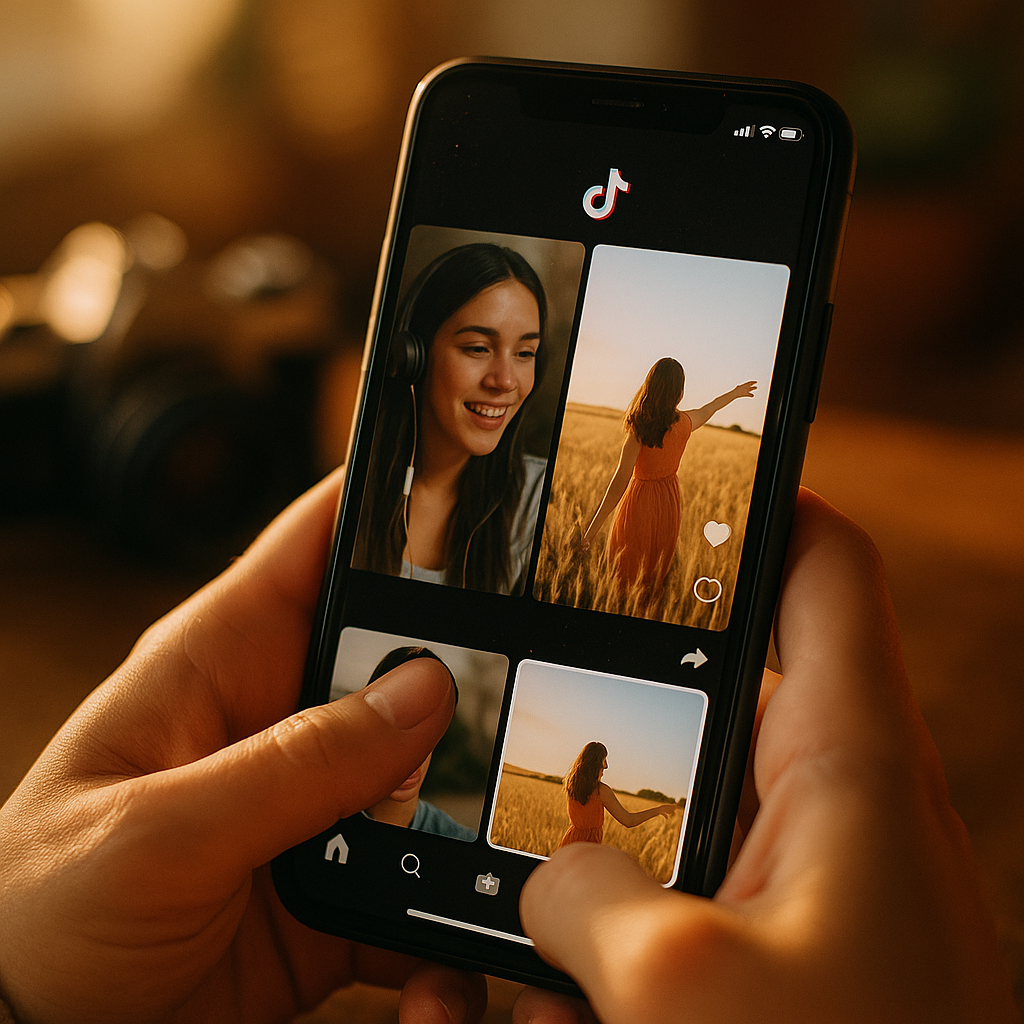
TikTok’s own creator tools team has quietly confirmed what feed data has been hinting at for months: photo-mode carousel posts are pulling longer average session times than standard video in several ad verticals. Slideshows are back, and this time they’re not a nostalgia play. If your carousel-style TikTok strategy still lives in “someday” on the content calendar, 2026 is the year that changes.
Wait, Slideshows? On TikTok?
Yes. The format that felt dated on Instagram in 2019 has resurfaced on TikTok as “photo mode,” and it’s quietly become one of the platform’s best-performing ad units for consideration and mid-funnel campaigns. Unlike a traditional video, a carousel forces the viewer to make a decision: swipe, or stop. That micro-interaction is exactly what the algorithm rewards.
Native TikTok video autoplays and often gets scrolled past in under two seconds if the hook doesn’t land immediately. A carousel behaves differently. Viewers pause, tap through frames at their own pace, and frequently double back to compare slides, especially in comparison or listicle-style content. That self-paced interaction generates dwell time that reads to the algorithm as genuine interest, not passive consumption.
The Watch Time Math Brands Are Missing
Most brand teams still optimize creative briefs around the first three seconds of video, the classic “hook or die” rule. That logic doesn’t fully transfer to slideshows, where the win condition is total swipe-through completion rather than a single cold open.
Internal creator reports circulating among agency partners suggest photo-mode posts are seeing completion rates 20 to 40 percent higher than comparable video content in categories like beauty, home goods, and personal finance, largely because the format rewards curiosity over spectacle.
Why does that matter for planning? Because watch time and completion rate directly influence distribution in TikTok’s recommendation system. A slideshow that gets fully swiped by a large share of viewers signals sustained relevance, even if the raw view count looks modest next to a viral video hit. For brands chasing efficient CPMs rather than viral lightning, that’s a meaningfully different optimization target, and one TikTok’s own ad platform is increasingly built to surface.
Why This Format Fits the Fatigue Moment
There’s a broader context here worth naming. Audiences are tired. Talking-head hooks, jump cuts, trending audio stitched over B-roll, it all starts to blur after enough scrolling. A slideshow interrupts that pattern simply by looking different in the feed. It reads as lower production value, which, ironically, is exactly the trust signal audiences respond to right now.
This isn’t a new insight for anyone who’s followed the shift toward rawer, less polished creator content. The same audience fatigue that’s driving interest in intentionally imperfect content is fueling the slideshow comeback. Carousels feel like something a friend put together in five minutes, not a brand’s media team. That perceived authenticity is doing real work on conversion metrics, not just vanity engagement.
Where Carousels Actually Outperform Video
Slideshows aren’t a universal upgrade. They’re a specific tool for specific jobs. Based on category performance patterns brand teams are reporting across beauty, retail, and finance verticals, carousels tend to win in these scenarios:
- Product comparisons and before/afters: Static side-by-side slides let viewers linger on details video’s motion blur obscures.
- List-style education: “5 things nobody tells you about X” content performs better as discrete swipeable cards than as a rapid-cut video.
- Price and value reveals: Slides that build suspense frame by frame (a tactic closely related to the pacing used in price reveal formats) benefit from the viewer controlling the pace themselves.
- Text-forward storytelling: If your content leans on captions and screenshots more than voiceover, a carousel is often a more natural home than video, echoing findings on why text-based hooks outperform voiceover for retention.
- Screenshot and meme-adjacent formats: The fake-tweet, faux-notification aesthetic that’s driven strong results in screenshot meme content translates almost natively into carousel slides.
Video still wins for anything requiring motion, demonstration, or emotional performance. Nobody’s swiping through a slideshow to feel a founder’s sincerity the way they would with founder-led video. Know the job before you pick the format.
Building a Carousel Brief That Actually Converts
Here’s where most brand teams stumble: they treat the carousel as a video script chopped into stills. That’s backwards. A slideshow needs its own structural logic, built around the swipe, not the scroll.
A workable brief structure looks like this:
- Slide one is the whole hook. You don’t get a three-second grace period like video. The first frame has to promise a payoff clearly enough that the viewer commits to swiping.
- Middle slides carry tension, not just information. Withhold the punchline. Comparison and countdown structures work because each slide raises the stakes slightly.
- Final slide delivers and directs. Whether that’s a CTA, a product tag, or a punchline, the last frame needs to close the loop the first frame opened.
- Captions do more lifting than usual. Since there’s no voiceover pacing to guide attention, on-slide text needs to be tight, scannable, and consistent in tone across frames.
This structural discipline overlaps heavily with the retention logic used in short-form video briefs, particularly the pacing principles covered in structuring short creator drops for retention. The mechanics differ, but the underlying goal of earning the next few seconds of attention is identical.
The Compliance Angle Nobody’s Talking About
Carousels come with a quieter operational benefit brand teams should appreciate: they’re cheaper and faster to produce than video, and easier to review for compliance. A ten-slide carousel is a set of static images and text, which means legal and brand safety teams can review it in the same way they’d review a static ad unit rather than scrubbing through footage frame by frame.
That matters more than it sounds. Disclosure requirements under FTC guidelines still apply to carousel content exactly as they do to video, and static slides make it easier to confirm a #ad or #sponsored disclosure is present, legible, and positioned correctly on every relevant frame. Teams managing multi-market campaigns should also check regional guidance, including standards published by the UK’s ICO where influencer content touches data or targeting claims.
Production speed is the other win. A creator can shoot the source images for a carousel in a fraction of the time a polished video demands, then iterate messaging across multiple slide sets for testing. That efficiency lines up well with the operational thinking behind faster niche content briefing frameworks, where speed to publish matters as much as polish.
What This Means for Budget Allocation
If you’re running a mixed video and carousel program, resist the urge to treat slideshows as filler content between “real” video drops. The data suggests they deserve their own line item and their own creative testing cadence, not leftover budget.
A reasonable starting split for brands testing the format: allocate 15 to 20 percent of short-form creator budget to carousel-native briefs for one full quarter, then compare cost-per-completed-view against your video benchmarks. Sprout Social’s and HubSpot’s platform benchmarking tools can help normalize that comparison against category averages if you don’t already have a clean internal dashboard for it.
Track completion rate and saves more closely than raw views. Slideshows rarely go viral in the traditional sense, but they tend to accumulate saves at a higher rate, especially for comparison and educational content people intend to reference later. That save behavior is arguably the strongest bottom-of-funnel signal the format offers.
Quick Reality Check Before You Reallocate Budget
None of this means video is declining. It means the feed has room for a second native format, and brands slow to adopt it are ceding an efficient, low-cost watch-time channel to competitors who moved first. Treat carousel testing as additive, not a replacement, and give creators the swipe-first brief structure they need to make it work.
FAQs
Are carousel-style TikToks actually a ranking factor, or just a trend?
They’re not a formally documented ranking factor, but higher completion rates and dwell time from swipe-based engagement do feed into TikTok’s broader recommendation signals, the same signals that influence distribution for any content format.
How long should a TikTok carousel be for best watch time?
Most high-performing carousels run between six and ten slides. Shorter sets can feel abrupt, while sets beyond twelve slides tend to see steep drop-off after the midpoint.
Do carousels need influencer talent, or can brands post them directly?
Both work, but creator-fronted carousels tend to outperform brand-account posts because the swipe interaction still benefits from a recognizable, trusted voice guiding the narrative across slides.
What metrics should brands track for carousel campaigns?
Prioritize completion rate and saves over raw impressions. These formats are built for consideration and reference behavior, not viral reach, so vanity view counts can be misleading.
Is carousel content harder to make accessible than video?
Not inherently, but on-slide text needs to be legible and high-contrast since there’s no voiceover to carry meaning. Alt text and caption clarity matter more here than in standard video posts.
Top Influencer Marketing Agencies
The leading agencies shaping influencer marketing in 2026
Agencies ranked by campaign performance, client diversity, platform expertise, proven ROI, industry recognition, and client satisfaction. Assessed through verified case studies, reviews, and industry consultations.
Moburst

-
2

The Shelf
Boutique Beauty & Lifestyle Influencer AgencyA data-driven boutique agency specializing exclusively in beauty, wellness, and lifestyle influencer campaigns on Instagram and TikTok. Best for brands already focused on the beauty/personal care space that need curated, aesthetic-driven content.Clients: Pepsi, The Honest Company, Hims, Elf Cosmetics, Pure LeafVisit The Shelf → -
3

Audiencly
Niche Gaming & Esports Influencer AgencyA specialized agency focused exclusively on gaming and esports creators on YouTube, Twitch, and TikTok. Ideal if your campaign is 100% gaming-focused — from game launches to hardware and esports events.Clients: Epic Games, NordVPN, Ubisoft, Wargaming, Tencent GamesVisit Audiencly → -
4

Viral Nation
Global Influencer Marketing & Talent AgencyA dual talent management and marketing agency with proprietary brand safety tools and a global creator network spanning nano-influencers to celebrities across all major platforms.Clients: Meta, Activision Blizzard, Energizer, Aston Martin, WalmartVisit Viral Nation → -
5

The Influencer Marketing Factory
TikTok, Instagram & YouTube CampaignsA full-service agency with strong TikTok expertise, offering end-to-end campaign management from influencer discovery through performance reporting with a focus on platform-native content.Clients: Google, Snapchat, Universal Music, Bumble, YelpVisit TIMF → -
6

NeoReach
Enterprise Analytics & Influencer CampaignsAn enterprise-focused agency combining managed campaigns with a powerful self-service data platform for influencer search, audience analytics, and attribution modeling.Clients: Amazon, Airbnb, Netflix, Honda, The New York TimesVisit NeoReach → -
7

Ubiquitous
Creator-First Marketing PlatformA tech-driven platform combining self-service tools with managed campaign options, emphasizing speed and scalability for brands managing multiple influencer relationships.Clients: Lyft, Disney, Target, American Eagle, NetflixVisit Ubiquitous → -
8

Obviously
Scalable Enterprise Influencer CampaignsA tech-enabled agency built for high-volume campaigns, coordinating hundreds of creators simultaneously with end-to-end logistics, content rights management, and product seeding.Clients: Google, Ulta Beauty, Converse, AmazonVisit Obviously →