


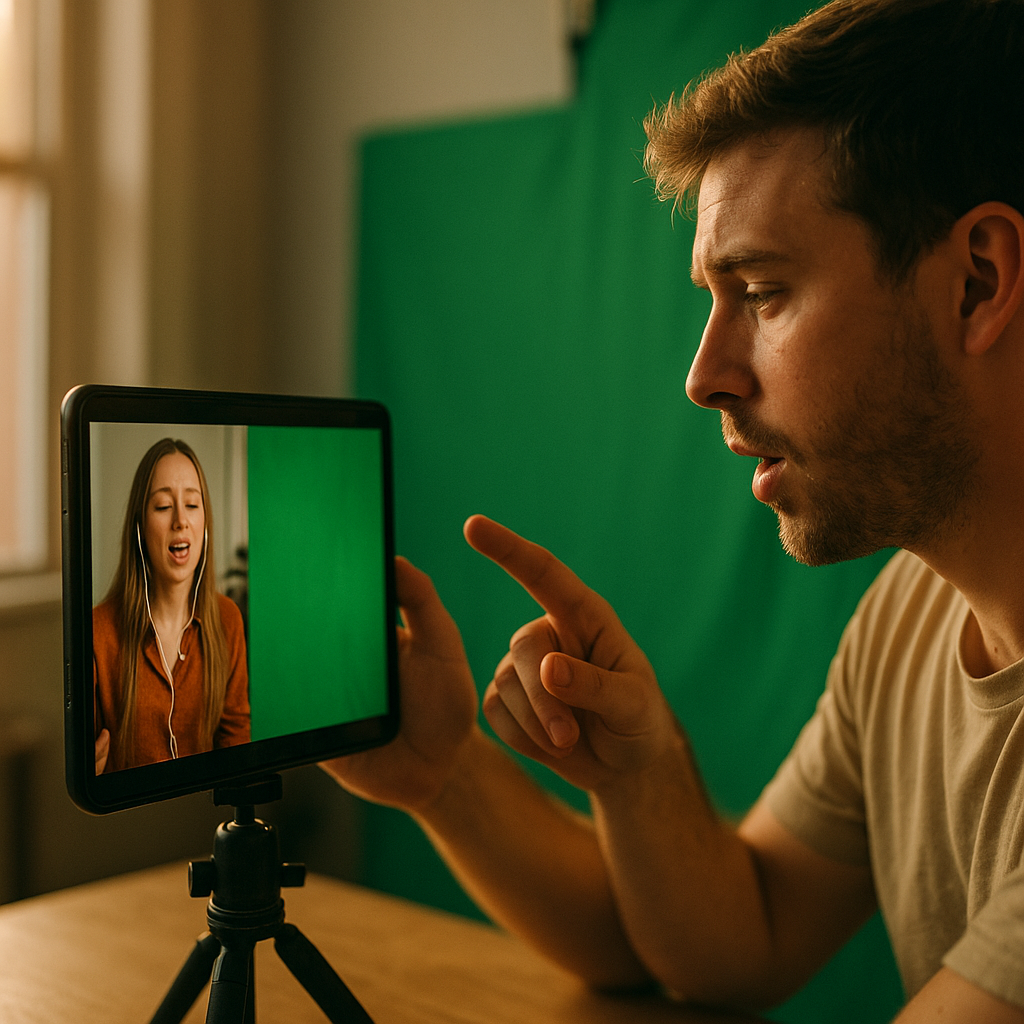
TikTok’s green screen duet format now drives some of the highest completion rates in reaction-style advertising, yet most brands still brief it like a standard UGC ask. That’s a mistake. The green screen duet works because it mimics an unscripted moment: a creator reacting to your product, ad, or claim in real time, with your content pinned behind them. Get the brief wrong, and it reads like an infomercial. Get it right, and it reads like proof.
What Is the Green Screen Duet, Actually?
Strip away the jargon and it’s simple. A creator uses TikTok’s green screen effect to overlay a piece of your existing content, a product shot, a review screenshot, a competitor’s ad, behind themselves while they react to it live on camera. The visual grammar borrows from reaction YouTube culture but compresses it into 15 to 45 seconds of punchy, thumb-stopping commentary.
It’s cousin to the split screen reaction review, but the green screen version feels rawer. There’s no dual-camera setup, no second creator to coordinate. Just one person, one screen, and a genuine (or at least genuine-seeming) reaction. That single-creator simplicity is exactly why it’s cheaper to produce and faster to scale than most reaction formats.
Why Brands Are Betting on Reaction Ads Right Now
Reaction content converts because it borrows credibility from the creator’s face. Viewers trust facial expressions more than voiceover claims, and platforms know it. Meta and TikTok have both leaned into “native feeling” ad formats over the past two years, rewarding content that doesn’t look like an ad in the first three seconds.
According to Sprout Social’s ongoing research into consumer trust, audiences consistently rank peer reaction and testimonial content above polished brand video for purchase influence. That’s not new information. What’s new is how cheaply brands can now produce it at scale using formats like the green screen duet, which requires no set, no B-roll, and often no more than a phone and a ring light.
The green screen duet isn’t a production shortcut, it’s a trust shortcut. Brands aren’t saving money by skipping sets, they’re borrowing the creator’s credibility to skip skepticism.
This is also why the format pairs so well with performance media. It slots directly into paid social as a top-funnel scroll-stopper, then feeds retargeting sequences with the same creator’s face carrying the message forward. Compare that to a comparison and versus video, which requires more editing and a clearer script. Green screen duets are faster to greenlight and faster to iterate.
Briefing the Format: What to Lock Down Before Filming
Here’s where most brands fumble. They send creators a product link, a vague “react to this” instruction, and call it a brief. That’s not a brief, that’s a wish. A proper reaction-ad brief needs five fixed elements and one flexible one.
- The stimulus. Specify exactly what goes behind the creator: a screenshot, a clip of your ad, a competitor claim, a price comparison. Ambiguity here kills the format.
- The emotional arc. Don’t write a script, but do map the beats. Confusion to curiosity to conviction is a common arc. Surprise to skepticism to buy-in is another.
- The claim boundaries. If the creator is reacting to a performance stat or price comparison, tell them what they can and can’t say verbatim. This protects you legally and protects the creator from overstating.
- Hook timing. Reaction ads live or die in the first two seconds. Brief the opening frame specifically, whether that’s a shocked face, a raised eyebrow, or a direct-to-camera line.
- Platform specs. Green screen only works well vertically, and text overlays need to avoid the safe zones TikTok and Instagram reserve for UI elements.
The flexible element is tone. Let the creator’s natural voice carry the reaction. Over-scripting is the single fastest way to make a green screen duet look fake, and viewers can smell a read-aloud line from a mile away.
If you’ve already built briefs for POV-style ad formats, this will feel familiar. The core discipline is the same: give creators guardrails, not lines.
The Compliance Layer Nobody Wants to Talk About
Reaction ads sit in a gray zone that brand legal teams should care about. When a creator reacts to a screenshot of a review, a competitor’s claim, or a data point pulled from your marketing deck, that content is now part of a paid promotion. The FTC’s endorsement guidance applies whether the creator is reading a script or reacting spontaneously. Disclosure requirements don’t disappear because the format feels informal.
Brands also need to think about what’s showing on screen behind the creator. If it’s a competitor’s ad or a third-party screenshot, get legal sign-off before it goes live. This is the same due diligence teams apply to screenshot-based ad formats, where the fake-tweet aesthetic can blur lines around implied endorsement or misrepresentation.
If your brief doesn’t specify a disclosure placement, don’t be surprised when the creator forgets one, or worse, places it somewhere the algorithm buries it.
Build disclosure language directly into the brief template, not as an afterthought in a separate legal doc. Specify placement (first three seconds, not buried in a caption), wording, and platform-native disclosure tools like TikTok’s branded content toggle.
Where This Format Fits (and Where It Doesn’t)
Green screen duets are strong for product reveals, price shock moments, and myth-busting content. They’re weak for complex B2B narratives or anything requiring nuance beyond a 30-second reaction. If your product needs explanation before it earns trust, this isn’t your format. That’s more the territory of vertical documentary shorts or founder-led explainer content.
It’s also worth sequencing. A single green screen reaction rarely carries a full campaign. Brands seeing the best returns are running these as one beat in a broader creator sequence, sometimes structured as a multi-creator relay, where reaction content opens the funnel and more detailed formats close it.
And don’t ignore comment sections. Reaction ads generate outsized comment engagement because viewers want to agree or argue with the creator’s take. That’s a feature, not a bug, but it also means brands should have a beat plan for how to leverage that engagement, something covered in depth in comment-bait content strategy.
Measuring What Matters
Standard video metrics undersell this format. Watch time matters less than the ratio of completions to shares, because reaction content spreads through duet chains and stitch reactions of its own. Track:
- Three-second hook retention (this format should outperform standard UGC by a wide margin)
- Comment sentiment ratio (agreement versus pushback)
- Duet and stitch volume from other creators picking up the format organically
- Click-through from the reaction into product pages, not just view counts
Platforms like TikTok Ads Manager now surface hook retention data natively, and HubSpot’s attribution tools can help tie those early engagement signals back to pipeline if you’re running this in a full-funnel B2B or DTC motion. According to eMarketer, short-form reaction content continues to post higher engagement rates than static image ads across most verticals, a gap that’s widened, not narrowed, as feeds get more crowded.
One more thing worth tracking: creator reuse rate. If a creator wants to do a second or third green screen duet with your brand unprompted, that’s a stronger trust signal than any single view count.
Next Step
Build a one-page green screen duet brief with the five fixed elements above locked in, then test it with two or three creators before scaling spend. The format rewards speed, but only if the guardrails are set before the camera turns on.
FAQs
What makes a green screen duet different from a standard reaction video?
The green screen duet layers your existing content directly behind the creator using TikTok’s native effect, rather than filming a side-by-side or split-screen setup. It’s faster to produce and requires less coordination than dual-camera reaction formats.
How long should a green screen duet ad be?
Most high-performing versions run between 15 and 45 seconds. Longer cuts tend to lose the spontaneous feel that makes the format credible in the first place.
Do creators need to disclose paid partnerships in reaction ads?
Yes. FTC endorsement guidance applies regardless of format. Disclosure should be placed in the first few seconds of the video and reinforced with platform-native tools, not buried in a caption.
What kind of products work best with this format?
Products with a clear, immediate value proposition perform best: price reveals, before-and-after results, or myth-busting claims. Complex or highly technical products usually need a longer format to build trust.
How many creators should a brand test before scaling a green screen duet campaign?
Two to three creators is usually enough for an initial test, giving you enough variation in tone and delivery to see which reaction style resonates before committing broader budget.
Top Influencer Marketing Agencies
The leading agencies shaping influencer marketing in 2026
Agencies ranked by campaign performance, client diversity, platform expertise, proven ROI, industry recognition, and client satisfaction. Assessed through verified case studies, reviews, and industry consultations.
Moburst

-
2

The Shelf
Boutique Beauty & Lifestyle Influencer AgencyA data-driven boutique agency specializing exclusively in beauty, wellness, and lifestyle influencer campaigns on Instagram and TikTok. Best for brands already focused on the beauty/personal care space that need curated, aesthetic-driven content.Clients: Pepsi, The Honest Company, Hims, Elf Cosmetics, Pure LeafVisit The Shelf → -
3

Audiencly
Niche Gaming & Esports Influencer AgencyA specialized agency focused exclusively on gaming and esports creators on YouTube, Twitch, and TikTok. Ideal if your campaign is 100% gaming-focused — from game launches to hardware and esports events.Clients: Epic Games, NordVPN, Ubisoft, Wargaming, Tencent GamesVisit Audiencly → -
4

Viral Nation
Global Influencer Marketing & Talent AgencyA dual talent management and marketing agency with proprietary brand safety tools and a global creator network spanning nano-influencers to celebrities across all major platforms.Clients: Meta, Activision Blizzard, Energizer, Aston Martin, WalmartVisit Viral Nation → -
5

The Influencer Marketing Factory
TikTok, Instagram & YouTube CampaignsA full-service agency with strong TikTok expertise, offering end-to-end campaign management from influencer discovery through performance reporting with a focus on platform-native content.Clients: Google, Snapchat, Universal Music, Bumble, YelpVisit TIMF → -
6

NeoReach
Enterprise Analytics & Influencer CampaignsAn enterprise-focused agency combining managed campaigns with a powerful self-service data platform for influencer search, audience analytics, and attribution modeling.Clients: Amazon, Airbnb, Netflix, Honda, The New York TimesVisit NeoReach → -
7

Ubiquitous
Creator-First Marketing PlatformA tech-driven platform combining self-service tools with managed campaign options, emphasizing speed and scalability for brands managing multiple influencer relationships.Clients: Lyft, Disney, Target, American Eagle, NetflixVisit Ubiquitous → -
8

Obviously
Scalable Enterprise Influencer CampaignsA tech-enabled agency built for high-volume campaigns, coordinating hundreds of creators simultaneously with end-to-end logistics, content rights management, and product seeding.Clients: Google, Ulta Beauty, Converse, AmazonVisit Obviously →