


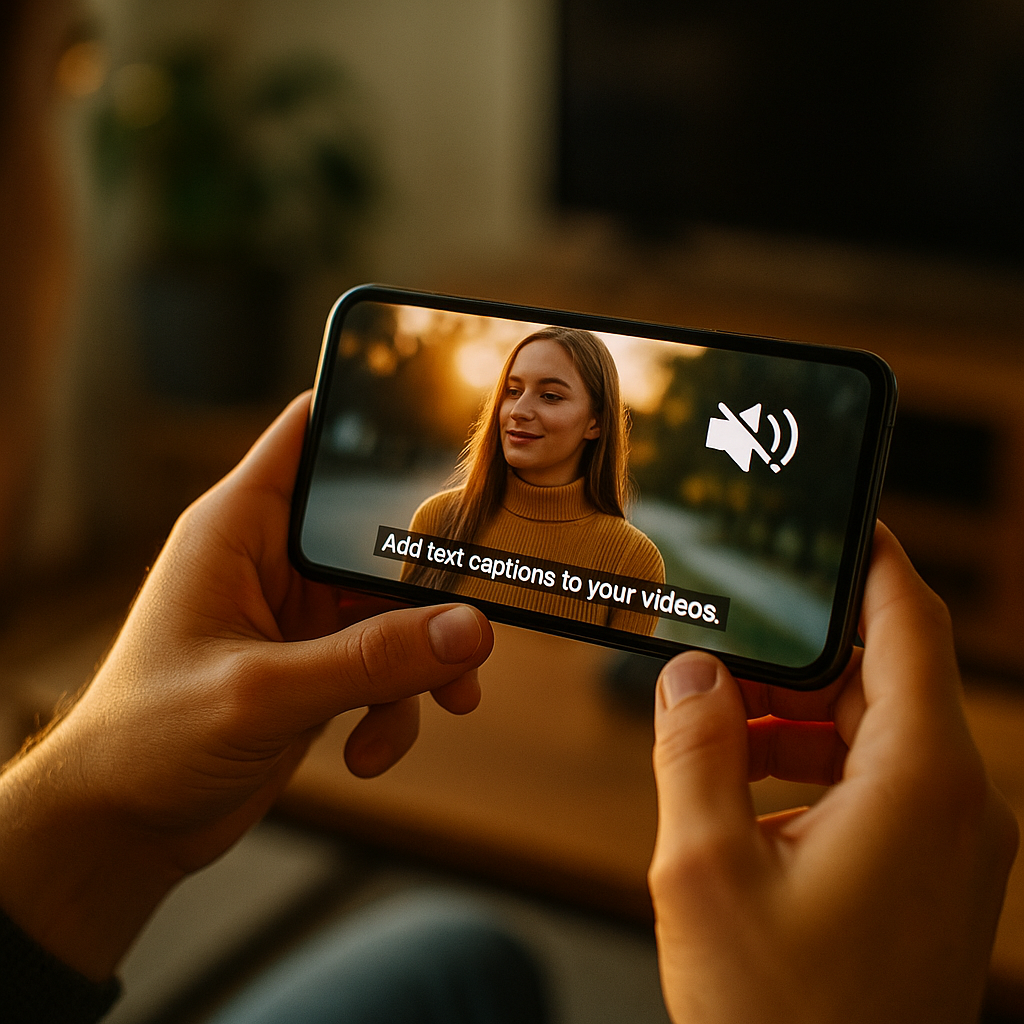
Roughly 85% of video views on major social platforms start with the sound off, according to eMarketer research on mobile viewing habits. So why do most brands still script voiceover first and captions as an afterthought? Caption only silent content flips that hierarchy, building videos that work without audio at all, and the format is quietly becoming one of the highest ROI plays in the accessibility and reach playbook.
What Caption Only Silent Content Actually Means
This isn’t just “add subtitles.” Caption only silent content is a deliberate creative format where the video is scripted, shot, and edited to communicate fully through on screen text, with no reliance on spoken narration, ambient audio cues, or music stings to carry meaning. Think product demos with animated callouts instead of a voiceover walkthrough, or a founder story told entirely through sequential text cards over B-roll.
The distinction matters operationally. A video with burned in captions on top of a voiceover is still an audio first asset, just made more accessible. A true caption only piece is designed from the script stage to stand alone, silent, in a feed. That means pacing, text hierarchy, and visual rhythm do the work that tone of voice and inflection would normally handle.
Why Sound Off Reach Is a Bigger Lever Than Most Media Plans Admit
Meta has reported for years that captioned video ads increase average watch time and drive measurable lifts in view through rate, a pattern Meta’s ad guidance continues to reinforce for feed and Reels placements. TikTok and LinkedIn show similar behavior: users scroll in silent mode at work, in transit, in waiting rooms, basically anywhere audio would be socially awkward or impossible.
Here’s the practical implication for anyone managing a media budget: if your creative only lands with sound on, you’re forfeiting reach to every viewer scrolling silently, which by most platform estimates is the majority default state, not the exception.
Treating sound off viewing as an edge case rather than the default behavior is the single biggest reason mid-funnel video spend underperforms on watch time metrics.
This connects directly to a piece we published on caption heavy TikTok content, which found that text dense videos consistently outlasted voiceover led equivalents on completion rate. Caption only silent content takes that logic to its endpoint: no audio dependency at all.
Accessibility Is a Compliance Issue, Not a Feel Good Add-On
Let’s be blunt: framing captions purely as an “inclusivity nice to have” undersells the risk. Brands operating in regulated markets face growing scrutiny over digital accessibility, and video content is squarely in scope. The World Health Organization estimates over 1.5 billion people globally live with some degree of hearing loss, and that number is only growing as populations age.
For agencies managing brand safety and legal exposure, caption only formats reduce risk on two fronts simultaneously: they satisfy accessibility expectations for deaf and hard of hearing audiences, and they remove ambiguity around whether a video’s claims are being accurately conveyed when platforms auto-generate (often inaccurate) captions on your behalf. If you’ve ever seen an auto-caption mangle a product claim into something legally dicey, you understand why owning the caption script matters. Regulatory bodies like the FTC hold brands accountable for what’s communicated in an ad regardless of format, and a garbled auto-caption is not a defense.
This is also where caption only content pairs well with formats we’ve covered around trust and transparency, like the approach detailed in returns and product fail content, where precise on screen text prevents misinterpretation that audio nuance might otherwise smooth over.
Building the Format: A Practical Creative Brief
Briefing caption only silent content requires a different rhythm than a standard voiceover script. You’re not writing dialogue, you’re writing timed text beats. Here’s the structure we recommend to creators and agencies building this into a content calendar:
- Script in beats, not sentences. Each on screen text card should hold for roughly 1.5 to 2.5 seconds, enough to read comfortably but not so long it drags pacing.
- Front load the hook in the first three seconds. Silent viewers scroll fast; your first text card needs to earn the pause before anything else happens.
- Use visual motion to replace vocal emphasis. Bold, scale changes, and color shifts on key words do what tone of voice would normally do.
- Design for platform native caption placement. Leave safe zones so your burned in text doesn’t collide with TikTok’s UI or Instagram’s Reels overlay.
- Pair with genuine ambient B-roll, not filler music. Silent doesn’t mean sterile. Let real environmental texture (hands, product, movement) fill the frame.
Platforms including YouTube provide detailed spec guidance on caption formatting and timing through Google’s support resources, which is worth reviewing before your team locks a house style for text overlays.
Where This Format Fits in the Broader Content Mix
Caption only silent content isn’t a replacement for every format, and treating it that way would be a mistake. It’s strongest in specific slots: top of funnel awareness ads running in feed placements where sound off is the default, accessibility compliant explainer content for product education, and any repurposed long form asset where you need a silent friendly cutdown for paid distribution.
It’s a weaker fit for formats that depend on vocal authenticity as the core trust signal, like the raw, conversational energy covered in voice note style audio ads, or sensory led content such as ASMR product demos, where sound is the entire point. Know which lever you’re pulling before you brief it out.
Common Mistakes That Quietly Tank Performance
A few patterns show up repeatedly when brands rush caption only content into production without rethinking the brief:
- Relying on auto-generated captions as the final product. Auto-captions are a starting draft, not a deliverable. Accuracy and brand voice both suffer when they’re left unedited.
- Cramming too much text per card. If a viewer can’t finish reading before the cut, you’ve lost them and possibly the compliance claim you needed them to see.
- Ignoring contrast and legibility on mobile. White text on a bright background disappears in outdoor scrolling conditions, a basic but frequently skipped QA step.
- Forgetting silent CTAs. If your call to action only appears as a spoken line at the end, a silent viewer never sees it. Bake it into the final text card, always.
Sprout Social’s ongoing research into social video consumption trends consistently flags caption quality as a top driver of retention, reinforcing that this isn’t a cosmetic detail, it’s a performance lever teams can actually control.
For teams building repeatable creative systems around this, the same discipline outlined in our brand safety style guide applies here: give creators clear guardrails without over-engineering every frame, and let the format’s natural rhythm do the persuasion work.
Frequently Asked Questions
What is caption only silent content?
It’s a video format built to communicate entirely through on screen text and visuals, designed to work fully with the sound off rather than relying on captions as a supplement to voiceover.
Why does sound off reach matter for brand video performance?
Most social video views start muted by default, so content that only makes sense with audio on forfeits a large share of potential watch time, completion rate, and reach.
Is caption only content the same as adding subtitles to a voiceover video?
No. Subtitled voiceover video still depends on audio for full comprehension. Caption only content is scripted from the start to stand alone without any spoken narration.
Does caption only content help with accessibility compliance?
Yes. It directly serves deaf and hard of hearing audiences and reduces legal risk tied to inaccurate auto-generated captions misrepresenting brand or product claims.
What formats work best for caption only silent content?
Top of funnel awareness ads, product explainers, and paid cutdowns of longer assets tend to perform best, since they benefit most from fast, scroll-friendly comprehension.
What’s the biggest mistake brands make with this format?
Relying on platform auto-captions as the finished product instead of writing and timing the text manually for accuracy, pacing, and brand voice.
Start with one existing video asset and rebuild it caption only, no voiceover, no audio dependency, and run it against your current best performer in a silent friendly placement. The watch time data will tell you fast whether this format deserves a permanent slot in your brief templates.
Top Influencer Marketing Agencies
The leading agencies shaping influencer marketing in 2026
Agencies ranked by campaign performance, client diversity, platform expertise, proven ROI, industry recognition, and client satisfaction. Assessed through verified case studies, reviews, and industry consultations.
Moburst

-
2

The Shelf
Boutique Beauty & Lifestyle Influencer AgencyA data-driven boutique agency specializing exclusively in beauty, wellness, and lifestyle influencer campaigns on Instagram and TikTok. Best for brands already focused on the beauty/personal care space that need curated, aesthetic-driven content.Clients: Pepsi, The Honest Company, Hims, Elf Cosmetics, Pure LeafVisit The Shelf → -
3

Audiencly
Niche Gaming & Esports Influencer AgencyA specialized agency focused exclusively on gaming and esports creators on YouTube, Twitch, and TikTok. Ideal if your campaign is 100% gaming-focused — from game launches to hardware and esports events.Clients: Epic Games, NordVPN, Ubisoft, Wargaming, Tencent GamesVisit Audiencly → -
4

Viral Nation
Global Influencer Marketing & Talent AgencyA dual talent management and marketing agency with proprietary brand safety tools and a global creator network spanning nano-influencers to celebrities across all major platforms.Clients: Meta, Activision Blizzard, Energizer, Aston Martin, WalmartVisit Viral Nation → -
5

The Influencer Marketing Factory
TikTok, Instagram & YouTube CampaignsA full-service agency with strong TikTok expertise, offering end-to-end campaign management from influencer discovery through performance reporting with a focus on platform-native content.Clients: Google, Snapchat, Universal Music, Bumble, YelpVisit TIMF → -
6

NeoReach
Enterprise Analytics & Influencer CampaignsAn enterprise-focused agency combining managed campaigns with a powerful self-service data platform for influencer search, audience analytics, and attribution modeling.Clients: Amazon, Airbnb, Netflix, Honda, The New York TimesVisit NeoReach → -
7

Ubiquitous
Creator-First Marketing PlatformA tech-driven platform combining self-service tools with managed campaign options, emphasizing speed and scalability for brands managing multiple influencer relationships.Clients: Lyft, Disney, Target, American Eagle, NetflixVisit Ubiquitous → -
8

Obviously
Scalable Enterprise Influencer CampaignsA tech-enabled agency built for high-volume campaigns, coordinating hundreds of creators simultaneously with end-to-end logistics, content rights management, and product seeding.Clients: Google, Ulta Beauty, Converse, AmazonVisit Obviously →