


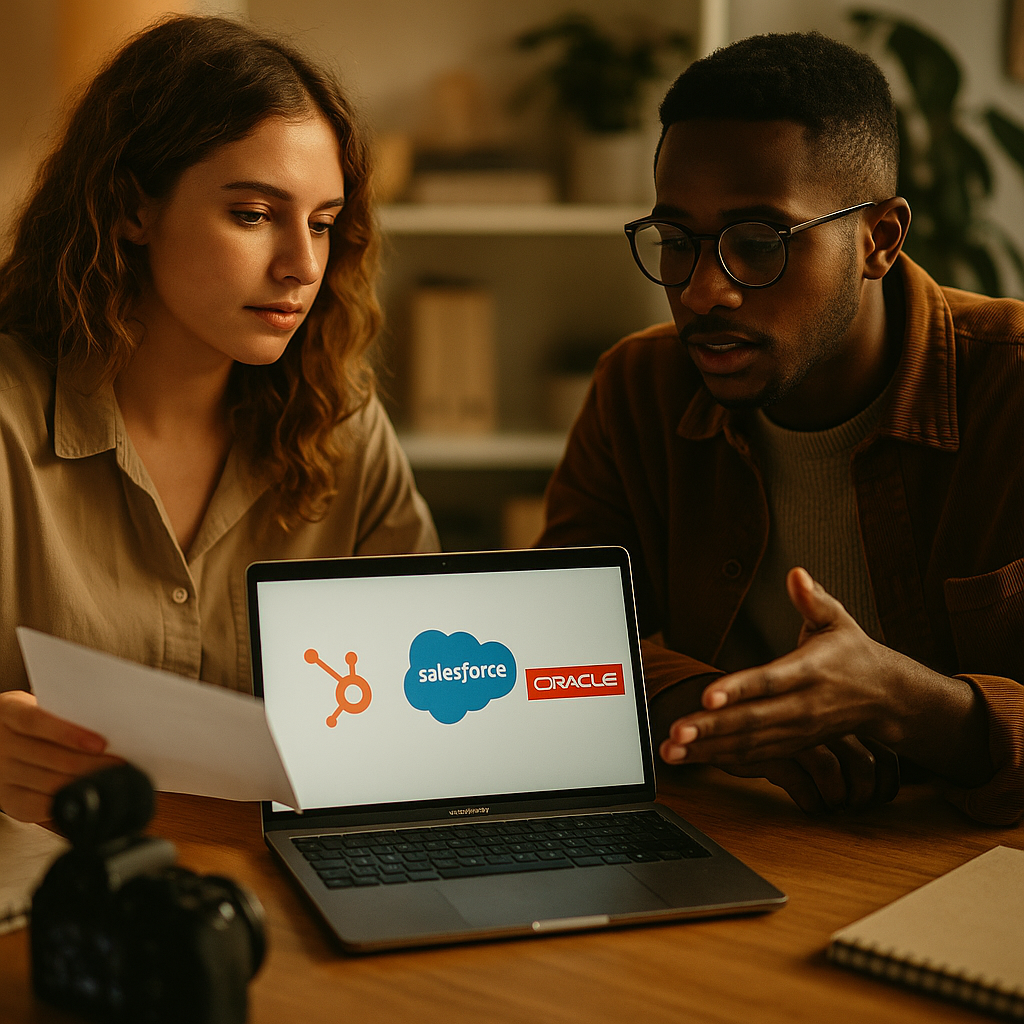
Only 12% of marketing teams say their current CRM was built with creator relationships in mind, according to recent tooling surveys from marketing operations communities. Yet brands are pouring six and seven figure budgets into influencer programs while trying to force that spend through systems designed for B2B sales pipelines. The question isn’t whether you need a CRM for creator management anymore. It’s which of the major marketing automation AI vendors, HubSpot, Salesforce, or Oracle, actually bends to fit a workflow built around content approvals, payout cadences, and disclosure tracking instead of deal stages.
Why Creator CRM Doesn’t Fit Inside Traditional Sales Stacks
Sales CRMs assume a linear funnel: lead, opportunity, close. Creator relationships don’t work that way. A single influencer might be in a content review cycle, a renegotiation, and a compliance audit simultaneously. None of the big three platforms were originally architected for that reality. What’s changed is the AI layer bolted on top, and how aggressively each vendor is repositioning that layer for non-sales use cases.
That repositioning matters because brand teams are increasingly buying marketing automation software specifically to manage creator rosters, not just email drips. The vendors know it. HubSpot, Salesforce, and Oracle have all shipped creator-adjacent features in the past year, but the depth and cost differ wildly.
HubSpot: The Marketer’s Default, But Does It Scale for Creators?
HubSpot remains the go-to for mid-market brands running their first serious influencer program. Its Breeze AI features handle content scheduling, basic sentiment tagging, and workflow automation reasonably well, and the pricing tiers make it approachable for teams without enterprise budgets. If you’re already using HubSpot’s marketing hub for email and lifecycle marketing, bolting on creator management feels natural.
The catch: HubSpot’s object model still leans heavily on “contacts” and “companies.” Creators don’t map cleanly to either. Teams end up building custom properties and workarounds to track things like usage rights, whitelisting permissions, or payout status. It works, but it’s duct tape, not a native fit. For brands running fewer than 50 active creator relationships, that’s tolerable. Past that, the manual overhead starts eating the time savings the automation was supposed to deliver.
Our creator marketing automation audit covers this exact tension in more detail, worth reading before you assume HubSpot scales linearly with roster size.
The real cost of a mismatched CRM isn’t the license fee. It’s the hours your team spends building workarounds that a purpose-built creator platform would have handled out of the box.
Salesforce: Enterprise Power, Enterprise Price Tag
Salesforce’s Agentforce and Marketing Cloud stack bring genuinely sophisticated AI orchestration to the table. Predictive scoring, dynamic segmentation, and agent-based workflows that can flag underperforming creator content before a human even looks at it. For enterprise brands running multi-market influencer programs with hundreds of creators, Salesforce’s flexibility is hard to beat.
But flexibility comes with a implementation tax. Standing up a custom creator object model in Salesforce typically requires a systems integrator, and that’s before you’ve trained a single team member on the interface. Licensing costs scale fast once you add Marketing Cloud, Data Cloud, and any AI add-ons. This is not a tool you buy on a whim; it’s a tool you commit to for three-plus years because switching costs are brutal.
Where Salesforce genuinely earns its price tag is compliance tracking at scale. If your legal team needs an audit trail across thousands of sponsored posts, Salesforce’s permissioning and reporting depth outperforms HubSpot without much argument. That’s especially relevant given rising scrutiny from the FTC’s disclosure guidance, which brands running large creator networks ignore at their own risk.
Oracle: The Quiet Contender for Regulated Industries
Oracle rarely gets mentioned in creator marketing conversations, and that’s partly deserved. Its Fusion Marketing and CX suite wasn’t built with TikTok creators in mind. But for brands in finance, healthcare, or pharma, industries where every piece of sponsored content needs a paper trail that survives regulatory review, Oracle’s data governance model is unusually strong.
Oracle’s AI features lag HubSpot and Salesforce on content generation and creative suggestions. Don’t buy Oracle expecting a slick creator discovery tool. Buy it if your compliance department is the loudest voice in the room and you need airtight data lineage across every creator payment and content approval.
This is a narrower use case than the other two vendors, but it’s a real one. A handful of enterprise brands we’ve spoken with chose Oracle specifically because their legal teams wouldn’t sign off on anything with looser audit controls. That’s a legitimate business reason, even if it means sacrificing some AI polish.
Which Vendor Actually Wins on Creator Workflows?
There’s no universal winner, and any vendor comparison claiming otherwise is selling something. It depends on three variables: roster size, compliance exposure, and existing tech stack.
- Under 50 creators, lean marketing team: HubSpot wins on cost and speed to launch.
- 50 to 500 creators, multi-market program: Salesforce wins on flexibility, assuming you budget for integration costs.
- Regulated industry, heavy legal oversight: Oracle wins on governance, even with a weaker AI feature set.
None of these platforms were purpose-built for creator management, which is exactly why a growing wave of specialized creator infrastructure vendors has emerged to fill the gap. Our creator infrastructure ROI framework is a useful companion read if you’re weighing a dedicated platform against retrofitting one of the big three.
Buying the biggest CRM name on the market doesn’t guarantee the best creator workflow. It guarantees the biggest implementation bill if the fit is wrong.
The Integration Question Nobody Asks Upfront
Every vendor demo looks great until you ask how payouts actually flow through the system. HubSpot, Salesforce, and Oracle all rely on third-party connectors or custom API work to handle creator payments, usage rights renewals, and content licensing windows. None of them natively solve the payout automation problem the way specialized platforms do. If payout speed and accuracy are core to your program (and for most brands running affiliate or performance-based creator deals, they are), read our breakdown on order automation for creator payouts before assuming your CRM vendor has this solved.
The same logic applies to AI agent evaluation more broadly. If you’re running a scorecard exercise across multiple vendors, our AI agent vendor evaluation framework gives you a structured way to compare embedded automation against standalone tools, a distinction we also unpack in our AI maturity framework piece.
Data from eMarketer’s marketing technology research consistently shows that brands underestimate integration timelines by 30 to 40%. That gap is where budgets quietly blow past projections, especially with Salesforce implementations that require certified consultants to configure creator-specific object models.
What This Means for Your Next Renewal Cycle
If your CRM renewal is coming up, don’t just negotiate price. Ask the vendor directly how they handle creator-specific fields: usage rights expiration, whitelisting permissions, FTC disclosure status, and payout tier logic. If the answer involves “we’d build that as a custom object,” factor that implementation cost into your total spend comparison. A cheaper license with a six-month build-out isn’t actually cheaper.
Also worth checking: how each platform’s AI features handle sentiment and performance data pulled from platforms like Meta’s business tools or TikTok’s ads platform. Native integrations here vary significantly, and a CRM that can’t ingest platform-level performance data in near real time will always be a step behind on optimization.
Frequently Asked Questions
Which CRM is best for a brand just starting a creator program?
HubSpot is generally the fastest and most affordable starting point for brands managing fewer than 50 active creator relationships, thanks to its lower cost of entry and shorter implementation timeline.
Is Salesforce worth the cost for creator marketing specifically?
Salesforce makes sense once a program scales past roughly 50 creators or spans multiple markets, since its flexibility and compliance reporting justify the higher licensing and integration costs at that volume.
Why would a brand choose Oracle over HubSpot or Salesforce?
Brands in regulated industries like finance or healthcare often choose Oracle for its stronger data governance and audit trail capabilities, even though its AI and content tools lag behind the other two vendors.
Do any of these platforms natively handle creator payouts?
No. All three vendors rely on third-party connectors or custom integrations to manage creator payments, licensing renewals, and payout cadences, so brands should budget separately for that piece of the stack.
How long does it typically take to implement a creator CRM workflow?
Timelines vary by vendor and complexity, but industry research suggests brands commonly underestimate integration time by 30 to 40%, particularly with enterprise platforms like Salesforce that require custom object configuration.
Next step: before your next renewal conversation, map your creator program’s actual workflow (approvals, payouts, disclosure tracking) against each vendor’s native capabilities, not their sales deck. The mismatch usually shows up in the first ten minutes of that exercise.
Top Influencer Marketing Agencies
The leading agencies shaping influencer marketing in 2026
Agencies ranked by campaign performance, client diversity, platform expertise, proven ROI, industry recognition, and client satisfaction. Assessed through verified case studies, reviews, and industry consultations.
Moburst

-
2

The Shelf
Boutique Beauty & Lifestyle Influencer AgencyA data-driven boutique agency specializing exclusively in beauty, wellness, and lifestyle influencer campaigns on Instagram and TikTok. Best for brands already focused on the beauty/personal care space that need curated, aesthetic-driven content.Clients: Pepsi, The Honest Company, Hims, Elf Cosmetics, Pure LeafVisit The Shelf → -
3

Audiencly
Niche Gaming & Esports Influencer AgencyA specialized agency focused exclusively on gaming and esports creators on YouTube, Twitch, and TikTok. Ideal if your campaign is 100% gaming-focused — from game launches to hardware and esports events.Clients: Epic Games, NordVPN, Ubisoft, Wargaming, Tencent GamesVisit Audiencly → -
4

Viral Nation
Global Influencer Marketing & Talent AgencyA dual talent management and marketing agency with proprietary brand safety tools and a global creator network spanning nano-influencers to celebrities across all major platforms.Clients: Meta, Activision Blizzard, Energizer, Aston Martin, WalmartVisit Viral Nation → -
5

The Influencer Marketing Factory
TikTok, Instagram & YouTube CampaignsA full-service agency with strong TikTok expertise, offering end-to-end campaign management from influencer discovery through performance reporting with a focus on platform-native content.Clients: Google, Snapchat, Universal Music, Bumble, YelpVisit TIMF → -
6

NeoReach
Enterprise Analytics & Influencer CampaignsAn enterprise-focused agency combining managed campaigns with a powerful self-service data platform for influencer search, audience analytics, and attribution modeling.Clients: Amazon, Airbnb, Netflix, Honda, The New York TimesVisit NeoReach → -
7

Ubiquitous
Creator-First Marketing PlatformA tech-driven platform combining self-service tools with managed campaign options, emphasizing speed and scalability for brands managing multiple influencer relationships.Clients: Lyft, Disney, Target, American Eagle, NetflixVisit Ubiquitous → -
8

Obviously
Scalable Enterprise Influencer CampaignsA tech-enabled agency built for high-volume campaigns, coordinating hundreds of creators simultaneously with end-to-end logistics, content rights management, and product seeding.Clients: Google, Ulta Beauty, Converse, AmazonVisit Obviously →