


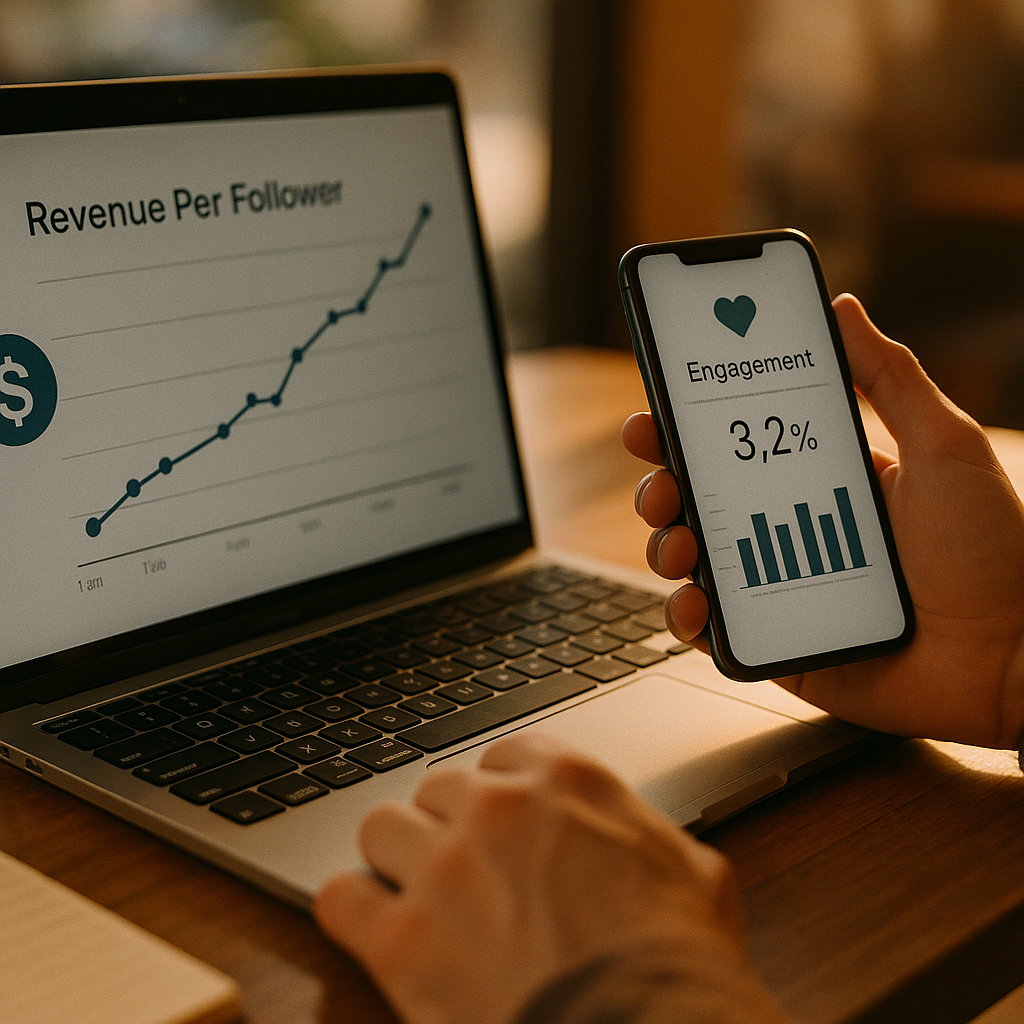
A creator with 40,000 followers just outsold one with 900,000, and the brand’s CMO wants to know why nobody caught this sooner. Welcome to the revenue per follower era, where influencer benchmark metric decisions finally get tied to dollars instead of vanity math. If your reporting deck still leads with reach, you’re measuring the wrong thing.
Why Follower Count Stopped Paying the Bills
Follower count was never a business metric. It was a proxy, and a leaky one at that. Bot farms, engagement pods, and pay-for-follower schemes turned audience size into something closer to theater than proof of commercial value. Brands kept using it anyway because it was easy to pull from a profile and easy to put in a slide.
Revenue per follower fixes that by forcing a simple question: how much actual sales value does each person in this creator’s audience generate? Divide attributable revenue (from affiliate links, promo codes, native checkout, or platform shopping tags) by total follower count, and you get a number that travels across campaigns, categories, and creator tiers. It’s blunt, it’s imperfect, but it’s honest in a way reach never was.
A creator earning $0.42 in revenue per follower on a $3,000 flat fee is outperforming a creator earning $0.03 per follower at half the price, even before you factor in production costs.
This shift didn’t happen in a vacuum. It’s the natural next step after brands already started walking away from top-line reach numbers, as covered in margin based creator KPIs. Revenue per follower is what that trend looks like once finance teams get involved.
The Math Behind the Metric
Calculating revenue per follower isn’t complicated, but it does require clean attribution, which is exactly where most brands fall down. Here’s the basic formula:
- Total attributable revenue from a creator’s content (tracked via affiliate codes, UTM links, or platform-native purchase data)
- Divided by the creator’s total follower count at time of posting
- Optionally segmented by platform, since a TikTok follower and a YouTube subscriber don’t behave the same way
The catch: this only works if you can actually attribute revenue to a specific creator and post. That’s harder than it sounds. Cross-device shopping, delayed purchases, and dark social sharing all muddy the water. Brands that have invested in clean checkout attribution are the ones actually able to run this math with confidence. Everyone else is estimating, which is fine as a starting point but risky as a permanent state.
Some agencies are now building revenue per follower into standard reporting dashboards, alongside cost per acquisition and lifetime value. According to eMarketer research on influencer spend efficiency, brands that track revenue level metrics report notably higher confidence in renewing creator contracts compared to those relying on engagement rate alone.
Micro Creators Are Winning This Fight
Here’s the uncomfortable part for celebrity-tier influencers: smaller, niche creators consistently post higher revenue per follower numbers. Tighter audiences, higher trust, and lower production overhead all play a role. A creator with 30,000 dedicated skincare followers who genuinely uses the products will often out-convert a lifestyle mega-influencer whose audience is broad but shallow.
This tracks with what Influencers Time has already reported on micro expert creators cutting acquisition costs by wide margins. Revenue per follower is essentially the receipts for that trend. It’s not that micro creators are inherently better marketers. It’s that their followers actually chose to be there for a reason, and that intent shows up on the balance sheet.
What This Means for Negotiations and Budgets
Once a brand starts tracking revenue per follower, negotiation leverage shifts. Creators who can point to strong historical numbers gain pricing power, regardless of audience size. Creators who can’t are suddenly competing on a metric that doesn’t flatter them.
This is accelerating a broader move toward revenue share contract structures over flat fees. If a brand can measure revenue per follower reliably, why pay a flat rate at all? Performance based deals let both sides align incentives. The creator earns more when the content actually converts, and the brand stops overpaying for reach that never turns into sales.
It also changes how budgets get allocated across a roster. Instead of splitting spend evenly across tiers, marketing teams are funneling more dollars toward the creators with proven per-follower economics, even if that means working with more mid-tier and micro talent instead of one or two big names. That’s a meaningful operational shift, and it lines up with what we’ve seen in ad budgets shifting toward creator distribution more broadly.
Does This Kill the Case for Big Follower Counts?
Not entirely. Scale still matters for awareness campaigns, product launches, and category-defining moments where reach genuinely is the goal. Revenue per follower isn’t a replacement for every KPI. It’s a complement, specifically useful when the objective is direct sales rather than brand lift.
Smart teams are running a dual scorecard: reach and impressions for top-of-funnel campaigns, revenue per follower for bottom-of-funnel performance pushes. Trying to force one metric to answer every question is how brands ended up over-indexing on follower count in the first place.
The Attribution Problem Nobody Wants to Talk About
Let’s be honest about the limitations here. Revenue per follower is only as good as the attribution model feeding it. Multi-touch customer journeys, especially in categories like beauty, apparel, and consumer electronics, make single-creator attribution genuinely difficult. A shopper might see a TikTok video, later search on Google, then buy weeks later through a completely different channel.
This is why brands pairing revenue per follower with marketing mix modeling are getting more defensible numbers than those relying purely on last-click attribution. MMM won’t give you creator-level precision, but it validates whether the channel-level revenue trends make sense, which acts as a useful sanity check on the individual creator math.
There’s also a compliance dimension worth flagging. Revenue tied claims in creator content, especially anything implying guaranteed results or earnings, need to stay within FTC disclosure guidelines. Brands leaning harder into performance based creator relationships should revisit their vetting process, something Influencers Time covered in depth around formal influencer vetting pipelines. Reference the FTC’s endorsement guidelines before building revenue claims into any creator brief.
How Platforms Are Reacting
Platform reporting tools are starting to catch up, slowly. Meta’s business suite and TikTok’s Shop analytics both offer more granular purchase attribution than they did a couple of years ago, though neither has built a native revenue per follower calculation yet. Brands are largely stitching this together themselves using tools like Sprout Social or HubSpot for cross-channel attribution layered on top of platform native data.
Expect third-party creator analytics platforms to build this metric into standard dashboards within the next reporting cycle, especially as demand grows from procurement and finance teams who want influencer spend justified in the same terms as any other media line item. Given that reporting dashboards now claim a growing share of martech budgets, revenue per follower is a natural next feature for vendors chasing that spend.
Getting Started Without Overhauling Everything
You don’t need a full martech rebuild to start tracking this. Begin with your top ten creator partners by spend. Pull attributable revenue from affiliate links or promo codes over the last two full campaign cycles. Divide by follower count at the time of posting, not current follower count, since audiences shift. Compare the results across your roster and you’ll likely find a wide spread, often wider than engagement rate alone would suggest.
From there, build it into contract renewal conversations. Creators with strong revenue per follower numbers deserve retention priority and potentially better terms. Creators who consistently underperform on this metric, despite strong reach or engagement, are worth a harder conversation about whether the partnership still earns its budget line.
Bottom line: pull revenue per follower data on your current roster this quarter, even with imperfect attribution, and use it alongside (not instead of) engagement and reach to decide where next year’s budget actually goes.
Frequently Asked Questions
What is revenue per follower in influencer marketing?
Revenue per follower is a metric that divides a creator’s total attributable sales revenue by their follower count, giving brands a per-person measure of commercial value rather than relying on raw audience size.
How is revenue per follower different from engagement rate?
Engagement rate measures interaction volume like likes, comments, and shares. Revenue per follower measures actual sales outcomes, which makes it a more direct indicator of a creator’s impact on business results.
Why are micro creators scoring higher on this metric?
Micro creators often have tighter, higher trust audiences with stronger niche relevance, which typically leads to higher conversion rates per follower compared to mega-influencers with broader, less targeted audiences.
Can brands calculate revenue per follower without perfect attribution?
Yes, though the numbers will be directional rather than exact. Using affiliate links, promo codes, or platform native shopping data provides a reasonable starting point even without full cross-channel attribution.
Should revenue per follower replace reach as the primary KPI?
Not entirely. Reach still matters for awareness campaigns, while revenue per follower is best used for performance driven partnerships focused on direct sales outcomes.
Top Influencer Marketing Agencies
The leading agencies shaping influencer marketing in 2026
Agencies ranked by campaign performance, client diversity, platform expertise, proven ROI, industry recognition, and client satisfaction. Assessed through verified case studies, reviews, and industry consultations.
Moburst

-
2

The Shelf
Boutique Beauty & Lifestyle Influencer AgencyA data-driven boutique agency specializing exclusively in beauty, wellness, and lifestyle influencer campaigns on Instagram and TikTok. Best for brands already focused on the beauty/personal care space that need curated, aesthetic-driven content.Clients: Pepsi, The Honest Company, Hims, Elf Cosmetics, Pure LeafVisit The Shelf → -
3

Audiencly
Niche Gaming & Esports Influencer AgencyA specialized agency focused exclusively on gaming and esports creators on YouTube, Twitch, and TikTok. Ideal if your campaign is 100% gaming-focused — from game launches to hardware and esports events.Clients: Epic Games, NordVPN, Ubisoft, Wargaming, Tencent GamesVisit Audiencly → -
4

Viral Nation
Global Influencer Marketing & Talent AgencyA dual talent management and marketing agency with proprietary brand safety tools and a global creator network spanning nano-influencers to celebrities across all major platforms.Clients: Meta, Activision Blizzard, Energizer, Aston Martin, WalmartVisit Viral Nation → -
5

The Influencer Marketing Factory
TikTok, Instagram & YouTube CampaignsA full-service agency with strong TikTok expertise, offering end-to-end campaign management from influencer discovery through performance reporting with a focus on platform-native content.Clients: Google, Snapchat, Universal Music, Bumble, YelpVisit TIMF → -
6

NeoReach
Enterprise Analytics & Influencer CampaignsAn enterprise-focused agency combining managed campaigns with a powerful self-service data platform for influencer search, audience analytics, and attribution modeling.Clients: Amazon, Airbnb, Netflix, Honda, The New York TimesVisit NeoReach → -
7

Ubiquitous
Creator-First Marketing PlatformA tech-driven platform combining self-service tools with managed campaign options, emphasizing speed and scalability for brands managing multiple influencer relationships.Clients: Lyft, Disney, Target, American Eagle, NetflixVisit Ubiquitous → -
8

Obviously
Scalable Enterprise Influencer CampaignsA tech-enabled agency built for high-volume campaigns, coordinating hundreds of creators simultaneously with end-to-end logistics, content rights management, and product seeding.Clients: Google, Ulta Beauty, Converse, AmazonVisit Obviously →