


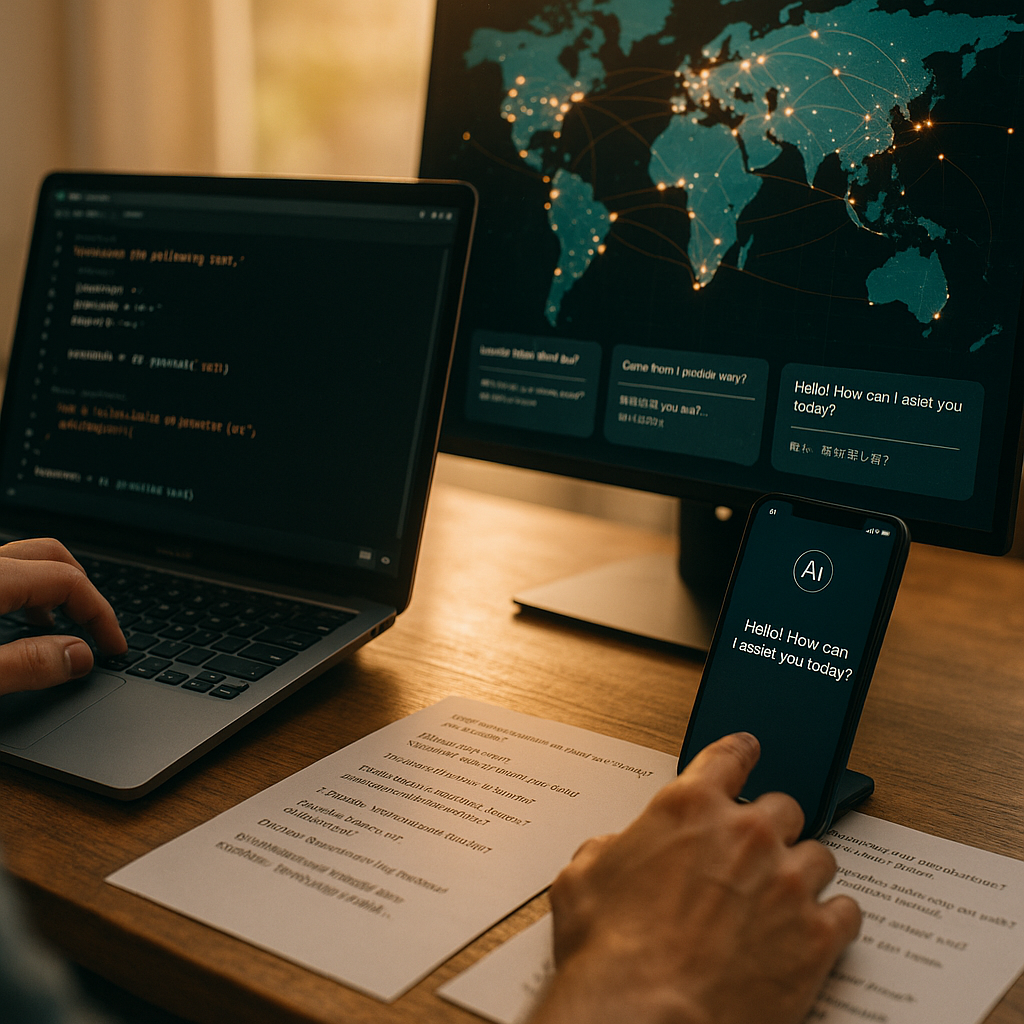
73% of consumers say they’re more likely to buy when marketing speaks their language, per localization research cited across the industry, yet most brands still ship one hero video and pray the subtitles hold up. That gap is exactly where AI localized micro assets earn their keep. Same day global rollout used to mean a six week waterfall of translation vendors and regional sign offs. Now it means a scripting system that outputs dozens of market ready cuts before your morning stand up ends.
Why Same Day Rollout Broke the Old Localization Model
Traditional localization was built for annual campaigns, not weekly drops. A single 30 second spot would move through translation, voiceover casting, dubbing studios, legal review, and regional media buying teams, each adding days. By the time the Japanese cut cleared compliance, the US version was already stale.
Influencer led content compressed that timeline further and exposed the cracks. Creators post daily. Trends peak and die within 72 hours. A localization pipeline that takes two weeks is functionally useless for reactive content, no matter how polished the output.
The brands winning global reach aren’t translating campaigns anymore. They’re scripting once and generating market specific variants at the same speed they generate the original.
This is the operational shift behind AI localized micro assets: short form, platform native clips built from a modular script that AI tools adapt for language, tone, and cultural reference points, all within a single production cycle.
What “Scripting for Localization” Actually Means
Forget the idea that localization starts after the script is done. It has to start inside the script. A brief written with hardcoded idioms, region specific humor, or untranslatable wordplay will break the moment it hits an AI localization layer, forcing a manual rewrite that kills the same day timeline.
Instead, senior creative leads are building scripts with swappable modules: a universal hook, a flexible proof point, and a locally adaptable CTA. Think of it like a layered video framework where the base structure stays fixed and only the surface language changes.
Practically, that looks like:
- Hook lines written in neutral, image driven language rather than puns or slang that don’t translate.
- Proof points tagged by market relevance so a US price comparison swaps for a value framing in markets where price transparency reads differently.
- CTAs built with placeholder variables for currency, shipping terms, and platform specific actions (swipe up versus link in bio versus shop tab).
This modular approach mirrors what worked in personalized video variant production, just applied to geography instead of audience segment.
The Micro Asset Advantage: Small, Fast, Disposable by Design
Here’s the uncomfortable truth: not every localized asset needs to be a masterpiece. Micro assets, 6 to 15 second clips built for a single platform moment, are disposable by design. That’s a feature, not a flaw. When an asset only needs to live for 48 hours before the trend cycle moves on, over investing in polish is wasted spend.
AI localization tools now handle voice cloning, lip sync adjustment, and text overlay translation fast enough that a single English source clip can produce eight to twelve market variants in under an hour. Compare that to the old dubbing studio model, where a single language pass could take two full business days.
Speed isn’t the only win. Micro assets also reduce the compliance surface area, since each localized cut carries less legal risk than a long form hero video with dense claims.
Brands running ultra short AI clip pipelines domestically are simply extending the same logic across borders. The production math doesn’t change much. The distribution math changes completely.
Building the Actual Rollout Pipeline
A same day global rollout isn’t magic, it’s sequencing. Here’s the operational flow most mid to large teams are converging on:
- Master script lock: one core script approved by legal and brand, with modular swap points flagged.
- AI localization pass: language, tone, and cultural reference adaptation run through an AI localization tool, producing draft copy per market.
- Human review checkpoint: a native speaking reviewer (internal or contracted) flags anything that reads as machine translated or culturally off.
- Voice and visual generation: AI voice cloning or licensed dubbing generates audio, paired with localized text overlays.
- Compliance sweep: automated or manual check against regional advertising and disclosure rules before anything ships.
- Platform specific formatting: aspect ratio, caption length, and CTA mechanics adjusted per platform per market.
Step three is where most teams get sloppy. AI translation has improved dramatically, but it still misses tone. A CTA that reads as confident in English can read as aggressive in German or overly casual in Japanese. Skipping the native review checkpoint to save an hour usually costs a brand its credibility in that market instead.
This pipeline logic borrows heavily from hook testing frameworks built for scale, where speed and quality control run in parallel instead of sequentially.
Compliance Doesn’t Pause for Speed
Here’s the part legal teams will ask about first: does going faster mean cutting compliance corners? It shouldn’t, and if your pipeline forces that tradeoff, the pipeline is broken.
Disclosure requirements vary by market. The FTC’s guidance on endorsements sets the US baseline, but the UK’s ICO and various EU regulators layer on additional data and advertising transparency rules. A localized asset that swaps #ad for a regionally appropriate disclosure tag isn’t optional, it’s the difference between a clean rollout and a regulatory headache.
Teams handling sensitive categories, skincare, supplements, financial products, already know this tension well. The same discipline applied in skincare compliance workflows needs to extend into every localized variant, not just the original market version. AI can flag likely compliance issues, but it shouldn’t be the final signoff. That’s still a human call, every time.
Same day rollout speed is only a win if every localized asset can survive a compliance audit six months later. Fast and reckless isn’t a strategy, it’s a liability.
Where AI Localization Still Falls Short
It’s tempting to treat AI localization as a solved problem. It isn’t. Idiomatic humor, sarcasm, and culturally specific references still trip up even the best models. A joke that lands in New York can flatten completely in São Paulo, and no amount of processing power fixes that without human cultural context.
Voice cloning has also raised new questions. Using an AI generated voice that mimics a creator’s tone across ten languages saves money, but it can also strip the authenticity that made the creator’s content work in the first place. HubSpot’s research on trust in marketing consistently shows audiences respond to perceived authenticity over polish, and a flattened, over localized voice can undercut that trust fast.
The fix isn’t abandoning AI localization. It’s using it for structure and speed while reserving human judgment for tone, humor, and anything culturally load bearing. Think of AI as the first draft engine and native reviewers as the editorial layer that keeps the brand voice intact.
Measuring Whether Same Day Rollout Actually Works
Speed without measurement is just noise. Teams running localized micro asset programs need market level tracking, not just aggregate view counts. Watch for:
- Completion rate by market, since a script that hooks a US audience might lose a European audience in the first three seconds.
- Engagement rate variance between the source asset and localized variants, flagging where translation quality is dragging performance.
- Conversion lift by region, tracked against localized CTA mechanics rather than a single global benchmark.
Platforms like TikTok Ads Manager and Meta Business Suite now offer country level breakdowns that make this tracking far easier than it was two years ago. If a localized asset underperforms consistently, that’s a signal the script’s modular swap points need rework, not just a translation touch up.
This tracking discipline echoes what worked in transformation reel brief testing, where beat level performance data shaped the next round of scripts. Apply that same rigor across markets and the localization program compounds instead of stalling.
Takeaway
Same day global rollout isn’t a production hack, it’s a scripting discipline: build modular, culturally neutral scripts up front, let AI handle speed and structure, and keep native reviewers and compliance checks as the non negotiable human layer. Start with one market pair, English and one high volume secondary language, and prove the pipeline before scaling to ten.
FAQs
What are AI localized micro assets?
They’re short form video or audio clips, typically 6 to 15 seconds, adapted from a single master script into multiple language and cultural variants using AI translation, voice cloning, and text overlay tools, built for fast multi market distribution.
How fast can a brand realistically launch localized content across markets?
With a modular script and a tested AI localization pipeline, teams are producing 8 to 12 market variants within hours of the source asset going live, compared to the multi week timelines of traditional dubbing and translation workflows.
Does AI translation replace the need for native language reviewers?
No. AI handles the bulk translation and structural adaptation, but native speaking reviewers remain essential for catching tone mismatches, cultural missteps, and compliance issues that automated tools consistently miss.
What compliance risks come with fast localized rollout?
Disclosure requirements, data handling rules, and advertising claims regulations vary by market. Skipping a compliance sweep to save time can expose a brand to regulatory action well after the content has already gone viral.
Which platforms support market level performance tracking for localized content?
TikTok Ads Manager and Meta Business Suite both offer country and language level performance breakdowns, letting teams identify underperforming localized variants and adjust scripts before scaling further.
Top Influencer Marketing Agencies
The leading agencies shaping influencer marketing in 2026
Agencies ranked by campaign performance, client diversity, platform expertise, proven ROI, industry recognition, and client satisfaction. Assessed through verified case studies, reviews, and industry consultations.
Moburst

-
2

The Shelf
Boutique Beauty & Lifestyle Influencer AgencyA data-driven boutique agency specializing exclusively in beauty, wellness, and lifestyle influencer campaigns on Instagram and TikTok. Best for brands already focused on the beauty/personal care space that need curated, aesthetic-driven content.Clients: Pepsi, The Honest Company, Hims, Elf Cosmetics, Pure LeafVisit The Shelf → -
3

Audiencly
Niche Gaming & Esports Influencer AgencyA specialized agency focused exclusively on gaming and esports creators on YouTube, Twitch, and TikTok. Ideal if your campaign is 100% gaming-focused — from game launches to hardware and esports events.Clients: Epic Games, NordVPN, Ubisoft, Wargaming, Tencent GamesVisit Audiencly → -
4

Viral Nation
Global Influencer Marketing & Talent AgencyA dual talent management and marketing agency with proprietary brand safety tools and a global creator network spanning nano-influencers to celebrities across all major platforms.Clients: Meta, Activision Blizzard, Energizer, Aston Martin, WalmartVisit Viral Nation → -
5

The Influencer Marketing Factory
TikTok, Instagram & YouTube CampaignsA full-service agency with strong TikTok expertise, offering end-to-end campaign management from influencer discovery through performance reporting with a focus on platform-native content.Clients: Google, Snapchat, Universal Music, Bumble, YelpVisit TIMF → -
6

NeoReach
Enterprise Analytics & Influencer CampaignsAn enterprise-focused agency combining managed campaigns with a powerful self-service data platform for influencer search, audience analytics, and attribution modeling.Clients: Amazon, Airbnb, Netflix, Honda, The New York TimesVisit NeoReach → -
7

Ubiquitous
Creator-First Marketing PlatformA tech-driven platform combining self-service tools with managed campaign options, emphasizing speed and scalability for brands managing multiple influencer relationships.Clients: Lyft, Disney, Target, American Eagle, NetflixVisit Ubiquitous → -
8

Obviously
Scalable Enterprise Influencer CampaignsA tech-enabled agency built for high-volume campaigns, coordinating hundreds of creators simultaneously with end-to-end logistics, content rights management, and product seeding.Clients: Google, Ulta Beauty, Converse, AmazonVisit Obviously →