


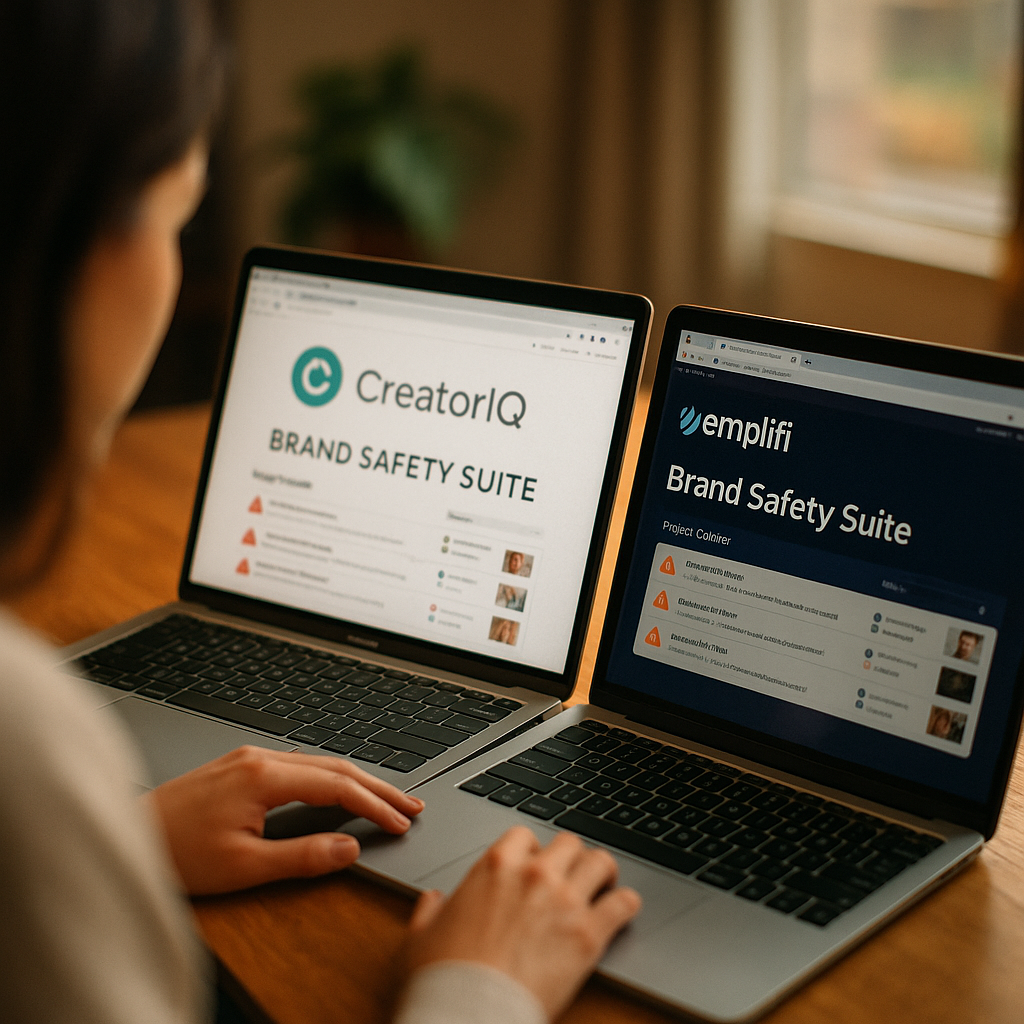
The FTC issued more than 700 warning letters to advertisers and influencers over undisclosed endorsements in the past two years alone. If your brand safety stack still relies on manual spot checks and a shared spreadsheet, you are one viral screenshot away from a regulatory headache. The CreatorIQ vs Emplifi debate has become one of the most consequential platform decisions marketing leaders make this year, and it deserves more than a feature checklist comparison.
Both platforms promise compliance automation, disclosure monitoring, and brand safety scoring. But they were built for different buyers, and choosing wrong means either overpaying for capability you won’t use or underbuying protection you desperately need.
Why Brand Safety Suites Matter More Than Ever
Social commerce isn’t a side channel anymore. It’s the storefront. TikTok Shop, Instagram Checkout, and livestream shopping have collapsed the distance between content and transaction, which means a compliance failure isn’t just reputational, it’s a direct line to consumer harm claims and regulatory scrutiny. The FTC’s endorsement guidelines apply just as strictly to a shoppable Reel as they do to a traditional ad, and enforcement has only tightened.
Add in the UK’s advertising standards regime under the ICO and you have a genuinely complex, multi-jurisdictional compliance surface. Brands running global creator programs can’t rely on a single legal reviewer eyeballing content. They need software that flags disclosure gaps, tracks contractual obligations, and audits creator content at scale before it goes live, or fast enough after that damage control is still possible.
A single undisclosed partnership post that goes viral can trigger regulatory inquiry, retailer delisting, and creator contract disputes simultaneously. Brand safety software isn’t a nice-to-have compliance layer anymore, it’s operational insurance.
CreatorIQ: Enterprise Scale, Deep Workflow Control
CreatorIQ built its reputation on managing sprawling creator programs for enterprise retailers and CPG giants, and its brand safety tooling reflects that DNA. The platform’s compliance module integrates directly into campaign workflows, meaning disclosure checks, contract terms, and content approval happen inside the same system where briefs and payments live. That matters because compliance divorced from workflow tends to get skipped under deadline pressure.
Its strongest feature is granular permissioning. Legal, brand, and agency teams can each get tailored views of what needs review, with automated escalation when a creator’s post trips a keyword, hashtag, or FTC disclosure flag. For brands running thousands of creators across multiple regions, this kind of segmented oversight is not optional, it’s the only way to keep a legal team from drowning.
CreatorIQ also plays well with the broader martech stack, which matters if you’ve already consolidated tools. Teams researching martech consolidation strategies often cite CreatorIQ’s integration depth as a reason to anchor their creator program around it rather than bolting on point solutions.
Where it falls short: cost and complexity. CreatorIQ’s enterprise pricing and implementation timeline make it a poor fit for mid-market brands running lean programs. If your creator roster is under 200 and your legal review process is one person with a Slack channel, you’ll pay for capability you don’t need.
Who CreatorIQ Actually Fits
- Enterprise retailers with multi-brand portfolios and regional compliance variance
- Teams that already run complex approval chains involving legal, brand, and regional marketing
- Programs with 500+ active creators where manual review is mathematically impossible
Emplifi: Social-First Compliance With Commerce Baked In
Emplifi comes at this from a different angle entirely. It grew out of social media management and customer experience tooling, which means its brand safety features are deeply embedded in social listening and community management rather than sitting as a bolt-on compliance layer. For brands whose social commerce program is tightly coupled to organic social performance, that integration is genuinely useful.
Emplifi’s disclosure monitoring leans heavily on AI-driven content scanning across owned and earned posts, flagging missing hashtags like #ad or #sponsored in near real time. It also ties compliance scoring into its social commerce analytics, so a brand can see not just whether a post was compliant, but how compliance status correlates with conversion and engagement. That’s a genuinely differentiated angle: most compliance tools treat legal risk and commercial performance as separate reports. Emplifi puts them in the same dashboard.
The tradeoff is depth on the creator contract side. Emplifi doesn’t offer the same granular workflow permissioning that CreatorIQ does for legal and procurement teams managing hundreds of individual creator agreements. If your compliance risk is concentrated in contract terms rather than in-content disclosure, Emplifi will feel thinner.
Who Emplifi Actually Fits
- Brands where social commerce and organic community management already run through one team
- Mid-market marketers who want compliance monitoring without a heavy implementation lift
- Programs prioritizing real-time disclosure scanning over deep contract governance
Feature-by-Feature: Where the Real Gaps Show Up
On paper, both vendors claim FTC compliance monitoring, brand safety scoring, and automated flagging. The differences show up in execution.
Disclosure detection accuracy: CreatorIQ’s flagging system is rules-based and highly configurable, letting legal teams define exactly what triggers review. Emplifi leans more on machine learning pattern detection, which catches novel disclosure gaps faster but occasionally produces more false positives that need human triage.
Contract and payment linkage: This is CreatorIQ’s clear advantage. Compliance status can be tied directly to payment release, meaning a creator doesn’t get paid until disclosure requirements are verified. That’s a powerful lever few competitors replicate well. For deeper context on how contract automation intersects with compliance risk, see our breakdown of AI creator contract tools and where the hidden risk actually sits.
Social commerce analytics integration: Emplifi wins here. Its unified dashboard pulls compliance data alongside shoppable content performance, giving marketing leaders a single view of risk and ROI. That’s valuable when you’re trying to justify creator program budget to a CFO who cares about conversion, not just legal exposure.
Discovery and vetting overlap: Neither platform is primarily a discovery tool, but both integrate with upstream vetting processes. Brands comparing discovery options alongside compliance suites should also review how tools stack up in our discovery tool comparison, since a weak vetting layer upstream creates more compliance work downstream regardless of which safety suite you choose.
The platform with the best dashboard isn’t necessarily the one that reduces your actual legal exposure. Match the tool to where your risk concentrates: content-level disclosure, contract terms, or cross-border regulatory variance.
Pricing and Implementation Reality
CreatorIQ operates on custom enterprise pricing, typically requiring six-figure annual commitments once you factor in seats, integrations, and implementation support. Expect a 60 to 90 day onboarding window for mid-sized programs, longer for global rollouts spanning multiple legal jurisdictions.
Emplifi’s pricing is more accessible for mid-market teams, with tiered plans that scale based on social account volume and monitoring depth. Implementation is faster, often under 30 days, because the compliance module sits on top of existing social management infrastructure rather than requiring a full creator program migration.
Neither vendor publishes transparent pricing publicly, which is standard for this category but frustrating for procurement teams trying to build a business case quickly. Budget for a sales cycle of several weeks minimum, and push both vendors for references from brands in your specific vertical. A beauty brand’s disclosure risk profile looks nothing like a fintech affiliate program’s, and vendor case studies rarely reflect that nuance unless you ask directly.
The Compliance Risk Most Brands Miss
Here’s the uncomfortable truth neither vendor’s sales deck emphasizes enough: software catches disclosure gaps, but it doesn’t fix a broken creator vetting process upstream. If you’re onboarding creators without clear contractual disclosure requirements baked in from day one, no amount of downstream monitoring fully closes the gap. According to Sprout Social’s industry research, brands that build compliance checkpoints into the creator onboarding process see meaningfully fewer post-publication violations than those relying solely on after-the-fact monitoring.
That’s why the strongest programs treat CreatorIQ or Emplifi as one layer in a broader compliance architecture, not a silver bullet. Pair either platform with clear creator contracts, consistent onboarding training, and a defined escalation path when violations occur. For a wider view of how compliance fits into the full creator pipeline, our piece on discovery to payment pipelines maps where each layer of risk actually sits across the creator lifecycle.
Making the Call for Your Team
If your program is enterprise-scale, contract-heavy, and spans multiple regions with varying disclosure laws, CreatorIQ’s workflow depth and payment-linked compliance controls justify the investment. If your social commerce program is organically integrated with community management and you need fast, affordable disclosure monitoring without a heavy implementation lift, Emplifi is the more pragmatic choice.
Either way, run a 90 day pilot against your actual creator roster before committing to an annual contract, and measure false positive rates alongside genuine violation catches, because a tool that cries wolf constantly gets ignored by the very team it’s meant to protect.
Frequently Asked Questions
What is the main difference between CreatorIQ and Emplifi for brand safety compliance?
CreatorIQ focuses on deep workflow integration, tying disclosure compliance directly to creator contracts and payment release, making it strongest for enterprise programs with complex approval chains. Emplifi integrates compliance monitoring with social commerce analytics, offering faster implementation and better visibility into how compliance status correlates with content performance.
Do these platforms guarantee FTC compliance for influencer content?
No software guarantees full regulatory compliance. Both platforms provide monitoring, flagging, and disclosure detection tools that significantly reduce risk, but final legal responsibility remains with the brand. Human review and clear creator contracts remain essential alongside any automated tool.
Which platform is better for mid-market brands with smaller creator programs?
Emplifi generally suits mid-market brands better due to lower pricing tiers, faster onboarding, and tighter integration with existing social media management tools. CreatorIQ’s enterprise pricing and implementation complexity make more sense for programs managing hundreds or thousands of creators.
How does social commerce compliance differ from standard influencer marketing compliance?
Social commerce compliance adds transactional layers, including shoppable posts, checkout integrations, and platform-specific commerce policies from TikTok Shop or Instagram Checkout, on top of standard endorsement disclosure requirements. This means brands must monitor not just disclosure language but also claims made about products being sold directly through social content.
Can these tools integrate with existing CRM or martech stacks?
Yes, both platforms offer integrations with common marketing and CRM systems, though CreatorIQ generally offers deeper native integrations given its enterprise focus. Brands should evaluate integration depth against their current stack before committing, particularly if compliance data needs to flow into legal or finance systems for audit purposes.
What happens if a brand doesn’t use any compliance monitoring software?
Brands relying solely on manual review risk slower detection of disclosure violations, increased regulatory exposure, and difficulty scaling oversight as creator programs grow. Given FTC enforcement trends, manual-only compliance processes are increasingly viewed as inadequate for programs operating at meaningful scale.
Top Influencer Marketing Agencies
The leading agencies shaping influencer marketing in 2026
Agencies ranked by campaign performance, client diversity, platform expertise, proven ROI, industry recognition, and client satisfaction. Assessed through verified case studies, reviews, and industry consultations.
Moburst

-
2

The Shelf
Boutique Beauty & Lifestyle Influencer AgencyA data-driven boutique agency specializing exclusively in beauty, wellness, and lifestyle influencer campaigns on Instagram and TikTok. Best for brands already focused on the beauty/personal care space that need curated, aesthetic-driven content.Clients: Pepsi, The Honest Company, Hims, Elf Cosmetics, Pure LeafVisit The Shelf → -
3

Audiencly
Niche Gaming & Esports Influencer AgencyA specialized agency focused exclusively on gaming and esports creators on YouTube, Twitch, and TikTok. Ideal if your campaign is 100% gaming-focused — from game launches to hardware and esports events.Clients: Epic Games, NordVPN, Ubisoft, Wargaming, Tencent GamesVisit Audiencly → -
4

Viral Nation
Global Influencer Marketing & Talent AgencyA dual talent management and marketing agency with proprietary brand safety tools and a global creator network spanning nano-influencers to celebrities across all major platforms.Clients: Meta, Activision Blizzard, Energizer, Aston Martin, WalmartVisit Viral Nation → -
5

The Influencer Marketing Factory
TikTok, Instagram & YouTube CampaignsA full-service agency with strong TikTok expertise, offering end-to-end campaign management from influencer discovery through performance reporting with a focus on platform-native content.Clients: Google, Snapchat, Universal Music, Bumble, YelpVisit TIMF → -
6

NeoReach
Enterprise Analytics & Influencer CampaignsAn enterprise-focused agency combining managed campaigns with a powerful self-service data platform for influencer search, audience analytics, and attribution modeling.Clients: Amazon, Airbnb, Netflix, Honda, The New York TimesVisit NeoReach → -
7

Ubiquitous
Creator-First Marketing PlatformA tech-driven platform combining self-service tools with managed campaign options, emphasizing speed and scalability for brands managing multiple influencer relationships.Clients: Lyft, Disney, Target, American Eagle, NetflixVisit Ubiquitous → -
8

Obviously
Scalable Enterprise Influencer CampaignsA tech-enabled agency built for high-volume campaigns, coordinating hundreds of creators simultaneously with end-to-end logistics, content rights management, and product seeding.Clients: Google, Ulta Beauty, Converse, AmazonVisit Obviously →