


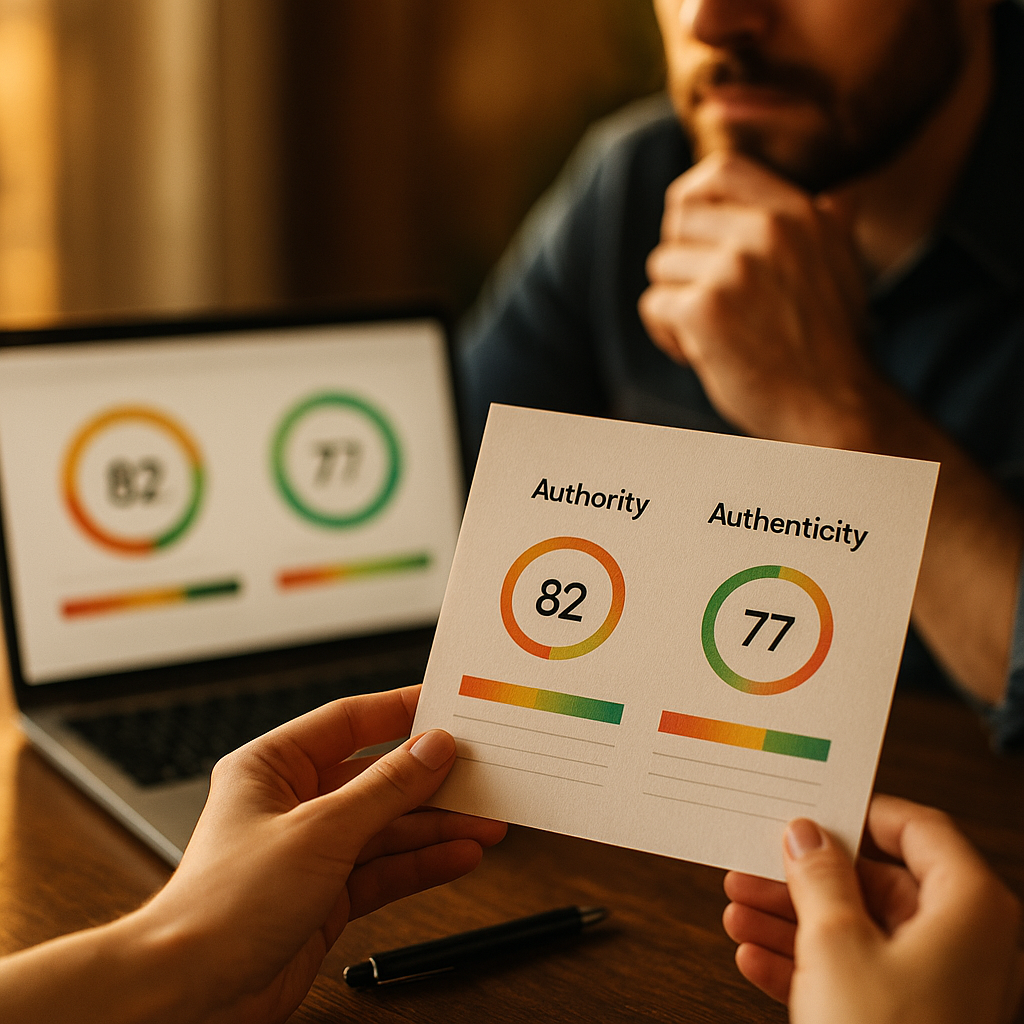
Sixty one percent of marketers say fake followers and inflated engagement are their top influencer marketing risk, yet most brands still greenlight creators based on gut feel and a follower count. Favikon’s Authority and Authenticity Scores exist to close that gap. Used correctly, they turn vetting from guesswork into a repeatable, defensible process. Used carelessly, they become just another number nobody on your team can explain to legal or finance.
What Favikon’s Scores Actually Measure
Favikon splits creator quality into two distinct signals, and conflating them is the single biggest mistake brand teams make.
The Authority Score measures a creator’s influence and reach within their specific niche. It’s not a raw follower tally. It weighs engagement quality, content consistency, cross-platform presence, and how the creator ranks relative to peers covering the same topic. A finance creator with 40,000 followers can outrank a lifestyle account with 400,000 if their audience engagement and topical relevance are stronger.
The Authenticity Score tackles a different question entirely: is this audience real? It analyzes follower growth patterns, engagement rate consistency, and behavioral red flags associated with bot activity or purchased followers. A creator can have sky-high authority and still fail authenticity, and that combination should stop any campaign brief in its tracks.
Authority tells you if a creator matters. Authenticity tells you if the audience is even there to notice. You need both scores agreeing before you commit budget.
Why Vetting on Follower Count Alone Is a Liability, Not Just a Mistake
Follower count is vanity math. It says nothing about whether a person actually watches the content, trusts the recommendation, or converts. Regulators are paying closer attention too. The FTC’s endorsement guidelines increasingly hold brands accountable for the creators they choose, not just the disclosures those creators post. If a partnership later surfaces as fraudulent engagement, “we checked their follower count” is not a defense that holds up in a compliance review.
This is where scoring systems earn their keep. They give brand and legal teams a documented, third-party rationale for creator selection, something that matters increasingly as procurement and compliance teams get pulled into influencer sign-off. If you’re already comparing discovery platforms on this basis, it’s worth reading how discovery tools match to budget before deciding which vetting layer fits your stack.
The Math Behind Authenticity Scoring
Favikon’s authenticity model looks at engagement to follower ratio over time, not a single snapshot. Bought followers tend to produce a telltale pattern: sudden growth spikes followed by flat or declining engagement, comment sections dominated by generic or repeated phrasing, and geographic mismatches between stated audience location and actual engagement origin. None of these signals alone is damning. Together, they build a probability score that a human reviewer would take days to replicate manually.
Industry benchmarking from eMarketer continues to show that engagement rate, not audience size, correlates most strongly with conversion in influencer campaigns. That’s the entire premise authenticity scoring is built on.
How to Read the Scores Without Overtrusting Them
No score is gospel. Treat Favikon’s output as a triage layer, not a final verdict.
- High authority, high authenticity: your safest bet for always-on ambassador programs and long-term partnerships.
- High authority, low authenticity: proceed with caution. The creator may have real influence but a compromised or aging audience base worth investigating manually.
- Low authority, high authenticity: often your best micro-influencer or nano-influencer pick for niche, high-trust campaigns where reach matters less than relevance.
- Low authority, low authenticity: pass, unless there’s a specific, well-documented reason (a hyper-niche B2B audience, for example) to override the signal.
What the scores won’t tell you: brand fit, tone alignment, or whether a creator’s past controversies could resurface mid-campaign. That still requires a human scan of recent content and comment sentiment. Automating discovery is not the same as automating judgment.
Building a Vetting Workflow Around the Scores
The most efficient teams build a three-step gate before any creator reaches a brief:
- Run the Authority and Authenticity Scores as a first filter, eliminating anyone below your minimum threshold.
- Cross-check the shortlist against past brand safety incidents or platform bans using a dedicated suite, something covered in depth in our comparison of brand safety platforms.
- Route the final list through contract and compliance review before outreach, ideally with AI-assisted tools that flag risky clauses early, as outlined in our breakdown of contract compliance risk.
This sequencing matters. Vetting scores first, safety checks second, and contract review last keeps your team from wasting legal hours on creators who fail the basic authenticity bar anyway.
Where Scoring Fits in the Bigger Discovery Stack
Favikon doesn’t operate in a vacuum. Most mature influencer programs run discovery, vetting, contracting, and payment as separate but connected layers, a structure mapped out well in our piece on discovery to payment pipelines. Authority and Authenticity Scores sit squarely in the vetting layer, feeding data downstream to whichever CRM or workflow tool manages relationship tracking, something teams weighing CRM options for creator teams should factor into their evaluation criteria.
The operational upside here is real. Teams that automate the vetting layer report cutting creator research time by more than half, according to workflow benchmarking from Sprout Social. That’s time reallocated to negotiation, creative briefing, and performance analysis, the parts of the job that actually move revenue.
Common Vetting Mistakes Even Experienced Teams Make
A few patterns show up repeatedly in post-campaign audits:
- Ignoring score decay. Authenticity Scores shift over time as follower bases change. A creator vetted six months ago needs a refresh before renewal, not a rubber stamp.
- Treating niche scores as universal. Authority within beauty content doesn’t transfer to a fintech campaign. Always check niche-specific ranking, not overall platform rank.
- Skipping the manual spot check. Scores catch statistical anomalies, not tone problems or controversial past posts. A five-minute content scroll still matters.
- Over-indexing on a single platform. A creator’s TikTok authenticity score can look pristine while their Instagram audience tells a very different story. Check cross-platform consistency before signing.
What About Micro and Nano Creators?
Smaller creators often score lower on Authority simply because reach is a component of that metric. That’s expected, not disqualifying. For hyper-targeted campaigns, particularly in B2B or niche verticals, a nano-creator with a strong Authenticity Score and a tightly engaged 8,000 person audience can outperform a mid-tier influencer with three times the reach. This is the same logic behind ambassador-model platforms gaining traction, discussed further in our review of the Fluencify ambassador model.
Building EEAT Into Your Own Vetting Documentation
If you’re a brand or agency publishing influencer results, or defending them internally, document your scoring thresholds the same way you’d document any other media buying criteria. Note the minimum Authority Score by tier, the minimum Authenticity Score you’ll accept, and any manual override rationale. This isn’t bureaucracy for its own sake. It’s the paper trail that protects your team when a partnership underperforms or a regulator asks questions, and it demonstrates the kind of expertise and accountability search engines and stakeholders alike reward.
Start every new creator vetting cycle by setting hard minimum thresholds for both scores before you look at a single profile, then let the numbers eliminate candidates before your team spends a minute on manual review.
Frequently Asked Questions
What is a good Authority Score on Favikon?
There’s no universal cutoff since Authority Scores are niche-relative, but most brands treat top-quartile ranking within a creator’s specific category as a strong signal for larger campaign investment.
Can a creator have high authority but still be a bad partner?
Yes. High authority reflects influence and reach, not audience quality or brand fit. Always pair it with the Authenticity Score and a manual content review before signing.
How often should brands re-check Authenticity Scores?
For ongoing ambassador relationships, a quarterly refresh is reasonable. For one-off campaigns, check the score no more than a few weeks before launch since follower composition can shift quickly.
Do Authority and Authenticity Scores replace manual vetting entirely?
No. They’re a triage layer that filters out obvious red flags and ranks candidates efficiently, but tone, brand safety history, and content quality still require human review.
Are these scores useful for B2B influencer programs?
Yes, arguably more so. B2B campaigns rely on niche credibility over raw reach, making the Authority Score’s niche-relative weighting especially valuable for identifying subject matter experts with real influence.
Top Influencer Marketing Agencies
The leading agencies shaping influencer marketing in 2026
Agencies ranked by campaign performance, client diversity, platform expertise, proven ROI, industry recognition, and client satisfaction. Assessed through verified case studies, reviews, and industry consultations.
Moburst

-
2

The Shelf
Boutique Beauty & Lifestyle Influencer AgencyA data-driven boutique agency specializing exclusively in beauty, wellness, and lifestyle influencer campaigns on Instagram and TikTok. Best for brands already focused on the beauty/personal care space that need curated, aesthetic-driven content.Clients: Pepsi, The Honest Company, Hims, Elf Cosmetics, Pure LeafVisit The Shelf → -
3

Audiencly
Niche Gaming & Esports Influencer AgencyA specialized agency focused exclusively on gaming and esports creators on YouTube, Twitch, and TikTok. Ideal if your campaign is 100% gaming-focused — from game launches to hardware and esports events.Clients: Epic Games, NordVPN, Ubisoft, Wargaming, Tencent GamesVisit Audiencly → -
4

Viral Nation
Global Influencer Marketing & Talent AgencyA dual talent management and marketing agency with proprietary brand safety tools and a global creator network spanning nano-influencers to celebrities across all major platforms.Clients: Meta, Activision Blizzard, Energizer, Aston Martin, WalmartVisit Viral Nation → -
5

The Influencer Marketing Factory
TikTok, Instagram & YouTube CampaignsA full-service agency with strong TikTok expertise, offering end-to-end campaign management from influencer discovery through performance reporting with a focus on platform-native content.Clients: Google, Snapchat, Universal Music, Bumble, YelpVisit TIMF → -
6

NeoReach
Enterprise Analytics & Influencer CampaignsAn enterprise-focused agency combining managed campaigns with a powerful self-service data platform for influencer search, audience analytics, and attribution modeling.Clients: Amazon, Airbnb, Netflix, Honda, The New York TimesVisit NeoReach → -
7

Ubiquitous
Creator-First Marketing PlatformA tech-driven platform combining self-service tools with managed campaign options, emphasizing speed and scalability for brands managing multiple influencer relationships.Clients: Lyft, Disney, Target, American Eagle, NetflixVisit Ubiquitous → -
8

Obviously
Scalable Enterprise Influencer CampaignsA tech-enabled agency built for high-volume campaigns, coordinating hundreds of creators simultaneously with end-to-end logistics, content rights management, and product seeding.Clients: Google, Ulta Beauty, Converse, AmazonVisit Obviously →