


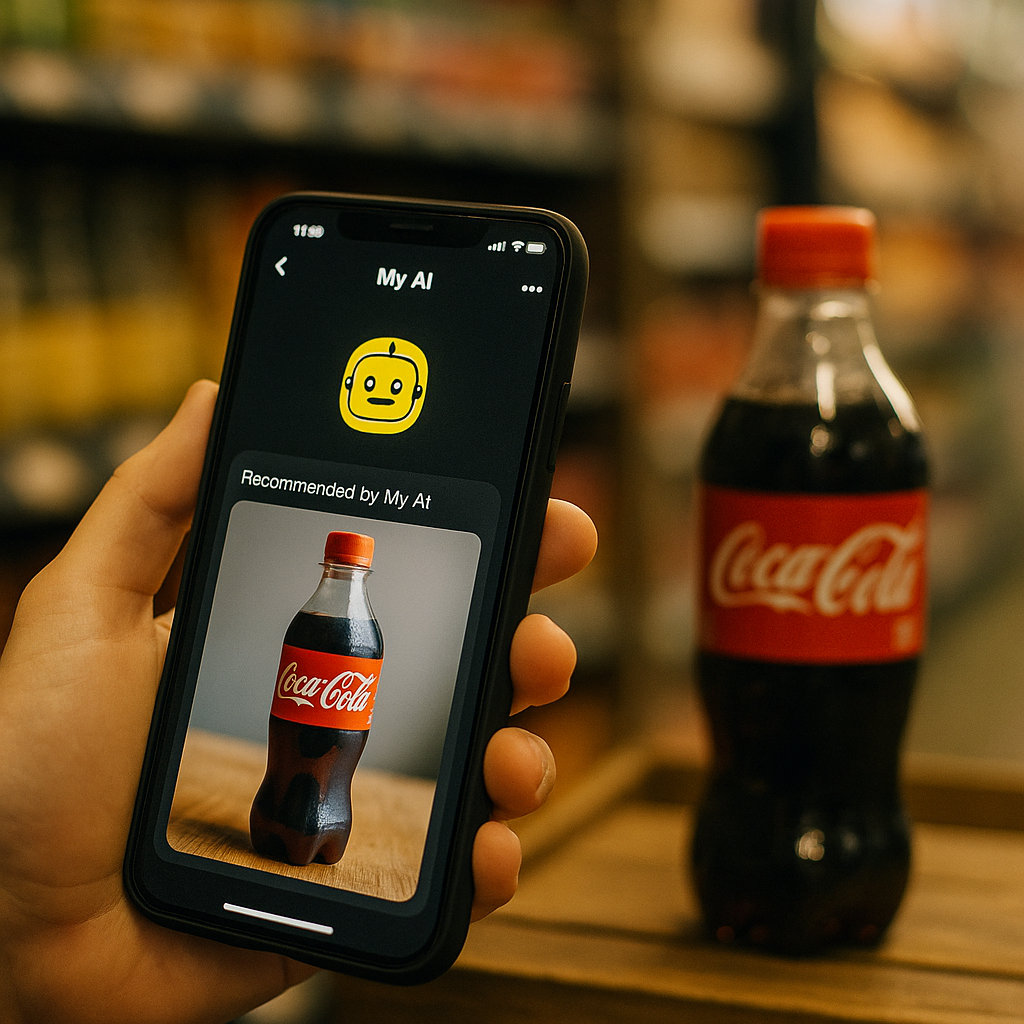
Snapchat’s My AI chatbot fields more than 10 billion messages since launch, and inside those conversations sit sponsored product links that most brands still haven’t touched. Snapchat My AI product placement is quietly becoming one of the few conversational commerce surfaces with real reach behind it. The question isn’t whether it works. It’s whether your team has a testing framework built before you spend a single dollar.
What Snapchat My AI Product Placement Actually Is
My AI is Snapchat’s built in generative assistant, powered by OpenAI’s technology and pinned to the top of every user’s chat feed. When a user asks a question that touches shopping intent (think “what should I get my sister for her birthday” or “best running shoes for flat feet”), My AI can surface a sponsored product card with a link straight into the chat thread. Snap calls these “Sponsored Links,” and they sit inside a conversational flow rather than a scroll feed.
That distinction matters. Feed ads compete for attention against dozens of other posts. A My AI recommendation shows up as the answer to a direct question the user just typed. It’s less “ad” and more “suggestion,” which is exactly why brands are curious and regulators are watching closely.
Why This Deserves a Test Budget Right Now
Most brand teams are stretched across TikTok Shop, Meta Partnership Ads, and whatever Reddit is doing this quarter. Adding a conversational AI placement to the mix sounds like scope creep. But the early data suggests the format converts differently than static placements, precisely because it responds to expressed intent rather than inferred interest.
A placement triggered by a user’s own question carries a different trust signal than one interrupting a scroll, and that difference shows up in click through behavior even at small sample sizes.
Snap’s own advertiser materials position My AI commerce as a discovery layer for younger, mobile first shoppers, a demographic that eMarketer has repeatedly flagged as underserved by traditional search advertising. If your brand already runs Snapchat AR lens campaigns or has budget parked in Spotlight seeding, My AI product placement is a logical next line item, not a whole new platform relationship.
How the Sponsored Link Flow Actually Works
Understand the mechanics before you brief creative. My AI generates a response to a user query, and if that query maps to a commercial category Snap has enabled for sponsorship, a product card appears inline, tagged as sponsored, with a direct link out. Brands don’t write the conversational copy. Snap’s system decides when and how often a product surfaces based on query relevance and bid parameters set at the campaign level.
That’s the part that trips up performance marketers used to controlling every word of ad copy. You’re not writing a script. You’re bidding into a probabilistic surface where the AI decides the framing. It’s closer to buying placement in a recommendation engine than buying a media slot.
- Campaigns are typically built off existing Snapchat Ads Manager product catalogs.
- Targeting leans on category and intent signals rather than granular demographic slicing.
- Reporting currently lags behind Snap’s core feed ad dashboards, so expect manual reconciliation early on.
Building a Test Framework That Won’t Waste Budget
Treat this like any new channel test: small spend, tight hypothesis, clear kill criteria. Here’s a structure that’s worked for teams piloting adjacent formats like Instagram native checkout and Meta Partnership Ads.
- Pick one category, not five. My AI’s relevance engine performs better when your catalog maps cleanly to a query type. A single hero SKU or tight category (skincare, sneakers, snack packs) beats a scattershot catalog.
- Run a four week minimum window. Conversational surfaces need volume to normalize. Two weeks won’t tell you anything statistically useful.
- Set a hard CPA ceiling before launch. Decide your walk away number in the planning meeting, not after you’ve already spent against sunk cost.
- Isolate the placement in reporting. Don’t blend My AI spend into your broader Snapchat Ads line. You need clean attribution to judge it fairly.
Budget wise, most brands piloting this format start between five and fifteen thousand dollars for the initial test window, roughly the same entry point teams use when testing Pinterest Performance Plus or early Reddit ad buys. Small enough to fail cheaply, large enough to generate a real read.
The Compliance Question Nobody Wants to Answer
Conversational ad placements sit in a regulatory gray zone that traditional feed advertising doesn’t. When a chatbot recommends a product in response to a personal question, the line between “helpful answer” and “paid promotion” blurs fast, and the FTC has made disclosure enforcement a recurring priority across AI powered marketing surfaces. Brands running these tests need to confirm sponsored labeling is visible and unambiguous, not just technically present in the metadata.
There’s also a data handling angle. My AI conversations often contain sensitive personal context (health questions, relationship advice, financial stress) that a user never intended to become an ad targeting signal. Legal and compliance teams should review Snap’s data usage terms before greenlighting spend, the same way they would for any platform with moderation risk exposure. Document your review. If a regulator asks in six months, “we assumed it was fine” isn’t an answer anyone wants to give.
Measuring What Actually Matters
Click through rate is the vanity metric here. The real question is whether a conversational recommendation drives incremental purchase intent that a feed ad wouldn’t have captured. Build your measurement around three layers:
- Assisted conversion tracking, comparing users exposed to My AI placements against a holdout group.
- Query category performance, since some product categories will clearly outperform others inside conversational flows (gifting and recommendations tend to outperform pure utility purchases).
- Post click behavior, tracking whether traffic from My AI converts at a different rate than traffic from Spotlight or standard Snap Ads, similar to how brands compare Spotlight payout performance against paid placements.
Tools like Sprout Social and standard UTM tagging through your existing marketing stack should cover attribution needs without requiring new martech investment. If your BI team already builds dashboards off HubSpot or a similar CRM, plug My AI conversion events into the same reporting cadence you use for every other paid channel. Don’t build a bespoke dashboard for a test budget this size.
What Success Actually Looks Like After One Quarter
Don’t expect My AI product placement to outperform your best performing TikTok Shop or Meta campaigns in raw ROAS terms within one test cycle. The realistic win is a directional signal: does conversational intent convert at a meaningfully different rate than passive feed exposure for your specific category? If the answer is yes, scale the budget in the next quarter. If it’s flat or negative, you’ve spent a small amount to rule out a channel before a competitor beats you to figuring out it doesn’t work for your category either.
The Next Move
Run the four week test with a single category, a hard CPA ceiling, and a compliance sign off before launch, then decide with data instead of hype whether Snapchat My AI product placement earns a permanent line in your media plan.
FAQs
What is Snapchat My AI product placement?
It’s a sponsored product recommendation surfaced inside conversations with Snapchat’s My AI chatbot, triggered when a user’s question maps to a commercial category a brand has bid into.
How much should a brand budget for an initial test?
Most brands start with five to fifteen thousand dollars over a four week window, enough to generate a statistically useful read without significant financial risk.
Is Snapchat My AI product placement clearly disclosed to users?
Sponsored links are labeled within the chat interface, but brands should independently verify the labeling is unambiguous given ongoing FTC scrutiny of AI driven ad disclosures.
Does this replace standard Snapchat Ads or Spotlight campaigns?
No. It’s an additional, narrower placement that works best alongside existing Snapchat spend rather than as a replacement for feed ads or Spotlight seeding.
What’s the biggest risk with this ad format?
The blurred line between conversational assistance and paid promotion creates compliance exposure, along with the possibility that sensitive user context could inform targeting in ways brands and users don’t fully anticipate.
Top Influencer Marketing Agencies
The leading agencies shaping influencer marketing in 2026
Agencies ranked by campaign performance, client diversity, platform expertise, proven ROI, industry recognition, and client satisfaction. Assessed through verified case studies, reviews, and industry consultations.
Moburst

-
2

The Shelf
Boutique Beauty & Lifestyle Influencer AgencyA data-driven boutique agency specializing exclusively in beauty, wellness, and lifestyle influencer campaigns on Instagram and TikTok. Best for brands already focused on the beauty/personal care space that need curated, aesthetic-driven content.Clients: Pepsi, The Honest Company, Hims, Elf Cosmetics, Pure LeafVisit The Shelf → -
3

Audiencly
Niche Gaming & Esports Influencer AgencyA specialized agency focused exclusively on gaming and esports creators on YouTube, Twitch, and TikTok. Ideal if your campaign is 100% gaming-focused — from game launches to hardware and esports events.Clients: Epic Games, NordVPN, Ubisoft, Wargaming, Tencent GamesVisit Audiencly → -
4

Viral Nation
Global Influencer Marketing & Talent AgencyA dual talent management and marketing agency with proprietary brand safety tools and a global creator network spanning nano-influencers to celebrities across all major platforms.Clients: Meta, Activision Blizzard, Energizer, Aston Martin, WalmartVisit Viral Nation → -
5

The Influencer Marketing Factory
TikTok, Instagram & YouTube CampaignsA full-service agency with strong TikTok expertise, offering end-to-end campaign management from influencer discovery through performance reporting with a focus on platform-native content.Clients: Google, Snapchat, Universal Music, Bumble, YelpVisit TIMF → -
6

NeoReach
Enterprise Analytics & Influencer CampaignsAn enterprise-focused agency combining managed campaigns with a powerful self-service data platform for influencer search, audience analytics, and attribution modeling.Clients: Amazon, Airbnb, Netflix, Honda, The New York TimesVisit NeoReach → -
7

Ubiquitous
Creator-First Marketing PlatformA tech-driven platform combining self-service tools with managed campaign options, emphasizing speed and scalability for brands managing multiple influencer relationships.Clients: Lyft, Disney, Target, American Eagle, NetflixVisit Ubiquitous → -
8

Obviously
Scalable Enterprise Influencer CampaignsA tech-enabled agency built for high-volume campaigns, coordinating hundreds of creators simultaneously with end-to-end logistics, content rights management, and product seeding.Clients: Google, Ulta Beauty, Converse, AmazonVisit Obviously →