


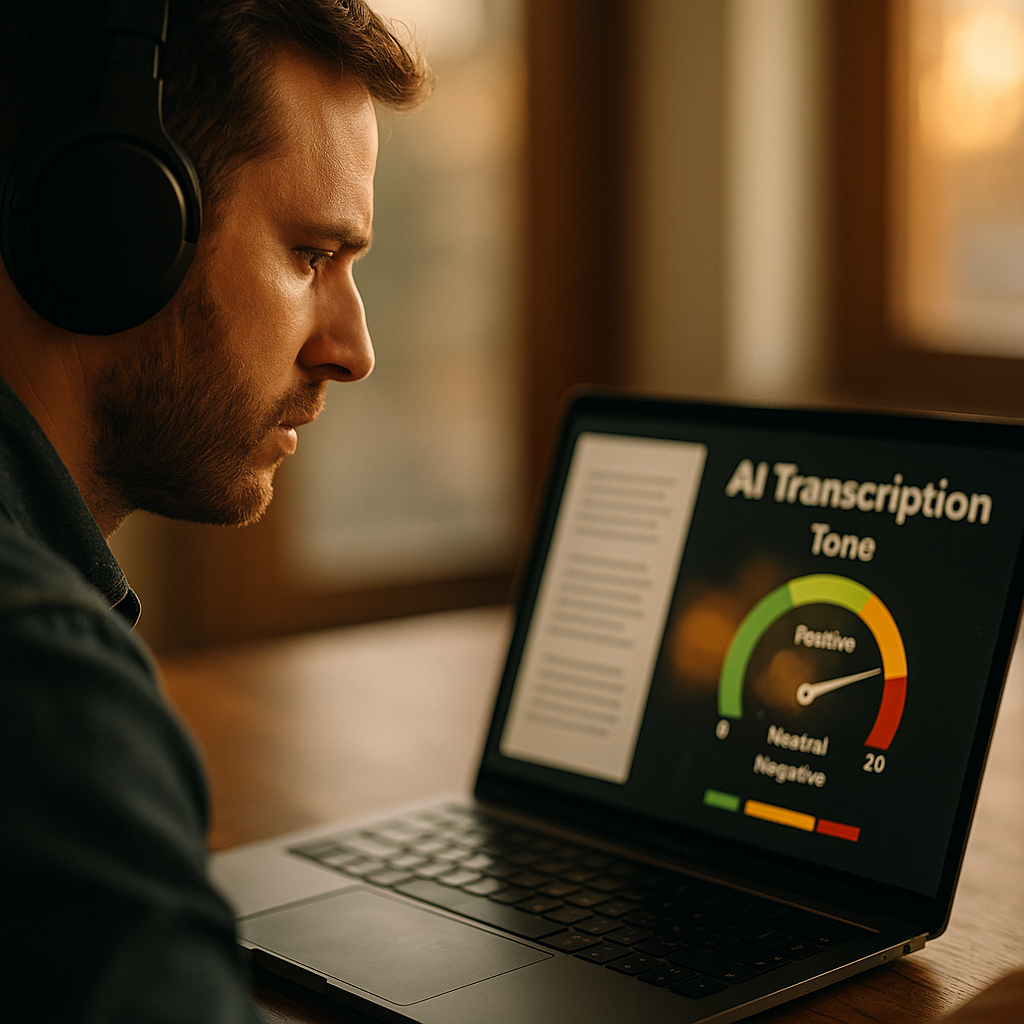
Ninety percent of marketers say they now use AI somewhere in their creator workflow, yet almost none of them can explain how a machine decides whether a creator “sounds authentic.” AI transcription tools for scoring creator authenticity promise to fix that blind spot by turning spoken content into text, then text into a quantifiable tone score. The pitch is seductive: vet 500 creators in the time it used to take to review five. The reality is messier, and brands that skip the fine print are already paying for it.
What “Scoring Authenticity” Actually Means
Let’s be honest: “authenticity” has always been a soft, vibes-based metric. A brand manager watches a video, gets a gut feeling, and greenlights the partnership. That doesn’t scale past a handful of campaigns a quarter.
AI transcription tools change the input. Instead of a human watching hours of footage, the system runs speech-to-text engines (think Whisper-based models, AssemblyAI, or Rev’s API) across a creator’s entire content history, then applies natural language processing to flag patterns: filler word frequency, sentence cadence, sentiment consistency, even whether phrasing matches the creator’s typical vocabulary or reads like a copy-pasted brand script. The output is a numerical “consistency score” that theoretically correlates with perceived authenticity.
It’s a real technical advance. Transcription accuracy on conversational speech has improved enough that word error rates on clean audio now sit in the low single digits for major providers, according to benchmarking data tracked by eMarketer. That’s the difference between a usable dataset and noise.
The Mechanics: How Transcription Feeds the Scoring Engine
Here’s the pipeline most platforms run, in plain terms:
- Ingestion: Pull video and audio from a creator’s public posts, sponsored content, and historical archive.
- Transcription: Convert speech to timestamped text, ideally with speaker diarization so brand mentions from a co-host don’t get attributed to the wrong person.
- Linguistic fingerprinting: Build a baseline of the creator’s normal speech patterns, sentence length, slang usage, pacing.
- Deviation scoring: Compare sponsored content transcripts against that baseline to flag scripted-sounding reads, sudden vocabulary shifts, or tonal whiplash.
- Aggregate output: Roll everything into a single authenticity or consistency score, often on a 1 to 100 scale.
On paper, that’s a solid framework. In practice, the deviation scoring step is where most vendors get lazy. A creator reading a legally required disclosure (“this video is sponsored by…”) will always sound slightly more formal than their normal banter. If the model can’t distinguish mandatory disclosure language from genuine brand-voice mismatch, it’ll ding creators for doing exactly what the FTC requires them to do.
A transcription-based authenticity score is only as good as the baseline it’s measured against. Feed it a thin sample of a creator’s history and you’re not scoring authenticity, you’re scoring noise.
Tone Drift Is the Metric Nobody’s Watching Closely Enough
Tone consistency sounds simple until you try to define it across a creator roster of 200 people spanning beauty, fintech, and gaming. A finance creator’s “authentic” tone is measured, careful, slightly formal. A gaming streamer’s authentic tone is chaotic and profane. A scoring model trained on one vertical and applied blindly to another will misfire constantly.
This is the same problem sentiment detection tools have wrestled with for years. The piece on sentiment detection speed versus human judgment applies directly here: speed without contextual grounding just produces confident wrong answers faster.
There’s also the multilingual problem. A creator who code-switches between English and Spanish mid-sentence, common in a huge share of US creator content according to Sprout Social’s audience research, will trip up transcription models trained primarily on monolingual data. The transcript comes back garbled, the tone score comes back meaningless, and nobody upstream questions it because the number looks precise.
Precision and accuracy are not the same thing. A score of “74.3” feels more trustworthy than “roughly authentic,” even when the underlying data is worse.
Why This Matters for Budget and Risk, Not Just Vibes
Brand teams aren’t adopting this tech for academic interest. They’re adopting it because manual creator vetting doesn’t scale to influencer programs running 300+ creators across regions and languages simultaneously. The economic case is real: cutting vetting time from days to hours per creator frees up strategist bandwidth for the judgment calls that actually need a human.
But there’s a compliance angle that gets underdiscussed. If your authenticity scoring model systematically penalizes creators who speak a first language other than English, or who use disability-related speech patterns the transcription engine misreads, you’ve built a discriminatory filter into your creator selection process. That’s not a hypothetical, it’s the same pattern that shows up in the broader conversation around automated content screening flagging false positives at scale.
The fix isn’t abandoning the tool. It’s treating the score as one input among several, the same operational discipline brands are learning to apply to AI-driven creator vetting generally: automate the first pass, keep a human checkpoint before anything becomes a contract decision.
Building a Scoring Framework That Won’t Embarrass You Later
If you’re evaluating or building an authenticity scoring workflow, a few non-negotiables:
- Segment baselines by vertical and language. Never compare a beauty creator’s tone drift against a fintech creator’s baseline.
- Exclude mandatory disclosure language from scoring. FTC-required disclosures shouldn’t count against tone consistency.
- Audit for demographic bias quarterly. Pull scores by language, dialect, and region and check for systematic gaps.
- Keep raw transcripts, not just scores. If a creator disputes a score, you need to show your work, not just the output number.
- Weight recency. A creator’s voice evolves. A baseline built on content from three years ago won’t reflect who they are now.
This last point connects directly to a broader shift happening in how brands structure creator content for machine readability. The same discipline that governs structuring UGC transcripts for AI citation purposes applies here: clean, well-tagged transcript data produces better scoring outputs than raw, unstructured audio dumps.
Transcription Accuracy Still Sets the Ceiling
None of the scoring logic matters if the underlying transcript is garbage. Background music, overlapping speakers, regional accents, and fast-paced editing all degrade transcription quality, and every downstream tone score inherits that error. This is the exact tension explored in the discussion of caption accuracy tradeoffs in AI video editing: speed and accuracy pull against each other, and most vendors default to speed because it demos better.
Before you trust a vendor’s authenticity score, ask for the raw word error rate on your actual creator content, not their marketing benchmark. A tool that performs beautifully on studio-quality podcast audio can fall apart on a 15-second TikTok shot in a moving car with a dog barking in the background. That’s not an edge case in influencer marketing, that’s Tuesday.
What to Ask Vendors Before You Sign
Procurement teams evaluating these platforms should push past the demo and ask pointed questions: How is the baseline built, and how much content is required before a score is considered reliable? Does the model account for code-switching and multilingual speech? Is disclosure language excluded from tone deviation calculations? Can you export raw transcripts for legal or compliance review, similar to how teams now expect audit trails from AI contract review tools? And critically: what’s the false positive rate on flagging authentic creators as “inconsistent”?
Most vendors will have a polished answer for the first two questions and a much shakier one for the last. That gap tells you how mature the product actually is.
Benchmarking data from Statista and HubSpot’s annual marketing surveys consistently shows AI adoption in influencer programs outpacing internal governance policies. Transcription-based scoring is following that same curve: fast adoption, thin oversight.
Score at scale, but never let the number make the final call. Run every AI authenticity score through one human review pass before it touches a contract decision, and audit the model quarterly for language and dialect bias.
FAQs
What are AI transcription tools for creator authenticity scoring?
They’re systems that convert a creator’s spoken content into text, then analyze that text for tone consistency, sentiment, and vocabulary patterns to produce a numerical authenticity or brand-fit score.
How accurate is AI transcription for scoring tone consistency?
Accuracy varies significantly with audio quality, background noise, and accent or dialect. Clean studio audio can score in the high nineties for word accuracy, while noisy short-form video content often performs far worse.
Can these tools replace manual creator vetting entirely?
No. They’re best used as a first-pass filter that flags creators for deeper human review, not as a final decision-making system, especially given known bias risks around language and dialect.
Do these scores account for FTC disclosure language?
Not by default. Brands need to explicitly configure scoring models to exclude mandatory disclosure phrasing, or risk penalizing compliant creators for sounding “less authentic.”
What’s the biggest risk with authenticity scoring at scale?
Systematic bias against non-native English speakers, regional dialects, or code-switching creators, which can quietly filter out diverse voices without anyone noticing the pattern.
Top Influencer Marketing Agencies
The leading agencies shaping influencer marketing in 2026
Agencies ranked by campaign performance, client diversity, platform expertise, proven ROI, industry recognition, and client satisfaction. Assessed through verified case studies, reviews, and industry consultations.
Moburst

-
2

The Shelf
Boutique Beauty & Lifestyle Influencer AgencyA data-driven boutique agency specializing exclusively in beauty, wellness, and lifestyle influencer campaigns on Instagram and TikTok. Best for brands already focused on the beauty/personal care space that need curated, aesthetic-driven content.Clients: Pepsi, The Honest Company, Hims, Elf Cosmetics, Pure LeafVisit The Shelf → -
3

Audiencly
Niche Gaming & Esports Influencer AgencyA specialized agency focused exclusively on gaming and esports creators on YouTube, Twitch, and TikTok. Ideal if your campaign is 100% gaming-focused — from game launches to hardware and esports events.Clients: Epic Games, NordVPN, Ubisoft, Wargaming, Tencent GamesVisit Audiencly → -
4

Viral Nation
Global Influencer Marketing & Talent AgencyA dual talent management and marketing agency with proprietary brand safety tools and a global creator network spanning nano-influencers to celebrities across all major platforms.Clients: Meta, Activision Blizzard, Energizer, Aston Martin, WalmartVisit Viral Nation → -
5

The Influencer Marketing Factory
TikTok, Instagram & YouTube CampaignsA full-service agency with strong TikTok expertise, offering end-to-end campaign management from influencer discovery through performance reporting with a focus on platform-native content.Clients: Google, Snapchat, Universal Music, Bumble, YelpVisit TIMF → -
6

NeoReach
Enterprise Analytics & Influencer CampaignsAn enterprise-focused agency combining managed campaigns with a powerful self-service data platform for influencer search, audience analytics, and attribution modeling.Clients: Amazon, Airbnb, Netflix, Honda, The New York TimesVisit NeoReach → -
7

Ubiquitous
Creator-First Marketing PlatformA tech-driven platform combining self-service tools with managed campaign options, emphasizing speed and scalability for brands managing multiple influencer relationships.Clients: Lyft, Disney, Target, American Eagle, NetflixVisit Ubiquitous → -
8

Obviously
Scalable Enterprise Influencer CampaignsA tech-enabled agency built for high-volume campaigns, coordinating hundreds of creators simultaneously with end-to-end logistics, content rights management, and product seeding.Clients: Google, Ulta Beauty, Converse, AmazonVisit Obviously →