


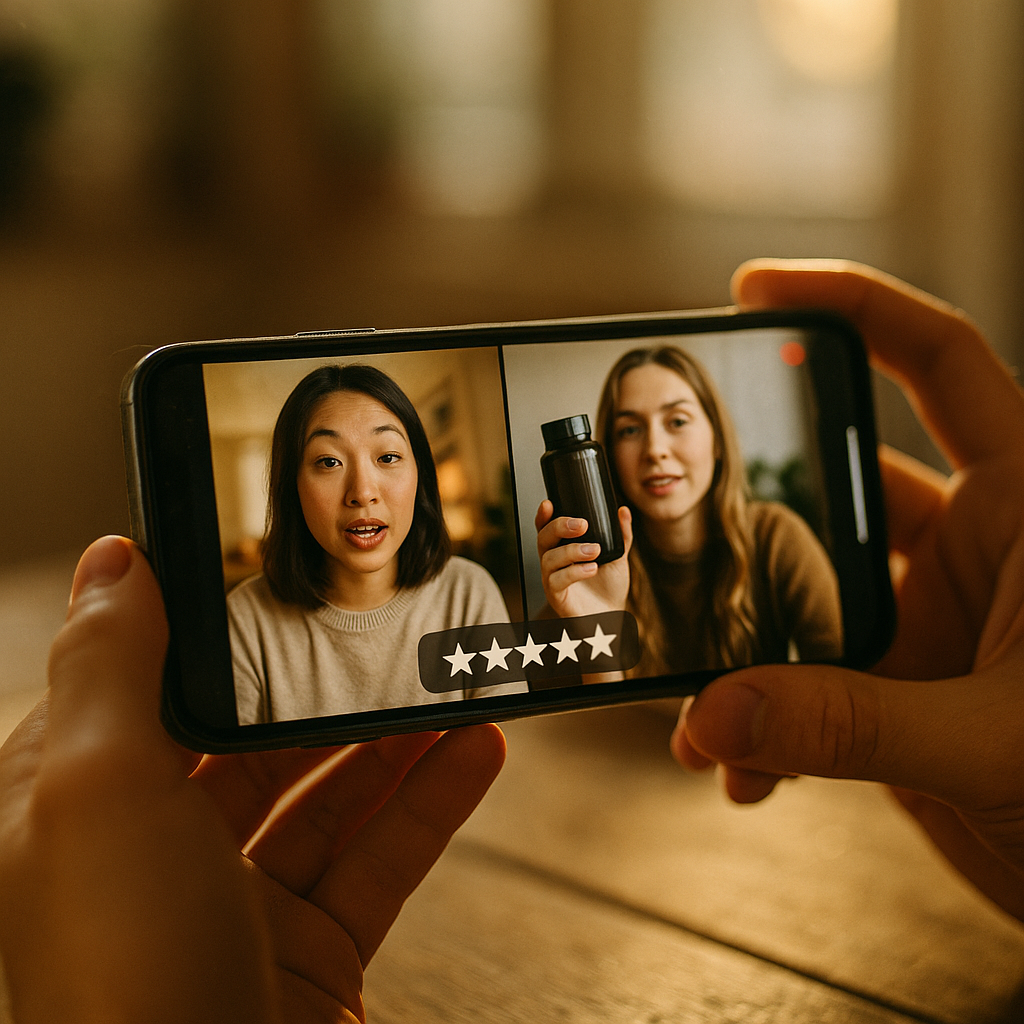
Sixty-four percent of shoppers say they don’t trust a single product review anymore, they want to see the reaction happen in real time. That’s the gap split-screen duet reviews fill. This format pairs a creator’s live, unscripted reaction on one half of the frame with tight product proof on the other, and it’s quietly becoming the highest-converting UGC style brands are briefing in 2026.
What Makes a Split-Screen Duet Review Different
Most product reviews are one shot: creator talks to camera, holds up the product, done. Split-screen duet reviews break that mold. One panel shows the creator’s face, reacting live, unedited, often mid-laugh or mid-surprise. The other panel shows the product doing the thing it claims to do: the stain lifting, the serum absorbing, the zipper not catching.
Why does this matter to a brand strategist? Because the split screen does something a single-camera testimonial can’t: it lets the viewer verify the claim and the emotion at the same time. There’s no cutaway to hide a bad take. No B-roll standing in for proof. The format is inherently harder to fake, which is exactly why audiences trust it more.
The split screen isn’t a stylistic choice, it’s a trust mechanism. When reaction and proof share the frame, viewers stop asking “is this staged?” and start asking “does this work for me?”
Why Brands Are Shifting Budget Toward This Format
Influencer marketing spend is projected to keep climbing past $35 billion globally, and yet skepticism toward sponsored content is rising just as fast. Marketers are chasing formats that read as authentic without sacrificing message control. Split-screen duets thread that needle better than most.
Compare it to the standard comparison versus videos approach, where two products go head-to-head. That format wins on decision-stage clarity, but it can feel like a spec sheet with better lighting. Split-screen duets win on something different: emotional credibility. You’re not comparing product A to product B, you’re comparing a creator’s genuine reaction to the product’s actual performance, side by side, no cuts.
Agencies running paid amplification on these assets are also seeing lower cost-per-click than standard talking-head UGC, largely because the format naturally slows scroll. Split screens are visually unusual in a feed dominated by single-frame video, which buys the brand an extra second of attention before the skip.
The Brief: What to Actually Ask Creators For
A weak brief here is the most common failure point. Brands hand creators a product and say “do a duet review,” and the result is two disconnected clips awkwardly stitched together in editing. That’s not a split-screen duet, that’s a compilation. The brief needs to specify simultaneous capture or tightly synced timing, so the reaction and the proof are locked to the same moment.
- Sync point: Define the exact second the reaction must match the product action (e.g., “reaction face at the moment the fabric releases the stain”).
- Camera setup: Two phones or a dual-camera rig, one on the face, one on the product, both rolling continuously.
- No re-takes on reaction: First honest reaction only. Coach the setup, never the emotion.
- Claim boundaries: Give creators the exact, legally cleared claim language they’re allowed to demonstrate.
- Caption requirement: Split-screen or side-by-side editing template, timestamp markers if the platform supports them.
This is where the format overlaps with disclosure discipline more than most brands expect. If the creator is testing a product on-camera and reacting live, the FTC’s endorsement guidance still applies in full, and platforms are getting stricter about labeling. Review the FTC’s endorsement guidance before finalizing any brief that involves live product testing claims, especially health, beauty, or performance categories where “results may vary” isn’t optional legal boilerplate, it’s a required disclosure.
Platform Fit: Where This Format Actually Performs
Split-screen duets were born on TikTok, where the native duet feature made side-by-side stitching a built-in mechanic rather than a post-production trick. That heritage still shows. TikTok Shop integrations reward this format heavily because the proof panel functions almost like a live product demo, and demo content converts inside shoppable feeds. For brands running paid support, TikTok’s ad platform now offers native templates that mimic the duet layout for Spark Ads, which is worth testing against organic performance before scaling spend.
Instagram Reels supports the format too, though the algorithm treats it more like standard UGC unless the split-screen visual is baked into the file before upload. Meta’s Meta Business ad tools don’t currently have a duet-native template, so brands need to hand-produce the split before it ever hits a Reels placement.
YouTube Shorts is the weakest fit. Vertical split-screen reviews get lost in a platform still optimized for single-frame storytelling, and creators there tend to perform better with formats like multi-angle demo reels, which give more room to show product function without cramming two feeds into one vertical frame.
Getting the Editing Right (Without Killing the Authenticity)
Here’s the tension every brand hits: too much polish and the format loses its whole point. Too little and it looks like a shaky bootleg. The fix is disciplined, minimal editing.
Keep the split fixed for the duration of the clip. Don’t zoom, don’t add transitions between panels, don’t layer music that drowns out the creator’s real reaction audio. If you need captions for accessibility or muted autoplay, follow the same restraint used in silent-first editing guidance: subtitles should support the reaction, not narrate over it.
One editing choice that does help: a subtle border or divider line between the two panels. It sounds trivial, but user testing across several creator agencies has found viewers process the “two things happening at once” concept faster with a visible seam. Without it, some viewers assume it’s one continuous shot and miss the proof panel entirely.
Measuring What Actually Matters
Vanity metrics like views tell you almost nothing about whether the format is working. What you want to track:
- Watch-through rate past the sync point: If viewers drop off right before the reaction-proof moment, your pacing is off.
- Comment sentiment specificity: Are viewers referencing the specific proof moment (“the stain thing” or “her face at 0:12”)? That’s a sign the format landed.
- Return rate on the SKU: This is the number that actually matters to a P&L. Formats that build accurate expectations, not hype, tend to reduce returns, similar to what’s been observed with multi-angle demo reels.
- Save and share rate: Split-screen content gets saved more often than standard UGC because it functions as reference material, “show my partner this” behavior.
Sprout Social’s research on social media benchmarks consistently shows that content perceived as “proof-driven” outperforms purely promotional content on save and share metrics, and split-screen duets sit squarely in that proof-driven bucket.
Common Mistakes That Undercut the Format
A few patterns show up repeatedly when this format underperforms:
- Scripting the reaction. The second a reaction looks rehearsed, the format’s core value proposition collapses. Audiences can tell.
- Choosing the wrong creator match. A creator known for skepticism or dry humor duetting a beauty claim reads as more credible than an overly enthusiastic creator saying the same thing. Casting matters more here than in almost any other UGC format.
- Skipping the disclosure. Because the format feels so organic, brands sometimes forget the #ad or #partner tag. Regulators don’t care how authentic it looks, disclosure rules apply regardless of format. The ICO’s guidance on influencer marketing is a useful reference for UK-facing campaigns specifically.
- Overproducing the product panel. If the reaction panel looks raw but the product panel looks like a studio ad, the mismatch is jarring and undercuts trust instead of building it.
A Quick Note on Scaling This Format
Once a split-screen duet performs well organically, brands often want to push it into paid and repurpose it across formats. That’s fine, but treat it the way you’d treat any strong organic asset headed into paid rotation: check pacing against platform specs, and consider companion cuts for placements outside vertical feeds. The reformatting logic used in companion cutdowns applies here almost directly, since you’re taking one authentic asset and adapting its proof structure for different screen ratios without re-shooting.
It’s also worth running the winning creator on a repeat cadence rather than a one-off. A single split-screen duet builds curiosity. A recurring one from the same trusted face starts building the kind of habitual trust discussed in ambassador reel series strategy, where the arc across multiple posts does more heavy lifting than any single video.
Frequently Asked Questions
What is a split-screen duet review in influencer marketing?
It’s a video format where a creator’s live reaction appears in one half of the frame while product proof, such as a demo or result, plays simultaneously in the other half, giving viewers real-time verification of a claim.
How is this different from a standard testimonial video?
A standard testimonial is a single shot of the creator talking about the product, often after the fact. A split-screen duet shows the reaction and the proof happening at the same moment, which makes it harder to stage and easier for viewers to trust.
Which platforms work best for split-screen duet reviews?
TikTok performs best because the format grew out of its native duet feature and integrates well with TikTok Shop. Instagram Reels can work if the split is built into the file before upload. YouTube Shorts is generally a weaker fit.
Do split-screen duet reviews still need FTC disclosure?
Yes. Disclosure requirements apply regardless of how organic or unscripted the content appears. Any sponsored relationship must be clearly labeled per FTC endorsement guidelines.
How do you keep the reaction authentic while still hitting brand messaging goals?
Brief creators on the claim boundaries and sync timing, but never script the emotional reaction itself. Give creators the facts to demonstrate accurately, then let the reaction happen naturally on the first take.
What metrics best measure success for this format?
Watch-through rate past the sync point, comment sentiment referencing the specific proof moment, save and share rate, and downstream return rate on the product SKU are more reliable indicators than raw view counts.
Ready to Test the Format?
Brief one creator, one product claim, and one tightly synced split-screen moment before scaling the format across your roster. Measure return rate and save rate first, those two numbers will tell you faster than any view count whether the format is earning real trust with your audience.
Top Influencer Marketing Agencies
The leading agencies shaping influencer marketing in 2026
Agencies ranked by campaign performance, client diversity, platform expertise, proven ROI, industry recognition, and client satisfaction. Assessed through verified case studies, reviews, and industry consultations.
Moburst

-
2

The Shelf
Boutique Beauty & Lifestyle Influencer AgencyA data-driven boutique agency specializing exclusively in beauty, wellness, and lifestyle influencer campaigns on Instagram and TikTok. Best for brands already focused on the beauty/personal care space that need curated, aesthetic-driven content.Clients: Pepsi, The Honest Company, Hims, Elf Cosmetics, Pure LeafVisit The Shelf → -
3

Audiencly
Niche Gaming & Esports Influencer AgencyA specialized agency focused exclusively on gaming and esports creators on YouTube, Twitch, and TikTok. Ideal if your campaign is 100% gaming-focused — from game launches to hardware and esports events.Clients: Epic Games, NordVPN, Ubisoft, Wargaming, Tencent GamesVisit Audiencly → -
4

Viral Nation
Global Influencer Marketing & Talent AgencyA dual talent management and marketing agency with proprietary brand safety tools and a global creator network spanning nano-influencers to celebrities across all major platforms.Clients: Meta, Activision Blizzard, Energizer, Aston Martin, WalmartVisit Viral Nation → -
5

The Influencer Marketing Factory
TikTok, Instagram & YouTube CampaignsA full-service agency with strong TikTok expertise, offering end-to-end campaign management from influencer discovery through performance reporting with a focus on platform-native content.Clients: Google, Snapchat, Universal Music, Bumble, YelpVisit TIMF → -
6

NeoReach
Enterprise Analytics & Influencer CampaignsAn enterprise-focused agency combining managed campaigns with a powerful self-service data platform for influencer search, audience analytics, and attribution modeling.Clients: Amazon, Airbnb, Netflix, Honda, The New York TimesVisit NeoReach → -
7

Ubiquitous
Creator-First Marketing PlatformA tech-driven platform combining self-service tools with managed campaign options, emphasizing speed and scalability for brands managing multiple influencer relationships.Clients: Lyft, Disney, Target, American Eagle, NetflixVisit Ubiquitous → -
8

Obviously
Scalable Enterprise Influencer CampaignsA tech-enabled agency built for high-volume campaigns, coordinating hundreds of creators simultaneously with end-to-end logistics, content rights management, and product seeding.Clients: Google, Ulta Beauty, Converse, AmazonVisit Obviously →