


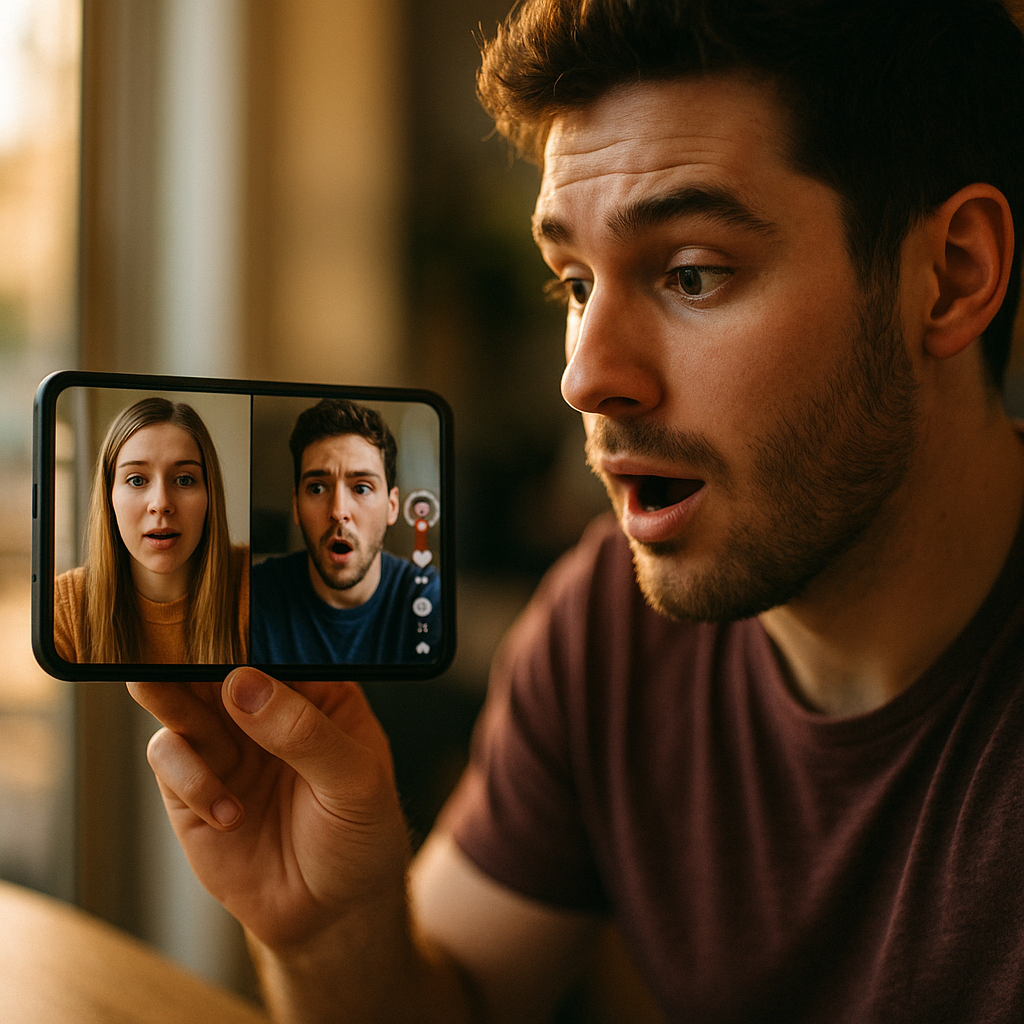
Sixty three percent of consumers say they trust a stranger’s genuine reaction more than a brand’s polished ad, according to recent Sprout Social consumer research. That single stat explains why the split-screen reaction brief has quietly become one of the most requested formats in influencer marketing this year. It is not flashy. It does not require a production crew. But it converts, and it does so by making trust transferable in a way most ad formats cannot fake.
The premise is simple: a creator watches, tastes, or tries something on camera, live and unscripted, while the brand’s product demo, spec sheet, or claim runs on the other half of the screen. The viewer sees the pitch and the honest human response at the same time. No cutaway. No edit that could hide a flinch. That simultaneity is the entire value proposition, and it’s why brands are treating it as a distinct line item in their creator briefs rather than a stylistic choice left to the editor.
Why This Format Works When Trust Is the Bottleneck
Every brand marketer knows the problem by now. Organic reach is down, ad skepticism is up, and Gen Z shoppers routinely say they assume sponsored content is exaggerated before they even watch it. The split-screen reaction format sidesteps that skepticism by structurally removing the gap between claim and proof. You are not asking the audience to take the creator’s word for it after the fact. You are showing them the moment of discovery in parallel with the thing being discovered.
The split-screen format doesn’t ask viewers to trust the brand. It asks them to trust their own eyes watching someone else react in real time, and that’s a much lower bar to clear.
This is also why the format pairs so well with categories that have a built-in trust deficit: skincare, supplements, financial apps, anything where the claim (this works, this is safe, this is worth the price) needs external validation before a purchase happens. It’s a close cousin to split screen duet reviews, but the reaction brief leans harder into unfiltered emotion rather than structured comparison. The duet format says “here’s how it stacks up.” The reaction brief says “watch what happens to a real person.”
What Actually Goes Into the Brief
Here’s where most brands get it wrong. They ask for a “reaction video” and hand the creator a product, assuming authenticity will just happen. It won’t, not reliably, and definitely not at the volume a paid media plan requires. A workable split-screen reaction brief needs structure without scripting the reaction itself. That distinction matters legally and creatively.
- Stimulus side, defined tightly. What exactly plays on the brand half: a product spec animation, a before/after data overlay, a price reveal, or a competitor comparison. This side can be pre-produced and reused across multiple creator reactions, which is a real cost efficiency.
- Reaction side, left open. The creator’s face, hands, or environment, filmed live with no retakes encouraged. Retakes kill the format’s credibility if they’re discovered, and audiences are good at spotting a second-take reaction.
- Timing sync points. Brands mark two or three moments where the stimulus must land (price reveal, ingredient callout, result reveal) so editors can align the split without manufacturing the reaction itself.
- Disclosure placement. Paid partnership labels need to sit on screen for the duration, not just in a caption, per FTC endorsement guidance. Split-screen formats sometimes bury disclosure in the corner of one panel, which is a compliance risk worth flagging explicitly in the brief.
- Fallback plan for flat reactions. Not every creator reacts with visible enthusiasm. Briefs should specify what happens if the reaction reads neutral: reshoot with a different stimulus, or use the footage anyway as a “measured, credible” cut.
Brands running this at scale often borrow structure from hybrid UGC templates, which already balance creative freedom against brand control. The split-screen reaction brief is essentially that same tension, just with a harder edit constraint layered on top.
The Production Math Brands Actually Care About
Split-screen reaction content is cheap to produce relative to its performance. Most agencies report per-video costs 30 to 40 percent lower than scripted testimonial formats, mainly because there’s no dialogue to write, approve, or reshoot. The creative lift shifts from scripting to editing: syncing two video tracks, timing the reveal, and making sure the reaction reads clearly even on a phone screen where each panel is only a few inches tall.
That last point trips up a lot of first-time briefs. A split screen that looks great on a monitor can become an unreadable mess at mobile scale. Faces get too small, text overlays compete for space, and the reaction, the entire point of the format, gets lost. Smart brands now require a mobile preview pass before any split-screen asset goes into paid rotation, the same discipline used for shoppable reel formats where every pixel of screen real estate is fighting for attention.
On the media buying side, split-screen reaction assets are performing well as top-of-funnel hooks on TikTok Ads and Meta Advantage+ placements, largely because the format’s novelty still holds up against a feed dominated by talking-head UGC. Early data from brand partners suggests hook rates (three-second view retention) run 15 to 20 percent higher than single-panel UGC ads, though that gap tends to close as the format saturates a given feed, which is worth building into forecast assumptions rather than treating as a permanent lift.
Borrowed Trust Has a Shelf Life
Here’s the uncomfortable part nobody puts in the case study slide. Borrowed trust decays. The first time an audience sees a split-screen reaction from a creator, it reads as spontaneous. The fifth time, from the same creator, in the same format, for a different sponsor, it starts to read as a template, and templates read as ads. Audiences are not naive about format fatigue even if they can’t name it.
This is why rotation matters more in this format than most others. Brands that keep a stable of three to five creators cycling through split-screen reaction briefs, rather than leaning on one high-performer repeatedly, see slower decay in engagement metrics. It also spreads compliance risk: if one creator’s disclosure practices come under scrutiny, the brand isn’t dependent on a single relationship for an entire content pillar.
Worth noting too: the format only works if the “brand side” of the split screen is genuinely informative, not just decorative. If the data overlay or product shot adds nothing the reaction doesn’t already communicate, the second panel becomes dead weight and viewers’ eyes drift to the reaction alone anyway. In that case you might be better served by a straight data overlay format without the split.
Where It Fits Against Other Trust Formats
Split-screen reaction briefs sit in a broader category of what agencies now loosely call “proof formats,” alongside comparison versus videos and confession-style content like affiliate storytime videos. All three exist because standard testimonial ads have lost credibility with younger buyers. What separates the split-screen approach is its speed. A comparison video takes narrative setup. A confession format takes a story arc. A split-screen reaction can deliver its entire trust payload in under eight seconds, which matters enormously for paid social where attention spans are measured in fractions of a second.
That speed comes at a cost, though: less room for nuance. If your product’s value proposition needs explanation (a complex B2B tool, a financial product with fine print) the split-screen format will feel thin. It’s built for immediate, visceral, sensory claims: taste, texture, price shock, visible results. Brands selling anything more complicated should look toward formats like chaptered long form explainers instead, where the trust-building happens over minutes, not seconds.
Measuring What Actually Matters
Standard engagement metrics undersell this format because likes and comments don’t capture the trust transfer that’s actually happening. Brands running split-screen briefs at scale should track:
- Hook retention at three seconds, since the reaction needs to land before the scroll instinct kicks in.
- Completion rate against a control UGC asset, run as an A/B split in the same ad set.
- Comment sentiment specifically referencing the reaction (“her face when,” “the way he reacted”) as a proxy for whether the format’s core mechanic is actually registering with viewers rather than being ignored.
- Downstream conversion lift tied through UTM or promo code, following the same attribution logic used in UGC briefs with tracking fields that feed CRM systems directly.
Marketing teams that skip this step tend to keep running the format long past its performance peak simply because the early results looked good. Build a decay check into your quarterly content audit, the same way you’d review any paid creative for fatigue using benchmarks from sources like eMarketer or HubSpot‘s creative performance research.
If you’re briefing this format for the first time, start small: one creator, one clear product claim, one mobile-first edit pass, and a hard rule against scripted reactions. Measure hook retention against your current best-performing UGC ad before scaling spend, because the format’s entire value collapses the moment it starts looking manufactured.
Frequently Asked Questions
What is a split-screen reaction brief?
It’s a creator content brief that pairs a brand-controlled visual (product demo, spec, price reveal) on one half of the screen with a creator’s live, unscripted reaction on the other, filmed and edited to sync at key moments.
How is this different from a standard duet or stitch format?
Duets and stitches typically respond to existing content or another creator. Split-screen reaction briefs pair brand-owned creative directly against a creator’s real-time response, and the reaction itself is the core asset rather than a commentary layer.
Does the reaction need to be genuinely unscripted?
Yes, and this is the format’s biggest compliance and credibility risk. Scripted or re-shot reactions that get exposed publicly can trigger backlash and, depending on disclosure practices, regulatory scrutiny under FTC endorsement rules.
What products or categories work best with this format?
Anything with an immediate sensory or visual payoff: food and beverage, skincare, beauty, unboxing-style tech, and price-reveal moments. Complex or highly technical products tend to underperform because the format doesn’t allow room for explanation.
How do brands avoid disclosure issues with a split-screen layout?
Paid partnership labels should be visible for the full duration of the video, not tucked into one panel or buried in the caption. Reviewing current FTC endorsement guidance before launch is standard practice for any compliance-conscious brand.
How often should the same creator repeat this format for one brand?
Most agencies cap repeat use at two or three assets per creator before rotating to a new face, since audiences start recognizing the format as templated rather than spontaneous after repeated exposure.
Next step: Run one split-screen reaction test against your current top-performing UGC ad, cap the creator rotation at three people, and pull hook retention data before you commit real budget to a full rollout.
Top Influencer Marketing Agencies
The leading agencies shaping influencer marketing in 2026
Agencies ranked by campaign performance, client diversity, platform expertise, proven ROI, industry recognition, and client satisfaction. Assessed through verified case studies, reviews, and industry consultations.
Moburst

-
2

The Shelf
Boutique Beauty & Lifestyle Influencer AgencyA data-driven boutique agency specializing exclusively in beauty, wellness, and lifestyle influencer campaigns on Instagram and TikTok. Best for brands already focused on the beauty/personal care space that need curated, aesthetic-driven content.Clients: Pepsi, The Honest Company, Hims, Elf Cosmetics, Pure LeafVisit The Shelf → -
3

Audiencly
Niche Gaming & Esports Influencer AgencyA specialized agency focused exclusively on gaming and esports creators on YouTube, Twitch, and TikTok. Ideal if your campaign is 100% gaming-focused — from game launches to hardware and esports events.Clients: Epic Games, NordVPN, Ubisoft, Wargaming, Tencent GamesVisit Audiencly → -
4

Viral Nation
Global Influencer Marketing & Talent AgencyA dual talent management and marketing agency with proprietary brand safety tools and a global creator network spanning nano-influencers to celebrities across all major platforms.Clients: Meta, Activision Blizzard, Energizer, Aston Martin, WalmartVisit Viral Nation → -
5

The Influencer Marketing Factory
TikTok, Instagram & YouTube CampaignsA full-service agency with strong TikTok expertise, offering end-to-end campaign management from influencer discovery through performance reporting with a focus on platform-native content.Clients: Google, Snapchat, Universal Music, Bumble, YelpVisit TIMF → -
6

NeoReach
Enterprise Analytics & Influencer CampaignsAn enterprise-focused agency combining managed campaigns with a powerful self-service data platform for influencer search, audience analytics, and attribution modeling.Clients: Amazon, Airbnb, Netflix, Honda, The New York TimesVisit NeoReach → -
7

Ubiquitous
Creator-First Marketing PlatformA tech-driven platform combining self-service tools with managed campaign options, emphasizing speed and scalability for brands managing multiple influencer relationships.Clients: Lyft, Disney, Target, American Eagle, NetflixVisit Ubiquitous → -
8

Obviously
Scalable Enterprise Influencer CampaignsA tech-enabled agency built for high-volume campaigns, coordinating hundreds of creators simultaneously with end-to-end logistics, content rights management, and product seeding.Clients: Google, Ulta Beauty, Converse, AmazonVisit Obviously →