


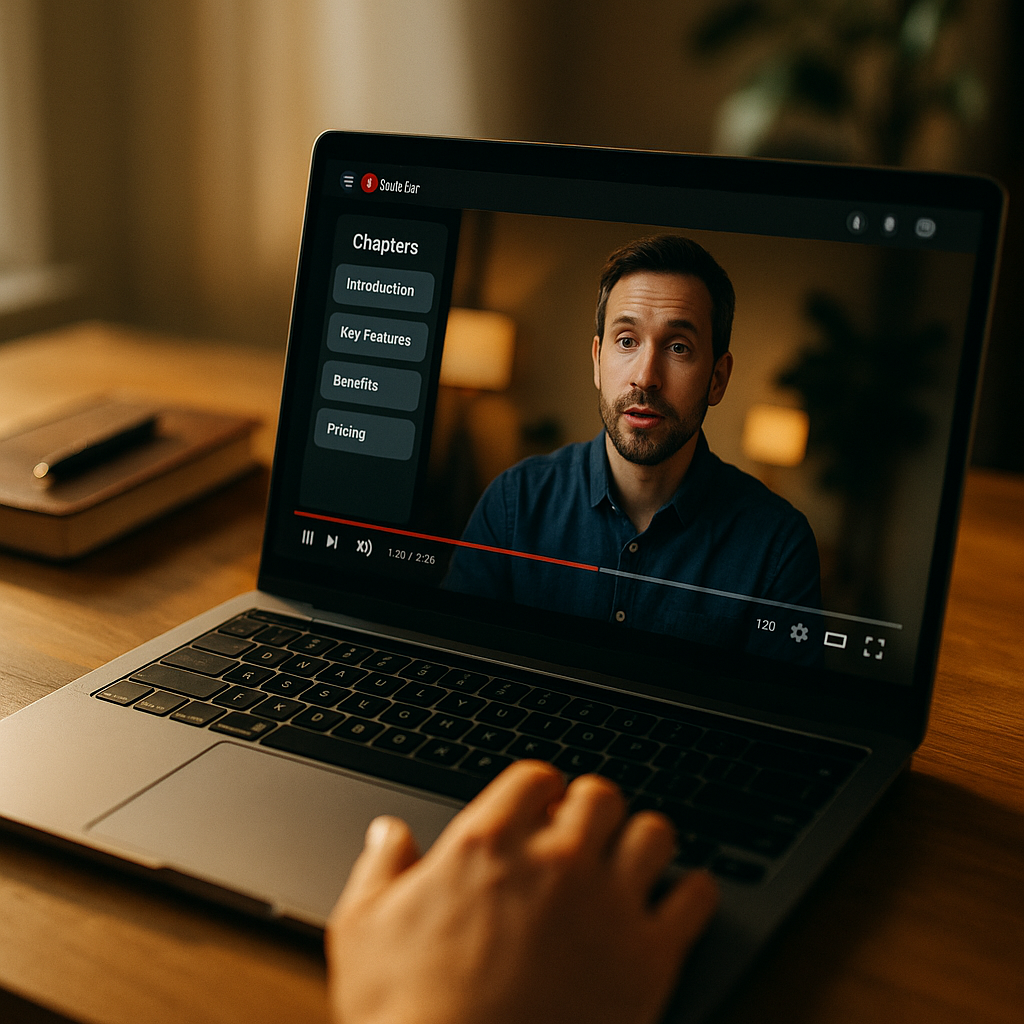
Only 12% of B2B buyers watch a full 30-second ad before skipping it, yet the average enterprise software buyer spends over an hour consuming video content before ever talking to sales. That gap is exactly why chaptered long form explainers have become the default YouTube format for brands selling anything complicated, expensive, or slow to decide on. If your product needs explaining, not just showing, this format deserves a line item in your next content budget.
What Are Chaptered Long Form Explainers, Exactly?
A chaptered long form explainer is a YouTube video, usually 8 to 25 minutes, broken into distinct sections using YouTube’s native chapter markers. Think of it as a mini documentary crossed with a product demo crossed with an FAQ page. Instead of forcing viewers through a linear script, chapters let a CFO jump straight to “Pricing and ROI Math” while a technical evaluator skips to “Integration and Security.”
This is not a repackaged webinar. It is a structured, skimmable asset designed around how high consideration buyers actually behave: nonlinear, research heavy, and skeptical of polish. The format works because it respects the viewer’s time while still capturing the SEO and watch time benefits of longer content.
Chapters do not just improve navigation. They turn a single video into multiple searchable entry points, each capable of ranking independently in YouTube and Google search results.
Why High Consideration Purchases Need a Different Format
Low consideration products sell on impulse. A $19 skincare serum can convert off a 15-second hook. A $40,000 SaaS contract, an industrial equipment purchase, or a B2B financial services product cannot. Buyers in these categories run committee decisions, compare vendors over weeks or months, and revisit content multiple times before signing.
Short form video is brilliant for awareness. It is terrible for closing consideration gaps. You cannot explain a compliance workflow, a pricing model with four tiers, or a multi step onboarding process in 30 seconds without leaving the viewer more confused than when they started. Chaptered explainers solve this by giving buyers permission to self-serve depth on their own timeline.
This is the same instinct behind documentary style process content, which builds trust through transparency rather than a hard sell. Chaptered explainers push that further by organizing the transparency into a structure buyers can navigate on demand.
The Data Behind the Behavior
YouTube remains the second largest search engine globally, and eMarketer research consistently shows video content outperforming static pages for time on page and information retention in B2B contexts. Meanwhile, HubSpot data on buyer journeys shows that prospects who engage with multiple pieces of educational content before a sales call convert at meaningfully higher rates than those who go in cold.
Put those two facts together and the strategic case writes itself: long, structured, searchable video content shortens sales cycles by doing pre-sales education work that reps used to handle manually on discovery calls.
How to Structure a Chaptered Explainer That Actually Converts
Structure is the entire value proposition here. A poorly chaptered 20-minute video is just a long video. A well chaptered one is a navigation system. Here is a framework that works across most B2B and high ticket categories:
- Chapter 1, The Problem (60 to 90 seconds): Name the pain point in language your buyer already uses internally. No brand mentions yet.
- Chapter 2, Why Existing Solutions Fall Short: Position the category gap without trashing competitors by name.
- Chapter 3, How the Product Works: This is your demo chapter. Screen recordings, real workflows, no stock footage.
- Chapter 4, Pricing and ROI Math: Buyers want this and most brands hide it. Showing it builds credibility fast.
- Chapter 5, Integration, Security, or Compliance: Address the objections your sales team hears most often.
- Chapter 6, Proof: Case study snippets, customer quotes, or third party validation.
- Chapter 7, Next Steps: A clear, low pressure CTA. Not “buy now.” Something like “book a scoped demo.”
Notice that pricing sits in chapter four, not buried at the end. High consideration buyers abandon content when they suspect a brand is hiding the number. Transparency here is a conversion lever, not a risk.
Chapters Are Not Optional Metadata Anymore
YouTube auto-generates chapters from timestamps in your description, but manual chapters with intentional titles perform better in both user experience and search visibility. Google’s support documentation confirms chapter titles are indexed and can appear directly in search results, meaning a well-titled chapter like “Integration and Security Overview” can rank for that exact query independent of the parent video title.
This is the SEO angle most marketing teams miss. Each chapter title is effectively a micro headline competing for its own search intent. Treat chapter naming with the same rigor you’d apply to blog subheadings.
Production Realities: What This Actually Costs
Chaptered explainers are not cheap to produce well, but they are cheaper than most teams assume once you account for reuse. A single 18-minute explainer can be sliced into a dozen short form assets, similar to how podcast clip repurposing stretches one long recording across a paid social calendar.
Budget for three things: a real script (not a bullet point outline), professional screen capture or product footage, and a presenter who understands the product deeply enough to answer objections on camera without a teleprompter feel. Many B2B teams are now pairing founders or subject matter experts with creators experienced in mini documentary style briefs to get authenticity without sacrificing production quality.
The single biggest production mistake is treating chapters as an editing afterthought instead of a scripting foundation. Chapters should be planned before a single frame is shot.
Where This Fits in the Funnel
Chaptered explainers are not top of funnel content. They belong in the consideration and evaluation stage, typically served through YouTube search, retargeting campaigns, or embedded directly on pricing and product pages. Sales teams should also be sending these links in follow up emails instead of PDFs nobody opens.
Some teams pair this format with serialized content structures, releasing a new chapter-style video weekly to build a habit around evaluation content rather than dumping everything into one video. Both approaches work. Choose serialization when your sales cycle is long enough to sustain a drip campaign, and choose the single long form asset when buyers need everything in one sitting.
Measurement: What to Actually Track
Standard YouTube analytics undersell this format if you only look at total views. The metrics that matter for high consideration content are:
- Average view duration per chapter (not just overall)
- Chapter click through rate, meaning which sections viewers jump to first
- Traffic from YouTube search versus suggested versus external embeds
- Downstream conversion from viewers who watched more than 60% of the video
If your pricing chapter has a dramatically higher rewatch rate than your intro, that is a signal your sales team should lean harder into pricing transparency across other channels. Treat this as a research asset, not just a content deliverable.
Common Mistakes That Undercut the Format
Most failed chaptered explainers share the same three problems. First, chapters that are too vague (“More Info,” “Continued”) that give search engines and viewers nothing to grab onto. Second, front loading brand messaging before addressing the buyer’s actual problem, which triggers an immediate skip. Third, ignoring accessibility basics like accurate captions, which matters both for compliance and for viewers watching muted in an office, a pattern well covered in silent-first editing guidance.
Compliance teams should also weigh in early if the video touches regulated claims, pricing guarantees, or performance data. The FTC guidelines around clear and conspicuous disclosure apply just as much to a 20-minute explainer as they do to a 15-second sponsored clip.
FAQs
How long should a chaptered explainer be?
Most effective B2B explainers run between 8 and 25 minutes. Shorter than that and you cannot cover the objections a high consideration buyer needs answered. Longer than 25 minutes usually means the script needs tightening, not that the topic needs more time.
Do chapters actually help SEO or is that overstated?
Chapter titles are indexed by YouTube and can surface in search results independently of the main video title, giving each section its own ranking opportunity. This is confirmed in Google’s own support documentation for YouTube creators.
What is the ideal number of chapters per video?
Five to eight chapters is the sweet spot for most product explainers. Fewer than five rarely justifies the long form treatment, and more than eight tends to fragment the narrative and dilute watch time per section.
Should pricing information go in a chapter or stay off video entirely?
Include it. Buyers actively search for pricing chapters and reward transparency with higher trust and rewatch rates. Hiding pricing pushes buyers to competitor content instead.
Can this format work for lower cost products too?
It can, but the ROI case is strongest for products with longer sales cycles, multiple stakeholders, or high switching costs. For low consideration purchases, shorter formats typically outperform.
Start with one product line, one pain point, and one honest pricing chapter. If sales calls get shorter because prospects already watched the objection handling, you have found the format’s actual ROI, and it is time to scale the chapter framework across the rest of your catalog.
Top Influencer Marketing Agencies
The leading agencies shaping influencer marketing in 2026
Agencies ranked by campaign performance, client diversity, platform expertise, proven ROI, industry recognition, and client satisfaction. Assessed through verified case studies, reviews, and industry consultations.
Moburst

-
2

The Shelf
Boutique Beauty & Lifestyle Influencer AgencyA data-driven boutique agency specializing exclusively in beauty, wellness, and lifestyle influencer campaigns on Instagram and TikTok. Best for brands already focused on the beauty/personal care space that need curated, aesthetic-driven content.Clients: Pepsi, The Honest Company, Hims, Elf Cosmetics, Pure LeafVisit The Shelf → -
3

Audiencly
Niche Gaming & Esports Influencer AgencyA specialized agency focused exclusively on gaming and esports creators on YouTube, Twitch, and TikTok. Ideal if your campaign is 100% gaming-focused — from game launches to hardware and esports events.Clients: Epic Games, NordVPN, Ubisoft, Wargaming, Tencent GamesVisit Audiencly → -
4

Viral Nation
Global Influencer Marketing & Talent AgencyA dual talent management and marketing agency with proprietary brand safety tools and a global creator network spanning nano-influencers to celebrities across all major platforms.Clients: Meta, Activision Blizzard, Energizer, Aston Martin, WalmartVisit Viral Nation → -
5

The Influencer Marketing Factory
TikTok, Instagram & YouTube CampaignsA full-service agency with strong TikTok expertise, offering end-to-end campaign management from influencer discovery through performance reporting with a focus on platform-native content.Clients: Google, Snapchat, Universal Music, Bumble, YelpVisit TIMF → -
6

NeoReach
Enterprise Analytics & Influencer CampaignsAn enterprise-focused agency combining managed campaigns with a powerful self-service data platform for influencer search, audience analytics, and attribution modeling.Clients: Amazon, Airbnb, Netflix, Honda, The New York TimesVisit NeoReach → -
7

Ubiquitous
Creator-First Marketing PlatformA tech-driven platform combining self-service tools with managed campaign options, emphasizing speed and scalability for brands managing multiple influencer relationships.Clients: Lyft, Disney, Target, American Eagle, NetflixVisit Ubiquitous → -
8

Obviously
Scalable Enterprise Influencer CampaignsA tech-enabled agency built for high-volume campaigns, coordinating hundreds of creators simultaneously with end-to-end logistics, content rights management, and product seeding.Clients: Google, Ulta Beauty, Converse, AmazonVisit Obviously →