


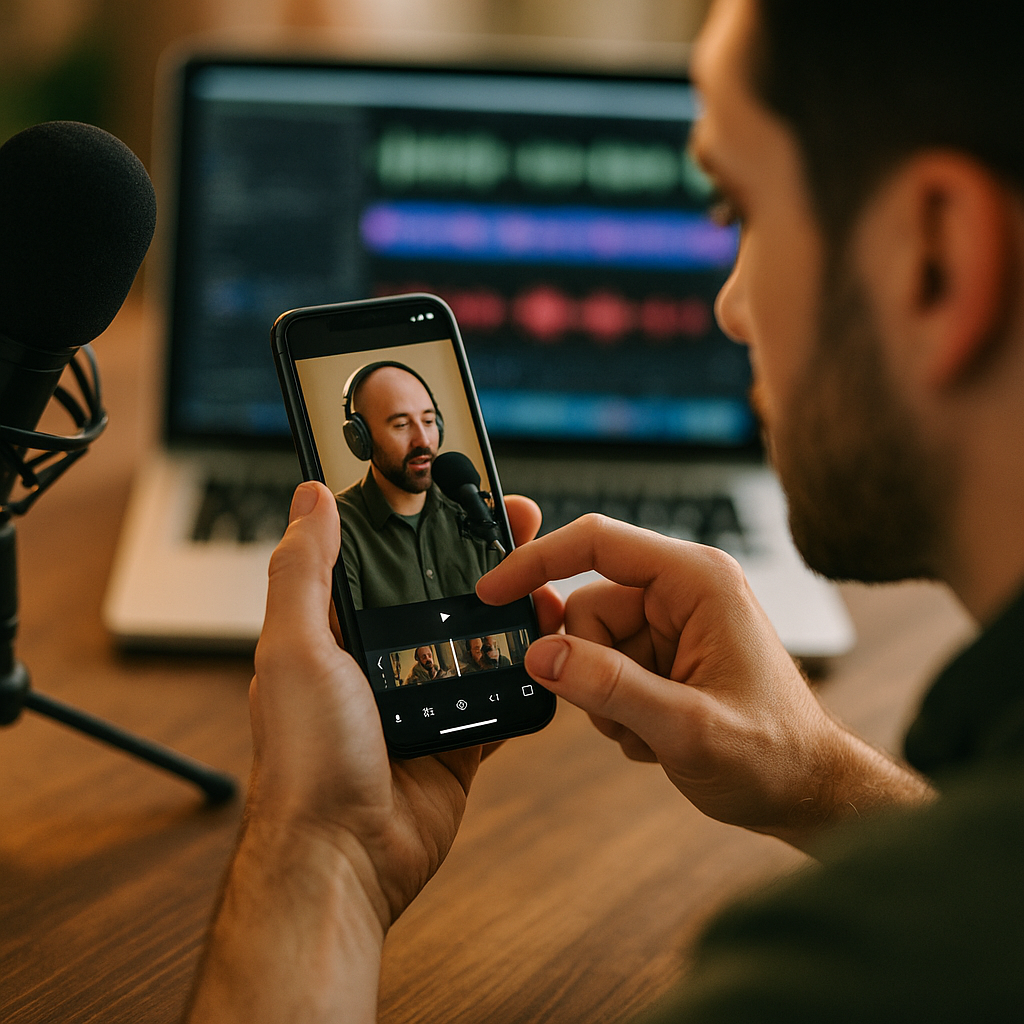
Podcast networks post over four billion minutes of long-form audio and video every month, yet the average listener never finishes an episode. So what happens to the other 80%? Smart brands are chopping it into YouTube Shorts and feeding the algorithm exactly what it wants: fast, native, snackable proof that the full conversation is worth a click. Hybrid distribution, pairing podcast snippets with short-form cuts, has quietly become one of the cheapest content engines available to marketing teams right now.
The Math Behind Why This Works
Podcasts generate hours of raw footage per episode. That footage already has structure: a hook, a tension point, a payoff. Editors don’t need to invent narrative, they just need to find it. Compare that to building short-form content from scratch, where a team has to script, shoot, and edit a 30-second concept with no guarantee it lands. Repurposing flips the cost structure entirely.
One episode can yield 15 to 25 usable Shorts, turning a single production cycle into weeks of daily posting without additional shoot days.
That ratio matters to anyone managing a content calendar on a fixed budget. A single 45-minute podcast recording, sliced correctly, can carry a channel’s Shorts cadence for a month. Compare that output to the CAC math brands are already running against Shorts versus TikTok for paid acquisition, and the repurposing model starts looking less like a nice-to-have and more like a baseline requirement for any brand running an owned podcast or creator interview series.
What Makes a Podcast Snippet Actually Work as a Short
Not every clip survives the cut. A moment that plays well in a two-hour conversation often falls flat isolated at 30 seconds. The clips that perform share a few traits: they open on conflict or surprise, they don’t require context from earlier in the episode, and they resolve within the first eight seconds or lose the viewer.
- Cold open, no lead-in. Cut straight to the sentence that makes someone stop scrolling. Skip the “so what we were just talking about” bridge entirely.
- Captions burned in. Most Shorts get watched muted in the first few seconds. If the caption doesn’t carry the joke or the claim, the clip is dead on arrival.
- One idea per clip. Resist the urge to cram two good moments into one cut. Split them into separate posts and let each one earn its own view count.
- A visual anchor. Static two-person podcast footage is boring on mobile. Overlay a stat, a product shot, or a reaction cutaway to keep the eye moving.
The editing formats that win on TikTok’s short-form side translate almost directly here. If your team hasn’t reviewed the pacing and jump-cut standards documented in the Q2 editing index, that’s a good starting brief for whoever’s cutting your podcast footage down.
Building the Hybrid Distribution Pipeline
Hybrid distribution isn’t just “post the podcast, then post some clips.” It’s a sequencing strategy. The long-form episode anchors the narrative. The Shorts act as scouts, sent out ahead of and after the drop to pull in viewers who’d never click on a 45-minute video cold.
A working pipeline usually looks like this:
- Pre-release teaser clips. Post two or three Shorts in the 48 hours before the full episode goes live, each one ending on an unresolved question the full episode answers.
- Launch-day full upload. Push the complete episode to YouTube’s long-form tab and, where eligible, the Podcasts tab for living-room discovery.
- Post-release drip. Spread remaining clips over the following one to two weeks, spacing them so the channel keeps posting daily without dumping everything on day one.
- Evergreen recycling. Strong-performing clips get re-cut with new captions or thumbnails and reposted months later. Nobody remembers a Short from four months ago, and the algorithm doesn’t care that it’s a repeat.
This cadence mirrors what always-on creator programs already do with retainer-based posting schedules. If you’re formalizing a recurring content commitment with a host or interview series, the pacing logic in our always-on retainer guide applies almost directly to podcast clip scheduling.
Where the Shorts Actually Live: TV, Mobile, and Community
It’s easy to think of Shorts as a purely mobile format, but YouTube has pushed hard into connected TV. A meaningful share of Shorts watch time now happens on television screens, especially for viewers who follow a channel already and get served its short-form content in a living-room session. That changes how clips should be framed and captioned, since a caption sized for a phone screen can look cluttered on a 55-inch display. Teams building for both surfaces should check the framing recommendations in the Shorts on TV monetization playbook before finalizing export settings.
There’s also a retention layer most brands ignore: the Community tab. Posting a poll or a quote card tied to an upcoming podcast episode primes the audience before the Short even drops, and it gives channels a way to keep engagement signals warm between uploads. The mechanics of that are covered in our Community tab retention playbook, which is worth pairing with any podcast-to-Shorts pipeline.
Measurement: What to Actually Track
Views are vanity here. The metric that matters is click-through from Short to full episode, because that’s the entire point of the hybrid model. A Short that gets 500,000 views but drives no episode traffic is a branding win at best and a wasted edit at worst.
Track these four numbers weekly:
- Swipe-up or link-click rate from Shorts to the full episode or landing page.
- Average view duration on the Short itself, since drop-off before the three-second mark signals a weak hook, not a distribution problem.
- Subscriber conversion from Shorts viewers, tracked separately from long-form subscriber growth.
- Cost per repurposed clip, calculated against your editor’s hourly rate or agency invoice, so leadership can see the efficiency gain in dollar terms, not just impressions.
Benchmarks from eMarketer and Sprout Social both point to short-form video consuming a growing share of daily platform time, which is exactly why the click-through metric matters more than raw view count. A view is cheap. A click that turns into a subscriber is the actual ROI event.
Compliance and Disclosure, Don’t Skip This Part
If the podcast features a paid guest, sponsor read, or branded segment, that disclosure obligation follows the clip into every derivative Short. It doesn’t reset just because the format changed. The FTC’s endorsement guidance applies to short-form cuts the same way it applies to the full episode, and platform-level disclosure tools (YouTube’s paid promotion toggle, for instance) need to be applied to each individual upload, not just the source video.
This trips up more teams than it should. An agency clips a sponsored podcast segment for Shorts distribution, forgets to re-apply the disclosure tag on the new upload, and now there’s a compliance gap that didn’t exist in the source content. Build a checklist step for this into your editing workflow, not your legal review, because by the time legal sees it the clip is usually already live.
Where Brands Get This Wrong
The most common mistake is treating repurposing as an afterthought handled by whoever has spare time that week. That produces inconsistent output and clips that clearly look like leftovers. The brands getting real traction assign a dedicated editor (in-house or contracted) whose entire job is mining podcast footage for Shorts, with a standing brief on hook selection and caption style.
The second mistake is ignoring format-native behavior on the destination platform. A clip edited with YouTube Shorts pacing in mind won’t necessarily perform if it’s cross-posted unchanged to TikTok or Instagram Reels. Each platform’s audience has different tolerance for pacing and different discovery mechanics. If your team is repurposing across all three, budget separate export passes rather than a single one-size-fits-all cut, and reference the platform CAC comparison before assuming identical performance across channels.
FAQs
Frequently Asked Questions
How long should a podcast-derived Short be?
Most high-performing clips land between 20 and 45 seconds. Shorter clips tend to have higher completion rates, but if the moment genuinely needs 50 seconds to land, don’t force an unnatural cut just to hit an arbitrary length.
Do we need a separate editor for Shorts, or can the podcast video editor handle both?
A single editor can handle both if they understand short-form pacing specifically. The skill sets overlap but aren’t identical: long-form editing prioritizes narrative flow, while Shorts editing prioritizes the first three seconds above almost everything else.
How many Shorts should come from one podcast episode?
Somewhere between 10 and 20 is typical for a 45 to 60 minute episode, assuming the conversation has enough standalone moments. Quality matters more than hitting a specific number, a thin episode might only yield six strong clips.
Does posting Shorts cannibalize views on the full episode?
Generally no. Most teams see Shorts acting as a discovery funnel that increases full-episode views rather than replacing them, provided the clips end on a hook that requires the full context to resolve.
What’s the biggest compliance risk with clipped podcast content?
Forgetting to reapply sponsor disclosure tags to each individual Short. The obligation follows the content into every cut, and platform disclosure tools need to be set per upload.
Next step: pull your last three podcast episodes, identify the moments that already got audience reactions in comments or downloads, and build your first Shorts test batch from those proven segments before cutting anything new from scratch.
Top Influencer Marketing Agencies
The leading agencies shaping influencer marketing in 2026
Agencies ranked by campaign performance, client diversity, platform expertise, proven ROI, industry recognition, and client satisfaction. Assessed through verified case studies, reviews, and industry consultations.
Moburst

-
2

The Shelf
Boutique Beauty & Lifestyle Influencer AgencyA data-driven boutique agency specializing exclusively in beauty, wellness, and lifestyle influencer campaigns on Instagram and TikTok. Best for brands already focused on the beauty/personal care space that need curated, aesthetic-driven content.Clients: Pepsi, The Honest Company, Hims, Elf Cosmetics, Pure LeafVisit The Shelf → -
3

Audiencly
Niche Gaming & Esports Influencer AgencyA specialized agency focused exclusively on gaming and esports creators on YouTube, Twitch, and TikTok. Ideal if your campaign is 100% gaming-focused — from game launches to hardware and esports events.Clients: Epic Games, NordVPN, Ubisoft, Wargaming, Tencent GamesVisit Audiencly → -
4

Viral Nation
Global Influencer Marketing & Talent AgencyA dual talent management and marketing agency with proprietary brand safety tools and a global creator network spanning nano-influencers to celebrities across all major platforms.Clients: Meta, Activision Blizzard, Energizer, Aston Martin, WalmartVisit Viral Nation → -
5

The Influencer Marketing Factory
TikTok, Instagram & YouTube CampaignsA full-service agency with strong TikTok expertise, offering end-to-end campaign management from influencer discovery through performance reporting with a focus on platform-native content.Clients: Google, Snapchat, Universal Music, Bumble, YelpVisit TIMF → -
6

NeoReach
Enterprise Analytics & Influencer CampaignsAn enterprise-focused agency combining managed campaigns with a powerful self-service data platform for influencer search, audience analytics, and attribution modeling.Clients: Amazon, Airbnb, Netflix, Honda, The New York TimesVisit NeoReach → -
7

Ubiquitous
Creator-First Marketing PlatformA tech-driven platform combining self-service tools with managed campaign options, emphasizing speed and scalability for brands managing multiple influencer relationships.Clients: Lyft, Disney, Target, American Eagle, NetflixVisit Ubiquitous → -
8

Obviously
Scalable Enterprise Influencer CampaignsA tech-enabled agency built for high-volume campaigns, coordinating hundreds of creators simultaneously with end-to-end logistics, content rights management, and product seeding.Clients: Google, Ulta Beauty, Converse, AmazonVisit Obviously →