


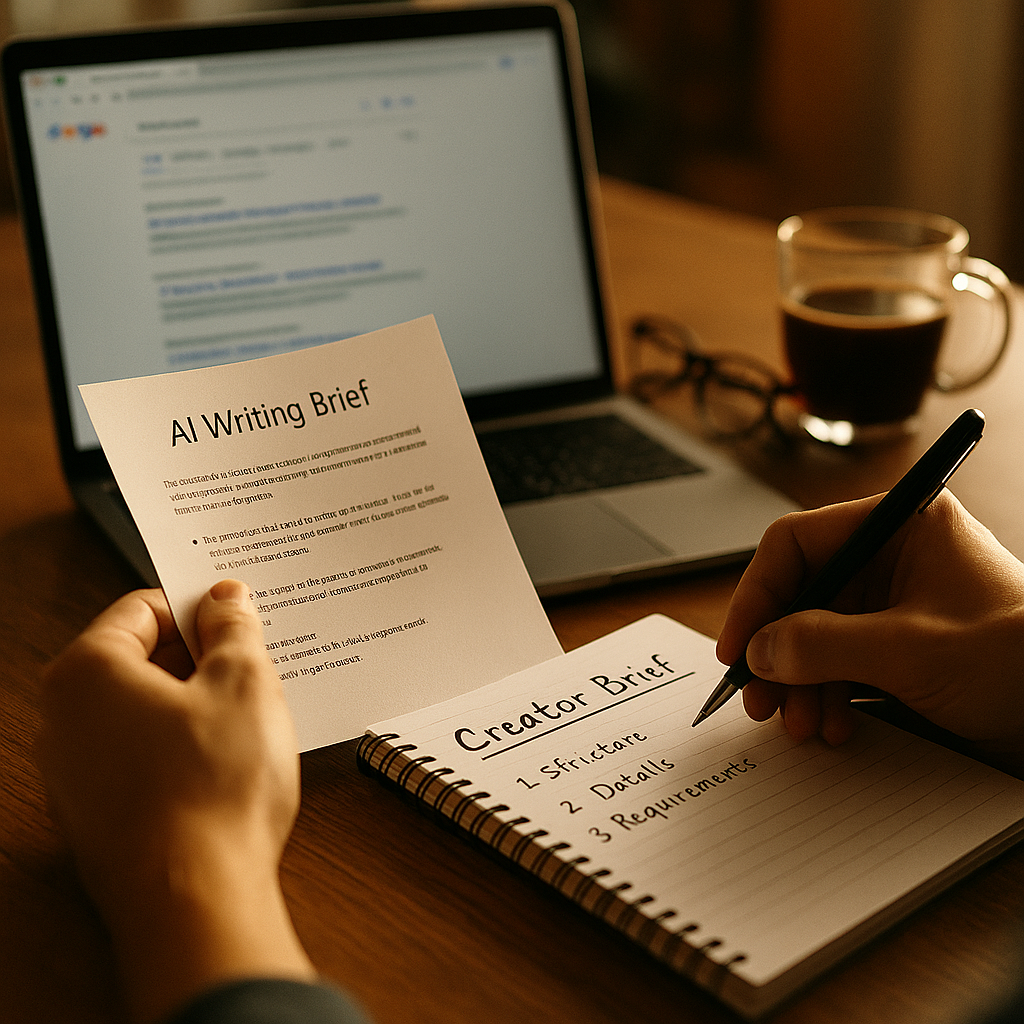
Only a fraction of brand content ever gets cited by AI search engines, and the selection process has nothing to do with creative quality. It’s about machine readability. As Google’s AI Overviews, ChatGPT search, and Perplexity build what amounts to an AI content supply chain, they’re quietly assembling lists of “preferred sources” they trust enough to cite. If your creator content isn’t structured to enter that pipeline, it’s invisible to a growing share of search traffic, no matter how good the campaign was.
What Is an AI Content Supply Chain, Really?
Think of it less as a marketing buzzword and more as literal infrastructure. Large language models don’t crawl the entire internet in real time when answering a query. They lean on cached, pre-vetted sources, ranked by trust signals, structural clarity, and historical citation patterns. That ranked list is the supply chain: raw content goes in, curated citations come out.
Brands used to obsess over backlinks and domain authority. Now the currency is something closer to “machine trust.” AI preferred source curation determines who gets cited, and creator content sits awkwardly in the middle. It’s authentic, it converts, but it’s rarely built with the structure AI crawlers reward.
If your influencer content lives only as a video caption or an Instagram carousel, it likely never enters the AI supply chain at all. No structured text, no citation.
Why Creator Content Keeps Getting Skipped
Here’s the uncomfortable truth. Most UGC is built for platform algorithms, not for retrieval by AI systems. TikTok wants watch time. Instagram wants saves. Neither format translates cleanly into the plain-text, claim-based structure that AI search tools prefer to extract and cite.
Compare that to a product page with clear specs, a comparison table, and structured FAQ markup. That page is trivially easy for a model to parse and quote. A fifteen-second unboxing video is not, even if it drove more actual purchase intent. The mismatch is structural, not qualitative.
- Creator captions rarely include the specific claims (dimensions, ingredients, comparisons) that AI answer engines quote directly.
- Video and audio content requires transcription and semantic tagging before it’s usable as a citation source.
- Platform-hosted content sits behind logins or JavaScript-heavy interfaces that many crawlers can’t fully render.
- There’s no consistent taxonomy connecting a creator’s claim to a brand’s canonical product data.
This is the same structural gap explored in structured UGC scripts work, where brands are rewriting creator briefs specifically so claims survive the transcription-to-citation pipeline.
Preferred Source Status Isn’t Random, It’s Engineered
Google, OpenAI, and Perplexity aren’t hand-picking favorites. They’re scoring sources against consistency, freshness, and structural markup, then reusing the winners repeatedly. Once a domain earns preferred status for a topic cluster, it gets cited disproportionately, a compounding advantage that’s brutal for latecomers.
For brand teams, that means the old “spray and pray” influencer strategy, dozens of creators, inconsistent messaging, no shared data layer, actively works against AI visibility. Inconsistent claims across creators confuse retrieval models. One creator says “clinically tested,” another says “dermatologist approved,” a third says nothing specific at all. The model has no reliable signal to cite, so it defaults to a competitor’s more consistent copy.
Consistency across creator content is now a ranking signal in its own right, not just a brand safety nicety.
According to Statista research on search behavior shifts, AI-generated answers are increasingly replacing traditional click-through search for informational queries, which means the citation, not the click, is becoming the primary brand exposure event. If your creator network isn’t feeding that citation layer, you’re marketing to an audience that’s shrinking by the quarter, a trend also detailed in AI Overview click decline data.
Curation Criteria Brands Can Actually Influence
You can’t buy your way into preferred source lists. But you can engineer content that meets the criteria these systems already reward:
- Claim clarity: specific, quotable statements (“reduces drying time by 40%”) outperform vague sentiment (“love how fast this dries”).
- Structural consistency: the same claim, phrased similarly, across multiple creators and owned channels, builds a repeatable pattern models learn to trust.
- Machine-readable formatting: transcripts, FAQ blocks, and schema markup attached to creator content, not just the raw video file.
- Freshness cadence: AI systems favor recently updated sources, so a static 2023 blog post loses to a regularly refreshed creator content hub.
- Cross-platform corroboration: the same claim appearing on the brand site, a review platform, and creator content simultaneously signals reliability.
Tools built for this exact gap are emerging fast. Citation prediction platforms now score content before it publishes, estimating the likelihood an AI engine will actually cite it. Pair that with GEO prediction tooling and you get a pre-flight check most brands didn’t have twelve months ago.
Adapting Creator Briefs for AI Search Visibility
The brief is where this gets operational. Creative teams have spent years optimizing briefs for hook rate and completion rate. Now they need a parallel layer optimized for extractability.
That doesn’t mean stripping the personality out of creator content, nobody wants a robotic script read. It means adding a structured layer alongside the creative one. A few practical shifts:
- Require creators to state at least one specific, factual claim per piece of content, scripted in advance and legally cleared.
- Mandate full transcripts for video and audio content, published on owned domains with proper heading structure.
- Attach FAQ schema to the transcript page, mirroring the questions the creator answers in the video itself.
- Standardize product terminology across the entire creator roster so the same phrase recurs consistently across sources.
- Republish top-performing UGC snippets as text-based content on brand-owned pages, since owned domains carry more consistent crawl access than social platforms.
This is a meaningful operational lift. It also explains why rising AI compute costs are squeezing budgets even as content volume needs increase. You’re not just producing creative anymore, you’re producing a parallel structured data asset for every piece of creative.
Rights, Risk, and Who Owns the Repurposed Text
Republishing creator video as transcribed text on owned domains raises a question legal teams haven’t fully answered yet: does the original creator agreement cover this use? Most influencer contracts were written for social distribution, not for AI-training-adjacent republication on brand websites.
This is not a hypothetical risk. Licensing disputes over AI use of creator content are already reshaping deal terms, as seen in Google’s AI licensing arrangements with publishers, where compensation structures are still catching up to actual usage. Brands repurposing creator content into AI-optimized formats without updated rights language are exposed, both to creator disputes and to platform-level compliance questions.
Practical fix: update creator contracts now to explicitly cover transcription, republication, and AI-search-optimized reformatting. It’s a small legal lift compared to renegotiating after a creator objects to their content being restructured. The FTC’s endorsement guidance also still applies here. A transcribed, restructured claim is still an endorsement, and disclosure rules don’t disappear just because the format changed.
Every repurposed piece of creator content is still a paid endorsement in the eyes of regulators, regardless of how many times it’s been reformatted for machine readability.
Measuring Whether It’s Working
Traditional influencer KPIs (impressions, engagement rate, click-through) don’t capture citation frequency. Brands need a new measurement layer that tracks how often creator-sourced claims show up in AI-generated answers, and whether those citations attribute back to the brand or get stripped of context entirely.
This connects directly to the broader attribution rebuild happening across the industry. As algorithmic opacity forces new attribution models, citation tracking needs to sit alongside incrementality testing and MMM as a core reporting pillar, not a side experiment run by the SEO team in isolation.
Some practical measurement steps:
- Query target AI engines manually on a schedule for brand and category terms, logging which sources get cited.
- Track referral traffic from AI search interfaces separately from traditional organic search in analytics.
- Audit competitor citation frequency quarterly to benchmark whether your structured content is closing or widening the gap.
Platforms like Sprout Social and HubSpot are starting to build AI citation tracking into their reporting suites, which suggests this becomes a standard KPI within a few reporting cycles, not a niche experiment.
Next Step
Audit your top ten creator assets this quarter: check whether each one exists as machine-readable text with a clear, quotable claim on an owned domain. If fewer than half pass, that’s your content supply chain gap, and it’s costing you citations right now.
Frequently Asked Questions
What does “preferred source curation” mean for creator content?
It refers to the ranking process AI search engines use to decide which sources they trust enough to cite in generated answers. Creator content qualifies only when it’s structured as clear, machine-readable text with specific claims, not just as social video or images.
Why doesn’t my influencer content show up in AI Overviews or ChatGPT answers?
Most creator content lacks transcripts, structured claims, and schema markup, so AI crawlers can’t extract or verify it. Even high-performing social content is often invisible to citation engines unless it’s republished as structured text on an owned domain.
Do I need to change creator contracts for AI search optimization?
Yes, in most cases. Standard influencer agreements typically cover social distribution only. Republishing transcribed or reformatted creator content for AI visibility usually requires updated rights language covering transcription and republication.
How do I measure whether creator content is getting cited by AI engines?
Track citation frequency by manually querying target AI search tools for brand and category terms on a recurring schedule, and monitor AI-referral traffic separately from traditional organic search in your analytics platform.
Is this the same as traditional SEO?
It overlaps but isn’t identical. Traditional SEO optimizes for ranking and clicks. AI supply chain optimization, sometimes called GEO, optimizes for citation and extraction, which prioritizes claim clarity and structural consistency over keyword density.
Top Influencer Marketing Agencies
The leading agencies shaping influencer marketing in 2026
Agencies ranked by campaign performance, client diversity, platform expertise, proven ROI, industry recognition, and client satisfaction. Assessed through verified case studies, reviews, and industry consultations.
Moburst

-
2

The Shelf
Boutique Beauty & Lifestyle Influencer AgencyA data-driven boutique agency specializing exclusively in beauty, wellness, and lifestyle influencer campaigns on Instagram and TikTok. Best for brands already focused on the beauty/personal care space that need curated, aesthetic-driven content.Clients: Pepsi, The Honest Company, Hims, Elf Cosmetics, Pure LeafVisit The Shelf → -
3

Audiencly
Niche Gaming & Esports Influencer AgencyA specialized agency focused exclusively on gaming and esports creators on YouTube, Twitch, and TikTok. Ideal if your campaign is 100% gaming-focused — from game launches to hardware and esports events.Clients: Epic Games, NordVPN, Ubisoft, Wargaming, Tencent GamesVisit Audiencly → -
4

Viral Nation
Global Influencer Marketing & Talent AgencyA dual talent management and marketing agency with proprietary brand safety tools and a global creator network spanning nano-influencers to celebrities across all major platforms.Clients: Meta, Activision Blizzard, Energizer, Aston Martin, WalmartVisit Viral Nation → -
5

The Influencer Marketing Factory
TikTok, Instagram & YouTube CampaignsA full-service agency with strong TikTok expertise, offering end-to-end campaign management from influencer discovery through performance reporting with a focus on platform-native content.Clients: Google, Snapchat, Universal Music, Bumble, YelpVisit TIMF → -
6

NeoReach
Enterprise Analytics & Influencer CampaignsAn enterprise-focused agency combining managed campaigns with a powerful self-service data platform for influencer search, audience analytics, and attribution modeling.Clients: Amazon, Airbnb, Netflix, Honda, The New York TimesVisit NeoReach → -
7

Ubiquitous
Creator-First Marketing PlatformA tech-driven platform combining self-service tools with managed campaign options, emphasizing speed and scalability for brands managing multiple influencer relationships.Clients: Lyft, Disney, Target, American Eagle, NetflixVisit Ubiquitous → -
8

Obviously
Scalable Enterprise Influencer CampaignsA tech-enabled agency built for high-volume campaigns, coordinating hundreds of creators simultaneously with end-to-end logistics, content rights management, and product seeding.Clients: Google, Ulta Beauty, Converse, AmazonVisit Obviously →