


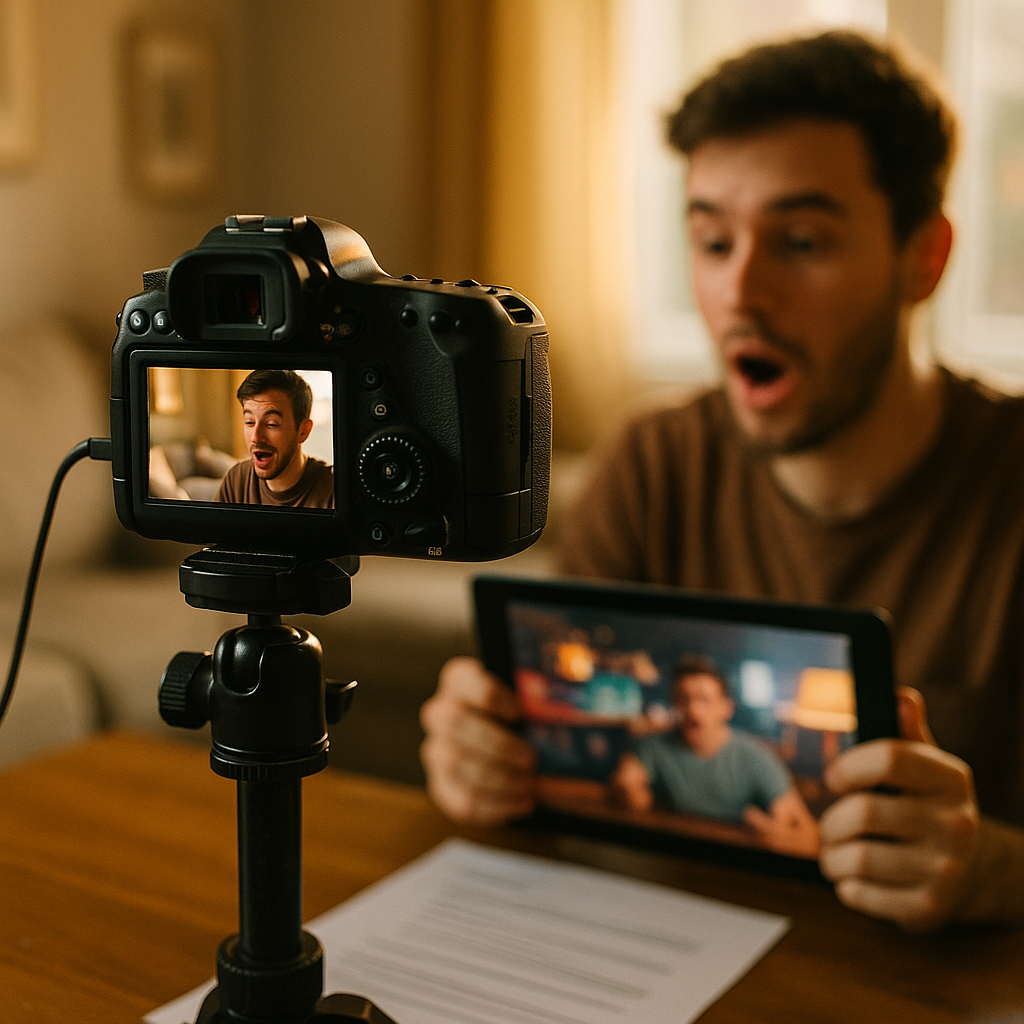
Reaction videos generate up to 40% higher completion rates than standard product demos on platforms like TikTok and Instagram Reels, according to internal creator platform benchmarks widely cited by agencies. Yet most brands still hand creators a rigid script and wonder why the “authentic first impression” looks like a hostage read. The fix isn’t less direction. It’s a smarter reaction content brief that guides tone and structure while leaving room for the messy, real moment that makes viewers stop scrolling.
Why Reaction Content Still Outperforms Polished Ads
Viewers have gotten good at spotting an ad. They’ve gotten worse at ignoring someone else’s genuine surprise, disgust, or delight. That gap is the entire value proposition of reaction content: it borrows credibility from spontaneity.
Brands love it because it’s cheap to produce relative to studio shoots. Creators love it because it requires less rehearsal than a scripted skit. And audiences love it because the format mimics how they’d actually react if a friend handed them the product. The problem shows up the moment a brand tries to control the outcome too tightly. Force a specific line reading or a manufactured gasp, and the illusion collapses instantly. Comment sections are merciless about calling out a “reaction” that clearly wasn’t one.
The best reaction briefs script the setup and the guardrails, never the emotion itself. The moment you write “react with excitement,” you’ve already killed the excitement.
What a Reaction Content Brief Actually Contains
A working brief for this format looks nothing like a traditional TV storyboard. It’s closer to a set of stage directions for an improv actor: enough structure to keep the scene on track, loose enough to let the performer find their own beat.
- The unboxing or reveal moment: exactly when and how the product, message, or surprise element is introduced on camera.
- Required talking points: two or three facts, claims, or disclosures that must appear somewhere in the video, phrased as bullet concepts rather than verbatim lines.
- Prohibited claims: anything that would trigger regulatory scrutiny, especially health, efficacy, or earnings statements.
- Framing and lighting minimums: vertical orientation, face visibility, audio clarity, without dictating exact camera angles.
- First impression window: a note asking the creator not to pre-watch or research the product before filming, which preserves the genuine reaction beat brands are paying for.
- Disclosure language: the required #ad or #sponsored tag placement per FTC guidance.
Notice what’s missing: a word-for-word script. That’s intentional. The brief tells the creator what has to happen and what can’t happen. It doesn’t tell them how to feel about it.
The Contradiction Every Brand Has to Solve
Here’s the tension nobody likes to say out loud: reaction content is, by definition, a manufactured moment being presented as an unscripted one. The creator knows the product is coming. The camera is already rolling. There’s no way around that basic contradiction.
So the job of the brief isn’t to eliminate the artifice. It’s to minimize how much of the artifice bleeds into the final cut. That means giving creators genuine first exposure to something, whether it’s an unreleased flavor, a surprise price reveal, or an unfamiliar feature, and letting the camera catch whatever happens next. Brands that pre-brief creators on every detail of the product before filming end up with reactions that feel like book reports. Brands that surprise creators on camera end up with reactions that feel like, well, reactions.
This is also why timing matters more than dialogue. A brief that specifies “reveal the price at the 8 second mark, hold for reaction before cutting” produces better footage than one that specifies “look surprised when you see the price.”
Where This Format Overlaps With Split Screen and Testimonial Formats
Reaction content rarely lives alone in a campaign. It’s often the front half of a two part structure, paired with a voiceover explanation or a testimonial layer added in post. Brands running split screen reaction formats use the raw reaction as the visual anchor, then layer scripted context alongside it in editing rather than asking the creator to narrate live. That separation is smart. It keeps the reaction pure while still giving the brand room to hit its required messaging points.
The same logic applies to raw cut testimonial reels, where the unpolished moment carries more weight than a clean, rehearsed delivery. Audiences have developed a sixth sense for detecting when a “genuine” reaction was actually take four.
Mistakes That Turn Authentic Into Awkward
A few patterns show up again and again in briefs that don’t work.
Over-scripting the emotional beat. Telling a creator exactly how surprised, delighted, or shocked to look guarantees a performance that reads as fake. Direct the structure, not the feeling.
Skipping the pre-roll context. Creators need to know why they’re filming and what the brand needs from the video, even if they don’t know the specific reveal. A confused creator produces confused footage.
Forgetting the legal layer. Reaction content is still sponsored content. Disclosure requirements don’t disappear because the tone is casual. The FTC’s endorsement guidelines apply regardless of how spontaneous a video looks.
Approving the wrong cut. Reaction videos live and die by the first 15 seconds. Brands that run every video through a slow, multi-stakeholder approval chain often end up flattening the exact spontaneity that made the raw footage good. This is a widely documented problem across the format landscape, and it’s worth reading how approval bottlenecks kill authenticity before locking in a review process for this format specifically.
Ignoring pacing data. Reaction videos aren’t exempt from editing science. Brands running pacing tests on watch time consistently find that cutting the reveal moment too early kills retention, because viewers stick around specifically for the payoff.
Building the Brief Without Killing the Moment
A practical structure that agencies use looks something like this: a one-page document split into “known before filming” and “revealed on camera” columns. The creator sees the known column in advance, things like required hashtags, video length, and disclosure placement. They do not see the revealed column, which contains the specific surprise element, until the camera starts rolling.
This mirrors how unscripted formats elsewhere in the creator economy operate. The b-roll diary format works on a similar principle: give the creator a loose frame, then let real behavior fill it in. Reaction content just compresses that same philosophy into a single, higher-stakes moment.
Subtitles deserve a specific note here too. Reaction videos are consumed overwhelmingly on mute during the scroll, which means the visible reaction, the face, the gesture, has to carry the story before sound ever kicks in. Briefs that ignore this often produce content that only works for the sliver of audience watching with sound on. It’s worth reviewing how muted autoplay design should shape any brief involving facial reactions, since the visual payoff needs to read without audio.
Measuring Whether the Reaction Actually Worked
ROI tracking for this format looks different from a standard demo video. Completion rate and replay rate matter more than click-through in the first 48 hours, since the format’s job is to stop the scroll and build trust, not necessarily drive an immediate purchase. Brands should also watch comment sentiment closely. If viewers are calling out the reaction as staged, that’s a signal to adjust the brief, not just the creator.
Platforms like Sprout Social and reporting from eMarketer both point to engagement depth, saves, shares, replies, as a stronger predictor of downstream conversion than raw view counts for reaction-style short form video. TikTok’s own advertising resources reinforce that authenticity signals correlate with lower cost per acquisition over time, even when initial reach looks modest.
Track sentiment, not just views. A reaction video with high completion but skeptical comments is a brief that needs fixing, not a creator that needs replacing.
Frequently Asked Questions
FAQs
What is a reaction content brief?
A reaction content brief is a creative document that outlines required talking points, disclosure language, and structural timing for a first-impression style video, while deliberately avoiding a word-for-word script so the creator’s on-camera reaction stays genuine.
How do you keep reaction videos from looking staged?
Give creators genuine first exposure to the surprise element on camera rather than pre-briefing every detail, and direct the video’s structure and timing instead of dictating the specific emotional response.
Do reaction videos still need FTC disclosure?
Yes. Sponsored reaction content is subject to the same endorsement and disclosure rules as any other paid partnership, regardless of how spontaneous or unscripted the video appears.
What metrics matter most for reaction content?
Completion rate, replay rate, and comment sentiment tend to matter more than raw view count or immediate click-through, since the format’s primary job is building trust and stopping the scroll.
How long should a reaction video be?
Most brands see stronger retention with videos under 30 seconds, structured so the reveal or surprise moment lands within the first third of the clip to hold viewer attention through the payoff.
Start your next reaction brief with two columns instead of one script: what the creator knows going in, and what gets revealed on camera. That single structural choice will do more for authenticity than any note about “acting natural” ever could.
Top Influencer Marketing Agencies
The leading agencies shaping influencer marketing in 2026
Agencies ranked by campaign performance, client diversity, platform expertise, proven ROI, industry recognition, and client satisfaction. Assessed through verified case studies, reviews, and industry consultations.
Moburst

-
2

The Shelf
Boutique Beauty & Lifestyle Influencer AgencyA data-driven boutique agency specializing exclusively in beauty, wellness, and lifestyle influencer campaigns on Instagram and TikTok. Best for brands already focused on the beauty/personal care space that need curated, aesthetic-driven content.Clients: Pepsi, The Honest Company, Hims, Elf Cosmetics, Pure LeafVisit The Shelf → -
3

Audiencly
Niche Gaming & Esports Influencer AgencyA specialized agency focused exclusively on gaming and esports creators on YouTube, Twitch, and TikTok. Ideal if your campaign is 100% gaming-focused — from game launches to hardware and esports events.Clients: Epic Games, NordVPN, Ubisoft, Wargaming, Tencent GamesVisit Audiencly → -
4

Viral Nation
Global Influencer Marketing & Talent AgencyA dual talent management and marketing agency with proprietary brand safety tools and a global creator network spanning nano-influencers to celebrities across all major platforms.Clients: Meta, Activision Blizzard, Energizer, Aston Martin, WalmartVisit Viral Nation → -
5

The Influencer Marketing Factory
TikTok, Instagram & YouTube CampaignsA full-service agency with strong TikTok expertise, offering end-to-end campaign management from influencer discovery through performance reporting with a focus on platform-native content.Clients: Google, Snapchat, Universal Music, Bumble, YelpVisit TIMF → -
6

NeoReach
Enterprise Analytics & Influencer CampaignsAn enterprise-focused agency combining managed campaigns with a powerful self-service data platform for influencer search, audience analytics, and attribution modeling.Clients: Amazon, Airbnb, Netflix, Honda, The New York TimesVisit NeoReach → -
7

Ubiquitous
Creator-First Marketing PlatformA tech-driven platform combining self-service tools with managed campaign options, emphasizing speed and scalability for brands managing multiple influencer relationships.Clients: Lyft, Disney, Target, American Eagle, NetflixVisit Ubiquitous → -
8

Obviously
Scalable Enterprise Influencer CampaignsA tech-enabled agency built for high-volume campaigns, coordinating hundreds of creators simultaneously with end-to-end logistics, content rights management, and product seeding.Clients: Google, Ulta Beauty, Converse, AmazonVisit Obviously →