


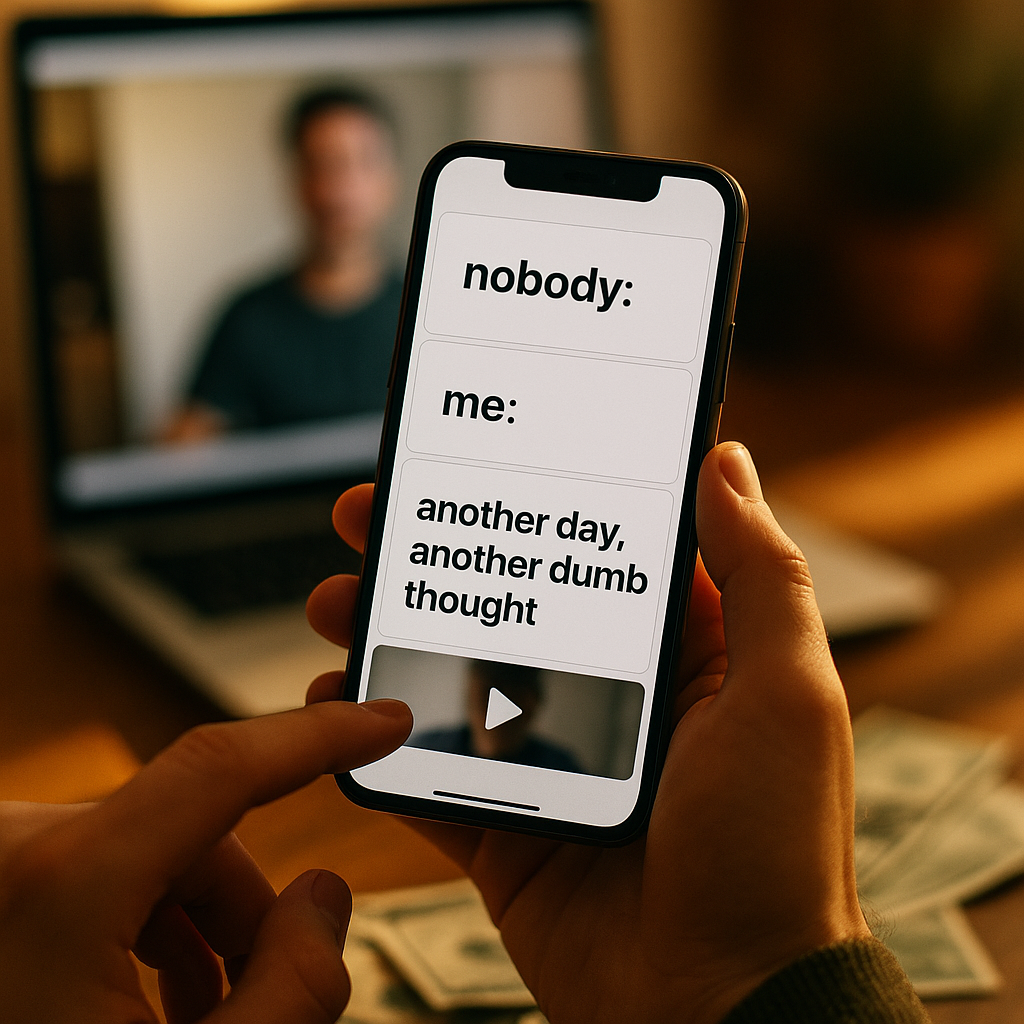
A single-slide text meme with a white background and black Helvetica text is now outpulling a $4,000 video shoot on Instagram. That is not a hypothetical. Media buyers running side-by-side tests report CPMs 30 to 50 percent lower on text-meme carousels compared to standard video ads in the same campaign. The format costs almost nothing to produce, yet it is quietly becoming one of the most efficient distribution vehicles on the platform. If you are still routing budget toward another polished video series, it might be time to ask why.
What Is a Text-Meme Carousel, Exactly?
Strip away the jargon and it is simple: a multi-slide Instagram carousel where each card is mostly typography, often mimicking the visual language of relatable meme accounts. Think a bold statement on slide one, a punchline or twist on slide two, maybe a brand logo tucked quietly into slide five. No actors, no b-roll, no voiceover, no editing timeline. Just a designer (or a marketer with Canva and twenty free minutes) building flat image cards that read like something a friend would screenshot and send.
The format borrows heavily from meme culture but applies it with intent. Instead of a random joke, the copy is engineered around a brand insight, a customer pain point, or a category truth that makes people nod and tap the save icon. It is closer to copywriting than videography, which is exactly why it is so cheap to make and so easy to scale.
Why the Algorithm Seems to Love It Right Now
Instagram’s ranking systems have leaned harder into signals like saves, shares, and time spent per interaction rather than pure watch time. A well-written text carousel invites re-reading. People pause on slide three, swipe back to slide one, then save the whole thing to reference later. That behavior sends stronger relevance signals than a fifteen-second video someone scrolls past in two seconds.
Carousels with five or more slides are seeing swipe-through completion rates that outperform average Reels watch-through rates, according to internal agency benchmarking shared across performance marketing forums in late 2025.
There is also a structural advantage. Meta’s ad auction rewards content that keeps people on-platform longer without requiring heavy bandwidth. A carousel of static JPEGs loads instantly. No buffering, no autoplay lag, no risk of someone bouncing before the hook lands. For advertisers optimizing on cost-per-result rather than vanity impressions, that speed advantage compounds across thousands of impressions.
The Production Math Nobody Talks About
Here is the part that should matter most to anyone holding a budget spreadsheet. A branded video series with a creator, a shoot day, editing, and revisions can run anywhere from $2,000 to $10,000 per asset depending on scope and talent fees. A text-meme carousel, built in-house or with a freelance designer, typically costs under $300 and can be turned around same-day.
Multiply that gap across a always-on content calendar and the efficiency case writes itself. Brands running twenty video assets a month at $3,000 each are spending $60,000. The same budget could fund two hundred text-meme carousels with room to spare for paid amplification. Even if carousel CPMs were merely comparable to video, the unit economics would favor the format. The fact that CPMs are frequently lower makes the case close to unavoidable.
Where This Fits Against Other Low-Lift Formats
Text-meme carousels are part of a broader shift toward formats that trade production polish for authenticity and speed. It sits alongside approaches like text overlay testimonial reels, which similarly strip video down to its most essential, scroll-stopping components. Brands that have already tested silent caption scripts for muted feeds will recognize the same underlying principle: readability and instant comprehension beat cinematic quality when attention spans are measured in fractions of a second.
The Brand Safety and Compliance Angle
Marketing leaders should not treat this format as a free pass on scrutiny. Meme-style content moves fast precisely because it feels informal, and that informality can tempt teams to skip the same disclosure and legal review steps they would apply to video. That is a mistake. If a creator or influencer is producing sponsored text-meme carousels, FTC disclosure rules still apply in full. The FTC’s endorsement guidance does not care whether the content is a video or a static image. Paid partnership labels, clear “#ad” tags, and platform-native disclosure tools still need to be present.
There is a subtler risk too. Meme formats often rely on cultural references, pop culture nods, or trending phrases. Legal and brand safety teams should review these carousels for the same reasons they would flag risky jokes in any other channel: tone-deaf humor spreads just as fast as clever humor, and it spreads with your logo attached. Build a lightweight review checklist specifically for this format rather than assuming it is too small-scale to warrant oversight.
How to Brief This Format Without Killing Its Voice
The biggest mistake brands make with text-meme carousels is over-directing them into something that reads like corporate copy wearing a meme costume. The format works because it sounds like a person, not a brand deck. That means briefs need to shift from “approved messaging pillars” to “voice and boundaries.”
- Give the creator or designer a point of view, not a script. Specify the insight you want conveyed (a frustration, an inside joke, a category truth) and let them find the punchline.
- Set hard boundaries, not soft suggestions. Define what topics, competitors, or cultural references are off-limits, then get out of the way on tone.
- Cap the slide count intentionally. Five to seven slides tends to be the sweet spot. Too few loses the swipe-through mechanic; too many feels like homework.
- Brand the payoff, not every slide. Logos or product mentions typically land best on the final one or two cards, after the hook has already earned trust.
This loose-structure approach mirrors what performance teams have learned from other formats too. The logic behind why loose structure wins creator reach applies just as directly to meme carousels as it does to influencer video briefs. Creative freedom within clear guardrails consistently outperforms line-by-line scripting, and this format is a near-perfect test case because the entire value proposition is authenticity of voice.
Where It Breaks Down (Because It Does)
Not every brand or category can pull this off. Text-meme carousels lean heavily on wit, brevity, and cultural fluency. A financial services brand joking about market volatility can land as clever or can land as tone-deaf depending entirely on execution and timing. Categories with heavy regulatory scrutiny, healthcare, pharma, and financial products chief among them, need extra legal sign-off before leaning into anything meme-adjacent.
There is also a fatigue curve. Because the format is so cheap, some brands flood their feeds with it, and audiences notice when every post starts to feel like filler. The smartest teams are using text-meme carousels as one format in a rotation, not a replacement for every other content type. Pairing it with something like blooper reel marketing or a periodic micro documentary keeps the feed from feeling one-note while still keeping average production costs down.
Measurement is another blind spot. Saves and shares are strong engagement signals, but they are not the same as conversion. Teams need to track downstream metrics, click-through to landing pages, promo code redemption, or branded search lift, rather than declaring victory on vanity engagement alone. A format performing well on cost-per-engagement can still underperform on cost-per-acquisition if the creative never asks for anything beyond a laugh.
Testing Framework for the Next Quarter
If you want to validate this format before shifting real budget, run a controlled test rather than a gut-feel pilot. Allocate 10 to 15 percent of your next paid social budget to text-meme carousels, running them against your current best-performing video creative in the same audience segment. Hold everything else constant: targeting, placement, bid strategy, and campaign objective.
Track CPM, cost-per-save, and cost-per-click over a minimum two-week window. Two weeks gives Meta’s delivery system enough time to exit the learning phase and optimize properly, a detail confirmed in Meta’s business advertising resources. Anything shorter risks comparing immature delivery data against a fully optimized video campaign, which will unfairly bias results toward the format you have already been running longer.
Layer in qualitative review too. Pull comments and DMs generated by the carousel test. Are people tagging friends? Quoting the copy back? That kind of organic amplification is often a leading indicator of paid performance before the CPM data fully confirms it. Tools like Sprout Social can help track engagement quality alongside raw volume, which matters more for this format than most.
Once you have baseline data, consider how this format complements your creator program rather than replacing it. A creator repurposing their existing podcast clip content into meme-carousel pull quotes, for instance, gets a second life out of an asset you already paid for. That kind of cross-format repurposing is where the real cost efficiency compounds, not just in the initial production savings.
FAQs
Frequently Asked Questions
What makes text-meme carousels cheaper than video content?
They require no filming, no editing software beyond basic design tools, and no talent or location fees. Most brands can produce a full carousel in-house using Canva or Adobe Express in under an hour, compared to the multi-day production cycle of a typical branded video.
Do text-meme carousels still need influencer disclosure labels?
Yes. Any sponsored content, regardless of format, still falls under FTC endorsement guidelines. Creators posting paid text-meme carousels must use clear disclosure language and platform-native paid partnership tags, exactly as they would for video content.
Which brands or categories should avoid this format?
Highly regulated categories like pharmaceuticals, financial services, and healthcare should proceed cautiously and route every carousel through legal review before publishing. The informal tone that makes the format work can also make regulatory missteps easy to overlook.
How many slides should a text-meme carousel have?
Five to seven slides tends to perform best. Fewer slides can undercut the swipe-through mechanic that drives engagement, while more slides risks losing the audience before they reach the branded payoff.
Can text-meme carousels replace video entirely in a content strategy?
No. The strongest-performing brands treat it as one format in a rotation alongside video, testimonials, and other creator content, rather than a full replacement. Overusing any single low-lift format tends to trigger audience fatigue.
Next step: run a two-week A/B test allocating 10 to 15 percent of your paid social budget to text-meme carousels against your current top-performing video creative, then compare cost-per-save and cost-per-click before scaling the format into your always-on calendar.
Top Influencer Marketing Agencies
The leading agencies shaping influencer marketing in 2026
Agencies ranked by campaign performance, client diversity, platform expertise, proven ROI, industry recognition, and client satisfaction. Assessed through verified case studies, reviews, and industry consultations.
Moburst

-
2

The Shelf
Boutique Beauty & Lifestyle Influencer AgencyA data-driven boutique agency specializing exclusively in beauty, wellness, and lifestyle influencer campaigns on Instagram and TikTok. Best for brands already focused on the beauty/personal care space that need curated, aesthetic-driven content.Clients: Pepsi, The Honest Company, Hims, Elf Cosmetics, Pure LeafVisit The Shelf → -
3

Audiencly
Niche Gaming & Esports Influencer AgencyA specialized agency focused exclusively on gaming and esports creators on YouTube, Twitch, and TikTok. Ideal if your campaign is 100% gaming-focused — from game launches to hardware and esports events.Clients: Epic Games, NordVPN, Ubisoft, Wargaming, Tencent GamesVisit Audiencly → -
4

Viral Nation
Global Influencer Marketing & Talent AgencyA dual talent management and marketing agency with proprietary brand safety tools and a global creator network spanning nano-influencers to celebrities across all major platforms.Clients: Meta, Activision Blizzard, Energizer, Aston Martin, WalmartVisit Viral Nation → -
5

The Influencer Marketing Factory
TikTok, Instagram & YouTube CampaignsA full-service agency with strong TikTok expertise, offering end-to-end campaign management from influencer discovery through performance reporting with a focus on platform-native content.Clients: Google, Snapchat, Universal Music, Bumble, YelpVisit TIMF → -
6

NeoReach
Enterprise Analytics & Influencer CampaignsAn enterprise-focused agency combining managed campaigns with a powerful self-service data platform for influencer search, audience analytics, and attribution modeling.Clients: Amazon, Airbnb, Netflix, Honda, The New York TimesVisit NeoReach → -
7

Ubiquitous
Creator-First Marketing PlatformA tech-driven platform combining self-service tools with managed campaign options, emphasizing speed and scalability for brands managing multiple influencer relationships.Clients: Lyft, Disney, Target, American Eagle, NetflixVisit Ubiquitous → -
8

Obviously
Scalable Enterprise Influencer CampaignsA tech-enabled agency built for high-volume campaigns, coordinating hundreds of creators simultaneously with end-to-end logistics, content rights management, and product seeding.Clients: Google, Ulta Beauty, Converse, AmazonVisit Obviously →