


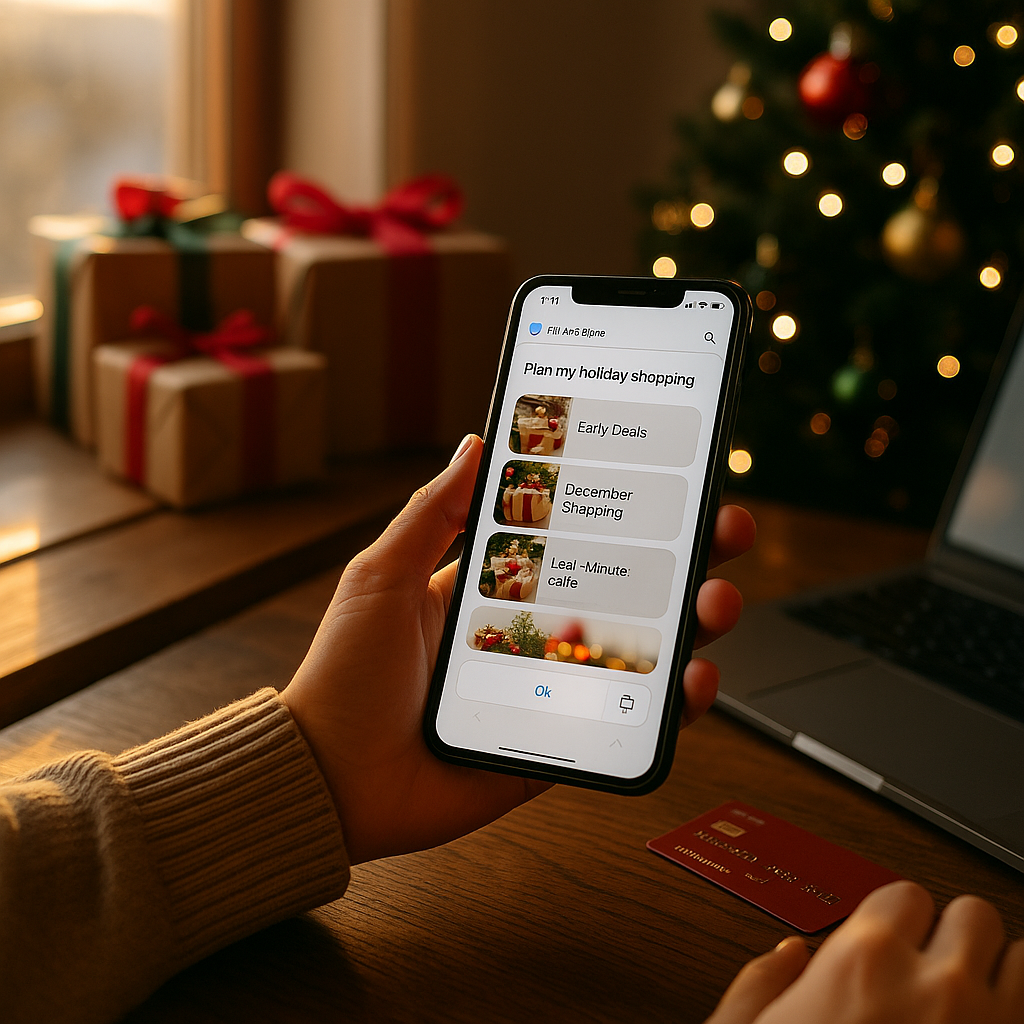
Picture this: a shopper opens an AI agent, types “best gift for a runner under $150,” and by the time they’ve finished their coffee, the agent has already compared 40 products, filtered out anything with bad return policies, and queued a purchase. No scrolling. No influencer video watched in real time. Just a decision, made on their behalf. Agentic AI search is rewriting the shape of the holiday shopping calendar, and it’s not stretching the season out. It’s compressing it into three sharp, distinct windows that brands need to plan around now.
The Holiday Calendar Isn’t Fading, It’s Fracturing
For the last decade, retailers treated the holiday season as a slow burn: Halloween teasers, Black Friday peaks, a long Christmas tail, then a January clearance hangover. That model assumed humans were doing the browsing, comparing tabs, and building wish lists over weeks.
Agentic AI search breaks that assumption. Tools like Google’s AI Mode, Perplexity Shopping, Amazon’s Rufus, and ChatGPT’s shopping integrations don’t browse the way humans do. They resolve intent fast, often in a single session, and they front-load research that used to happen across weeks into minutes. The result isn’t a shorter season overall. It’s a season split into three concentrated bursts of activity, each with different creator and media implications.
When an AI agent can complete product research, comparison, and pre-checkout in one session, the “slow build” holiday funnel stops being a funnel at all. It becomes a series of sprints.
Window One: The Pre-Season Intent Grab
This window opens earlier than most brands are staffed for, often before Halloween wraps. Agentic systems are already indexing gift guides, review sentiment, and creator content to build recommendation profiles weeks before a shopper even asks a question. If your brand’s content isn’t crawlable, structured, and credible by this point, you’re not in the consideration set when the agent runs its first query.
This is where earned media and creator content matter most, not because a human will watch the video, but because agents weight consensus. A product mentioned favorably across a dozen mid-tier creators reads as social proof to an AI system the same way it once did to a human scrolling reviews. That’s the logic behind the shift toward nano creators winning the ROI argument: volume and authenticity of mention now feed machine-readable trust signals, not just human ones.
Brands that wait until the week before Black Friday to activate creator campaigns are already behind. The agent’s “shortlist” logic is often locked in before the traditional promotional calendar even starts.
Window Two: The Compressed Comparison Sprint
This is the window everyone feels but few have named. It’s the 48 to 96 hour stretch around major sale events where agentic tools run live comparisons across price, shipping speed, and return terms, then surface a shortlist instead of a search results page. Human browsing behavior used to spread this comparison shopping across a week or more. Agents compress it into a single sitting.
What does that mean operationally? Pricing and promotional data need to be accurate and machine-readable in near real time, because an agent won’t forgive a stale price feed the way a human might shrug it off. It also means the brands that win this window are often the ones with the cleanest structured data, not necessarily the loudest ad spend. This mirrors what’s happening in AI answer engines rerouting discovery more broadly: visibility now depends on machine legibility as much as creative quality.
Agents don’t get “sale fatigue.” They run the comparison once, correctly, and move on, which means brands get one clean shot at the shortlist instead of a week of retargeting to wear shoppers down.
Creator content still plays a role here, but its job shifts. Instead of driving the initial discovery, UGC and reviews increasingly function as tie-breaker content, the evidence an agent (or a shopper double checking the agent’s pick) cites to confirm a decision. That’s part of why owned UGC models are gaining traction: brands want durable, licensable proof content they can point an agent’s crawler toward, not a 24 hour Story that disappears before the comparison sprint even peaks.
Window Three: The Last Mile Fulfillment Squeeze
The third window is shorter and higher stakes: the final days before shipping cutoffs, when agentic checkout assistants start optimizing purely for delivery certainty. At this point, product discovery is basically over. The agent’s job is logistics: which retailer can guarantee arrival by December 24, which one offers instant digital fallback, which one has the most reliable delivery track record.
Brands that can’t answer these logistics questions in structured, agent-readable formats lose the sale even if they won 46won the first two windows. This is less a marketing problem than an operations one, but it still lands on the marketing team’s desk when the returns and complaints roll in during January.
It’s worth noting how this connects to the broader trend of agentic commerce skipping the influencer funnel entirely. In window three, there often isn’t a funnel to skip, because the agent has already executed the purchase logic upstream. The brand’s only lever left is fulfillment reliability.
Why This Breaks Traditional Creator Timelines
Most influencer marketing calendars are still built around a single, extended holiday push: brief creators in October, ship content through December, measure in January. That cadence doesn’t map to three-window compression. A campaign that peaks in late November misses the pre-season intent grab entirely, and it’s too late by the time the fulfillment squeeze hits.
Practically, that means:
- Seeding creator content earlier, ideally by early autumn, so agents have consensus signals to crawl before the first comparison queries run.
- Prioritizing evergreen, citable review and comparison content over one-off promotional posts, since agents lean on durable proof, not ephemeral hype.
- Building fast-turnaround creator relationships for the compression sprint window, where speed matters more than production polish.
- Coordinating with logistics and customer service teams so creator-driven demand doesn’t outpace fulfillment promises an agent has already made to the shopper.
This is also why in-house acquisition models are gaining ground. Teams that own their creator relationships can move at agent speed. Agencies with longer approval chains often can’t. That’s a big part of the logic behind brands bringing influencer acquisition in house, and it’s echoed in the staffing data showing creator ops job postings now outnumbering creative roles. Speed and structure are becoming more valuable than raw creative volume.
Attribution Gets Messier Before It Gets Better
If an agent completes research, comparison, and part of the checkout flow, who gets credit for the sale? This is already a sore spot. Marketing teams surveyed by industry groups routinely flag attribution as their top unresolved challenge heading into agent-mediated shopping, and holiday compression makes the problem more acute because so much value gets created in such a short window.
The honest answer right now: attribution models built for click-through funnels don’t hold up well when a large chunk of the decision happens inside an AI agent’s session, invisible to your pixel. Brands are compensating with broader consensus tracking (share of voice across creator mentions, sentiment scoring, structured data audits) rather than relying purely on last-click data. This is the same blind spot flagged at recent industry discussions on AI influencer attribution, and it’s not going away before the holiday rush hits.
Third-party research from firms like eMarketer and Statista has tracked the steady rise of AI-assisted shopping journeys over the past two years, and the trend line all points the same direction: less linear, more compressed, harder to attribute with legacy tools.
What Brands Should Actually Do About It
Stop treating the holiday season as one long campaign and start treating it as three separate operations, each with its own brief, timeline, and success metric.
- Pre-season window: Prioritize structured data, crawlable creator content, and review volume. Measure share of AI-cited mentions, not just impressions.
- Comparison sprint: Keep pricing feeds and promotional data airtight. Lean on creator content as tie-breaker proof, not top-of-funnel awareness.
- Fulfillment squeeze: Treat logistics transparency as a marketing asset. Delivery guarantees need to be as visible to agents as they are to humans.
None of this works without cross-functional coordination between marketing, e-commerce ops, and customer service, teams that historically operated on separate calendars. For a deeper look at how compliance and disclosure obligations layer on top of this (especially for regulated categories), the FTC’s endorsement guidance is a useful baseline check before any agentic-adjacent creator campaign goes live.
FAQs
FAQ Section
What is agentic AI search in the context of holiday shopping?
Agentic AI search refers to AI systems, like Google’s AI Mode, Perplexity Shopping, or Amazon’s Rufus, that don’t just return search results but actively research, compare, and sometimes execute purchase decisions on a shopper’s behalf within a single session.
Why is the holiday shopping season compressing into three windows instead of stretching out?
Because agentic tools resolve research and comparison tasks in minutes rather than days, shopper activity clusters into short, intense bursts (pre-season intent capture, sale-event comparison sprints, and last-mile fulfillment decisions) instead of spreading evenly across weeks.
How should brands adjust creator campaign timing for agentic AI search?
Seed durable, citable creator and review content earlier, ideally before major sale events begin, since agents crawl and weigh consensus signals before shoppers even start their comparison queries. Waiting until Black Friday week is often too late.
Does agentic AI search hurt influencer marketing attribution?
It complicates it. Since much of the research and comparison happens inside an AI agent’s session rather than on a brand’s website, last-click attribution models undercount influencer impact. Brands are shifting toward consensus and sentiment tracking as a supplement.
What role does creator content play once an AI agent has already shortlisted products?
It often functions as tie-breaker evidence, content an agent or a double-checking shopper references to confirm a near-final decision, rather than the original spark of discovery.
FAQ Visible
Frequently Asked Questions
What is agentic AI search in the context of holiday shopping?
Agentic AI search refers to AI systems, like Google’s AI Mode, Perplexity Shopping, or Amazon’s Rufus, that don’t just return search results but actively research, compare, and sometimes execute purchase decisions on a shopper’s behalf within a single session.
Why is the holiday shopping season compressing into three windows instead of stretching out?
Because agentic tools resolve research and comparison tasks in minutes rather than days, shopper activity clusters into short, intense bursts (pre-season intent capture, sale-event comparison sprints, and last-mile fulfillment decisions) instead of spreading evenly across weeks.
How should brands adjust creator campaign timing for agentic AI search?
Seed durable, citable creator and review content earlier, ideally before major sale events begin, since agents crawl and weigh consensus signals before shoppers even start their comparison queries. Waiting until Black Friday week is often too late.
Does agentic AI search hurt influencer marketing attribution?
It complicates it. Since much of the research and comparison happens inside an AI agent’s session rather than on a brand’s website, last-click attribution models undercount influencer impact. Brands are shifting toward consensus and sentiment tracking as a supplement.
What role does creator content play once an AI agent has already shortlisted products?
It often functions as tie-breaker evidence, content an agent or a double-checking shopper references to confirm a near-final decision, rather than the original spark of discovery.
Treat this holiday season as three separate sprints, not one long campaign, and audit your structured data and creator proof points now, before the first agentic comparison query runs without you in the results.
Top Influencer Marketing Agencies
The leading agencies shaping influencer marketing in 2026
Agencies ranked by campaign performance, client diversity, platform expertise, proven ROI, industry recognition, and client satisfaction. Assessed through verified case studies, reviews, and industry consultations.
Moburst

-
2

The Shelf
Boutique Beauty & Lifestyle Influencer AgencyA data-driven boutique agency specializing exclusively in beauty, wellness, and lifestyle influencer campaigns on Instagram and TikTok. Best for brands already focused on the beauty/personal care space that need curated, aesthetic-driven content.Clients: Pepsi, The Honest Company, Hims, Elf Cosmetics, Pure LeafVisit The Shelf → -
3

Audiencly
Niche Gaming & Esports Influencer AgencyA specialized agency focused exclusively on gaming and esports creators on YouTube, Twitch, and TikTok. Ideal if your campaign is 100% gaming-focused — from game launches to hardware and esports events.Clients: Epic Games, NordVPN, Ubisoft, Wargaming, Tencent GamesVisit Audiencly → -
4

Viral Nation
Global Influencer Marketing & Talent AgencyA dual talent management and marketing agency with proprietary brand safety tools and a global creator network spanning nano-influencers to celebrities across all major platforms.Clients: Meta, Activision Blizzard, Energizer, Aston Martin, WalmartVisit Viral Nation → -
5

The Influencer Marketing Factory
TikTok, Instagram & YouTube CampaignsA full-service agency with strong TikTok expertise, offering end-to-end campaign management from influencer discovery through performance reporting with a focus on platform-native content.Clients: Google, Snapchat, Universal Music, Bumble, YelpVisit TIMF → -
6

NeoReach
Enterprise Analytics & Influencer CampaignsAn enterprise-focused agency combining managed campaigns with a powerful self-service data platform for influencer search, audience analytics, and attribution modeling.Clients: Amazon, Airbnb, Netflix, Honda, The New York TimesVisit NeoReach → -
7

Ubiquitous
Creator-First Marketing PlatformA tech-driven platform combining self-service tools with managed campaign options, emphasizing speed and scalability for brands managing multiple influencer relationships.Clients: Lyft, Disney, Target, American Eagle, NetflixVisit Ubiquitous → -
8

Obviously
Scalable Enterprise Influencer CampaignsA tech-enabled agency built for high-volume campaigns, coordinating hundreds of creators simultaneously with end-to-end logistics, content rights management, and product seeding.Clients: Google, Ulta Beauty, Converse, AmazonVisit Obviously →